
Lecture 7 min.
Ballroom dance is one of the most aesthetic and harmonious forms of choreographic art. It combines elements of sport, music, culture and communication. Modern sport ballroom dance is not only a competitive discipline but also an important means of aesthetic, physical and moral education of the individual. Studying the history of ballroom dance, its social nature and the features of its musical accompaniment allows for a deeper understanding of the significance of this art form in contemporary society.
Ballroom dance arose as a form of social communication and cultural interaction between people. Its main feature is that it is performed in a couple, where the partners must act in a coordinated, respectful and harmonious manner.
The social nature of ballroom dance is revealed in several aspects:
During the dance, non-verbal communication takes place between the partners. Through movement, the position of the body, the gaze and musical interpretation, a special wordless dialogue is created.
Ballroom dance contributes to the development of:
Each dance reflects the national character of a people, its era and its historical traditions.
For example:
Regular sport ballroom dance training contributes to:
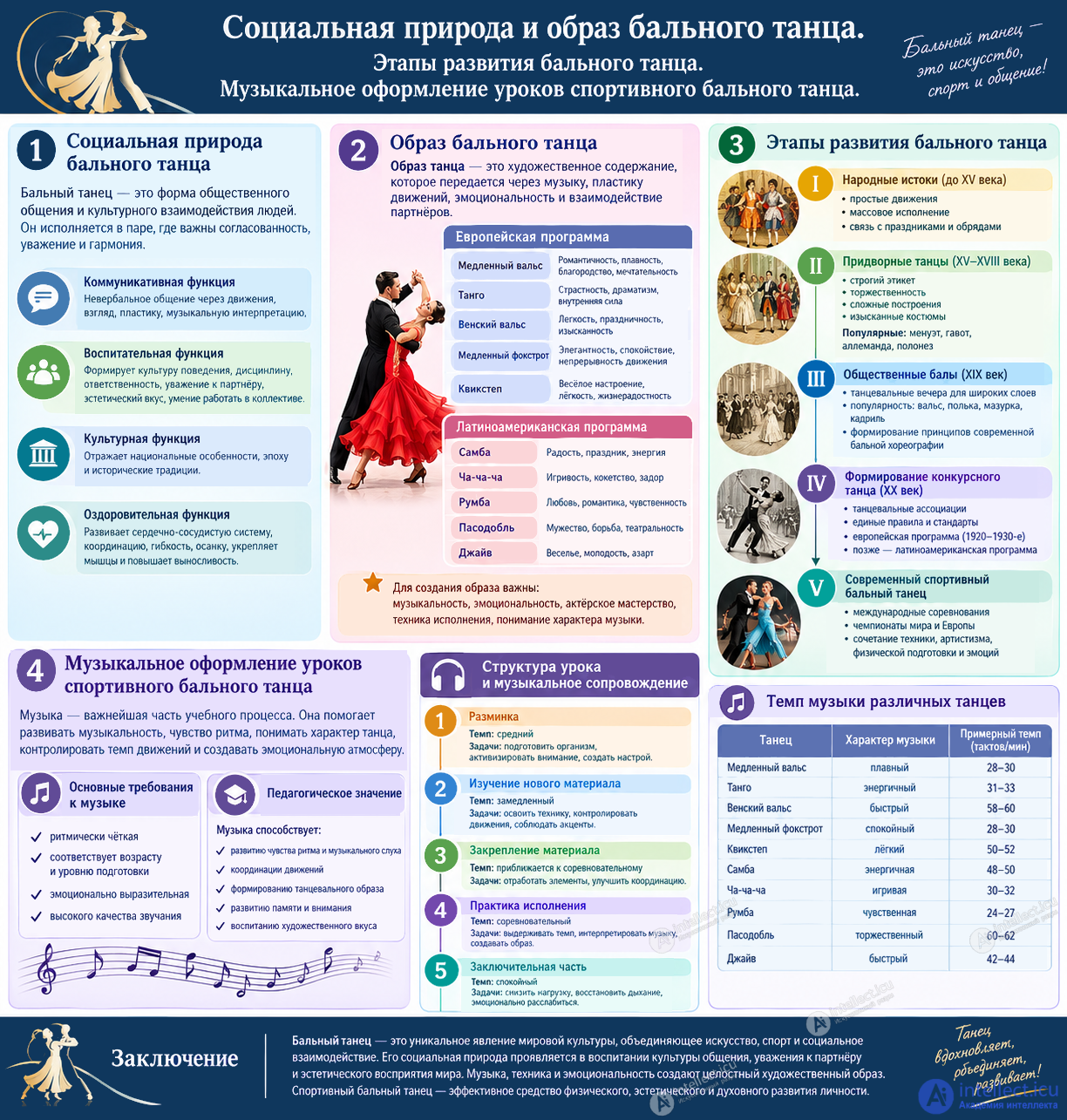
The image of a dance — is the artistic content conveyed through the music, the plasticity of movement, the emotional quality of performance and the interaction of the partners.
Each dance possesses its own artistic image.
Slow Waltz
An image of romance, smoothness, nobility and dreaminess.
Tango
Passion, drama, inner strength, tension between the partners.
Viennese Waltz
Lightness, festivity, refinement.
Slow Foxtrot
Elegance, calm, continuity of movement.
Quickstep
A joyful mood, lightness, cheerfulness.
Samba
Joy, celebration, energy, freedom.
Cha-cha-cha
Playfulness, coquetry, zest.
Rumba
Love, romance, sensuality.
Paso Doble
Courage, struggle, theatricality.
Jive
Fun, youthfulness, excitement.
Creating an artistic image requires the performer to have:
The history of ballroom dance spans several centuries.
The forerunners of ballroom dances were the folk dances of everyday life in various European countries.
These were characterised by:
Ballroom dances become part of court culture.
Main features:
Popular dances:
Dance evenings appear for broad sections of the population.
The most popular dances become:
It is during this period that the basic principles of modern ballroom choreography take shape.
In England, the systematisation of technique begins.
The following are created:
In the 1920s–1930s the Standard programme takes shape.
Later, the Latin American programme is officially established.
Today, sport ballroom dance is an international sport and art form.
The following are held:
Modern sport dance combines:
Musical accompaniment is one of the most important parts of the training process.
Music helps to:
The music must be:
Music of a medium tempo is used.
Main tasks:
Music is used at a slower tempo.
This makes it possible to:
The tempo gradually approaches the competitive one.
Full musical compositions are used.
The music fully corresponds to competition requirements.
Dancers learn to:
Calm music is used.
The aim:
| Dance | Character of the music | Approximate tempo |
|---|---|---|
| Slow Waltz | smooth | 28–30 bars/min |
| Tango | energetic | 31–33 bars/min |
| Viennese Waltz | fast | 58–60 bars/min |
| Slow Foxtrot | calm | 28–30 bars/min |
| Quickstep | light | 50–52 bars/min |
| Samba | energetic | 48–50 bars/min |
| Cha-cha-cha | playful | 30–32 bars/min |
| Rumba | sensual | 24–27 bars/min |
| Paso Doble | solemn | 60–62 bars/min |
| Jive | fast | 42–44 bars/min |
Correctly chosen music contributes to:
Musical accompaniment makes a lesson more engaging, helps maintain the students' high level of working capacity, and contributes to the successful mastery of sport ballroom dance technique.
Ballroom dance — is a unique phenomenon of world culture, uniting art, sport and social interaction. Its social nature is revealed in fostering a culture of communication, respect for one's partner and an aesthetic perception of the world. The artistic image of each dance is revealed through the music, technique and emotional expressiveness of the performers. The history of the development of ballroom dance reflects the evolution of society and its cultural traditions. Of particular importance in the educational process is the musical accompaniment of lessons, which ensures the development of musicality, sense of rhythm and coordination, and contributes to the creation of a coherent artistic image.
Thus, sport ballroom dance is an effective means of the physical, aesthetic and spiritual development of the individual, and its study occupies an important place in the system of modern choreographic education.
Sign in and the lectures you have studied will be marked in this list.
Choose a course
Comments