
Lecture 4 min.
Dance is an important part of the culture of every people. Folk dances reflect the character, traditions and everyday life of a people. One of the best known and best loved dances in Europe is the polka. It is distinguished by its cheerful character, its fast tempo and its light, hopping movements.
Today we shall become acquainted with the history of the polka, its musical features and its basic dance elements.
The polka appeared in the first half of the nineteenth century in Bohemia (the territory of present-day Czechia). Despite its name, it has no connection with Poland. The name comes from the Czech word půlka, meaning «half a step» or «half-step».
Thanks to its high spirits, the polka quickly spread throughout Europe. It began to be performed at folk festivals, balls and formal occasions. Later, the dance entered the repertoire of professional dance companies and came to be used in children's choreography.
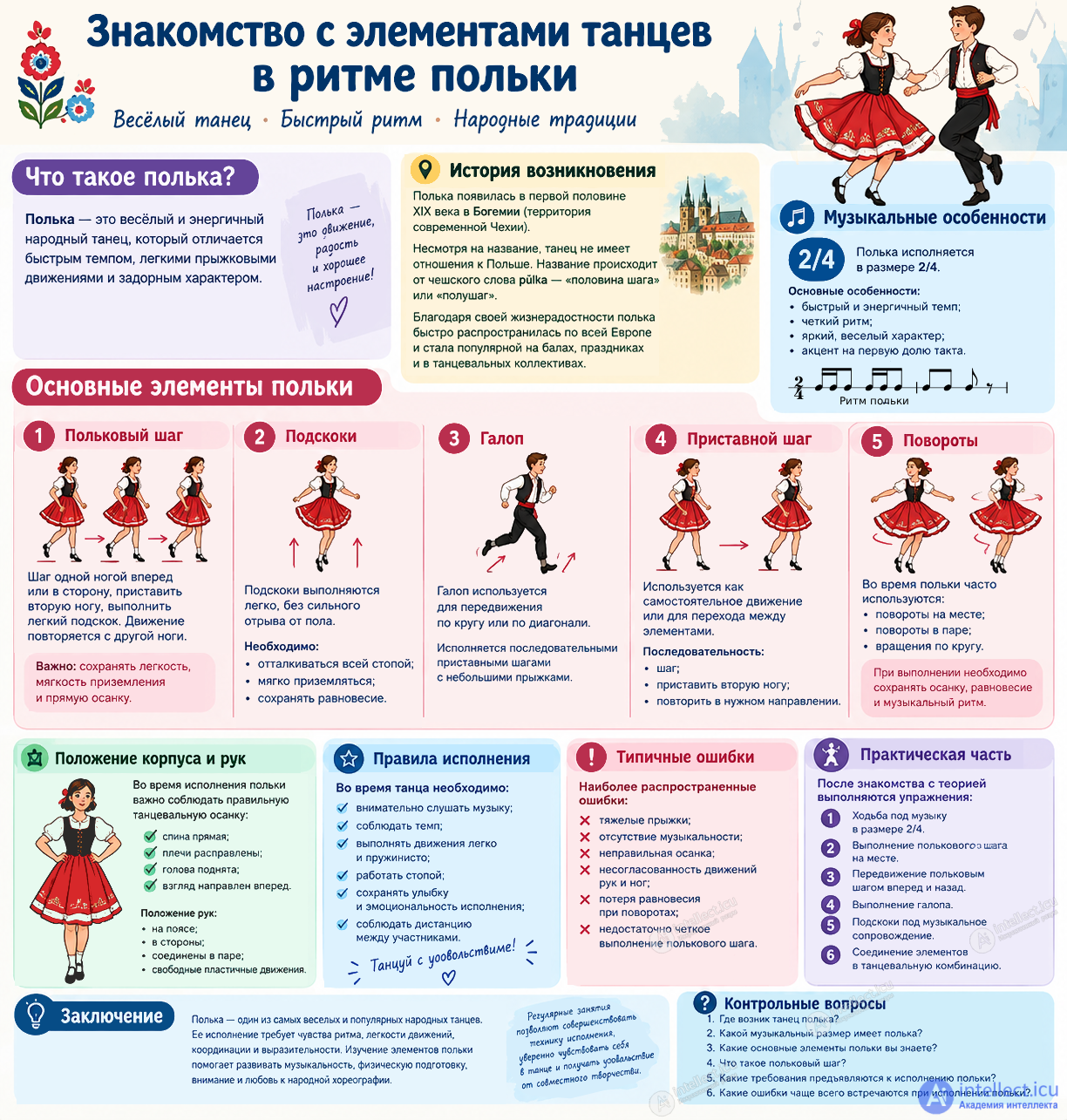
The polka is performed in 2/4 time.
The main features of the music:
The performer must listen closely to the music, feel the strong beat, and execute the movements precisely in keeping with the rhythm.
This is the basic element of the dance.
Technique of performance:
It is important to keep the movement light, to land softly, and to keep the posture upright.
Hops are performed lightly, without pushing off strongly from the floor.
One must:
The gallop is used to travel in a circle or along a diagonal.
It is performed as a sequence of chassé-like steps with small hops.
It is used either as an independent movement or as a transition between elements.
Sequence:
During the polka, the following are often used:
When performing them, one must maintain posture and balance and keep to the musical rhythm.
When performing the polka, it is important to maintain correct dance posture:
The position of the arms depends on the staging of the dance:
During the dance one must:
The most common mistakes:
After the theoretical introduction, students carry out the following exercises:
The polka — is one of the most cheerful and popular of folk dances. Performing it calls for a sense of rhythm, lightness of movement, coordination and expressiveness. Studying the elements of the polka helps to develop musicality, physical fitness, attention and a love of folk choreography.
Regular practice makes it possible to improve one's technique of performance, to feel confident in the dance, and to enjoy the pleasure of shared creativity.
Sign in and the lectures you have studied will be marked in this list.
Choose a course
Comments