
Lecture 12 min.
Composition – means combination, connection. This concept applies equally to a choreographic work as a whole and to a particular dance étude or dance combination. Spatial composition includes the floor pattern of a dance and the rules governing its development.
The floor pattern of a dance – is the arrangement and movement of the performers on the stage in a certain sequence and compositional completeness. The spatial arrangement of the pattern and its change can be devised by looking at the stage from the auditorium (the pattern is described from the viewer's perspective).
The floor pattern organizes the movements of the dancers and has a certain psychological effect on the viewer, and it is the choreographer's task to ensure that the floor pattern most fully expresses the idea, the direction, and the character embedded in the number. The floor pattern must develop logically and be closely linked to the dance vocabulary. The logic of the pattern's development moves from simple to complex and requires not only a connection between the preceding pattern and the one that follows, but also that each subsequent pattern be a development of the previous one. A pattern should last exactly as long as is necessary for the viewer to perceive it, but it must not «wear out its welcome».
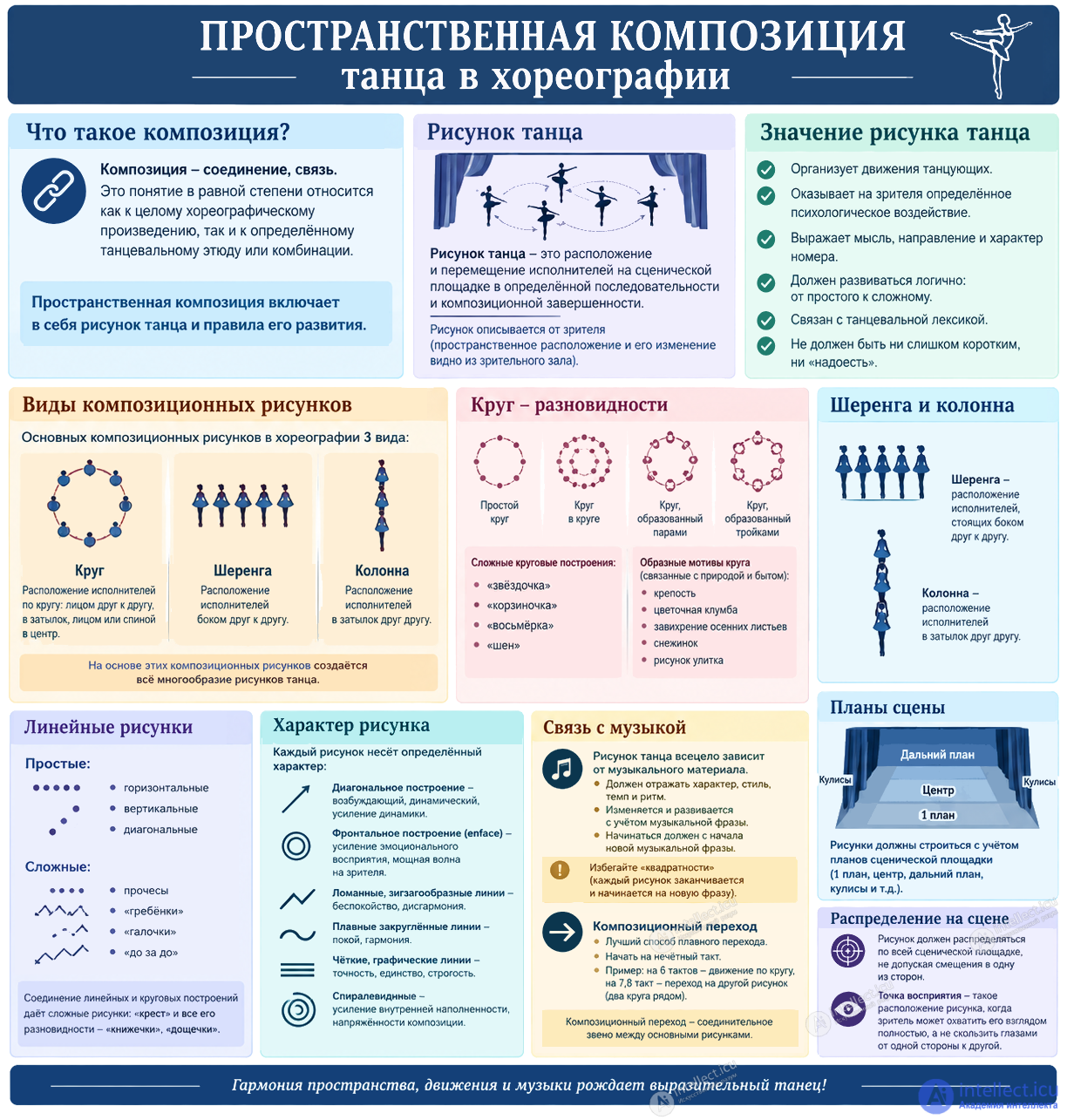
There is a concept known as the compositional pattern. This is the basic pattern, made up of various arrangements of the performers' figures, interlacing of arms, and various angles. There are 3 basic compositional patterns in choreography: the circle, the line, and the column. The whole variety of dance patterns is created on the basis of these compositional patterns. The circle – is an arrangement of performers around a circle, one behind another, facing each other, or facing or with their backs toward the center of the circle. The circle – is a formation in which the participants see one another. And the viewer has the opportunity to see the performers from every possible angle, because someone stands facing forward, someone with their back turned, someone sideways or at a half-turn to the audience. The circle has a number of variants: a simple circle, a circle within a circle, a circle formed by pairs or by threes. A circular formation can be simple or complex. Complex formations include such patterns as: «the little star», «the little basket», «the figure eight», «the shen» (a weaving chain figure). The circle carries a number of figurative associations connected with nature and everyday life: it can suggest a fortress, a flower bed, a swirl of autumn leaves or snowflakes, or a snail's-shell pattern.
The line and the column form the basis of all linear patterns. A line – is an arrangement of performers standing side by side. A column – is an arrangement of performers standing one behind another.
The arrangement of performers in these formations horizontally, vertically, or diagonally – are simple patterns. Complex linear patterns include cross-throughs, «combs», «chevrons», and «do-si-do». The combination of linear and circular formations produces such complex patterns as the «cross» and all its variants – the various «little books» and «little boards». Every formation and every pattern carries a certain character; for example, - a diagonal formation (an exciting, dynamic character, a device for intensifying the dynamics of the composition); - a frontal formation (directly facing the audience, en face) intensifies the emotional perception of the composition, a powerful wave directed straight at the audience; - broken, zigzag lines (a means of expressing unease and disharmony); - smooth, rounded lines, an expression of calm and harmony; - clear, graphic lines, expressing precision, unity, and rigor; - spiral shapes (winding, unwinding), intensifying the inner fullness and tension of the composition,
The floor pattern of a dance depends entirely on the musical material on the basis of which the given dance number is composed. One must hear one's own dance pattern within the music. It should reflect the music's character, style, tempo, and rhythm. The pattern changes and develops in accordance with the musical phrase. Each new pattern (dance phrase) should begin at the start of a new musical phrase, but at the same time one must try to avoid «squareness» in how the pattern is distributed across the music, that is, when every preceding pattern ends together with the end of a musical phrase and each new pattern begins exactly with a new musical phrase. Such a coincidence of the end of the previous pattern and the start of the new one does not allow for a smooth transition from one pattern to another. The best way to achieve a smooth transition from one pattern to another is a compositional transition. It should begin on an odd measure. For example, movement in a circle is performed for the first 6 measures of the musical phrase, and on measures 7 and 8 a transition is made to another pattern – two circles side by side. A compositional transition – is a connecting link that helps achieve a smooth transition from one main pattern to another main pattern. The creation of a compositional transition depends on the task at hand and is tied to the artistic and figurative content of the dance. Patterns must be built with the planes of the stage taken into account (the first plane, the center, the background, the wings, etc.).
The pattern should be distributed across the entire stage; there should be no shift toward one side or another. This applies, above all, to simple patterns. So that the viewer's attention does not wane, simple patterns must be distributed so that the point of perception lies at the center of the stage. The point of perception – is an arrangement of the pattern such that the viewer can take it in with a single glance, rather than having to scan from one side to the other. All the patterns in a dance must be united by a single concept, built in relation to one another, and must depict a single theme.
Perception – is a form of the sensory reflection of reality in consciousness, the ability to detect, receive, distinguish, and assimilate phenomena of the external world and to give them form. A choreographer's knowledge of the laws of perception leads to the emergence of a spiritual contact between the performers and the audience. Applying these laws is essential in the creative process so that the choreographic work becomes of higher quality, more memorable, and more interesting for the viewer. The duration of perception depends on the complexity of the pattern: the simpler the pattern, the faster it is perceived, and vice versa. But if the pattern includes dance vocabulary, then the more complex the vocabulary, the simpler the pattern should be. This is one of the fundamental laws of the perception of spatial composition.
In addition, the perception of a composition is influenced by: - the costume, its cut, length, and color, - the contrast of patterns – this can appear in combinations of patterns, for example, gathering the pattern toward the center of the circle and then actively dispersing across the whole stage, or in the combination of music and movement, for example, when the music sounds slow while the movement is performed faster, or vice versa (this device must be used very carefully, so that all contrasting choices strictly correspond to the main idea of the production). - the correspondence of the pattern to the musical material and to the length of the musical phrase. - the point of active action also intensifies the perception of the spatial composition. The point of active action is the moment in the pattern that arises during a compositional transition. For example, if a pattern moves along a diagonal and flows into a horizontal line, the angle formed between the diagonal and the horizontal will be the point of active action. This moment can be made passive or active by embellishing the transition with a wave of a handkerchief, a turn, or some other brief movement. In addition, to develop the pattern, give it color, and heighten the audience's perception, the choreographer may use various props: ribbons, towels, shawls, wreaths. A prop should take part in the production almost like a living character; it must carry meaning. In choreographic productions where the pattern is the principal expressive means, such as the khorovod (round dance), the dramaturgy is built on revealing the image through the pattern, from simple to complex, and the most complex pattern should appear at the climax.
In developing a spatial composition, certain devices are used, which can be divided into two groups. The first group includes devices for building patterns:
1. The device of fragmentation (a pattern of increasing intensity). It consists in the basic pattern being divided into smaller ones: one circle is divided into two, then into three, four.
2. The device of consolidation (a pattern of decreasing intensity). This is the reverse device – several patterns gradually merge into one.
3. The device of accumulation – occurs more often at the start of a dance. For example, one performer enters, then two more, then three more, and so on.
4. The device of complication – consists in the basic pattern being made more complex with additional transitions and movements; for example, a simple circle can be made more complex with a «shen», «little gates», or «little loops». Sometimes in
such patterns additional patterns arise.
The second group includes devices for presenting the pattern:
1. The device of the «point of perception» (a correctly chosen center of the pattern) – its purpose – is to draw the viewer's attention to the main element.
2. The device of contrast
3. The device of building from the particular to the general. The essence of this device is that each participant (or group) performs their own movement or moves along their own pattern, thereby creating an overall compositional pattern. This device is used when staging any large-scale, major compositions (the opening of festivals, the Olympic Games, and so on).
By the complexity of their arrangement in space, patterns can be:
By the character of its perception, a pattern can be:
Thus, the building of a pattern, its development, and its perception are influenced by:
Spatial composition, the floor pattern of a dance – is an important expressive means that helps the choreographer convey his or her concept to the viewer.
1. Define the concept of «spatial composition».
2. Define the concept of the «floor pattern of a dance»
3. Explain the logic behind the development of a dance's floor pattern.
4. The main types of compositional patterns.
5. The circle and its variants.
6. The line. The column. Characterize these formations
7. Characterize a straight-line formation of a pattern (movement in a straight line)
8. The horizontal. The vertical. Features of building a spatial composition along these directions.
9. Characterize spatial formations based on the circle, the square, and the diagonal.
10. What is a compositional transition.
11. Give definitions of the three main planes of the stage.
12. What is the point of perception.
13. What is the point of active action in spatial composition.
14. Define the two groups of devices for building spatial composition.
15. Which devices increase the audience's perception of a pattern
16. List and characterize the devices for building a dance's floor pattern.
17. What does a figurative pattern mean
18. How are patterns classified by the complexity of their arrangement in space.
Sign in and the lectures you have studied will be marked in this list.
Choose a course
Comments