
Groups of Body Positions in Classical Dance: En Face, Effacé, Croisé, Écarté. Poses Par Terre and En l'Air

Lecture 6 min.


Classical dance is a coherent system of movement built on the strict laws of the plasticity of the human body. One of the most important elements of this system is the positions of the body, which determine the orientation of the body relative to the audience and the stage space.

It is the position of the body that helps create the artistic image, reveals the character of the movement, and makes the dance expressive and harmonious. All poses of classical dance are built on the basis of specific spatial directions.

The main groups of body positions are:

  • En face
  • Effacé
  • Croisé
  • Écarté

These positions are used both in the barre and center exercises and in dance combinations, variations and performances.
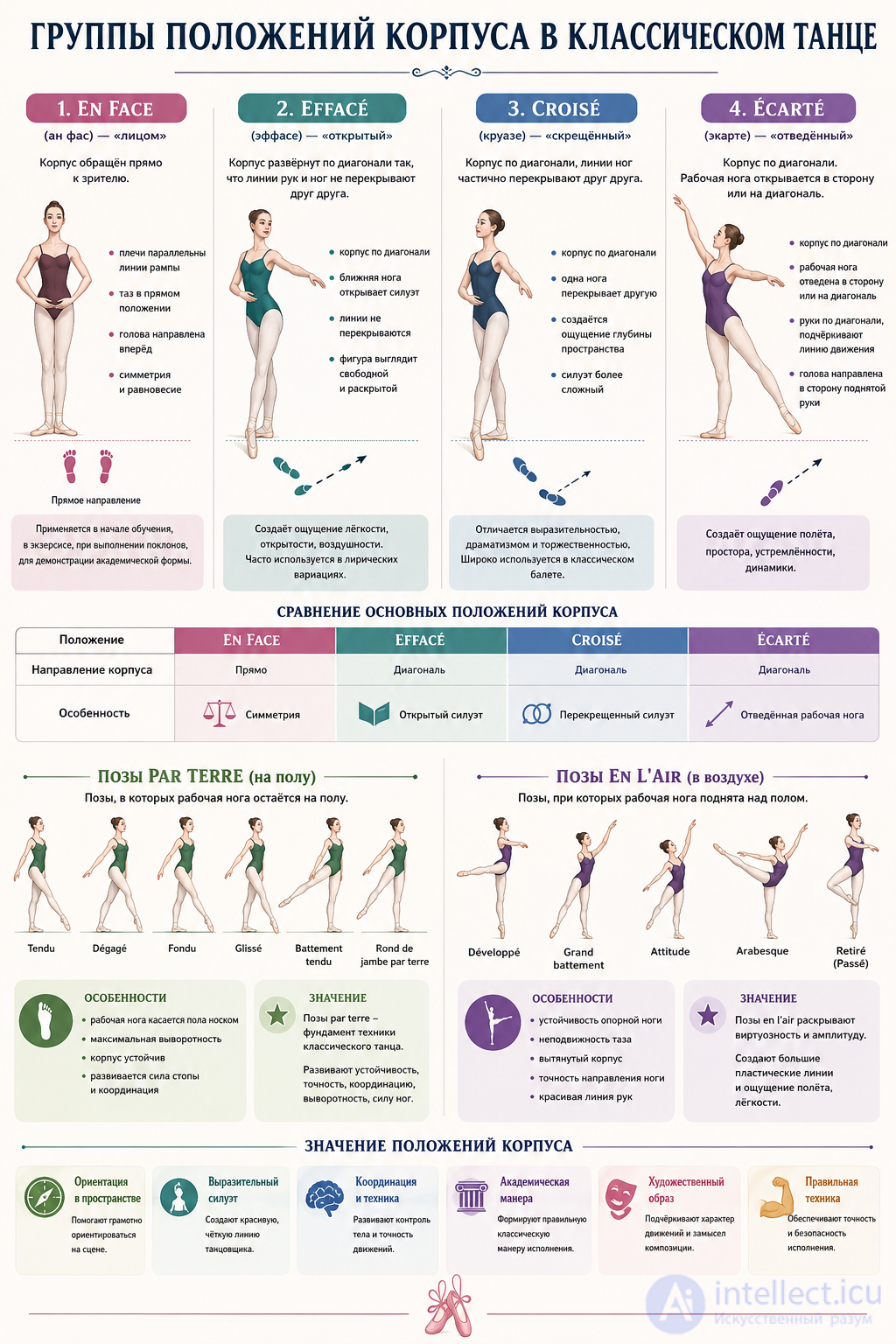
Groups of Body Positions in Classical Dance: En Face, Effacé, Croisé, Écarté. Poses Par Terre and En lAir

1. The Body Position En face

En face — a French term meaning «facing».

This is the simplest and most basic body position.

Characteristics

  • the body faces the audience directly;
  • the shoulders are parallel to the footlights;
  • the pelvis is in a straight position;
  • the head faces forward.

In the en face position there is no diagonal turn of the body.

Features of Execution

It is necessary to maintain:

  • an elongated spine;
  • a lifted torso;
  • symmetry of the shoulders;
  • even distribution of body weight.

Significance

The en face position is used:

  • when studying the basic movements;
  • at the beginning of training;
  • in the exercise;
  • when performing reverences (bows);
  • to demonstrate a clear academic form.

2. The Body Position Effacé

Effacé translates as «effaced», «open».

This position is created by turning the body on the diagonal so that the lines of the arms and legs do not overlap one another.

Main Features

  • the body is turned on the diagonal;
  • the leg nearer the audience opens the silhouette;
  • the figure looks free and open;
  • there is no visual crossing of the lines.

Artistic Significance

The effacé position creates a sense of:

  • lightness;
  • openness;
  • airiness;
  • romanticism.

It is very often used in lyrical variations.

Main Poses

In the effacé position the following are performed:

  • arabesque;
  • attitude;
  • développé;
  • grand battement;
  • various types of jumps.

3. The Body Position Croisé

Croisé means «crossed».

The body is also positioned on the diagonal, but the lines of the legs partially overlap one another.

Main Features

  • the body is turned on the diagonal;
  • one leg visually crosses the other;
  • an impression of spatial depth is created;
  • the silhouette becomes more complex.

Artistic Significance

The croisé position is distinguished by:

  • expressiveness;
  • drama;
  • solemnity;
  • plastic richness.

This is precisely why it is widely used in classical ballet.

4. The Body Position Écarté

Écarté translates as «separated», «spread apart».

This is one of the most beautiful positions in classical dance.

Features

The body is turned on the diagonal.

The working leg opens:

  • to the side;
  • on the diagonal.

The arms are placed on the diagonal, emphasizing the spatial composition.

The head is usually turned toward the raised arm.

Artistic Image

The écarté position creates a sense of:

  • flight;
  • spaciousness;
  • aspiration;
  • dynamism.

Comparison of the Main Body Positions

Position Direction of the Body Feature
En face Straight Symmetry
Effacé Diagonal Open silhouette
Croisé Diagonal Crossed silhouette
Écarté Diagonal Working leg spread to the side

Poses Par terre

Par terre means «on the floor».

This is the name given to poses in which the working leg remains on the floor.

These include:

  • tendu;
  • dégagé;
  • fondu;
  • glissé;
  • battement tendu;
  • rond de jambe par terre.

Features

In par terre poses:

  • the working leg touches the floor with the toe;
  • maximum turnout is maintained;
  • the body remains stable;
  • strength of the foot and correct coordination are developed.

Significance

Par terre poses are the foundation of classical dance technique.

They develop:

  • stability;
  • precision;
  • coordination;
  • turnout;
  • leg strength.

Poses En l'air

En l'air translates as «in the air».

These are positions in which the working leg is raised off the floor.

These Include

  • développé;
  • grand battement;
  • attitude;
  • arabesque;
  • retiré;
  • passé.

The height to which the leg is raised may be:

  • 45°;
  • 90°;
  • above 90°.

Features of Execution

It is necessary to maintain:

  • stability of the supporting leg;
  • stillness of the pelvis;
  • an elongated torso;
  • precision in the direction of the leg;
  • a beautiful line of the arms.

Artistic Significance

En l'air poses make it possible to create:

  • large plastic lines;
  • a sense of flight;
  • expressiveness of movement;
  • an effect of lightness.

The Significance of Body Positions in Classical Dance

The correct use of body positions makes it possible to:

  • orient oneself correctly in the stage space;
  • create an expressive silhouette for the dancer;
  • develop coordination;
  • form an academic manner of execution;
  • emphasize the artistic image;
  • ensure correct technique in the execution of movements.

All the positions of the body are closely connected with the work of the head, arms, legs and gaze, forming a unified plastic system of classical dance.

Conclusion

The body positions en face, effacé, croisé and écarté form the basis of the spatial organization of classical dance. They determine the direction of movement, the character of the pose and the artistic expressiveness of the execution. Par terre poses form the dancer's technical foundation, developing stability, strength and turnout, while en l'air poses reveal the virtuosity, amplitude and plastic beauty of classical dance.

A deep understanding and correct mastery of these positions is a necessary condition for the professional training of a ballet artist and a choreography teacher.

Review Questions

  1. What does the term en face mean?
  2. What is the difference between the effacé and croisé positions?
  3. What features does the écarté position have?
  4. What is meant by par terre poses?
  5. Which movements belong to the en l'air group?
  6. What role do body positions play in creating an artistic image?
  7. Why are par terre poses considered the foundation of classical dance?
  8. What requirements apply to the execution of en l'air poses?

Comments

To leave a comment

If you have any suggestion, idea, thanks or comment, feel free to write. We really value feedback and are glad to hear your opinion.
To reply

Lectures and tutorial on "choreographic creativity BASICS OF DANCE COMPOSITION AND STAGE"

Terms: choreographic creativity BASICS OF DANCE COMPOSITION AND STAGE

Sign in and the lectures you have studied will be marked in this list.

Choose a course