
Lecture 12 min.
Composition in art as a whole expresses an artistic idea and organises the aesthetic perception of the work in such a way that it moves from one component to another, from the part to the whole. A component (from Latin – a constituent part of something). The necessary components of a composition are: the dance pattern, choreographic vocabulary, music, and others.
V. I. Panferov, in his book «Fundamentals of Dance Composition», identified five basic laws (principles) that must be relied upon when creating a choreographic work:
The law of the unity of dramaturgical and choreographic content. There are dances that amount to a set of movements not bound together by a unified content. Such productions may give the audience aesthetic pleasure while they are being performed, but they are not particularly memorable. By contrast, there are compositions with a well-thought-out dramaturgy reflected in the dance movements. Such dances are remembered by the audience much better. This law applies equally to every kind and form of dance composition, from a short stage dance to a multi-act ballet. It follows that before beginning to stage a choreographic work, one should think through its future substantive basis. Choreographers sometimes turn to scriptwriters for help. Having received someone else's working-out of the dramaturgical basis, the choreographer-director must master it and translate it into the language of dance.
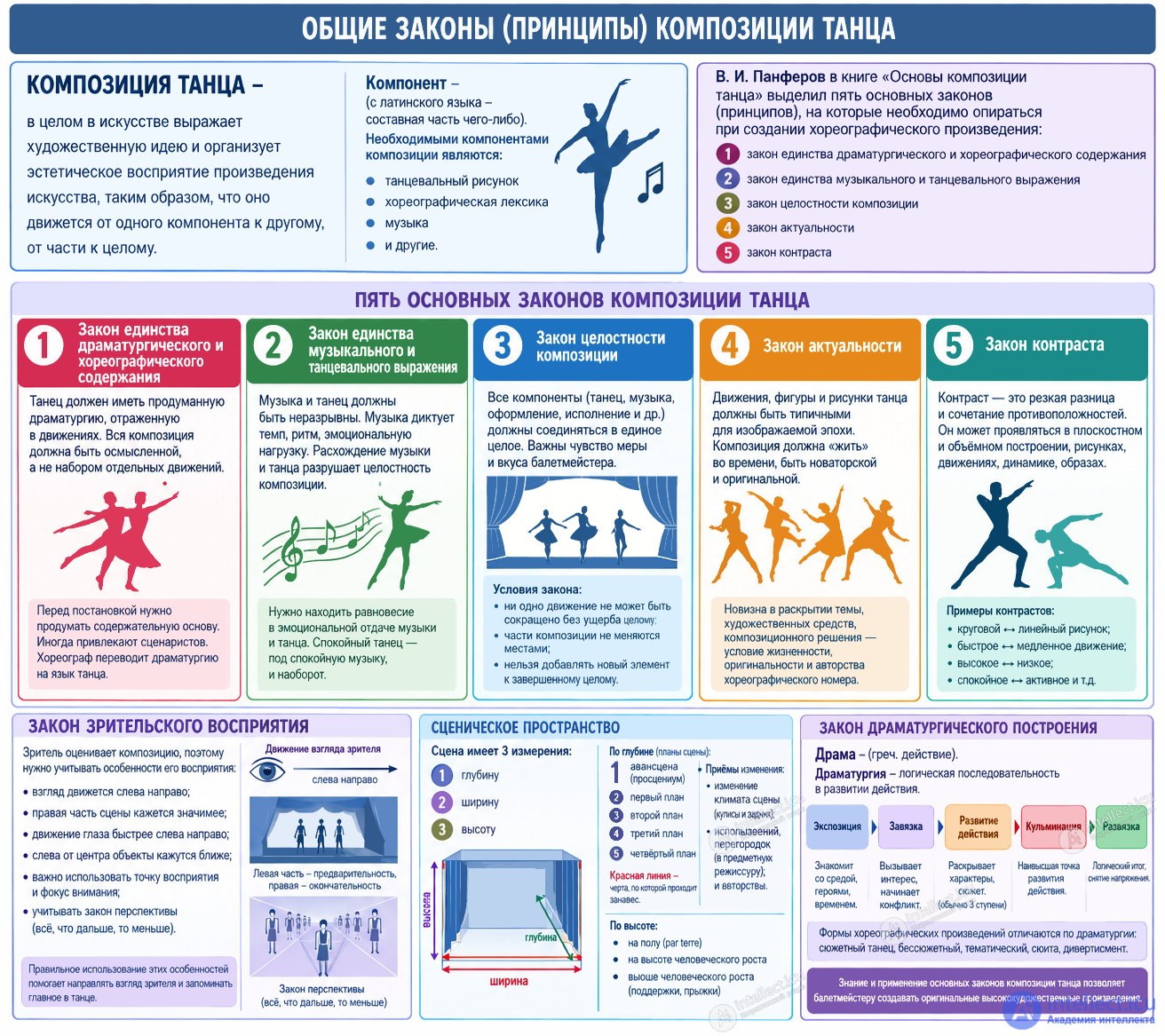
This law links dance with music. After working out the substantive basis, one should select music that matches the director's conception. Ideally the music is commissioned from a composer and created to the choreographer's wishes. But it also happens that music the choreographer has heard gives rise in his or her mind to a visual image of a dance, and he or she creates a dance composition to that music. Music always dictates the tempo, rhythm and emotional charge. A mismatch between the dance vocabulary and the music destroys the integrity of the composition. One must find a balance in the emotional charge of the music and the dance. A calm, measured dance cannot go with powerful, intense music, and vice versa.
Thanks to this law we perceive a work of choreographic art as a single whole. This law takes into account all the components of the composition, as well as the design and the performance, that is, all the expressive means together. In combining all these components, an important role is played by the sense of measure and taste that a choreographer must possess:
Three conditions of the law of integrity may be identified:
The law of integrity determines the mutual understanding between the performers of a composition and the audience perceiving it.
The movements and patterns of a dance, as well as its figures and their relationship to the development of the action, must be typical of the era being depicted. A composition should contain a sense of movement through time, which will make it «alive», emotional, and artistically full.
One must strive for novelty in a dance composition. In composing a choreographic composition, aesthetic development and the exploration of the world take place every time. A choreographer conveys his or her own emotional feeling, his or her own vision of the surrounding reality, through choreographic images. Novelty in the treatment of the theme, in the artistic means, and in the compositional solution is a necessary condition for the vitality, originality and authorship of a choreographic piece.
Contrast is an important component force both from the standpoint of construction and from the standpoint of the creative process of creating a choreographic image. The law of contrast provides for a sharp difference and a combination of opposites. A significant role in a dance composition is played by contrasts of flat and three-dimensional construction, contrasts of dance patterns, contrasts of dance movements, contrasts of dynamics, and contrasts of dance images. For example, a circular dance pattern gives way to a linear one, a fast movement gives way to a slow one, and so on. In addition to these laws, one must also make use of the laws of audience perception and of the dramaturgical construction of a choreographic work.
Taking audience perception into account is important. After all, it is ultimately the viewer who judges how successful or unsuccessful the compositional solution of the dance he or she sees has turned out to be. When composing, one needs to imagine oneself in the auditorium. Owing to a conditioned reflex, our eyes scan the stage from left to right. In relation to this, a composition in the left part of the stage signifies something preliminary; the gaze, as it were, drives it toward the right part of the stage, and so a composition in the right part tends toward finality. The space on the left side of the stage, as it were, presses upon a composition placed on the right and thereby makes it more significant, more monumental. The movement of the human eye is faster from left to right and considerably slower from right to left; these features of perception must be taken into account and used when creating a choreographic image and when choosing the direction of movement of the dancers. Everything located to the left of the centre of the stage seems closer to the viewer, so if we need to create an unobtrusive entrance for a character onto the stage, this can be achieved by having the character enter from the upper right wing.
The depiction of a character, of a group of performers, or simply the start of movements draws our attention depending on where the point of perception is located at that moment, that is, on what the viewer sees most fully, what catches the eye. The ability to correctly identify the point of perception and logically guide the viewer's gaze across the stage from one point to another makes it possible to understand correctly the development of the dance and allows the viewer to remember the vivid, important stages of the dramaturgy. This allows us to make use of the device of focus, making the viewer look where the choreographer needs him or her to look, since on stage there is always something primary and something secondary, and the viewer should see what is primary and interesting.
In choreography the law of perspective is also important (everything that is further away is smaller). For example, when building a linear composition, in order to preserve an even increase in the performers' height with depth, the taller ones should be placed further back, or one can create the effect of a road receding into the distance by using two lines converging at the centre of the backdrop.
Stage space has three dimensions: depth, width and height. In depth, the stage is divided into stage planes, which are determined by the position of the wings: the apron (proscenium), the first plane (the distance from the red line to the first pair of wings), the second plane, and the third and fourth planes of the stage. The red line is the line along which the curtain runs. We described the characteristics of the stage planes in the lecture on the expressive means of choreographic art.
By height, the stage space is divided into three sizes:
The stage space can be altered with the help of certain devices:
Drama (from the Greek for action). Dramaturgy is the logical sequence in the development of the action; one action gives rise to another and is the cause of its appearance. According to this law a dance has a beginning, a development and an end, that is, it consists of several parts, each of which carries its own weight. It is precisely this development that allows the dance to be watched with continuous, ever-growing attention.
Exposition (from the Latin for a setting-out, a description). This is the part of the work that precedes the action; it introduces the viewer into the figurative world of the dance. The exposition acquaints the viewer with the characters, with their personalities, and with the place and time of the action. The length of the exposition depends on the task the choreographer is solving; it may be unhurried or dynamic, but in terms of duration the exposition should be shorter than the other parts.
The tie-up is the beginning of the action (it may be the beginning of the emergence of a conflict). The viewer should be interested in what will happen next. The exposition and the tie-up should arouse interest and capture attention. The development of the action is the largest, principal part, where the plot unfolds and develops, and the characters and the content of the production are revealed. One must strive for a vivid, interesting development. The number of steps in the development of the action can vary and depends on the scale and content of the piece (usually the action develops in three steps). Each of them should be full of imagery and should help prepare the viewer for the climax.
The climax (from the Latin for summit). In choreography this is the highest point in the development of the musical-choreographic action. Here the highest degree of intensity is reached in the development of the content, the plot, and the relationships among the characters. The compositional solution at the climax should be unexpected and intriguing.
The denouement should follow logically from the whole of the dance action. It should complete the thought, the image, and put a clear full stop. It is the ideological and moral outcome that the viewer should come to realise in the process of taking in everything happening on stage. The denouement should be short, first preserving and then releasing the tension that was built up at the climax.
There are certain differences in the dramaturgical construction of various forms of choreographic works. Thus the dramaturgy of a narrative dance differs from the dramaturgy of a non-narrative, thematic dance, and from that of a suite or a divertissement.
Knowledge and application of the basic laws of dance composition enable a choreographer to create original, highly artistic choreographic works.
1. List the basic laws that must be relied upon when creating a choreographic work.
2. Characterise the law of the unity of dramaturgical and choreographic content
3. Characterise the law of the unity of musical and dance expression,
4. Characterise the law of the integrity of the composition,
5. Characterise the law of relevance,
6. Characterise the law of contrast.
7. Characterise the law of audience perception
8. Characterise the law of the dramaturgical construction of a choreographic work.
Sign in and the lectures you have studied will be marked in this list.
Choose a course
Comments