
Lecture 5 min.
Battement (from the French battre — «to beat», «to strike») is a group of classical-dance movements based on the work of the legs. Battements form the basis of the exercise at the barre and in the centre of the room. They develop strength, turnout, flexibility, stability, coordination and mobility of the hip joints, and prepare the dancer for more advanced technique.
All kinds of battements are performed while maintaining correct posture, an engaged torso, stretched knees and feet, and with strict observance of turnout.
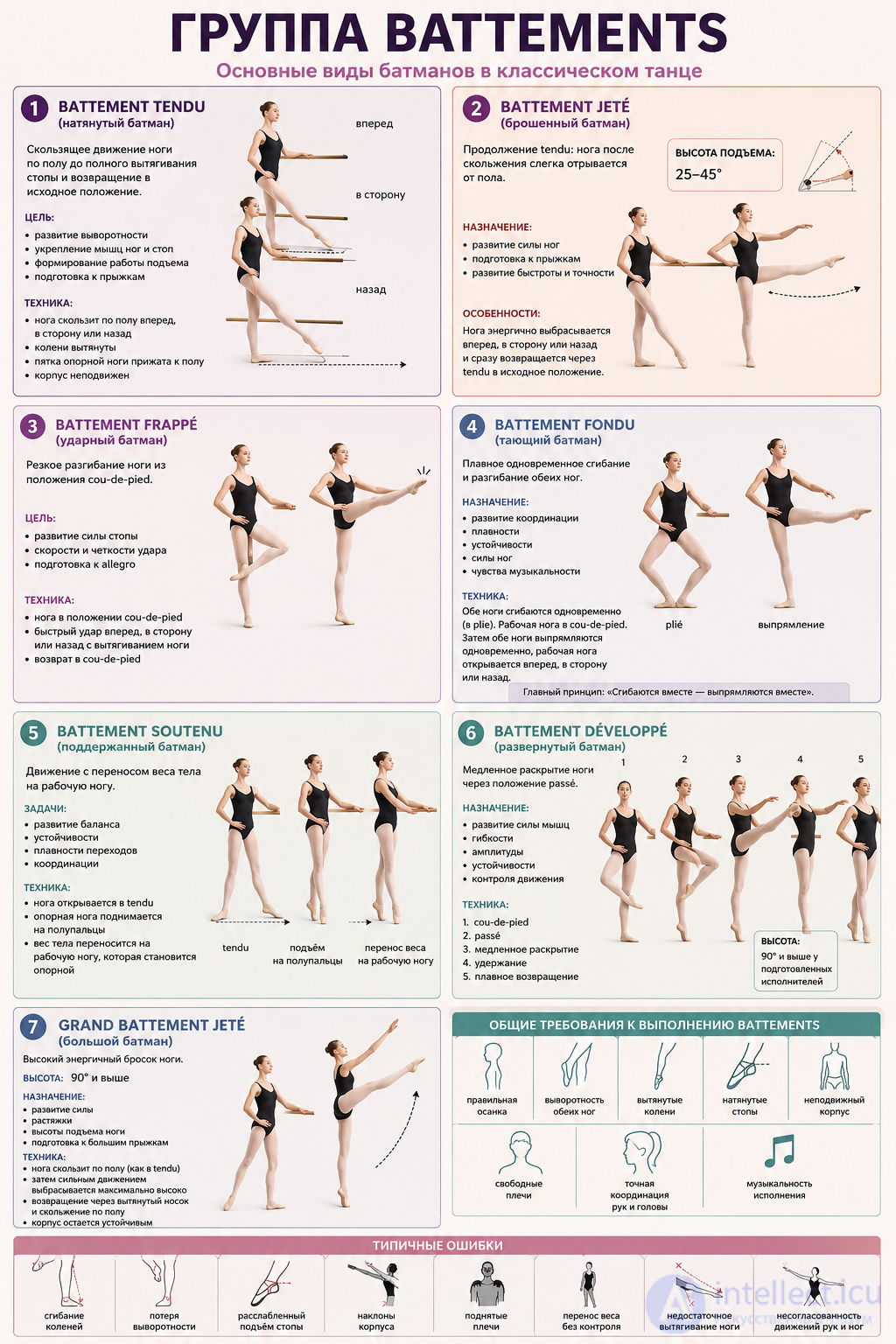
Battement tendu («stretched battement») is a sliding movement of the leg along the floor until the foot is fully stretched.
The starting position is fifth or first position.
The working leg slides along the floor forward, to the side or backward, fully stretching to the point of the toe. It then returns the same way to the starting position.
During execution:
Battement jeté («thrown battement») is a continuation of battement tendu in which, after sliding, the leg lifts slightly off the floor.
Height of the lift:
The working leg is energetically thrown forward, to the side or backward and immediately returns through tendu to the starting position.
The movement must be:
Battement frappé («struck battement») is a sharp extension of the leg from the cou-de-pied position.
Develops:
The working leg is in the cou-de-pied position.
From this position a quick strike is performed with the leg extending at the same time forward, to the side or backward.
After the strike the leg returns back to cou-de-pied.
The main feature is the sharpness and precision of the movement.
Battement fondu («melting battement») is a smooth, simultaneous bending and straightening of both legs.
The name comes from the French fondre — «to melt».
Develops:
Both legs bend at the same time.
The working leg is in the cou-de-pied position.
Both legs then straighten at the same time, and the working leg opens forward, to the side or backward.
The main principle:
«They bend together — they straighten together.»
Battement soutenu («sustained battement») is a movement with a transfer of body weight onto the working leg.
Develops:
The working leg opens into tendu.
The supporting leg rises onto demi-pointe.
The body weight is then transferred onto the working leg, which becomes the supporting leg.
The movement is performed softly, without jerks.
Battement développé («unfolded battement») is a slow opening of the leg through the passé position.
One of the most difficult movements of the classical exercise.
Develops:
The working leg:
Height:
The movement must be slow, controlled and stretched to the fullest extent.
In teaching literature it is sometimes referred to for short as Grand Battement.
This is a high, energetic throw of the leg.
90° and above.
Develops:
From fifth position the working leg slides along the floor (as in tendu), then is thrown with a strong movement as high as possible.
The return is performed through a stretched point and a slide along the floor.
The torso remains stable.
In all kinds of battements it is necessary to observe:
The Battement group is the foundation of classical dance. It is through these exercises that a dancer's basic professional qualities are formed: strength, turnout, flexibility, stability, precision, coordination and musicality. The sequential mastery of battement tendu, jeté, frappé, fondu, soutenu, développé and grand battement creates a solid technical base for performing more complex elements of classical dance, turns, jumps and stage combinations.
Sign in and the lectures you have studied will be marked in this list.
Choose a course
Comments