
Lecture 7 min.
Jumps (French allegro) are one of the most important components of classical dance. They demonstrate the performer's strength, coordination, lightness, musicality and virtuosity. The art of the jump lies not only in the height of the flight but also in the correct technique of the push-off, the position of the body, the work of the arms, a soft landing and precision of execution.
All jumps in classical dance are grouped into several categories depending on which foot or feet the movement begins from and which foot or feet it ends on.
Jumping movements contribute to:
The basic principle of any jump is:
plié → push-off → flight → landing through demi-plié.
All jumps should be performed lightly, silently, and with a sense of airiness.
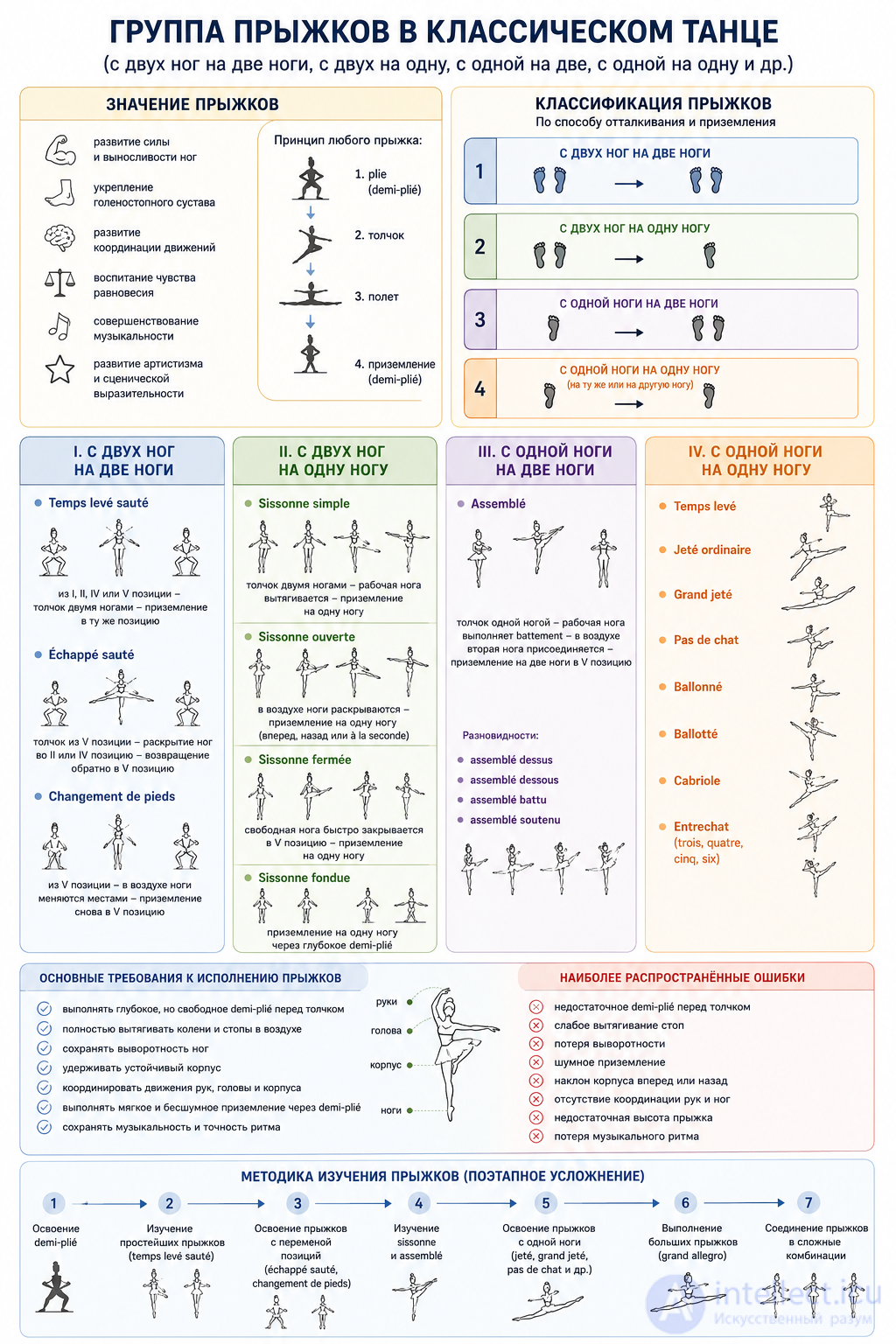
According to the method of push-off and landing, jumps are divided into four main groups:
Each group includes a large number of movements of varying complexity.
This is the simplest group of jumps and the first one to be learned.
The dancer pushes off with both feet after a demi-plié and lands on both feet at the same time.
The main task:
1. Temps levé sauté
The very first jump taught.
It is performed:
It is used to develop allegro technique.
2. Échappé sauté
It is performed:
It develops:
3. Changement de pieds
It is performed:
One of the most important jumps for preparing complex allegro combinations.
When performing these jumps, the push-off is done with both feet, while the landing is on one foot.
This group requires greater stability and strength in the supporting leg.
1. Sissonne simple
It is performed:
The free leg holds its given position.
2. Sissonne ouverte
After the push-off the legs open in the air.
The landing is on one foot.
The working leg may be placed:
3. Sissonne fermée
It differs in that the free leg quickly closes into V position.
It is used in fast combinations.
4. Sissonne fondue
The landing is done through a deep demi-plié.
It is performed smoothly and softly.
The push-off is done with one foot, and the landing is on two.
This group occurs considerably less often.
Assemblé
It is performed as follows:
Assemblé is considered one of the fundamental academic jumps.
Varieties:
This is the largest and most complex group.
The push-off is done with one foot, and the landing may be:
These jumps require a high level of technique, strength and precision.
It is performed on one leg.
After the push-off the dancer lands on the same leg.
It is used both as an independent movement and as an element of larger combinations.
Push-off with one foot.
Landing — on the other.
The working leg is thrown forward, backward or to the side.
One of the most spectacular jumps.
It is performed with a powerful forward travel.
In flight it creates the impression of a full split.
It requires:
A jump with a successive bending of the legs.
In shape it resembles a cat's leap.
It is often used in women's variations.
After the push-off the working leg opens, then closes.
It is performed lightly and with spring.
A jump with a rocking motion of the body.
It is performed forward and backward.
It requires a good sense of balance.
One leg beats against the other in the air.
After the beat the dancer lands on the working leg.
It is considered one of the most difficult male jumps.
A series of jumps with rapid beats of the legs in the air.
The best known are:
When performing any jump, the following rules must be observed:
The following mistakes are frequently encountered while learning jumps:
Training is built on the principle of gradually increasing complexity:
The jump group is one of the most important parts of classical dance technique. Correctly mastering jumps develops the dancer's strength, endurance, coordination, expressiveness and performing skill. Study begins with the simplest jumps from two feet to two feet and gradually moves on to the complex types of jumps from one foot to the other, which require a high level of technical training. Quality execution of jumps is based on precise work of the feet, the correct use of demi-plié, maintaining turnout, a soft landing, and a harmonious combination of technique with musicality and artistic expressiveness.
Sign in and the lectures you have studied will be marked in this list.
Choose a course
Comments