
Lecture 5 min.
Classical dance is the foundation of the professional training of both choreographers and performers. In the course of training, it is important not only to master individual elements of technique but also to be able to combine them into a single system of movement. It is precisely this goal that combined tasks in a classical dance lesson serve.
Combined tasks make it possible to simultaneously develop technique, coordination, musicality, artistry and expressive performance. They represent an important stage in the transition from studying individual movements to creating a complete dance composition.
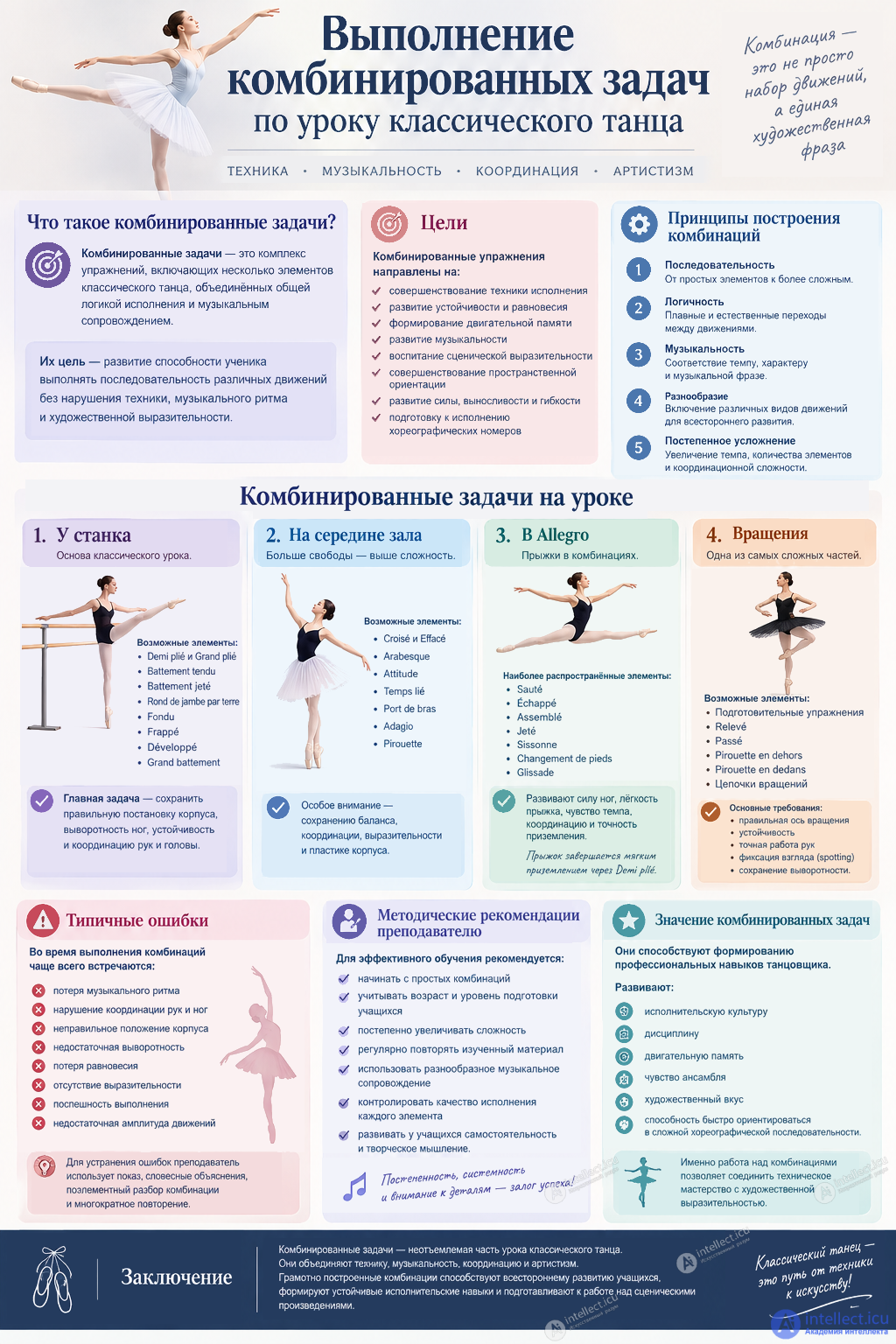
Combined tasks — are a complex of exercises that include several elements of classical dance united by a common performance logic and musical accompaniment.
Their main purpose is to develop the student's ability to perform a sequence of different movements without compromising technique, musical rhythm or artistic expressiveness.
Combinations may include:
Combined exercises are aimed at solving several pedagogical tasks at once:
When putting together combinations, the teacher must take into account the students' level of training.
The main principles are:
1. Sequence
The combination is built from simple elements to more complex ones.
2. Logic
Each movement must flow naturally into the next.
3. Musicality
All movements are performed in accordance with the musical phrase, tempo and character of the music.
4. Variety
Combinations should include various types of movement for the all-round development of the performer.
5. Gradual Increase in Complexity
As skill grows, the tempo, the number of elements and the coordinational complexity all increase.
Work at the barre is the foundation of the classical lesson.
Combinations may include:
The main task is to maintain the correct placement of the body, turnout of the legs, stability, and coordination of the movements of the arms and head.
When performing combinations, it is important to maintain continuity of movement and precision of musical execution.
After the exercises at the barre have been mastered, the work is transferred to the center.
Here the difficulty of execution increases considerably, since the additional support disappears.
Combinations may contain:
At this stage, great attention is paid to:
The Allegro section includes various jumps performed in combinations.
The most common elements:
Combinations develop:
Special attention is paid to a soft landing through Demi plié.
Turns are one of the most difficult parts of the lesson.
Combinations may include:
The main requirements:
The following mistakes are most often encountered while performing combined tasks:
To correct mistakes, the teacher uses demonstration, verbal explanation, element-by-element breakdown of the combination, and repeated practice.
For effective teaching, it is recommended to:
Performing combined tasks contributes to the development of a dancer's professional skills.
It develops:
It is precisely work on combinations that makes it possible to unite technical mastery with artistic expressiveness, which is the main goal of teaching classical dance.
Combined tasks are an integral part of the classical dance lesson and play an important role in a dancer's professional development. They unite technical elements, musicality, coordination and artistry into a single system of movement. Well-constructed combinations promote the all-round development of students, form stable performing skills, and prepare them to work on stage productions.
Thus, performing combined tasks represents an essential stage in the teaching of classical dance, providing a gradual transition from mastering individual movements to the free and artistically expressive performance of complex choreographic compositions.
Sign in and the lectures you have studied will be marked in this list.
Choose a course
Comments