
Lecture 6 min.
Classical dance is the foundation of the art of choreography. It is a system of movements and exercises directed at developing a dancer's strength, flexibility, coordination, expressiveness and correct posture. Every element of classical dance is built on strict rules governing the placement of the torso, arms, legs and head. Study begins with mastering the basic concepts, without which no further refinement of technique is possible.
The positions of the legs are the foundation of classical dance. They are based on the principle of turnout — the outward rotation of the legs from the hip joint.
There are five basic positions of the legs.
The heels are joined together, the toes turned out as far as possible to the sides, forming a single line. Body weight is distributed evenly on both legs.
The feet are placed one foot's length apart, toes turned outward. Body weight is distributed evenly between both legs.
The heel of one foot is placed at the middle of the other foot. It is rarely used in modern methodology and is considered preparatory.
The feet are placed one in front of the other, a foot's length apart. Both legs retain full turnout.
The most important position in classical dance. The heel of one foot touches the toe of the other, the feet fully overlapping one another. Both legs are turned out to the maximum.
Requirements for performing the positions of the legs:
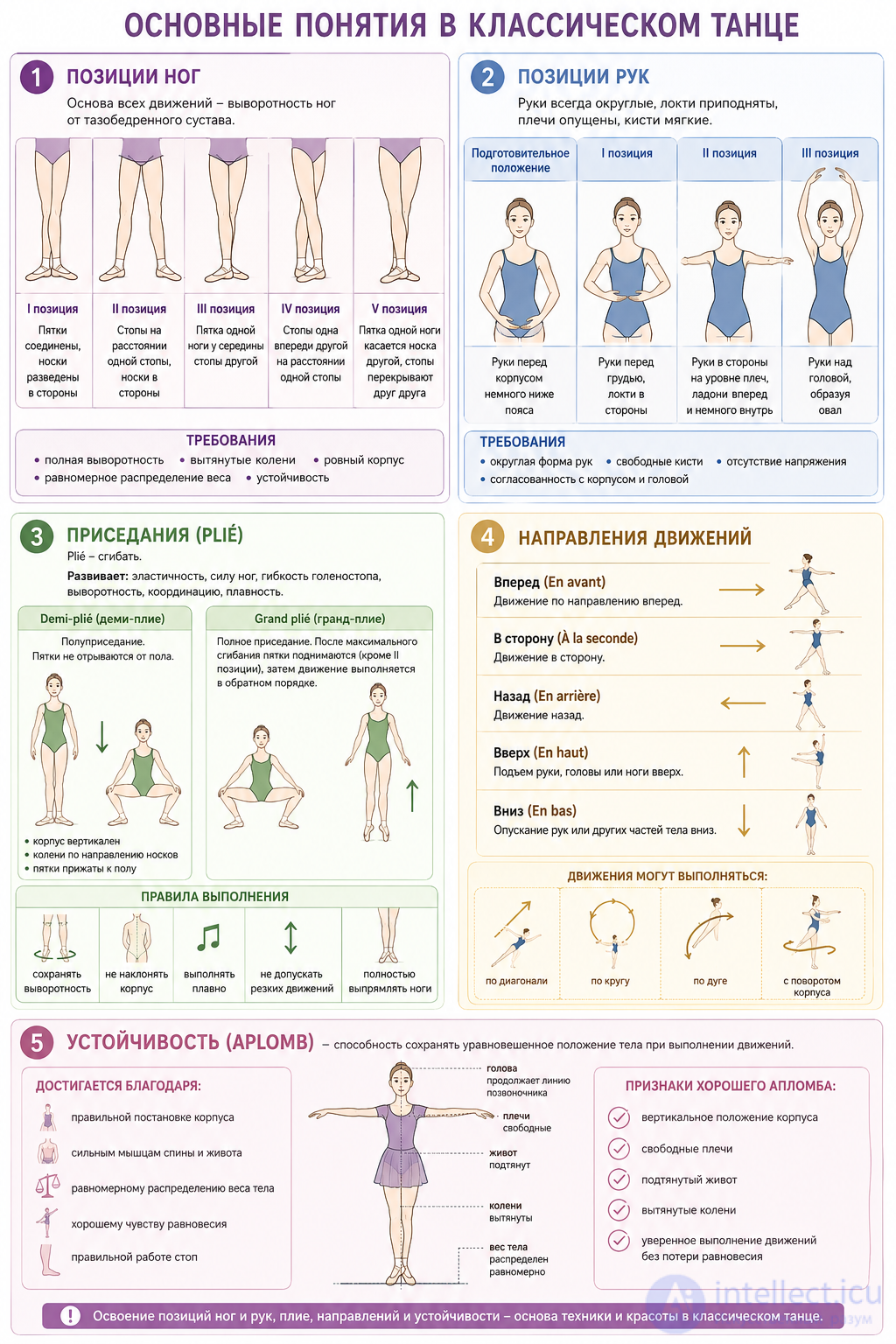
The placement of the arms gives movements expressiveness, plasticity and completeness. The arms always keep a rounded shape, the elbows slightly raised, the hands soft and continuing the line of the forearm.
In classical dance a preparatory position and three basic positions of the arms are distinguished.
The arms are held in front of the body, slightly below waist level, forming a soft oval.
The arms rise in front of the chest, keeping a rounded shape. The elbows point to the sides, the shoulders remain lowered.
The arms open out to the sides at shoulder level. The elbows are slightly rounded, the palms turned forward and slightly inward.
The arms rise above the head, forming an oval. The shoulders remain lowered, the neck free.
Basic requirements:
Plié is one of the most important exercises in classical dance. Translated from French it means «to bend».
Plié develops:
Two basic kinds of plié are distinguished.
A half bend of the knees in which the heels do not leave the floor. The knees bend in the direction of the toes.
Features:
A full bend of the knees. Once the knees reach maximum bend, the heels gradually lift from the floor (except in second position, where they remain on the floor), and then smoothly return to the starting position.
Basic rules for performing plié:
In classical dance there are set directions of movement that make it possible to keep precision of execution.
The movement is performed in a direction forward relative to the performer.
The movement is directed to the side.
The movement is performed backward.
The raising of an arm, the head or a leg upward.
The lowering of the arms or other parts of the body downward.
In addition, movements may be performed:
While performing, it is necessary to maintain correct posture and control over the position of the centre of gravity.
Aplomb is a dancer's ability to keep a stable, balanced position of the body while performing any movement.
Aplomb is one of the most important qualities of a classical-dance performer.
It is achieved through:
The development of stability begins with the very first classes at the barre and continues throughout the whole course of training.
Mastering the positions of the legs and arms, performing plié, understanding the directions of movement and developing stability are an obligatory foundation of training for every classical-dance performer.
Without correct execution of these elements it is impossible to properly master:
This is precisely why training in classical dance always begins with the study of the basic positions and exercises.
The basic concepts of classical dance form the foundation of a dancer's professional training. Correct positions of the legs and arms shape a beautiful line of the body, plié develops strength, flexibility and plasticity of movement, knowledge of the directions ensures precision of execution, and aplomb helps maintain stability and confidence in performing both simple and complex elements.
Sequential mastery of these foundations makes it possible to build correct technique of execution, expressiveness of movement, and a high level of performance skill, which is the main goal of training in classical dance.
Sign in and the lectures you have studied will be marked in this list.
Choose a course
Comments