
Lecture 5 min.
The group of circular leg movements (rond de jambe, French for «circle of the leg») is one of the most important groups in the system of classical dance. These movements develop turnout of the hip joints, flexibility, coordination, stability, and strength of the leg and torso muscles, and they cultivate smoothness, continuity and expressiveness of execution.
Circular movements are performed both at the barre and in the center of the room. They form the basis of many elements of classical dance and are widely used in the exercise, adagio and dance combinations.
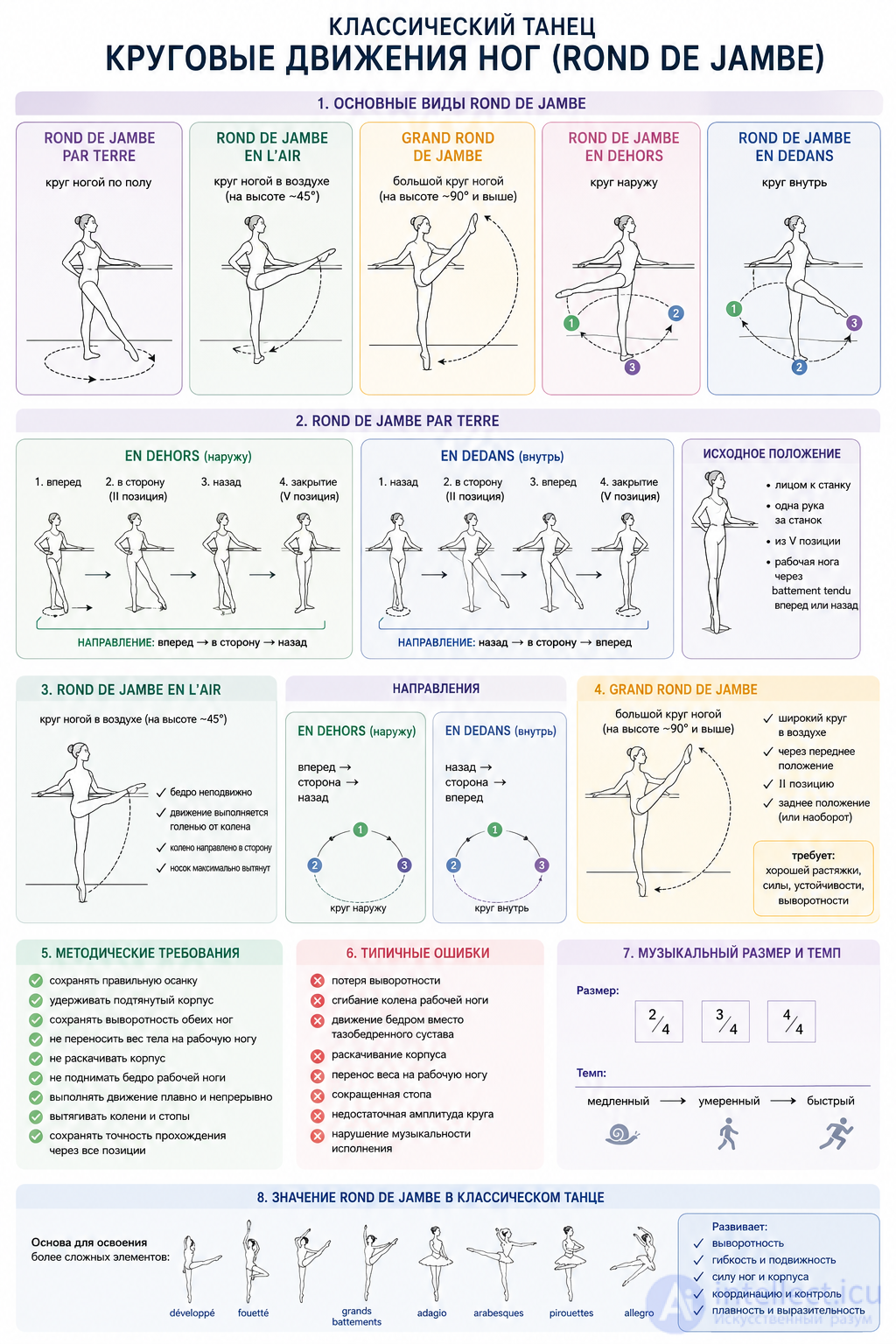
The group of circular movements includes:
Rond de jambe par terre — a circle described by the leg along the floor.
This is one of the first exercises studied in classical dance after mastering battement tendu and battement jeté.
As a rule, the exercise is performed:
The working leg is extended forward or back through battement tendu.
En dehors means outward.
Sequence of the movement:
Direction of the circle:
forward → to the side → back.
During execution:
En dedans means inward.
Sequence:
Direction of the circle:
back → to the side → forward.
Despite the change in direction, all the requirements for execution remain the same.
Rond de jambe en l'air — a circle described by the leg in the air.
This exercise is considerably more difficult.
The working leg is raised to approximately 45°, the thigh remains still, and the circle is traced only by the lower part of the leg from the knee.
During the exercise:
It is performed:
Grand rond de jambe — a large circle of the leg.
The working leg performs a wide circle in the air, usually at a height of 90° or higher.
This movement requires:
The circle is performed:
Or the reverse — depending on the direction of the movement.
In all types of rond de jambe, two directions are distinguished.
Movement outward.
Pattern:
Front → side → back
Develops:
Movement inward.
Pattern:
Back → side → front
Develops:
Most often the exercises are performed in:
Tempo:
When performing rond de jambe, the following rules must be observed:
The most common mistakes:
Circular movements form the foundation of classical dance technique. They prepare the performer for mastering:
Without properly mastering rond de jambe, it is impossible to achieve a high level of technique in more complex elements.
The group of circular movements known as rond de jambe occupies an important place in the system of classical dance. These exercises form correct turnout, strengthen the muscles and joints, and develop plasticity, coordination and stability. The consistent mastery of rond de jambe par terre, rond de jambe en l'air and grand rond de jambe creates a solid technical foundation for studying all subsequent elements of classical dance and fosters expressiveness, lightness and academic purity of execution.
Sign in and the lectures you have studied will be marked in this list.
Choose a course
Comments