
Interconnected Tempos (Temps Lié) in Various Forms in Classical Dance

Lecture 5 min.


In this lecture you will become acquainted with the concept of temps liés, its significance in the system of classical dance, the main forms of its execution, and the methodology for studying it.
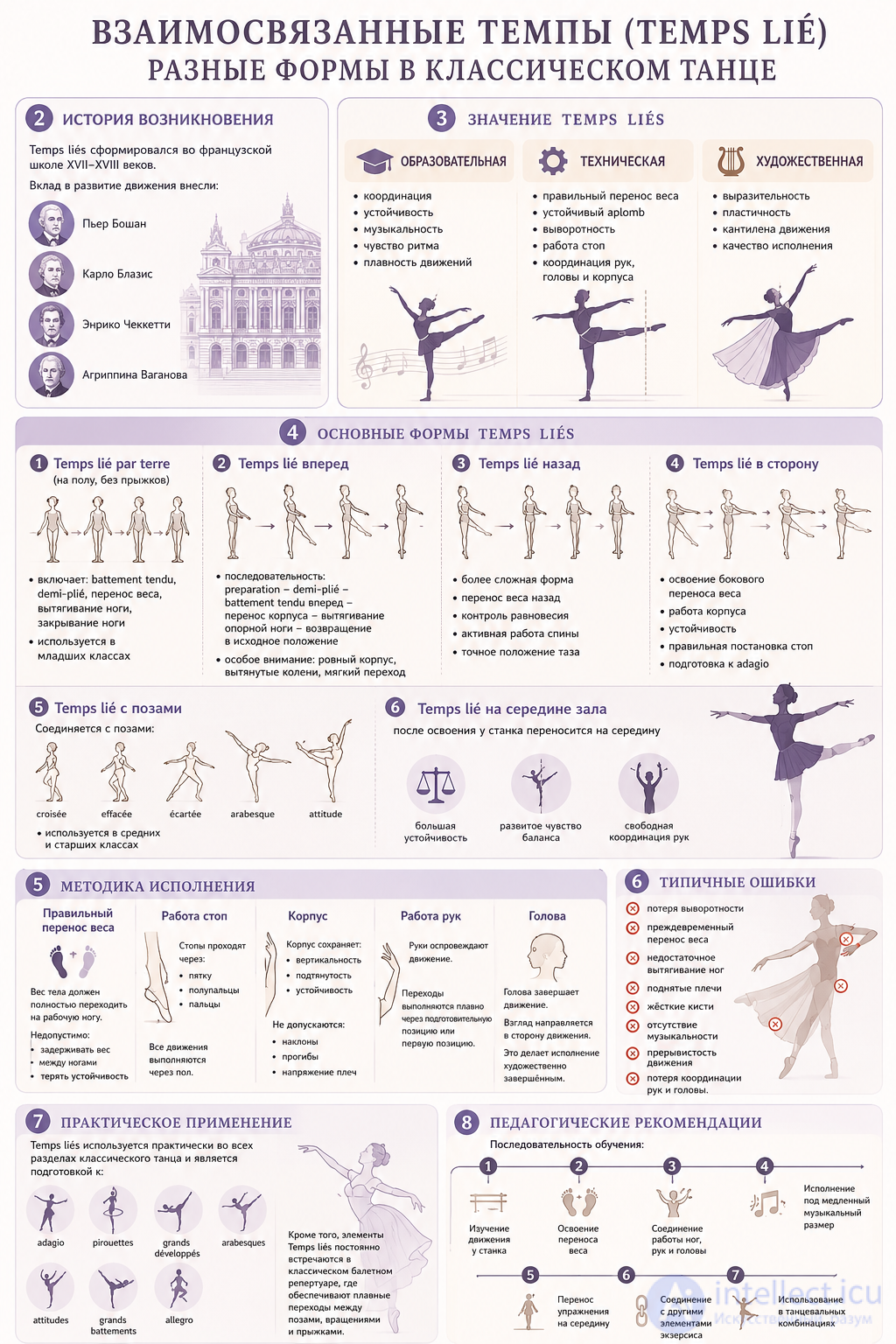
Interconnected Tempos (Temps Lié) in Various Forms in Classical Dance

1. The Concept of Temps Liés

The French term Temps liés (pronounced tahn lee-ay) translates as «connected movements» or «connected tempos».

In classical dance, temps liés is a system of smoothly connected movements based on transferring the body's center of gravity from one leg to the other. During execution, the following are combined:

  • demi-plié;
  • battement tendu;
  • the transfer of body weight;
  • stretching of the legs;
  • coordination of the arms, head and body.

The main feature of temps liés lies not in the complexity of its individual elements but in their continuity and plastic connectedness.

2. Historical Origins

Temps liés took shape in the French school of classical dance in the 17th–18th centuries.

A significant contribution to the development of the movement was made by:

  • Pierre Beauchamp;
  • Carlo Blasis;
  • Enrico Cecchetti;
  • Agrippina Vaganova.

The system of temps liés was worked out in particular detail in the method of A. Ya. Vaganova, where these exercises are regarded as the foundation for developing correct coordination of the whole body.

3. The Significance of Temps Liés

In the system of teaching classical dance, temps liés performs several essential functions.

Educational

It develops:

  • coordination;
  • stability;
  • musicality;
  • a sense of rhythm;
  • smoothness of movement.

Technical

It builds:

  • correct weight transfer;
  • stable aplomb;
  • turnout;
  • work of the feet;
  • coordination of the arms and head.

Artistic

It develops:

  • expressiveness;
  • plasticity;
  • cantilena of movement;
  • quality of execution.

4. The Main Forms of Temps Liés

Classical dance has several varieties of this movement.

1. Temps lié par terre

The simplest form.

It is performed without jumps.

It includes:

  • battement tendu;
  • demi-plié;
  • weight transfer;
  • closing the leg.

It is used in the junior classes.

2. Temps lié Forward

Sequence of execution:

  • preparation;
  • demi-plié;
  • battement tendu forward;
  • transfer of the body;
  • stretching of the supporting leg;
  • return to the starting position.

Special attention is paid to:

  • a straight body;
  • stretched knees;
  • a smooth transition between positions.

3. Temps lié Backward

This is a more complex form.

Characteristics:

  • transferring the weight backward;
  • controlling balance;
  • active work of the back;
  • precise position of the pelvis.

It is used after the forward movement has been mastered.

4. Temps lié to the Side

It allows the student to master:

  • a sideways transfer of weight;
  • work of the body;
  • stability;
  • the correct placement of the feet.

It is often performed as a preparatory exercise for adagio.

5. Temps lié with Poses

It is combined with:

  • croisée;
  • effacée;
  • écartée;
  • arabesque;
  • attitude.

This form is found mainly in the intermediate and senior classes.

6. Temps lié in the Center of the Room

After it is mastered at the barre, the movement is transferred to the center.

This requires:

  • greater stability;
  • a well-developed sense of balance;
  • free coordination of the arms.

5. Performance Methodology

When performing temps liés, several principles must be observed.

Correct Weight Transfer

The weight of the body must fully transfer onto the working leg.

It is not permitted to:

  • hold the weight between the legs;
  • lose stability.

Work of the Feet

The feet pass through:

  • the heel;
  • the demi-pointe;
  • the toes.

All movements are performed through the floor.

The Body

The body maintains:

  • verticality;
  • lift;
  • stability.

The following are not allowed:

  • leaning;
  • arching;
  • tension in the shoulders.

Work of the Arms

The arms accompany the movement.

Transitions are performed smoothly through the preparatory position or the first position.

The Head

The head completes the movement.

The gaze is directed toward the movement.

This gives the performance artistic completeness.

6. Typical Mistakes

The most common mistakes made by students:

  • loss of turnout;
  • premature transfer of weight;
  • insufficient stretching of the legs;
  • raised shoulders;
  • stiff wrists;
  • lack of musicality;
  • choppiness of movement;
  • loss of coordination between the arms and head.

7. Practical Application

Temps liés is used in practically every section of classical dance.

It serves as preparation for:

  • adagio;
  • pirouettes;
  • grands développés;
  • arabesques;
  • attitudes;
  • grands battements;
  • allegro.

In addition, elements of temps liés constantly appear in the classical ballet repertoire, where they provide smooth transitions between poses, turns and jumps.

8. Pedagogical Recommendations

In teaching, it is recommended to follow this sequence:

  1. Learning the movement at the barre.
  2. Mastering the transfer of weight.
  3. Combining the work of the legs, arms and head.
  4. Performing it to a slow musical meter.
  5. Transferring the exercise to the center.
  6. Combining it with other elements of the exercise.
  7. Using it in dance combinations.

Conclusion

Temps liés is one of the fundamental elements of classical dance. Despite its outward simplicity, this exercise builds the foundations of professional performing skill: correct weight transfer, stability, coordination, musicality, plasticity and expressiveness of movement. Thoroughly mastering the various forms of temps liés promotes success in learning more complex elements of the classical exercise and raises the artistic culture of performance.

Questions for Self-Check

  1. What does the term temps liés mean?
  2. What is the main purpose of this exercise?
  3. What forms of temps liés exist?
  4. What elements make up the structure of the movement?
  5. What are the most common mistakes encountered in performance?
  6. What role does temps liés play in studying adagio and other sections of classical dance?
  7. Why is temps liés considered the foundation for developing coordination in classical dance?

Comments

To leave a comment

If you have any suggestion, idea, thanks or comment, feel free to write. We really value feedback and are glad to hear your opinion.
To reply

Lectures and tutorial on "choreographic creativity BASICS OF DANCE COMPOSITION AND STAGE"

Terms: choreographic creativity BASICS OF DANCE COMPOSITION AND STAGE

Sign in and the lectures you have studied will be marked in this list.

Choose a course