
Lecture 18 min.
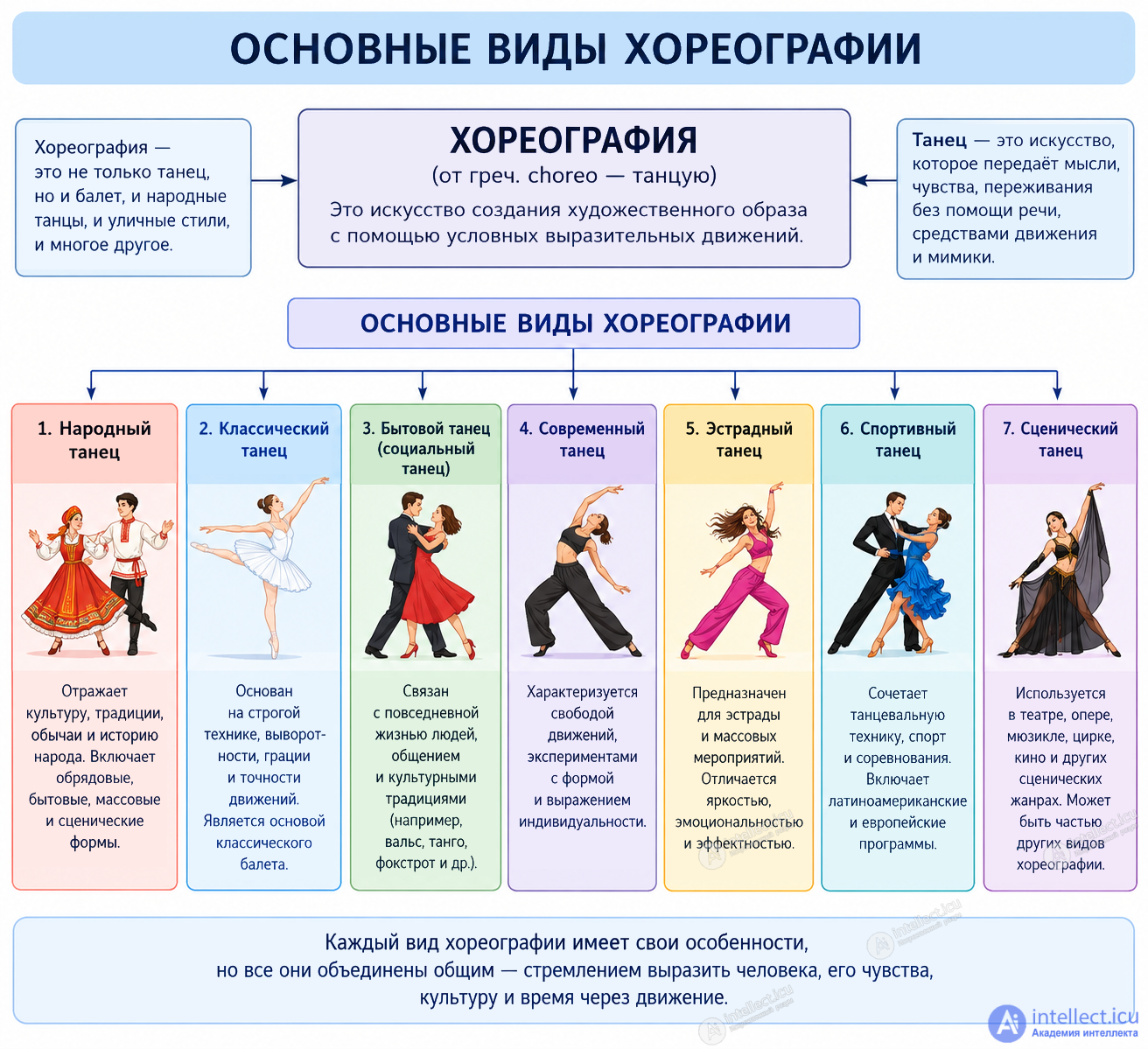
The concept of choreography (from the Greek choreo – I dance) encompasses various forms of dance art, in which an artistic image is created through conventional expressive movements. Many people believe that choreography means dance, or that choreography means ballet, but in the view of Rostislav Zakharov, the concept of «choreography» is much broader. It includes not only dances themselves – folk and everyday dances, classical ballet and street dance. The word «choreography» itself is of Greek origin and literally means «to write dance». Later, however, this word came to denote everything related to the art of dance. It is in this broader sense that most modern dance practitioners use the word today.
There are discrepancies and terminological inconsistency in defining the concept of «dance», both in the work of Russian researchers and in that of foreign scholars. According to E.A. Koroleva, the word for «dance» entered the Russian language in the seventeenth century (from the German tanz, itself borrowed from Polish, with the addition of the suffix -ets), while before that the Slavic word plyaska (folk dancing) had been used. In feudal Russia the concept of plyaska was broader than the concept of dance, since it embraced every variety of plyaska: ritual and non-ritual, professional and amateur, mass and group, paired and solo, as well as the plyaska of various social, professional and local community groups. Choreography is a distinctive form of creative activity, governed by the laws that shape the development of a society's culture.
Dance is an art, and every art must reflect life in a figurative, artistic form. The specific feature of choreography is that it conveys a person's thoughts, feelings and experiences without the help of speech, using movement and facial expression instead. Dance is also a means of a dancer's nonverbal self-expression, manifested as bodily movements organized rhythmically in space and time. Dance has existed, and continues to exist, in the cultural traditions of every human being and society. Over the long history of humankind it has changed, reflecting the development of culture.
Today choreographic art embraces both traditional folk dance and professional stage dance. Dance art is present, to one degree or another and in one form or another, in the culture of every ethnos and ethnic group. This is no accident but an objective phenomenon, for traditional folk choreography has always occupied a place of primary importance in the social life of society, both in the early stages of human development and today, when it performs one of the functions of culture, serves as one of the distinctive institutions for the socialization of people – children, adolescents and young people above all – and also fulfills a number of other functions inherent in culture as a whole.
Choreography was born at the dawn of humankind: even in primitive society there were dances depicting labor processes, reproducing the movements of animals, and dances of a magical or warlike character. Through them, people appealed to the forces of nature. Unable to explain these forces, they prayed to them, cast spells and offered them sacrifices, asking for a successful hunt, for rain, for sunshine, for the birth of a child, or for the death of an enemy. All of this, incidentally, can still be seen today – in the art of the peoples of Africa, for example. Descriptions of dances by travelers and folklorists tell us about the life, customs and morals of various peoples.
Dance is one of the oldest and most widespread of the arts. It reflects a people's social and aesthetic ideals, its history, its centuries of labor, its way of life, its morals, customs and character. In dance, a people creates the ideal image it strives toward and affirms it in an emotional, artistic form. The development of dance technique in the salons took a different direction from that taken among the common people: after all, ordinary folk danced on the village green or on the earthen floors of huts, while noble ladies and gentlemen glided across smooth floors, gracefully pointing their toes and curtseying smoothly and solemnly according to rules specially devised by court dancing masters.
As the social order and living conditions changed, so did the character and subject matter of art, including folk choreography. New themes, new images and a different manner of performance appeared in the dances of the peoples of our country after the Great October Socialist Revolution. There is a wealth of lyrical, heroic and comic plyaskas, slow and flowing or whirling and fiery ones, collective and solo, in which the image of our contemporaries is revealed vividly and convincingly. In the numerous folk dance ensembles, both professional and amateur, we see dances devoted to various themes and historical events in the life of the people. We encounter the professional art of dance in opera, musical comedy, variety shows, the circus, film, ice ballet, and sometimes in drama. Classical ballet is considered the most complex form of professional choreography. In our country choreographic art is dearly loved. Year after year the number of amateur dance companies grows, and the level of their skill continues to rise.
Today, choreographic art can be divided into several styles and types:
Folk dance is a vivid, colorful creation of the people, an emotional, artistic and distinctive reflection of its centuries-long and varied life. Folk dance is divided into folkloric folk dance, folk-stage dance, character dance, and everyday folk dance.
Folkloric folk dance is a spontaneous expression of feelings, mood and emotion; it is performed first of all for oneself, and only afterward for an audience (society, a group).
Folk-stage dance, understood as a whole, is folk dance together with the various ways of interpreting it within a stage space and according to the laws of theatrical action. Folk-stage dance can be defined as a historically developed, stable system of expressive means of choreographic art, representing the stage interpretation of the great variety of dances that have taken shape over several centuries among many peoples.
Character dance is dance performed in character. It is folk-stage dance within a ballet production. Character dance differs from folk dance in that it synthesizes the vocabulary of classical dance with elements of folk dance.
Everyday folk dance is a folkloric dance performed in its natural setting, with movements, rhythms, costumes and the like that are traditional for the given locality. The principal genres of folk dance are the khorovod (round dance) and the plyaska, which in turn are divided by type into ornamental and game dances, and, respectively, into solo, paired, group and pereplyas (competitive dance duel) forms, as well as mass plyaska. There are also later forms of plyaska – the waltz, the polka, and the kadril (quadrille). In content, folk dances may be ritual, military or hunting dances, or they may depict labor processes or images of nature.
Classical dance is the term for a special form of theatrical dance. Its movements and poses form an integral artistic system, subject to a particular aesthetic and to definite rules. Here the movements and poses are poetically meaningful and generalized into images. Classical dance affirms the idea of the perfect human being – one who commands their body freely, overcomes space and the force of gravity, and is capable of embodying the concept of a beautiful, harmonious, proportionate and purposeful world.
A dancer trained in the system of classical dance is, on the one hand, a performer meant to play a role, to be a character, and, on the other, an instrument capable of conveying, through the plasticity of the body, the harmonies of dance and of performing a particular part. This duality of classical dance is the foundation of its theatrical and musical nature, and the combination of the two gives it the inimitable charm of a special dramatic element.
The term «classical dance» arose late – only at the end of the nineteenth century – and displaced the earlier names: «noble, serious, academic» dance. Classical dance took shape over the last four centuries and became the principal expressive means of the ballet production. A powerful impetus for the development of this style of dance was given by the Romantic ballet of the nineteenth century. The classical (from the Latin for «exemplary», first-rate) is characterized by a strict simplicity of line, polished poses, swift jumps and turns, a wealth of plastic nuance, and poetic spirituality.
Everyday (social) dance includes several types of dance:
1. Historical dance is the dance of past centuries: the branle, the minuet, the contredanse, the waltz, the polka, the twist, the boogie-woogie and others. Historical dance appears in films and stage productions, and there are also many amateur dance companies in which historical dance is studied and preserved. They hold balls at which they exchange experience and information on the study of historical dance, while also enjoying these events immensely. Historical dance is also included in the curriculum of certain educational institutions, for example children's art schools, cadet corps, and Suvorov military schools.
2. Street dance is a type of social dance that came to our country from Europe and America. It includes such dance directions as hip-hop, breaking, krump, house, tecktonik and others. The active development of street dance at the present stage, and its mass popularity among young people, is due to the worldwide popularization of rap and r’n’b music and to the ease of mastering this style's basic movement vocabulary, which does not require the performer to have any special choreographic training.
3. Social dances today are very widespread among older people. They include various forms of dance fitness (aerobics, Zumba) as well as a variety of Latin American and European dances (tango, salsa, bachata, hustle and others). Contemporary dance is a dance style that has developed over a fairly recent period (the twentieth and twenty-first centuries). Contemporary dance includes jazz dance, modern dance, as well as other mixed and newer styles that have arisen relatively recently (jazz-modern, postmodern, neoclassical, contemporary and others). As is well known, modern dance is a movement in foreign choreography that originated in the late nineteenth and early twentieth centuries in the USA and Germany. Translated literally, modern dance means «contemporary dance». Today the term «modern», most widespread in America, is increasingly being replaced by the term contemporary. It is well known that the etymology of the words «jazz» and «jazz dance» combines two roots: as a noun, «jazz» is translated as «force, impulsiveness, ecstasy», and as a verb, as «to excite, to energize, to delight». The flowering of jazz dance in the USA, where this movement originated, occurred in the 1960s, together with the flowering of jazz music. Since this movement first arose, jazz dance has given rise to a great many different styles, schools and techniques. Famous jazz dancers such as Matt Mattox, Gus Giordano and Luigi founded their own schools of jazz dance, becoming the founders of this movement. As a result, terms such as «Matt Mattox technique», «Luigi jazz» and «Simmons jazz» came into use. It should be noted that contemporary jazz dance has changed considerably, absorbing elements of funk, modern dance and breakdance.
Contemporary variety-stage dance (estrada dance) is a dance direction that synthesizes the most diverse styles. It may contain elements of classical dance, folk dance, modern ballet, jazz dance, hip-hop and funk. Contemporary estrada is a form of stage art that includes diverse genres of vocal and instrumental music, choreography, theatre, circus and so on. An estrada dance performance consists of numbers – separate, self-contained performances by one or several companies or artists. Estrada traces its roots back to the performances of medieval strolling players and to booth-theatre shows. Another of its sources is considered to be the divertissement – additional, entertaining scenes that in the seventeenth and eighteenth centuries were inserted between the acts of a musical or dramatic production. These featured arias from operas, excerpts from ballets, and folk songs and dances. The main characteristics of estrada numbers are their easy adaptability to various conditions, and the brevity and concentration of their artistic and expressive means.
The genre varieties of estrada dance can be classified, tentatively, according to the technique used in them:
Estrada dance is characterized by the synthesis of the expressive means of choreography, direction, vocals, music, lighting, scenography, set design, costume and various technical effects. It is precisely this feature that gave rise to a new direction in estrada – the show. Sport dance includes competitive ballroom dance and belly dance.
Belly dance is the Western name for a dance technique widespread in the Middle East and the Arab countries. In Arabic it is known as Raqs Sharqi (Arabic: ي شرق ص رق – «oriental dance»), and in Turkish as Oryantal dansı, that is, «oriental dance». The distinctive feature of oriental belly dance lies in its plasticity.
There are more than 50 styles of oriental dance, and the following directions are also distinguished:
Certain forms of belly dance may make use of props: a cane, fire, swords, zills (small metal discs worn on the thumb and middle finger), a shawl (a large, rectangular scarf), wings, fans, small hand-drums, a candelabrum and even a snake. Until roughly 2001 the Arabic dance industry led an «underground existence». As it evolved and developed, Arabic dance in our country received official recognition. In 2001 belly dance became part of the structure of the All-Russian Dance Organization (ORTO), a belly-dance federation was formed, and it began holding annual competitions. In 2005 the League of Belly Dance Professionals split off from the federation, and a division arose between amateurs and professionals.
Competitive ballroom dance is a special form of choreographic art, governed by definite laws and rules, that took shape over the course of the twentieth century into a stable system. From a choreographic point of view, this discipline covers the study of ten dances: the samba, cha-cha-cha, rumba, jive and paso doble – the Latin American program – and the slow waltz, tango, Viennese waltz, slow foxtrot and quickstep – the European program. Competitions are held in sport dance. Several programs have taken shape: European, Latin American, the combined (ten-dance) event, European and Latin American Sequence (a three-minute show to original music), and European and Latin American Formation (competitions among ensembles of eight couples). Amateur world championships are held under the auspices of the WDSF (formerly the IDSF), while professional championships are held under the patronage of the World Dance Council. The most prestigious competitions in the world remain the English ones, in particular the UK Open and the Blackpool Dance Festival. Another direction in competitive dance is the Professional-Amateur (Pro-Am) mixed-couple competition, a direction especially well developed in the USA and Canada.
Stage dance is dance performed for an audience, from a specially equipped platform (a stage). Whereas social dances can be performed without an audience, for the dancers' own pleasure, and, as a rule, do not presuppose any pre-set choreography and may be performed to any music of a given character, stage dance pursues entirely different goals. Stage dance is characterized by a high level of technical execution, ample movement, a particular compositional structure (the audience is positioned on one side of the stage), and the presence of acrobatic, trick and maximally difficult elements. Examples include classical dance (ballet), folk-stage dance and character dance.
Dance theatre is a form of stage art whose principal expressive means are music, dance and dramaturgy, inseparably linked to one another. Ballet is the highest «theatrical» form of choreographic art, in which it rises to the level of a musical-stage presentation. The chief expressive means of ballet is the system of European classical dance. At the foundation of ballet's expressive means lies stage dance – one of the principal forms of choreographic art, intended for an audience and involving the creation of a choreographic image onstage. Ballet is most often based on some plot, dramatic conception or libretto, though plotless ballets also exist. In addition to classical ballet theatres, there are theatres of contemporary dance and theatres of folk dance, both amateur and professional. The foundation of a dance theatre's repertoire is the choreographic production.
Dance animation is the organization of leisure activities in hotels, at corporate events and at children's parties. It is carried out by a team of entertainers (animators). Animation in social-cultural services and tourism is a distinctive kind of service, one of the effective means of improving the quality of service, and at the same time a distinctive form of advertising for attracting repeat guests.
1. Define the concept of «choreography».
2. What is the specific nature of choreographic art?
3. List the main types and styles of choreography.
4. Define the concept of «folk dance».
5. What does the concept of «folk-stage dance» mean?
6. What does the concept of «character dance» mean?
7. List the genres and types of folk dance.
8. What does the term «classical dance» mean? When did it arise?
9. What types of dance does everyday (social) dance include?
10. Where can historical dance be encountered?
11. List the main types of street dance.
12. Define the concept of «contemporary dance».
13. Define the concept of «sport dance».
14. Name the dances of the European and Latin American programs of competitive ballroom dance.
15. What does the concept of «stage dance» mean?
16. What is dance theatre?
17. What is dance animation?
Sign in and the lectures you have studied will be marked in this list.
Choose a course
Comments