
Lecture 6 min.
Musical accompaniment is one of the most important components of the classical dance class. Music not only accompanies movement but also fosters a sense of rhythm, musicality, coordination, expressiveness and performing culture in the dancer. A well-chosen musical accompaniment helps the teacher organise the class, maintain the required working tempo, shape the students’ artistic taste and create a creative atmosphere.
Music in a classical dance class performs pedagogical, educational and artistic functions. The effectiveness of the training process depends to a great extent on the professionalism of the accompanist and on how well he or she works together with the teacher.
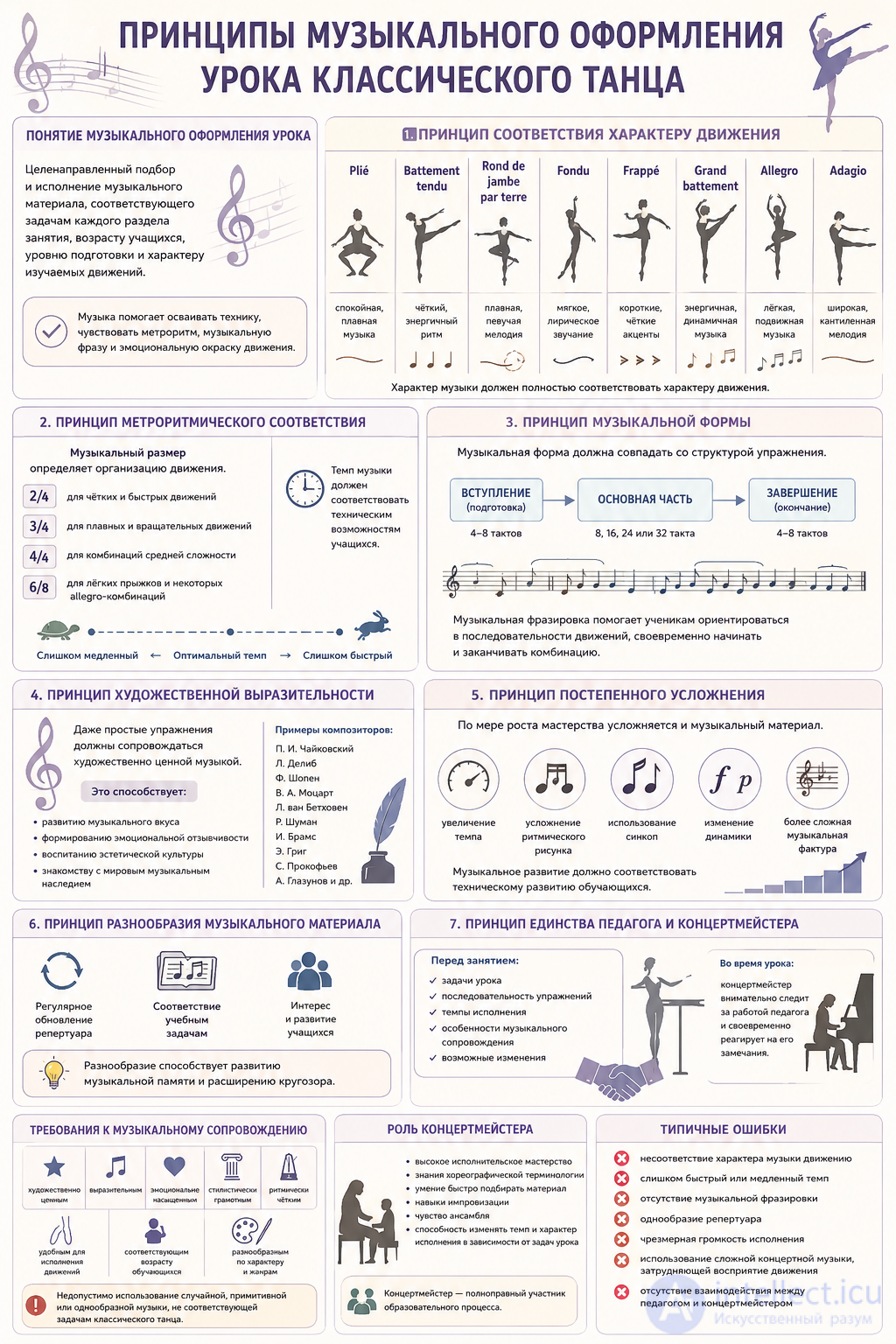
Musical accompaniment for a class is the purposeful selection and performance of musical material that matches the tasks of each section of the lesson, the age of the students, their level of training and the character of the movements being studied.
The musical accompaniment should not distract the students’ attention but should instead help them master technique and feel the metre and rhythm, the musical phrase and the emotional colouring of the movement.
Each exercise requires a particular character of musical accompaniment.
For example:
The character of the music must fully correspond to the character of the movement.
The time signature determines how the movement is organised.
The most commonly used are:
The tempo of the music must match the students’ technical abilities. A tempo that is too fast worsens the quality of execution, while one that is excessively slow lowers the working tone.
The musical form must coincide with the structure of the exercise.
Every exercise has:
Musical phrasing helps students find their bearings in the sequence of movements and begin and end the combination at the right moment.
Musical periods of 8, 16, 24 or 32 bars are the most common.
Even simple exercises should be accompanied by artistically valuable music.
The use of works by classical composers helps to:
Classes may make use of works by P. I. Tchaikovsky, L. Delibes, F. Chopin, W. A. Mozart, L. van Beethoven, R. Schumann, J. Brahms, E. Grieg, S. Prokofiev, A. Glazunov and other composers.
As the students’ performing skill grows, the musical material grows more complex as well.
This is expressed through:
Musical development must correspond to the students’ technical development.
Frequent repetition of the same melodies reduces the students’ interest.
The accompanist should therefore regularly renew the repertoire while keeping it suited to the teaching tasks.
Variety fosters the development of musical memory and broadens the students’ horizons.
A high-quality class is impossible without close cooperation between the teacher and the accompanist.
Before the class, they determine:
During the class the accompanist watches the teacher’s work closely and responds promptly to his or her remarks.
Musical accompaniment should be:
The use of random, primitive or monotonous music that does not correspond to the tasks of classical dance is unacceptable.
The accompanist is a full-fledged participant in the educational process.
He or she must possess:
A professional accompanist helps create a creative atmosphere, fosters the development of the students’ musicality and makes the class more emotional and productive.
The most widespread mistakes are:
Avoiding these mistakes considerably improves the quality of the training process.
The musical accompaniment of a classical dance class is an important pedagogical tool that ensures the successful mastery of dance technique and the development of the students’ musicality and artistic culture. It is built on the principles of matching the character of the movement, metre-rhythm precision, a logical musical form, artistic expressiveness, gradual complication, variety of repertoire, and close interaction between the teacher and the accompanist. A well-organised musical accompaniment makes the class more effective and emotionally rich, and helps shape the harmoniously developed personality of the future ballet artist or choreography teacher.
Sign in and the lectures you have studied will be marked in this list.
Choose a course
Comments