
Lecture 6 min.
Classical dance is the foundation of professional choreographic education and one of the greatest achievements of world culture. For several centuries it has retained its artistic value despite constant changes in society, art, and technology. The modern era demands of choreographers and performers not only a high level of command of academic technique but also the ability to adapt classical dance to new artistic conditions. This is precisely why innovation is becoming an essential part of the development of classical choreography.
Innovation in classical dance does not mean abandoning tradition. On the contrary, it makes it possible to preserve the academic foundation while expanding the expressive possibilities of dance, improving teaching methods, and creating new forms of stage art.
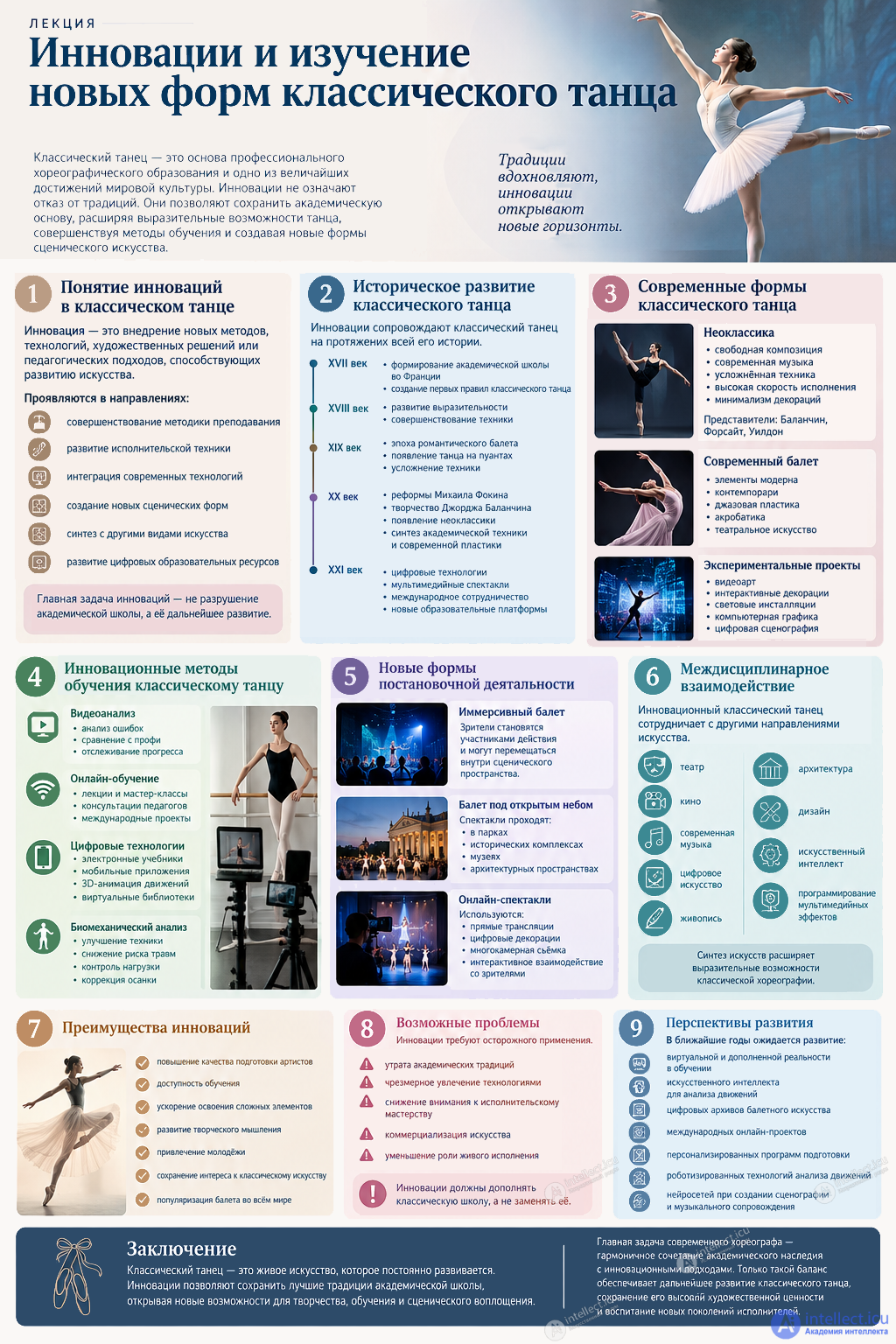
Innovation is the introduction of new methods, technologies, artistic solutions, or pedagogical approaches that contribute to the development of art.
In the field of classical dance, innovation manifests itself in several areas:
The main purpose of innovation lies not in destroying the academic school but in its further development.
The history of classical ballet shows that the art has always developed thanks to innovative ideas.
The main stages of development:
17th century
18th century
19th century
20th century
21st century
Thus, innovation has accompanied classical dance throughout its entire history.
Today, classical dance exists not only in its traditional academic form.
The most common contemporary forms are:
Neoclassical ballet retains academic technique but frees itself from strict narrative constraints.
Features:
Its outstanding representatives include George Balanchine, William Forsythe, and Christopher Wheeldon.
Contemporary productions make use of:
At the same time, academic technique remains the foundation of performing skill.
Contemporary choreographers actively make use of:
Such projects make ballet more accessible and interesting for contemporary audiences.
Modern education is impossible to imagine without the use of new technologies.
The most effective methods are:
The use of video recording makes it possible to:
Modern platforms make it possible to:
The learning process makes use of:
The use of modern technology helps to:
Contemporary ballet masters actively experiment with the form of a production.
The most common directions are:
Spectators become participants in the action and can move around within the performance space.
Performances take place:
These make use of:
Innovative classical dance actively collaborates with other art forms.
This collaboration includes:
Such a synthesis expands the expressive possibilities of classical choreography.
The use of modern technology makes it possible to:
Despite their many advantages, innovations require careful application.
The main risks are:
Innovation should therefore complement the classical school rather than replace it.
In the coming years, further development is expected in the following areas:
However, the key factor in success will remain the professionalism of the teacher, the talent of the performer, and respect for the traditions of academic art.
Classical dance is a living art that is constantly evolving. Innovation makes it possible to preserve the best traditions of the academic school while opening up new possibilities for creativity, education, and stage realisation. Modern technology, new pedagogical methods, and interdisciplinary projects are making classical ballet more accessible, expressive, and in demand in the 21st century.
The main task of the contemporary choreographer is to harmoniously combine the academic heritage with innovative approaches. Only such a balance ensures the further development of classical dance, the preservation of its high artistic value, and the training of new generations of professional performers.
Sign in and the lectures you have studied will be marked in this list.
Choose a course
Comments