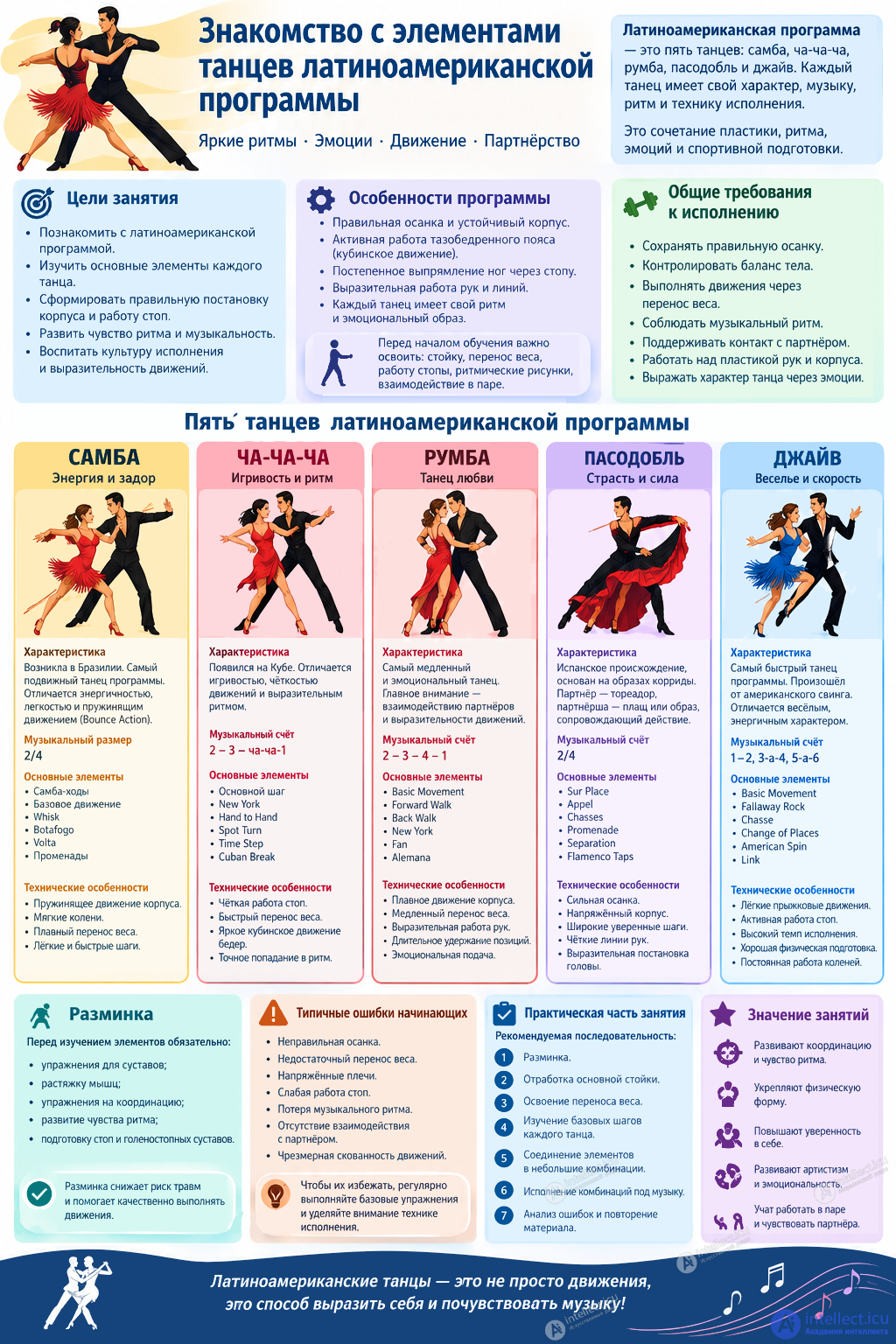
The Latin American programme of sport ballroom dance is a vivid combination of music, plasticity of movement, rhythm and emotional expression. It comprises five dances: the samba, the cha-cha-cha, the rumba, the paso doble and the jive. Each of them has its own history, character, time signature and technique of performance.
Studying the elements of the Latin American programme develops coordination of movement, a sense of rhythm, physical fitness, artistry and the ability to interact with a partner. The foundation of successful learning is mastering the basic technique of each dance and understanding its character.
Aims of the Lesson
- to introduce students to the Latin American programme of sport ballroom dance;
- to study the basic elements of each dance;
- to develop the correct posture of the body and the work of the feet;
- to develop a sense of rhythm and musicality;
- to cultivate a culture of performance and expressiveness of movement.
Features of the Latin American Programme
All the dances of the Latin American programme share the following technical features:
- movement begins from correct posture;
- the body maintains stability and balance;
- the hip area works actively (Cuban motion);
- the legs straighten gradually through the foot;
- close attention is paid to the work of the arms and the expressiveness of the lines;
- each dance has its own rhythm and emotional image.
Before studying the dances themselves, one must master:
- the basic stance;
- the transfer of body weight;
- the work of the foot;
- the basic rhythmic patterns;
- interaction with a partner.
1. Samba
Characteristics
The samba arose in Brazil and is the most mobile dance of the Latin American programme. It is distinguished by its energy, lightness and characteristic springing movement — Bounce Action.
Basic Elements
- Samba Walks;
- Basic Movement;
- Whisk;
- Botafogo;
- Volta;
- Promenades.
Technical Features
- continuous springing movement of the body;
- soft work of the knees;
- the transfer of weight is performed smoothly;
- the steps are performed lightly and quickly.
2. Cha-cha-cha
Characteristics
The cha-cha-cha originated in Cuba. The dance is distinguished by its playfulness, the precision of its movements and its expressive rhythm.
Musical count:
2 – 3 – cha-cha-1
Basic Elements
- Basic Step;
- New York;
- Hand to Hand;
- Spot Turn;
- Time Step;
- Cuban Break.
Technical Features
- precise work of the feet;
- a quick transfer of weight;
- vivid Cuban hip motion;
- precise alignment with the musical rhythm.
3. Rumba
Characteristics
The rumba is considered the slowest and most emotional dance of the programme. It is known as the dance of love, since the main attention is given to the interaction between the partners and the expressiveness of the movements.
Musical count:
2 – 3 – 4 – 1
Basic Elements
- Basic Movement;
- Forward Walk;
- Back Walk;
- New York;
- Fan;
- Alemana.
Technical Features
- smooth movement of the body;
- a slow transfer of weight;
- expressive work of the arms;
- a prolonged holding of positions;
- emotional delivery.
4. Paso Doble
Characteristics
The paso doble is of Spanish origin and is based on the imagery of the bullfight. The man symbolises the toreador, while the woman represents the cape or an image accompanying the action.
Basic Elements
- Sur Place;
- Appel;
- Chasses;
- Promenade;
- Separation;
- Flamenco Taps.
Technical Features
- strong posture;
- a taut body;
- broad, confident steps;
- clear lines of the arms;
- an expressive carriage of the head.
5. Jive
Characteristics
The jive — is the fastest dance of the programme. It derives from American swing and is distinguished by its cheerful, energetic character.
Musical count:
1–2, 3-a-4, 5-a-6
Basic Elements
- Basic Movement;
- Fallaway Rock;
- Chasse;
- Change of Places;
- American Spin;
- Link.
Technical Features
- light, hopping movements;
- active work of the feet;
- a fast tempo of performance;
- good physical conditioning;
- continuous work of the knees.
General Requirements for Performance
In all the dances, the following rules must be observed:
- maintain correct posture;
- control the body's balance;
- perform the movements through the transfer of weight;
- keep to the musical rhythm;
- maintain contact with one's partner;
- work on the plasticity of the arms and body;
- express the character of the dance through emotion.
The Importance of the Warm-up
Before studying the elements, a warm-up is essential, and should include:
- exercises for the joints;
- stretching of the muscles;
- coordination exercises;
- the development of a sense of rhythm;
- preparation of the feet and ankle joints.
The warm-up reduces the risk of injury and helps in performing the dance movements with quality.
Common Mistakes Made by Beginners
At the initial stage of learning, the following mistakes occur most often:
- incorrect posture;
- an insufficient transfer of weight;
- tense shoulders;
- weak work of the feet;
- loss of the musical rhythm;
- a lack of interaction with one's partner;
- excessive stiffness of movement.
To correct these, one must regularly perform the basic exercises and pay attention to the technique of performance.
The Practical Section of the Lesson
During the practical work, it is recommended that the exercises be performed in the following sequence:
- Warm-up.
- Practising the basic stance.
- Mastering the transfer of weight.
- Studying the basic steps of each dance.
- Combining the elements into short combinations.
- Performing the combinations to music.
- Analysing mistakes and repeating the material.
Conclusion
The Latin American programme of sport ballroom dance combines sporting conditioning, musicality and acting skill. Each dance has a unique character, which is revealed through the technique of its movements, its rhythm and its emotional expressiveness.
Mastering the basic elements is the foundation for further learning. Gradual improvement of technique, regular training and attention to musicality enable dancers to perform compositions with confidence and to reveal the artistic image of each dance.
Review Questions
- Which dances make up the Latin American programme of sport ballroom dance?
- How does the samba differ from the cha-cha-cha?
- Why is the rumba called the dance of love?
- What technical features are characteristic of the paso doble?
- What are the basic elements studied in the jive?
- What is the transfer of weight, and why is it important?
- What is the role of the warm-up before a lesson?
- What mistakes do beginner dancers most often make?
- Why is it important to keep to the musical rhythm?
- What qualities do lessons in Latin American dance develop?


Comments