
Lecture 26 min.
Choreographic compositions that have no clearly expressed plot are called plotless. The absence of a plot does not mean an absence of content, or a refusal to reflect the surrounding world. The use of the expressive resources of the human body, an emotional richness, and, in many cases, the nature of the staging, distinguish plotless dance, for example, from abstract painting as a non-objective art that fundamentally rejects representation. Relying on the music, the choreographer shapes an emotionally meaningful dance dramaturgy. In plotless dances there is no storyline, no concrete action, but there is an image — of a people, a season, a plant, an animal, an emotional state. For example, the image of a symbol of Russian nature — the birch tree — in N. Nadezhdina's production «Beryozka» (The Little Birch). The boldness and youthful spirit of Russian young men and women in the plyaska «Polyanka» (The Little Meadow), the hot, playful, sunny «Summer» in the choreographic works of I. Moiseyev. Russian folklore, reflecting character, thoughts, feelings, aesthetic views and an understanding of the beauty of the surrounding world in the creative canvases of T. Ustinova, O. Knyazeva, M. Godenko, P. Virsky and other choreographers, is also often expressed in plotless compositions («Blizzard», «Spring Khorovod» (round dance), «Melody», «The Great Cossack Plyas», «Mood», and others).
In the 1970s, in contemporary dance art, such trends as jazz dance, modern dance and jazz-modern declared themselves in full voice. The choreographers Jerome Robbins, Alvin Ailey and Alberto Alonso synthesized, in their ballets, the technique of jazz dance with ethnic, folk and classical dance. Through choreography they conveyed the thoughts and feelings of their characters, their inner states, as well as images of literary characters, national mentality, and so on.
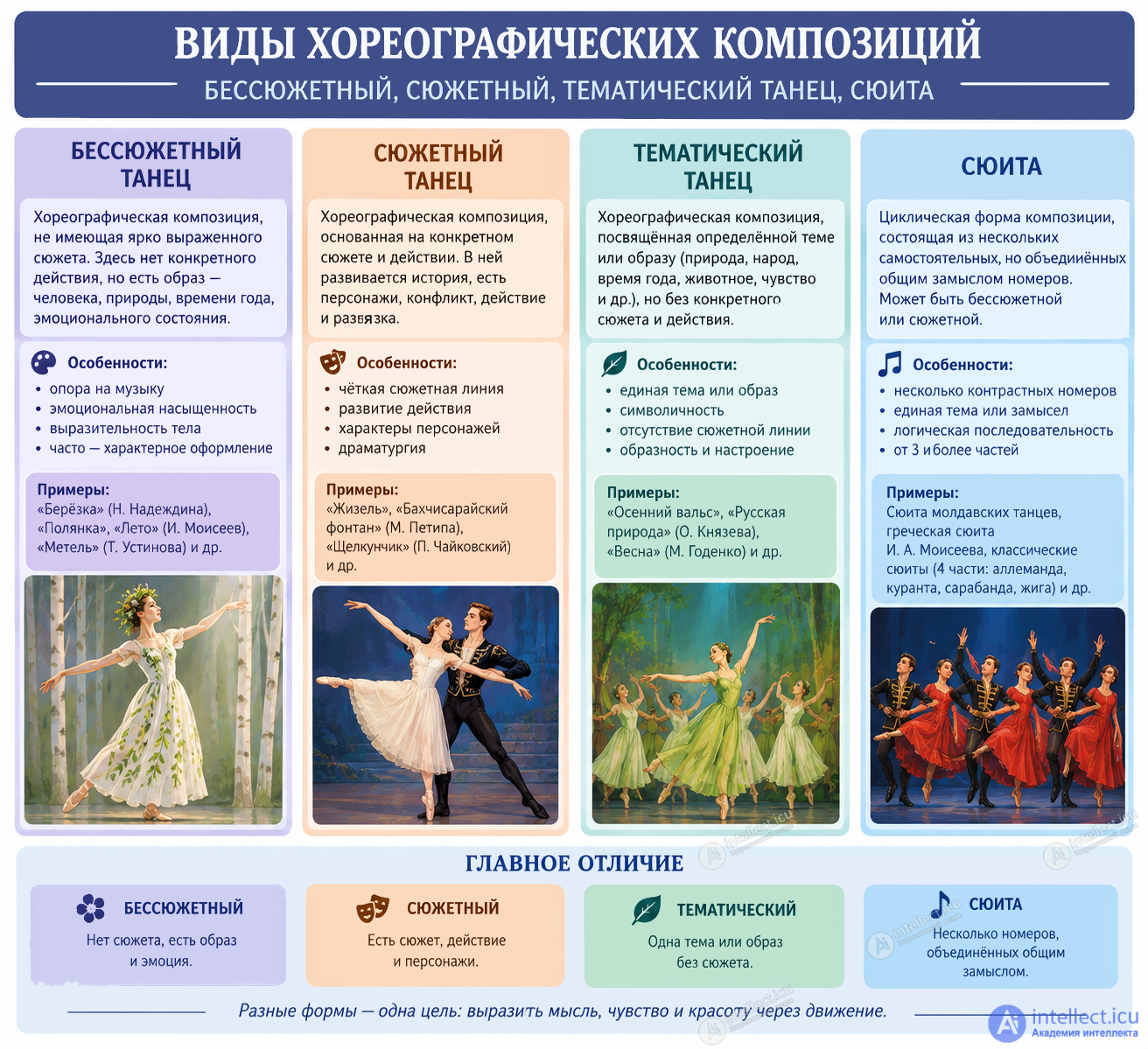
Thus the principal types of plotless choreographic compositions can be distinguished: the divertissement, the «white ballet», the lyrical picture, the suite, and the concert choreographic composition. The divertissement (from the French divertissement – «amusement», «entertainment», and the Italian divertimento) is the name given to:
- a series of concert numbers making up a special – entertaining – programme, given in addition to some principal performance or concert;
- a small ballet performance made up of separate numbers, or an inserted number in a ballet or opera not directly connected with the plot;
- musical compositions made up of several short, easily arranged pieces for one or several instruments.
The divertissement can include vocal numbers, dances, comic sketches, parodies and other numbers of an entertaining character. The divertissement became significantly widespread in Russian ballet during the period of the Patriotic War of 1812, turning into a special kind of ballet performance on patriotic and folk themes. In the 1870s the divertissement became an independent concert programme of variety theatres and fairground booths.
The «White Ballet». The ideas of Romanticism spread through every kind of art and across the whole world. Ballet Romanticism achieved great success in France, where the technique of dance, especially women's dance, was highly developed. The first Romantic choreographer was Filippo Taglioni, who staged the ballets «La Sylphide» (1832) and «The Maid of the Danube» (1838), with his daughter Marie Taglioni in the leading role. The choreographers of Romanticism also included Jean Coralli, Jules Perrot and Arthur Saint-Léon. The heroines of these ballets became sylphs and the wilis, forest spirits, figures from Celtic and Germanic folklore. The image of the dancer in a white tunic, embodying an otherworldly being with a little wreath on her head and small wings on her back, was devised by the French costume designers I. Lecomte, E. Lami and P. Lormier. Later the term «white», or «white-tutu», ballet arose. White is the colour of the absolute; the «white ballet» expressed a Romantic yearning for the ideal, and the ballerina in an arabesque became its graphic formula. Gennady Yanin spoke in more detail about the «white ballet» in the programme «The Absolute Ear on the White Ballet». The lyrical picture is a form of plotless choreographic production based on the author's creation of a poetic image. This can take various forms of dance: the miniature, the lyrical khorovod plyaska, the ornamental khorovod («The Swan» by Fokine, «The Snowdrop» by Godenko).
The suite (from the French Suite – «series», «sequence», «alternation») is one of the principal varieties of cyclical form in instrumental music; it consists of several large, independent, usually contrasting parts united by a common artistic conception. The suite arose as a musical form in the 14th-15th centuries. As a dance form it became widespread at the end of the 16th century, in everyday ballroom choreography. The dances alternated on the principle of contrast. Each successive dance was more complex than the one before it in rhythm, dynamics and vocabulary. A choreographic suite consists of several complete choreographic works united by a common theme – three or more numbers (3, 5 or 7 numbers). A suite may be built on musical material specially written in the form of a suite, or the music may be chosen separately for each number. Each musical excerpt must combine well with the others. A suite is more often plotless, but the dances within a suite can also be united by a common storyline (a suite of Moldavian dances, I. A. Moiseyev's Greek suite).
The classical type of the old 16th-century suite consisted of four parts.
1. Moderately slow (Allemande, 3/4)
2. Fast or moderate (Courante, 3/4)
3. Very slow (Sarabande, 4/4)
4. Fast, headlong (Gigue, 2/4)
17th century: in ballroom choreography the suite developed and was refined. Divertissement (plotless) numbers in ballet were built on its principle.
18th century: the suite was forgotten and ceased to develop.
19th century: a vigorous development of the suite, both in music and in choreography. It was built on the basis of classical dance («Carnaval», music by Schumann; the folk dances in the ballet «Swan Lake»).
20th century: with the emergence of folk dance ensembles, the suite began to be built:
- on the dances of different peoples,
- on the dances of a single people (a Russian suite).
The distinguishing features of the suite are contrast and programmaticism.
Moreover, the contrast intensifies toward the end of the suite. Within the programme, the suite unites all the numbers under one theme, one conception. A choreographic suite has a theme and an idea. The dramaturgy of the suite is built as follows:
- exposition – the first number,
- inciting incident – the first number,
- rising action – the second number,
- climax – the second number,
- resolution – the third number.
Each number of a suite must be complete in content and form, and can subsequently be performed as a separate concert number. The number of parts is three or more, for example the suite «Friendship of the Peoples». In duration a suite runs from nine minutes upward. A suite can be built on the basis of any single choreographic genre. If it does not contradict the content, several genres can be performed within one suite (for example, a fantastical plot, where the action is transferred from one time to another).
In a plotless dance, the connecting thread that replaces action can be a single movement running through the dance, or a compositional device, or a floor pattern that recurs from time to time (a leitmotif, a guiding motif). Plotless dramaturgy is determined by the development of the form of the choreographic composition (an ornamental khorovod – through its pattern; a plyaska – through its vocabulary of movement, from simple to complex).
The exposition is the entrance of the performers, the characterization of the dramatis personae, the time and place of the action; it establishes the character of the action and the emotional mood (a lyrical khorovod, a whirling plyaska).
The inciting incident is the beginning of the development of the image's content, the beginning of the development of the form. The development of the action is worked out through the development of increasingly complex vocabulary, pattern, more intricate devices, and musical dramaturgy. The climax: taking into account the proportion of parts in a number that has no connected plot, the climax can be expressed through a cascade of technically complex movements and combinations, or through the most interesting dance pattern, the greatest dynamism of movement, the highest emotional intensity of performance, or other choreographic devices. When the performers remain on stage at the end of the dance, this is a coincidence of the climax and the resolution. The climax can also be built by means of a musical or choreographic pause – the «freeze-frame» device. This means that the dynamics of the dance stop, and the performer freezes for a time in a particular pose. The choreographer constructs the mise-en-scène in order to sharpen an important idea characteristic of this composition, or for some other purpose. The climax can be built emotionally through the musical material, but it is always the peak in the development of the image.
The resolution is the outcome, the conclusion. In a plotless choreographic work the resolution can coincide with the climax, or can take the form of the performers' exit. The devices «freeze-frame» and «looping» can be used here. In this part the choreographer's conception becomes maximally clear to the spectator.
The plot (sujet, from the French sujet – theme, subject) is the course of events, the development of the action in a dance. The plot is the most important aspect of the content of a choreographic work, revealing its theme and its ideological meaning. Ideological and thematic content is embodied in the movement of the events of the plot, connected with a particular life situation, with the twists and turns of the action and the resolution of the dramatic conflict. In the plot, the clash of the forces of the through-action and counter-action is realized, and the characters and images of the choreographic work are revealed. The plot is the backbone of a choreographic work.
Together with the plot, all the diversity of real life, of life's events and people's actions, comes into choreography – a stimulus for those feelings and ideas that are embodied in extended dance compositions and give rise to new choreography.
The features of narrative dance:
- the presence of concrete dramatis personae,
- the presence of a conflict and its resolution,
- a chain of concrete, sequential actions,
- the moral transformation of the main hero.
In addition, narrative dance is characterized by:
-the logic of actions,
-unexpected turns of events,
-intrigue,
- an unexpected ending.
E. V. Gurvich, a teacher and well-known choreographer-director, a specialist in children's dance, insists that children's dance (up to age 10), regardless of the type of choreography in which it is staged, must necessarily be narrative. Narrative dance is no less relevant for teenagers either. It must be understood that each age has its own particular range of characters, conflicts and events.
E. V. Gurvich identifies seven types of plot for staging choreographic compositions:
1. «Overcoming the Monster» (the theme of the struggle between good and evil)
2. «Rags to Riches» (the so-called Cinderella stories)
3. «Rebirth» (in the course of the plot's development a negative character is transformed into a positive one)
4. «The Journey» (the characters may travel through time, in a dream, through fairy tales, and so on)
5. «Adventure» (this type resembles the journey but is broader; here there must necessarily be the overcoming of some obstacles, a quest, for example the story of Kolobok, a Russian fairy-tale gingerbread-man character)
6. Comedy
7. Tragedy.
As a rule, a conflict lies at the heart of narrative dance, and so the arrangement and interconnection of events in the plot are determined by the development of the conflict.
Conflict is a clash of opposing views and interests, a serious disagreement, a sharp dispute, a struggle between the dramatis personae, a clash of human actions. It is impossible without action and counter-action; it must be exciting and credible, not false, and must be the driving force in the development of the action.
A situation is a confluence of circumstances that force a person to make a decision and act. In the dramaturgy of a choreographic number, a situation is used to reveal the image of the hero and the dramatis personae, their characters and principal traits. The dominant, or central, situation is the climactic situation. Secondary situations are arranged according to their significance in the development of the action.
The dramatis personae in a narrative dance are the hero, the character, and the type. The hero is the person who drives the development of the storyline; without a hero there can be no plot. In the course of the number the hero must change qualitatively; he passes through stages in the development of his character.
A character is a secondary dramatis persona who enters into relationships with the main hero, helps to reveal his character, and helps the action to develop. The image and character of this figure must also be in a state of development. The character, like the hero, is a necessary component of the plot.
A type is a secondary dramatis persona, an image that combines vivid, typical traits; it does not influence the development of the plot but only gives additional colour to the main heroes and characters, setting them off by contrast. If the type is removed, the plot is not distorted.
Conflict arises when the dramatis personae, in pursuit of their goal (love, power, an ideal), oppose other dramatis personae, or come up against a psychological, moral or fatal obstacle. The outcome of a conflict can be comic, reconciliatory, or tragic, when neither side can make concessions without suffering harm. An approximate theoretical model of all conceivable dramatic situations that determine the character of the stage action could be defined as follows:
– rivalry between two characters for economic, romantic, moral, political or other reasons;
– a conflict between two world-views, two irreconcilable moralities;
– a moral struggle between the subjective and the objective, between attachment and duty, between passion and reason: this dilemma may arise within the soul of a single hero, or between two «camps» that try to win the hero over to their side;
– a conflict between the interests of the individual and of society;
– a moral or metaphysical struggle of a person against some principle or desire that exceeds his capacities (God, the absurd, an ideal, overcoming oneself, and so on).
Thus, the following types of conflict can be distinguished:
- the hero against society,
- the hero against the elements,
- the hero against himself.
The presence of dramatic development is an indispensable condition necessary for staging a narrative dance. For example, in cinema 14 types of dramatic composition are distinguished (three-act, two-act, real time, novellistic, inverted – reversed, rondo, and others). Knowledge of these features will help the choreographer-director compose original narrative productions. Using numbers with a clearly expressed plot as examples, one can clearly see the laws of dramaturgy being observed.
The exposition is the most static part of the plot. Its purpose is to present certain characters and the setting of the action. The main plot action has not yet begun in the exposition. The exposition only motivates the actions that will take place afterward, as it were shedding light on them beforehand. One should not expect to be introduced to all the heroes in the exposition. Secondary figures may be presented in it. Sometimes it is precisely the appearance of the main dramatis persona that concludes the exposition and constitutes the inciting incident of the action (for example, the appearance of the characters).
The inciting incident of the action is an event, or a series of events, that gives impetus to the main action. It is precisely in the inciting incident that the position of the characters changes sharply, and contradictions may arise between them. Quite ordinary situations often become the inciting incident: an acquaintance, a meeting between characters, and so on. It is important to correctly determine the moment at which the main plot action begins. To do this one must find a precise answer to the questions: what throws the established system of relationships between the dramatis personae off balance, what changes a character's life, what is the cause of all the subsequent events? For it is precisely the nature of the inciting incident that often predetermines the features of the plot's further movement. A clash between the heroes immediately establishes the conflicting relations between them, which will evidently be embodied in the plot.
The rising action is the most extended part of the plot. It is in the rising action that the conflict is realized. If the plot is based on conflicting relationships, then in the rising action the tension between the conflicting sides increases. In order to correctly determine the boundaries of the rising action, one must precisely establish the inciting incident and the moment at which the action reaches its highest tension.
The climax is the highest point in the development of the action, at which the conflict reaches its greatest sharpness and tension. After the climax the action inevitably subsides, since the conflict turns out to be exhausted. The climax is a turning point in the relations between the opposing sides. As a rule, after the climax, changes in the conflicting sides become inevitable. The resolution of the action is the concluding part of the plot, following the climax. In the resolution it usually becomes clear how the relations between the opposing sides have changed, and what consequences the conflict has had. It is evident that the finale of the production, the resolution, is an important element in the composition of a narrative dance.
The following types of endings exist:
- a closed ending: the conflict action is exhausted, it has ended in the complete victory (or defeat) of one of the sides,
- an open ending: the conflict action is not exhausted, it may, and most likely will, have a continuation,
- an ambivalent (sudden) ending: such an ending overturns the spectator's perception, and it is the most interesting.
In her master classes and seminars on developing narrative dance, E. V. Gurvich gives the following recommendations for quality work by the choreographer in this area:
- to begin with, one must invent interesting, provocative characters for the production (give them a detailed description, determine their wants and needs),
- one must carefully think through the hero's world (the place and time of the action, his surroundings),
- use the following structure for composing a plot:
1 – Once upon a time…
2 – every day…
3 – until one day…
4 – because of that…
5 – because of that…
6 – because of that…
7 – and so, finally…
8 – and ever since then…
9 – the moral of this story…
- one must come up with an interesting, intriguing title for the production,
- ideas for narrative dance, as well as interesting titles, can be found in literature, folk art (proverbs, sayings, riddles), and cartoons (for children under 8 – «Luntik», for children 8-10 – «Smeshariki», for ages 10-12 – «Yeralash»).
The foundation of a thematic choreographic number is a particular theme: the depiction of a life phenomenon or event, an understanding of love, hatred, motherhood, heroism, and so on. The director must learn to see the problem within the chosen theme, to pose the question that will become the theme of the future work. A theme contains many facets at its core (war – the Motherland; love – betrayal). The director needs to choose only that facet which is relevant to our time, and to determine his own attitude to the given problem. Returning to the theme of heroism, it should be said that it concerns choreographers and is relevant to any era.
A theme must be objective, its origins real (war, religion, freedom, labour, and so on). A number may lack a concrete plot, yet it can still express an eternal theme (happiness, childhood, and other such themes).
As a form, thematic dance arose during the Soviet period of the history of choreographic art. It can exist on folk material, on the basis of classical dance, demi-classical dance, free plasticity, or a synthesis of two genres, using devices of stylization. Thematic dance can be narrative or plotless, on a mass scale or in small forms, and worked out in a lyrical, tragic or heroic genre.
The sources for the conception of a thematic dance can include:
- some socially significant life phenomenon, a topical theme of the present day, a life event that can show a phenomenon typical of contemporary life,
- historical plots,
- events rich in extreme situations, in which people display the best traits of character, for example steadfastness, heroism, noble feelings, civic feelings,
- works of visual art, literature, documentary material, human characters.
Events should be shown in development, not narrated but revealed through the pivotal moments of the action, in which the content could be most vividly disclosed. The language of choreography must convey its ideological content to the spectator.
An entire, complete musical work can serve as the musical material for a thematic dance. The ideological and emotional content of the music and of the choreography must necessarily coincide.
Principles for constructing a plotless thematic dance.
- One or two artistic images.
- The dramaturgy is built on the principle of plotless dance, i.e. there is no plot, and the theme is expressed through the ideological and emotional side of the content. The conflict can be internal, if the thematic dance is built on a single image, or it can occur between two generalized images (of good and evil).
- The search for content can proceed in the following directions:
a) the concentration of lofty ideas and convictions,
b) the revelation of a person's character and emotional state.
Generalization in such works occurs through the revelation of the essential, characteristic traits of the image.
- An inherent property of thematic choreography is a tendency – an idea, a meaning, imposed upon some hero. The director directly and openly states his own positions, views and convictions about what he is promoting through his work.
Principles for constructing narrative thematic dance.
- It represents one of the most difficult forms of stage art. The difficulty lies not only in reflecting important, essential themes, but also in the need to reveal and develop the characters, feelings, actions and relationships of the dramatis personae within these themes.
- The composition of a narrative thematic dance represents a system of images, their interconnection, their relationships, which together create the image of the dance as a whole.
- Narrative thematic dance does not always bear a tendentious character.
The director leaves it to the spectator to judge the problems
raised in the choreographic work. However, through his
resolution of the images he provokes his own attitude toward the events, tactfully
leading the spectator to a particular conclusion, that is, to a decoding of the idea of the number.
The vocabulary of a thematic (narrative or plotless) dance must
correspond to the musical image that has been born from it. The director's main task
is the creation of an imagistic vocabulary.
The most interesting choreographic solution should be concentrated in the climax – in the vocabulary, the dynamics, the highest intensity of emotion.
A thematic dance with a large number of performers is most often oriented toward the auditorium. This makes it possible to significantly strengthen the emotional impact of the production in a narrative thematic dance, since there are dramatis personae and the floor pattern is varied; but it should be remembered that the pattern of the mass serves as a backdrop for the main dramatis persona or image.
Any spectacle is perceived as a whole; one should not forget about the lighting design, which can serve as an important device of the production, and attention should be paid to costume, detail and make-up. The decorative design of a thematic dance must also be distinctive.
- Costume can serve as a means of achieving unity; the colour relationship of the costume to the artistic images of the whole composition, and to the individual heroes, must correspond to one another.
- The set and lighting must correspond to the setting and atmosphere of the dance.
- Sound design (air-raid sirens, gunshot sounds, radio texts, and so on) is possible in a thematic dance, but it must be artistic and used logically within the production.
- The use of film material (various video sequences, newsreel footage, and so on) must correspond, in its subject matter, purpose and ideological content, to the choreographic work; it should not distract from but supplement the thematic dance.
A theme acquires subjective significance when it expresses a system of feelings and problems characteristic of the particular choreographer. The situation is revealed through form, content, and the director's particular feelings.
1. Define the concept of «plotless choreographic composition»
2. What lies at the basis of the conception of a plotless choreographic composition
3. Give examples of plotless choreographic compositions realized by means of folk dance
4. List the main types of plotless choreographic compositions
5. What is a divertissement
6. Define the concept of «white ballet»
7. Give an example of a «white ballet»
8. The lyrical picture (examples)
9. The suite
10. The features of the choreographic suite
11. Give examples of the choreographic suite
12. What expressive device can serve, in a plotless dance, as the connecting thread that replaces action
13. How is the climax resolved in a plotless dance
14. Define the concept of «plot»
15. Define the concept of «conflict»
16. Define the concept of «situation» in narrative dance
17. The hero. The character. The type.
18. What can the outcome of a conflict be in narrative dance
19. Give examples of possible conflicts
20. The features of the exposition of narrative dance
21. The features of the inciting incident of narrative dance
22. The features of the rising action of narrative dance
23. The climax in a narrative choreographic work
24. What is meant by a thematic choreographic production
Sign in and the lectures you have studied will be marked in this list.
Choose a course
Comments