
Working on the Artistry, Expressiveness and Musicality of Classical Dance Performance in Choreography

Lecture 7 min.


Classical dance is the foundation of professional training for both choreographer and performer. It is not only a system of precisely calibrated movements but also the art of conveying an artistic image through the plasticity of the human body. A modern performer must possess not only technical skill but also well-developed musicality, emotional expressiveness and acting mastery.

Work on the artistry, expressiveness and musicality of performance occupies an important place in the process of teaching classical dance. It is these qualities that turn technically correct execution into genuine stage art.
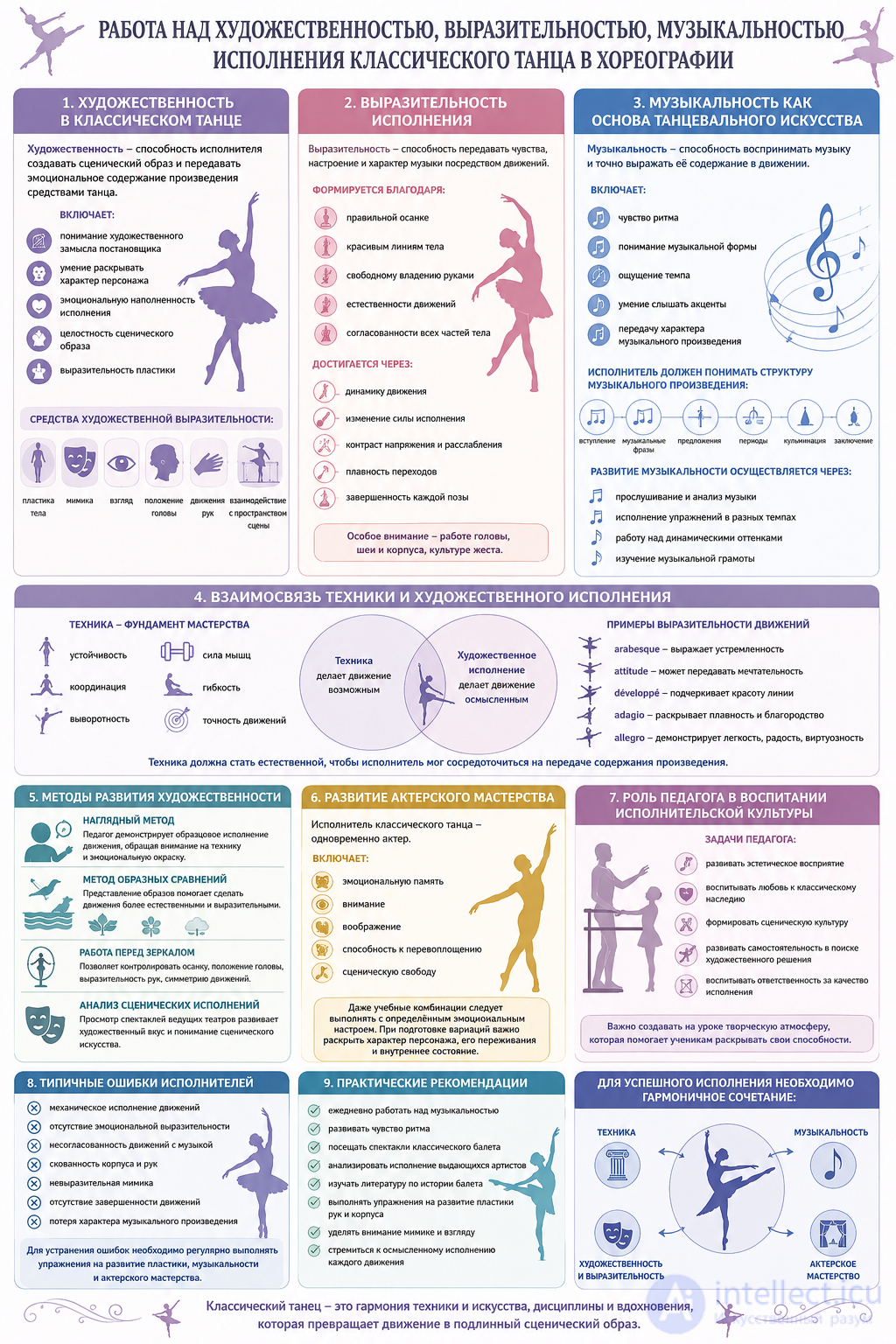
Working on the Artistry, Expressiveness and Musicality of Classical Dance Performance in Choreography

1. The Concept of Artistry in Classical Dance

Artistry is the performer's ability to create a stage image and convey the emotional content of a work through the means of dance.

It includes:

  • understanding the choreographer's artistic intent;
  • the ability to reveal a character's nature;
  • emotional fullness of performance;
  • the integrity of the stage image;
  • expressiveness of movement.

Even flawlessly executed technical elements fail to make the proper impression if the performer does not invest them with artistic meaning. That is why, from the very first years of training, the teacher cultivates in students an understanding that every movement must be meaningful.

The main means of artistic expressiveness are:

  • the plasticity of the body;
  • facial expression;
  • the gaze;
  • the position of the head;
  • the movement of the arms;
  • interaction with the space of the stage.

2. The Significance of Expressiveness in Performance

Expressiveness is the ability to convey feelings, mood and the character of the music through movement.

It is developed through:

  • correct posture;
  • beautiful lines of the body;
  • free command of the arms;
  • naturalness of movement;
  • coordination of all parts of the body.

Special attention is given to the work of the head, neck and torso. It is precisely these that help complete a movement and make it emotionally rich.

Expressiveness is achieved through:

  • the dynamics of movement;
  • variation in the force of execution;
  • the contrast between tension and relaxation;
  • smoothness of transitions;
  • the completeness of every pose.

In classical dance the culture of gesture is of great importance. Every gesture must be justified by the content of the dance rather than serve as a mechanical addition.

3. Musicality as the Foundation of the Art of Dance

Musicality is the ability to perceive music and to express its content accurately in movement.

Musicality includes:

  • a sense of rhythm;
  • an understanding of musical form;
  • a feel for tempo;
  • the ability to hear accents;
  • conveying the character of a piece of music.

A performer must understand the structure of a piece of music:

  • the introduction;
  • musical phrases;
  • sentences;
  • periods;
  • the climax;
  • the conclusion.

A dancer does not merely count musical beats but lives the music with the whole body.

Musicality is developed through:

  • listening to musical works;
  • analysing the character of music;
  • performing exercises to different tempos;
  • working on dynamic shading;
  • studying the fundamentals of music theory.

4. The Relationship Between Technique and Artistic Performance

Technique is the foundation of performing skill, yet on its own it does not create an artistic image.

Technical training includes:

  • stability;
  • coordination;
  • turnout;
  • muscular strength;
  • flexibility;
  • precision of movement.

Artistic performance arises when technical skills become natural and allow the performer to concentrate on conveying the content of the work.

The teacher's main task is to teach the student not merely to execute a movement but to understand its meaning.

For example:

  • arabesque expresses aspiration;
  • attitude can convey dreaminess;
  • développé emphasises the beauty of the line;
  • adagio reveals smoothness and nobility;
  • allegro displays lightness, joy and virtuosity.

5. Methods for Developing Artistry

Various pedagogical methods are used to develop artistic expressiveness.

The Demonstration Method

The teacher demonstrates an exemplary execution of the movement, drawing attention not only to the technique but also to its emotional colouring.

The Method of Imagery and Comparison

Students are asked to imagine various images:

  • the flight of a bird;
  • the movement of waves;
  • a flower opening;
  • a stately gait;
  • the lightness of clouds.

Imaginative thinking helps make movements more natural.

Working in Front of the Mirror

The mirror makes it possible to check:

  • posture;
  • the position of the head;
  • the expressiveness of the arms;
  • the symmetry of movement.

Analysis of Stage Performances

Watching performances by leading theatres helps develop artistic taste and an understanding of stage art.

6. Developing Acting Skill

A performer of classical dance is at the same time an actor.

Acting skill includes:

  • emotional memory;
  • attention;
  • imagination;
  • the ability to transform into character;
  • freedom on stage.

Even classroom combinations should ideally be performed with a particular emotional attitude.

When preparing variations, great attention is given to revealing the character's nature, feelings and inner state.

7. The Teacher's Role in Cultivating Performance Culture

The teacher is the principal mentor in shaping the student's artistic taste.

The teacher's tasks are to:

  • develop aesthetic perception;
  • cultivate a love for the classical heritage;
  • shape stage culture;
  • develop independence in seeking an artistic solution;
  • instil responsibility for the quality of performance.

It is very important to create a creative atmosphere in class that helps students reveal their abilities.

8. Typical Mistakes Made by Performers

The most common shortcomings are:

  • mechanical execution of movements;
  • a lack of emotional expressiveness;
  • movements not coordinated with the music;
  • stiffness of the torso and arms;
  • an inexpressive face;
  • a lack of completeness in movements;
  • loss of the character of the piece of music.

To eliminate these shortcomings it is necessary to regularly perform special exercises for developing plasticity, musicality and acting skill.

9. Practical Recommendations

To improve artistic performance it is recommended to:

  • work on musicality every day;
  • develop a sense of rhythm;
  • attend performances of classical ballet;
  • analyse the performances of outstanding artists;
  • study literature on the history of ballet;
  • perform exercises for developing the plasticity of the arms and torso;
  • pay attention to facial expression and the gaze;
  • strive for a meaningful execution of every movement.

Conclusion

Artistry, expressiveness and musicality are the most important components of performing skill in classical dance. They make it possible to combine technical perfection with emotional depth and to create a fully realised stage image.

Work on these qualities requires systematic training, a high culture of performance and constant creative searching. Only a harmonious combination of technique, musicality, artistry and a deep understanding of artistic content makes a performer a true master of classical dance.

Questions for Self-Assessment

  1. What is meant by artistry of performance in classical dance?
  2. What means of artistic expressiveness does a dancer use?
  3. What does the concept of musicality include?
  4. How are technique and artistic performance interrelated?
  5. What methods are used to develop expressiveness?
  6. What is the role of acting skill in classical dance?
  7. What typical mistakes are found among beginning performers?
  8. What is the teacher's role in cultivating a performer's artistic culture?

Comments

To leave a comment

If you have any suggestion, idea, thanks or comment, feel free to write. We really value feedback and are glad to hear your opinion.
To reply

Lectures and tutorial on "choreographic creativity BASICS OF DANCE COMPOSITION AND STAGE"

Terms: choreographic creativity BASICS OF DANCE COMPOSITION AND STAGE

Sign in and the lectures you have studied will be marked in this list.

Choose a course