
Lecture 6 min.
Classical dance is a coherent system of movement in which each element is logically connected to the one before and the one after. Special connecting movements (liaisons) are used to smoothly link individual movements, the most common of which is pas de bourrée.
Connecting movements not only help the dancer move from one pose to another, but also preserve the musicality, continuity and expressiveness of the dance. They are an important part of the exercise at the barre and in the center, as well as of classical variations and ensembles.
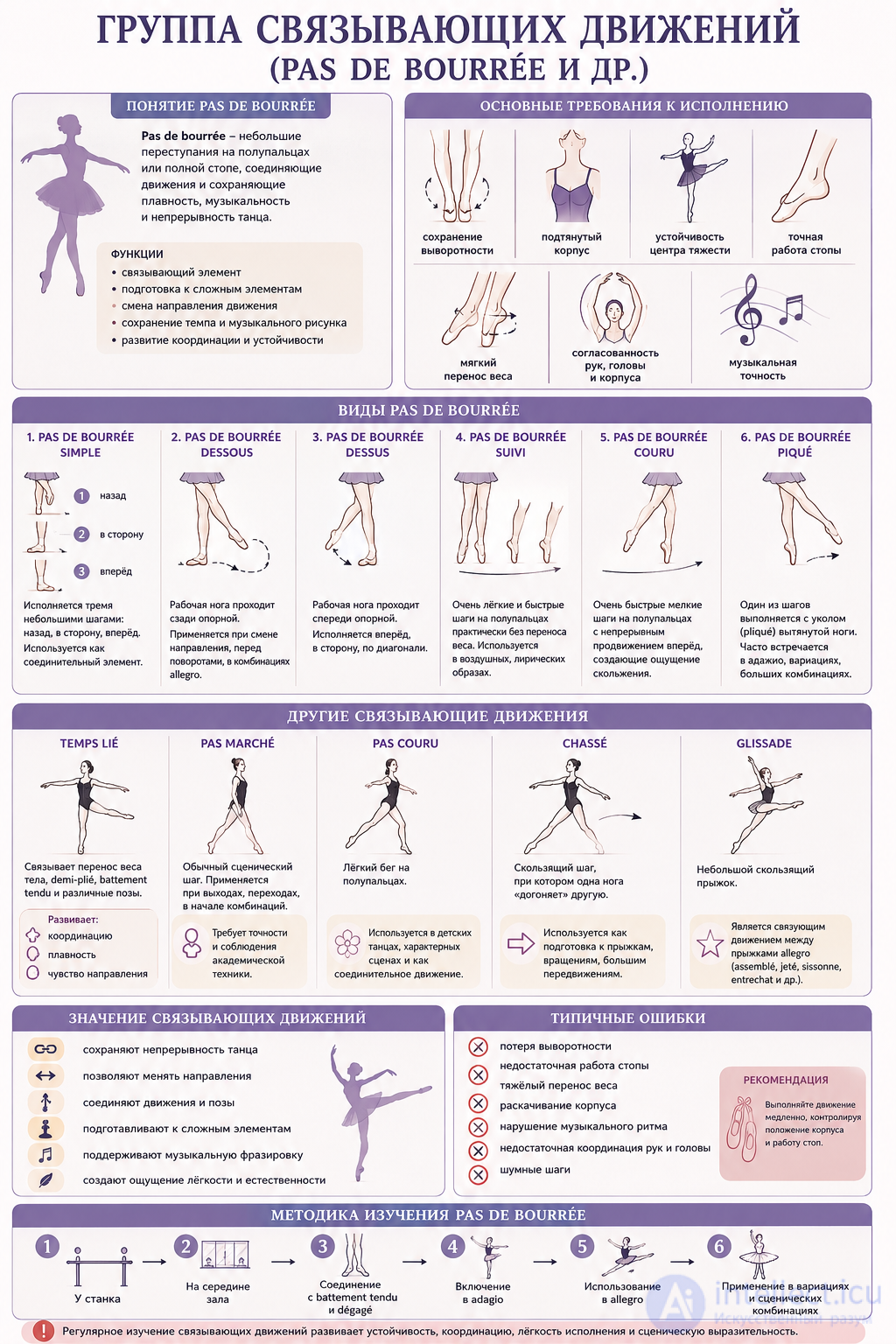
Pas de bourrée — small steps on demi-pointe or on the full foot, performed in various directions, that link the basic movements of classical dance.
The term comes from the French word bourrée — an old French folk dance of the seventeenth century, distinguished by its light, quick steps.
In the modern system of classical dance, pas de bourrée serves the function of:
When performing pas de bourrée, the following principles must be observed:
All the steps must be performed lightly, without excess noise or tension.
The most common variant.
It is performed in three small steps:
It is used as a connecting element between exercises.
The first leg passes behind the supporting leg.
It is used:
The working leg passes in front of the supporting leg.
It is performed when moving:
The lightest and most continuous variant.
It is performed:
It is often used in the parts of sylphs, fairies, swans, wilis and other ethereal characters.
Very quick, small steps on demi-pointe with continuous forward progression.
It is used to create the impression of gliding lightly across the stage.
One of the steps is performed with a jab (piqué) of the stretched leg.
It is often found:
In addition to pas de bourrée, classical dance also uses other elements.
A connecting movement that links the transfer of body weight, demi-plié, battement tendu and various poses.
Develops:
An ordinary stage walk.
It is used:
Despite its simplicity, it requires full compliance with academic technique.
A light run on demi-pointe.
It is used:
A sliding step in which one leg «catches up with» the other.
It is used as preparation:
A small gliding jump.
It is a connecting movement between allegro jumps.
It often links:
Connecting movements make it possible to:
It is thanks to connecting movements that the dance acquires integrity and artistic completeness.
The following mistakes are often encountered when performing pas de bourrée:
To correct these mistakes, it is recommended to perform the movement slowly, controlling the position of the torso and the work of the feet.
The mastery of pas de bourrée proceeds sequentially.
The tempo is gradually increased up to performance speed.
Without mastery of the group of connecting movements, it is impossible to perform the classical repertoire well. In practically every ballet — from «Giselle» to «Swan Lake» — pas de bourrée is used as an important element of technique and artistic expressiveness.
A high level of execution of these movements is evidence of a dancer's professional training, coordination, musicality and culture of movement.
The group of connecting movements occupies an important place in the system of classical dance. Pas de bourrée is one of the fundamental elements ensuring the smoothness, continuity and logic of dance composition. Its numerous varieties make it possible to link different movements, change direction, prepare turns and jumps, and create an artistic image.
The regular study and refinement of the technique of connecting movements promotes the development of stability, coordination, lightness of execution and stage expressiveness, which is a necessary condition for a ballet artist's professional mastery.
Sign in and the lectures you have studied will be marked in this list.
Choose a course
Comments