
Lecture 10 min.
The stage design of a choreographic work has specific features dictated by the conditions of the genre. The basic specific requirements that choreography places on the work of the set designer and the costume designer are these: to create a stage space that is convenient for dancing and a stage costume that is convenient for dancing.
Earlier we established that stage areas vary widely in their size, construction, and equipment. These may be well-equipped permanent stages, small performance spaces with a limited set of equipment, or open-air venues. We also determined the significance of stage drapery, scenery, props, and stage properties. But the means of designing a choreographic work do not end there. In choreography there is a device known as the «living curtain» or «living scenery.» Performers, dressed appropriately, organise the change of episodes within the composition, or remain on stage performing the function of scenery. An example is the fir forest in I. Moiseyev's choreographic production «Snowstorm.» In the repertoire of the Gzhel Dance Theatre there are a number of numbers in which the company is divided into two groups. One of them carries the main dramatic load, while the other plays the role of «living scenery,» masking the regroupings of the main group («Winter Fantasy,» «Pavlovo-Posad Patterns,» «Khokhloma Carousel,» the production «The Road to the Temple»). New approaches to designing the stage space are emerging in contemporary choreographic art. Examples include V. Vasiliev's production of «Romeo and Juliet,» B. Eifman's «Don Quixote» and «The Red Giselle,» and E. Panfilov's «The Armchair» and «The Run.»
At the same time, the decorative design of choreographic works is becoming ever simpler. Cumbersome scenery is being replaced by light constructions, or scenery is absent altogether. Under these conditions, lighting is given a special role. It makes it possible to «pick out» individual characters, to create compositional accents, and to divide the stage space into separate parts. Light helps to create the atmosphere of a choreographic work. A classic example of the use of light in the design of a choreographic work is M. Fokine's miniature «The Swan.»
Here the light creates the illusion of dawn while at the same time picking out the heroine. The shadows created by such lighting seem to fill the space of the stage, underscoring and setting off the trembling image of the lonely swan. At the finale of the choreographic miniature the light fades, underscoring the dying of the day and the dying of life. Many balletmasters use lighting effects in their works, but the main component of a choreographic work is the stage costume.
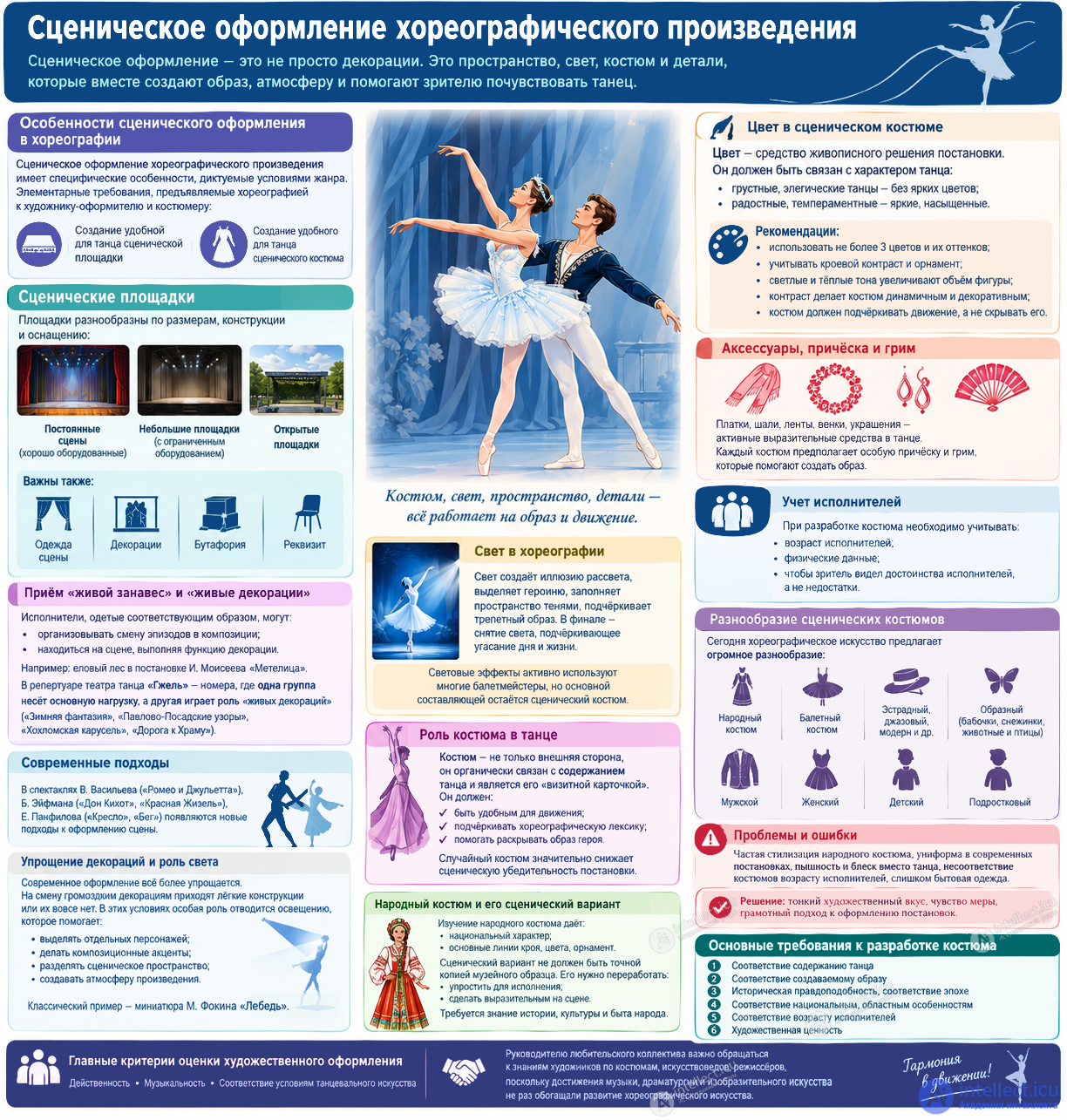
The role of costume in dance is significant: since a choreographic production lacks vocal or spoken text, the visual, spectacular side plays a very large role here. A costume can serve not only to characterise the hero and to bring out features of his individuality; above all, it must meet the requirements placed on clothing for dance: it must be comfortable for performing the dance, must not hinder movement, but on the contrary, must set it off. A carelessly chosen stage costume significantly reduces the theatrical persuasiveness of a choreographic production.
In the numerous variants of folk costume there are many common elements that give it its national character. By studying the rich heritage of folk dress and using it in a production, a company's director introduces the performers to the treasury of decorative art that the people created over the centuries in examples of folk clothing. But in studying folk costume one must not forget that its stage version should not be an exact copy of the original source, of a museum piece. Folk dress provides only the basic lines of cut, the combinations of colours, and the character of ornament or trim, which, in creating a stage costume, must be reworked so that it becomes simple to execute and expressive on stage. The variety of forms and colour combinations in folk costumes is endless. Often the inhabitants of one region, but of different districts, wear entirely different costumes. Designing a stage costume therefore cannot tolerate a superficial, formal approach. Work on creating a stage costume includes knowledge of the period and a thorough familiarity with the history, culture, and way of life of a given people.
The colour scheme of the stage costume plays no small role. The colour of a costume is a means of the pictorial solution of a choreographic production. The colour of a costume must always be linked to the character of the dance. Sad, elegiac dances cannot tolerate bright colours, whereas joyful, temperamental ones are unthinkable without them. In staging a mass dance one can design costumes so that with every change in the choreographic composition the arrangement of colours also changes, creating a wonderful, living colour palette. In working out the colour scheme of a costume one must take into account cut contrast – the layering of one colour over another – and ornament. In a costume it is recommended to use no more than three colours and their shades. A. V. Melekhov examines the significance of colour in creating a stage costume in great detail in his work «The Art of the Balletmaster. The Composition and Staging of Dance.» In a costume, ornament serves as a connecting material that defines colour, and also as a way of breaking up a plane. With its help one can visually lengthen or shorten the figure, and correct certain shortcomings (a long or wide waist, short legs). It should be kept in mind that light fabrics, as well as pale and warm tones, increase the apparent volume of the figure. For the greatest dynamism and decorative effect, a costume can be built on the principle of contrast. Among other things, it must be kept in mind that a stage dance costume will be perceived by the viewer in motion. It is important that it emphasise the dynamics of the dance rather than obscure the choreographic vocabulary.
Various accessories are also of great importance in creating a costume: kerchiefs, shawls, ribbons, wreaths, ornaments, and so on. They are actively used in dance, being an integral part of it and an expressive device. It should also be noted that every stage costume calls for a particular hairstyle and make-up, which help to create the image. In designing a stage costume one must take into account the age of the performers and their physical characteristics, so that the viewer sees only the performers' merits and does not notice their shortcomings. Thus costume and dance are in constant interdependence. A costume is not merely the purely external side of a dance; it is organically bound up with the dance's content and serves as its «calling card.» As soon as a performer appears on stage, the costume indicates nationality, period, and sometimes even the genre of the work. Today choreographic art has at its disposal an enormous number of varied stage costumes. This means, first of all, a diversity of genres: national costume, ballet costume, costume for performing variety, jazz, modern, and other dances. There is also imagery-based or associative costume: butterflies, snowflakes, animals, and birds. And there is men's, women's, children's, and teenagers' costume in any genre.
A number of problems can be identified that arise in designing various costumes. For example, in folk dance companies there is the problem of excessive stylisation of the national costume. In companies working in contemporary styles, the stage costume is often reduced to a certain uniform, which significantly impoverishes productions and makes them harder for the audience to perceive. In staging variety productions and show numbers, the dance itself is sometimes lost behind the lavishness and glitter of the costume. In addition, in amateur choreographic companies the costume does not always correspond to the age of the performers. And sometimes a stage costume is almost indistinguishable from everyday clothing. To avoid these problems, the director of an amateur choreographic company must possess refined artistic taste, be guided by a sense of proportion when designing costumes, and take a competent approach to the design of their choreographic productions.
On the basis of the foregoing, the main requirements for designing a stage costume for choreographic art can be formulated as follows:
The main criteria for assessing the quality of the artistic design of a choreographic work are: effectiveness, musicality, and conformity to the requirements of the art of dance. Therefore, when designing the stage presentation of their productions, the director of an amateur choreographic company needs to draw on the knowledge of costume designers, art scholars, and directors, since the achievements of music, dramaturgy, and the visual arts have repeatedly enriched the development of choreographic art.
Sign in and the lectures you have studied will be marked in this list.
Choose a course
Comments