
Lecture 15 min.
An image is a specific human character plus the sum of that person's relationships to the surrounding reality, expressed in actions and deeds that are determined by dramatic action. In artistic creation an image is a collective, typical, invented phenomenon, yet one drawn from the very thick of life. It takes shape organically out of a multitude of component qualities and features. The choreographer perceives the surrounding world in motion. Movement in dance is a synthesis of all human capacities, unfolding a complete thought in time and space through a conventional stage form. Elements of pantomime introduced into the dance serve the same purpose. In dance, facial expression and gesture merge into a single concept - movement. Movement is the artistic transformation of the habits, manners and other external traits of one or another category of people into stage choreographic action.
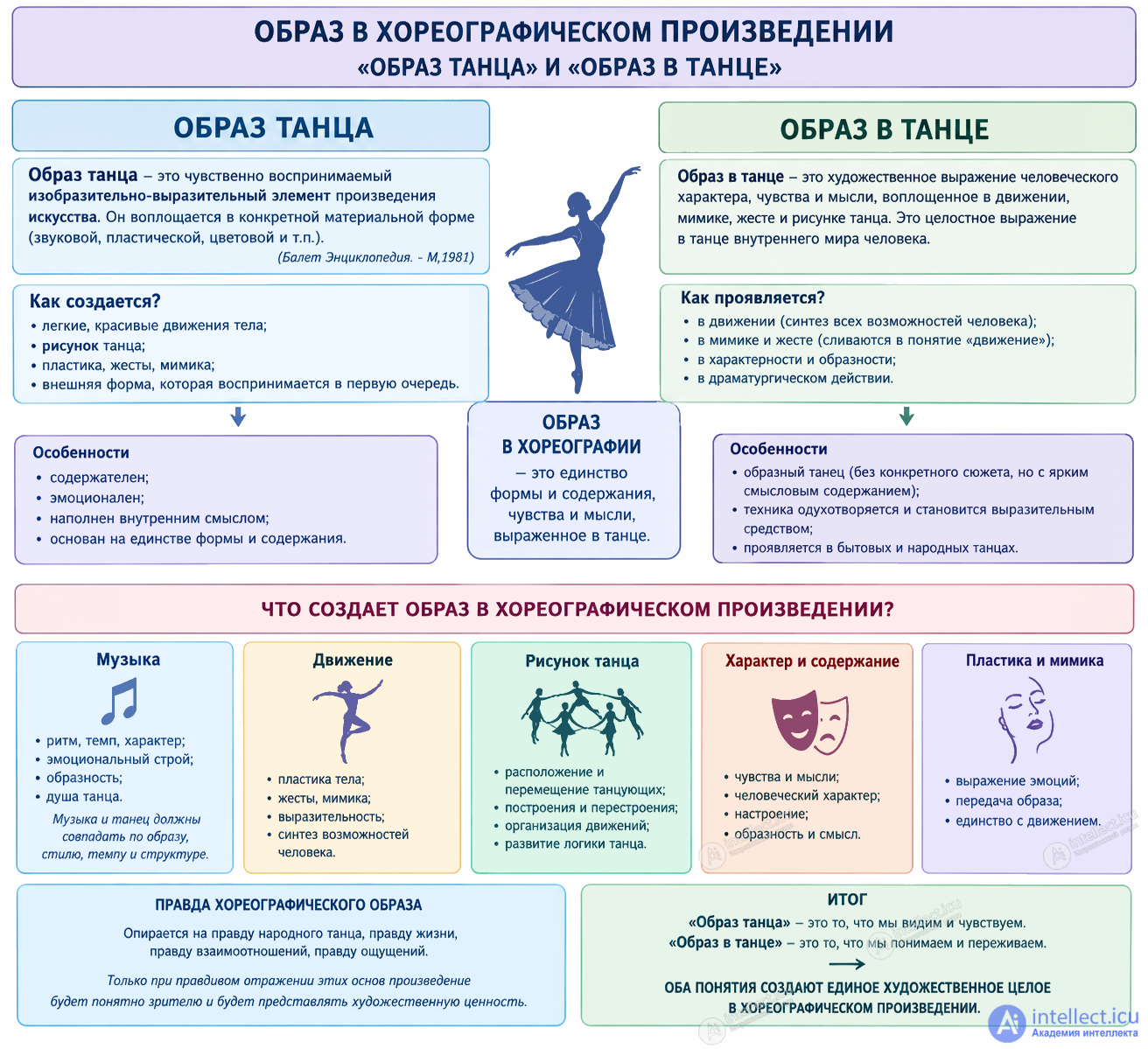
«The image of dance is a sensuously perceived pictorial and expressive element of a work of art. It is embodied in a concrete material form (sound, plastic movement, colour and so on)» (Ballet Encyclopedia. Moscow, 1981). The image of dance is created by the light, beautiful movements of the body and by the pattern of the dance itself. When we perceive a dance we first of all see its attractive external form: the plasticity of the body, the gestures. The inner meaning is grasped gradually and indirectly - through the movement of the human body. Undoubtedly, the external form and the content are inseparably linked and form a single whole: «works of the expressive arts do not create likenesses of objects, a picture of life; they are not tied to the objective world and do not reflect it. In their form and colouring they express particular experiences and embody a human sense of the world - an understanding and an evaluation of life» (Bogdanov G. F. Foundations of Choreographic Dramaturgy: A Study Guide, MGUKI, 2010). A choreographic image is a complete expression, in dance, of feeling and thought, of human character. An imagistic dance is meaningful, emotional, filled with inner sense. An imagistic dance is a dance vivid in meaning that has no specific plot (Beryozka, the Hopak, the Kazachok, the Vesnyanka). In an imagistic dance, technique becomes animated, turns into a means of expression, and helps to reveal the content. A dance devoid of imagery leads to bare technique, to meaningless sets of combinations and movements (formalism). The imagistic principle is inherent in everyday and folk dances, showing itself in their emotional orientation and substantive character.
The truth of a choreographic image rests on the truth of folk dance, the truth of life, the truth of relationships, the truth of sensation. If the choreographer succeeds in truthfully reflecting all of this in choreographic images, the work will be understood by the audience and will possess genuine artistic value.
Music is the foundation for creating a dance. Music gives movement its rhythmic basis; it determines its emotional character, its temperament, its imagistic expressiveness. Music is quite rightly said to be the soul of dance. In practice a choreographer uses either an existing piece of music or a composition written by a composer to the choreographer's own conception (that of the dramatist, the librettist). A choreographer working in an amateur choreographic ensemble unfortunately does not often have the opportunity to approach a composer to have the music for an intended choreographic work written specially. More often he uses an existing musical work, or contents himself with selecting musical material, or with an arrangement of folk melodies. Let me recall that when a dance is required to express its music, there must be a correspondence between the imagistic character and style of the music, its tempo, and the structure of the musical work's language, on the one hand, and the plastic pattern, structure, form, tempo and metrical rhythm of the choreographic work, on the other. Naturally, the music (or the musical material) already contains the author's corresponding idea and image, and the choreographer's task is to build, on the basis of that musical material and using all the expressive means of dance, a single stage choreographic dance image.
The floor pattern of a dance is the arrangement and movement of the dancers across the stage area. The pattern is subordinate to the idea of the choreographic work and is inseparably bound up with the dance text; it develops logically and helps the dance text to be revealed on stage as vividly as possible. The floor pattern organizes the dancers' movements and brings them into a system. Different formations and re-formations produce a definite psychological effect on the audience, and it is the choreographer's task to ensure that the floor pattern expresses as fully as possible the thought, the mood and the character embedded in the piece. For example, the repertoire of the State Academic Choreographic Ensemble Beryozka is built on every kind of Russian khorovod (round dance). The ensemble's founder, the choreographer N. Nadezhdina, created a great number of choreographic images inspired by the beauty of Russian nature, remarkable works of folk craft, and labour processes. The smooth development of the pattern, the unhurried motion matching the music, and the invisible footwork of the dancers, who seem to glide across the stage, create before the audience's eyes the image of a young swan in the dance of that name. The patterns of the khorovod Pryalitsa (The Spinning Wheel) let the audience watch Russian girls doing needlework on winter evenings, drawing out and winding thread while singing heartfelt songs. In the khorovod Beryozka the image is revealed of a Russian girl as slender as a young birch tree, her character, and the image of Russian nature. And this piece, which has been performed for many years on stages both in our country and abroad, and which gave the ensemble its name, has an enormous effect on the audience.
The dance text is the most important link in creating a choreographic image. Learning the movements cannot be regarded apart from the work on the role, on the image; this creative process must proceed simultaneously. The performers' movements must be technically correct and convincing, and must express a definite character. Every movement is a living fibre of the image. The choreographer helps the performer to think in plastic terms at every moment of the role while on stage, and to reveal character through the intonation of gesture, movement and pose. In every case individual touches and nuances must be found that correspond to the character's mood, to the spirit of the theme and the plot, and to the task of the production. In revealing images, characters, moods and relationships, one must combine the unity of plastic and inner content. Sometimes a subtle plastic touch enriches and develops movements already familiar, helping to reveal the image. Any choreographic work is built according to the laws of dramaturgy, and it is in accordance with them that the stage image is constructed.
The stage image must also have its own exposition, its inciting incident, its development of the action, its climax and its resolution. The choreographer must think through and develop the image so thoroughly that it results in stage truth of action. For a choreographic image to receive full and vivid embodiment on stage, the choreographer must set the dancer clear and concrete stage tasks arising from the action, the plot, the idea of the work, and the through-line of the image. In a plotless piece the dramaturgy is built somewhat differently than in a plotted one. Here, for example, to bring out the climax the choreographer uses a cascade of technically complex movements and combinations, or the most interesting floor pattern, the greatest dynamism of movement, the highest emotional intensity of performance, or some other choreographic device (unison, canon, contrast)
Thus emotions are visualized through the body, transformed into a dance pattern, rhythm, melody and dynamics that together create a complete image of dance. That is, to create the image of dance means to convey a story about a people, about a time, about a culture, about a mood. To create an image in dance means to depict, in dance, the actions and the character of the hero. Character is the sum of the traits of a particular person, the logic of their deeds, their way of reacting to events. Character remains unchanged throughout the whole work. It is endowed with its own plastic characteristic, its own plastic motif. The generalized, imagistic meaning of one movement or another becomes the key moment in creating a choreographic image and the dance as a whole. The selection and combination of movements are determined by the author's ideas about which dance and plastic means will most vividly and precisely embody a given image. In a unified composition this generalized plastic symbolism, thanks to its genetic connection with real-life movements, gives rise in the audience to particular imagistic associations. This is what makes it possible to understand the content of a dance without verbal explanation. «The basis of the image in dance is the text composed by the choreographer. But in the performers' rendering this text acquires one interpretation or another, which can enrich and deepen, or, on the contrary, impoverish and distort, the very image created by the choreographer. The dancer recreates not only the choreographer's text but also puts into the dance his or her own understanding of the hero's character and of life as a whole, animating the choreographic text and revealing his or her own individuality in doing so» (Fetisova E. V. On the Question of the Perception and Determination of Emotional States from Expressive Movements // Psychological Journal, 1981. – Vol.2. - No.2).
The diversity of choreographic images is striking:
a) images of nature in dance (spring, snowflakes, flowers, stars, a birch tree, a wave, fire, the northern lights, etc.)
b) images of the animal world (insects: a dragonfly, a butterfly, a spider, a bumblebee; inhabitants of the water world: a fish, an octopus, a crayfish; birds: swans, a seagull, a stork, chicks; animals: a hare, a bear, a fox, a cat, a dog);
c) the diversity of human images (a mother, a girl, a young man, an old man, a bride, an old woman, a sailor, a soldier, a student, a worker, a scholar, a pilot-cosmonaut, a bureaucrat, a toady, a hooligan, an idler, a stilyaga, a braggart, a drunkard, a hero, a coward, a modest person, a timid person, etc.);
d) dance for children and children's dance (fairy-tale images: Ded Moroz, Snegurochka, a prince, Cinderella, a tsarina, Barmaley, Baba Yaga, Buratino, Cipollino, Neznaika, etc.)
A choreographic image must be integral and must reflect the phenomena of life. The choreographer uses the fullest range of expressive means to create images: spatial pattern, dance vocabulary, facial expression, the dramaturgical development of the image, acting skill, music, costumes, the artistic design of the stage. Besides this, there are certain devices for constructing images that the art of dance has borrowed from literature:
- combination - the joining of various elements (the elements of the composition form a complex structure that includes text, music, light, costume and set design, all interacting to create the required image), for example «Svoya Svoboda» (One's Own Freedom) - «Kommunalka» (The Communal Flat);
- typification – the most vivid, typical traits of an object are combined into a single image, thereby creating new qualities of character, as in many of the khorovods of the State Academic Choreographic Ensemble «Beryozka»;
- emphasis (hyperbole) – exaggeration and understatement – certain special, characteristic qualities, objects or phenomena are brought to the fore;
- absolutization – a device tied to analysis and synthesis, which consists in combining separate elements taken from different images into one integral image (Ancient Rome, a man, a slave, Spartacus, the people);
and also devices for embodying an image
- agglutination (gluing together) – the joining of two things in one image (a girl-swan)
- synecdoche - its essence lies in replacing the plural of a phenomenon or concept with the singular, using a part in place of the whole and the whole in place of a part, the large in place of the small: a typical example: «And it could be heard until dawn how the Frenchman rejoiced» – from a poem by Mikhail Lermontov, where «the Frenchman» denotes not a specific person but the French army; in choreography this device is widely used (identical costumes, identical dance vocabulary).
Thus music, painting and literature all play an enormous part in creating a choreographic image. A choreographic image takes in the form of its stage embodiment, its content, its purpose and its means. In creating a choreographic image everything matters to the choreographer:
1. The choice of expressive means. The search for an external form is, for the choreographer, always a process of creating (necessarily together with the dancer-actor) the character's personality, temperament and manner of thinking, which dictate the logic of behaviour. The choreography, as the plastic expression of an inner life, is born of the organic nature of the image.
2. Contrast between lines of action (on the principle of intensification or slowing down). Contrast shows itself in the joining of mise-en-scenes and of separate dance fragments and movements. The headlong drive of the climactic movements is prepared by the soft, springy force and gracefulness of the preceding dance phrases.
3. The organization of the metro-rhythmic side of the dance and the music. At the moment of climax, the pointed sharpness and sweep of the movements, and the tempo-rhythmic dynamism combined with the swiftness of movement through space, express the character of the dance with the utmost emotional force.
4. All the other elements of choreographic form that help not only to create the image but also to reveal its content (the use of pantomime, pictorial means, props and so on)
So, a choreographic image is made up of the following stages:
1. The choice of expressive means;
2. Ways of combining them;
3. The search for a compositional solution;
4. The search for a unified style;
5. The use of various artistic and choreographic devices.
All the components of an image exist on the principle of the unity of content and form: the unity of a clear, precise, complete stage form of movement and of an emotionally and psychologically saturated content that constitutes the essence of choreographic images.
1. Definition of the concept of «image»
2. What does "the image of dance» mean
3. The significance of music in creating the image of dance
4. Pattern and image in dance
5. The dance text in creating a choreographic image.
6. What does "the image in dance» mean
7. Define the concept of «character»
8. List the possible choreographic images
9. Name the devices for constructing images
10. What is especially important for creating a choreographic image
11. What stages make up a choreographic image
Sign in and the lectures you have studied will be marked in this list.
Choose a course
Comments