Competitive ballroom dancing is divided into two main programmes: European (Standard) and Latin American (Latin).
The European programme is distinguished by smoothness of movement, elegance, continuous travel along the line of dance, and constant contact between partners. All the dances are performed in closed dance hold and require good posture, a sense of balance, and synchronised movement.
The European programme comprises five dances:
- Slow Waltz
- Tango
- Viennese Waltz
- Slow Foxtrot
- Quickstep
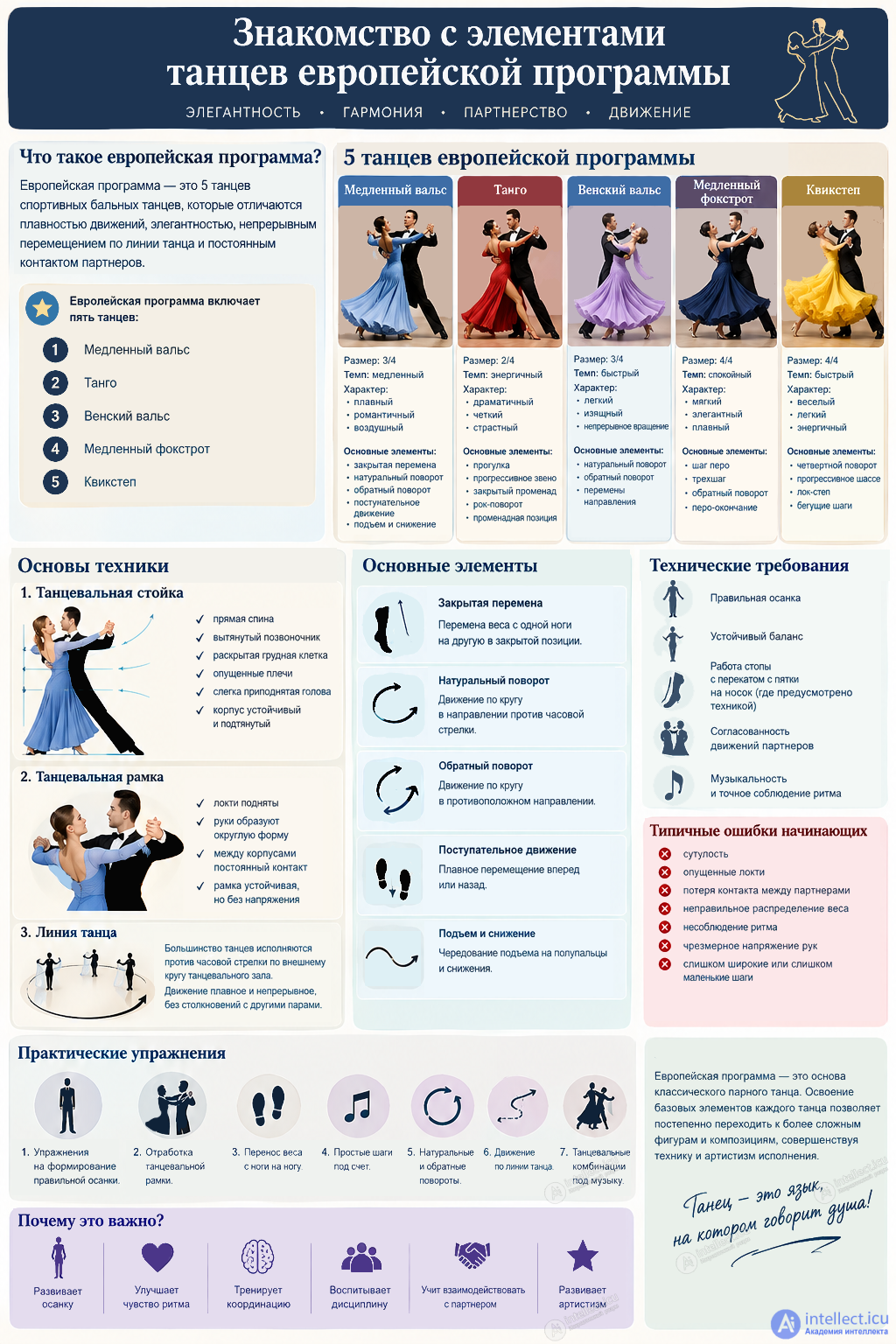
Fundamentals of the European Programme
Before studying individual dances, it is necessary to master the basic elements of technique.
1. Dance Posture
Correct posture is the foundation of all the European dances.
Basic requirements:
- a straight back;
- an elongated spine;
- an open chest;
- relaxed, lowered shoulders;
- a slightly lifted head;
- a stable and toned body line.
The man and the woman form a single dance frame.
2. Dance Frame
The frame — the position of the partners' arms and bodies.
Basic requirements:
- the elbows are raised;
- the arms form a rounded shape;
- constant contact is maintained between the bodies;
- the frame must be stable but not tense.
It is through the frame that the man leads the woman.
3. Line of Dance
Most dances of the European programme are performed counter-clockwise around the outer circle of the dance floor.
Movement is smooth and continuous, without collisions with other couples.
Basic Elements of the European Dances
Slow Waltz
Time signature: 3/4
Tempo: slow.
Character:
Basic elements:
- Closed Change;
- Natural Turn;
- Reverse Turn;
- progressive movement;
- Rise and Fall.
A distinctive feature of the dance is the gentle sway of the body and smooth rises.
Tango
Time signature: 2/4
Character:
- energetic;
- dramatic;
- sharp.
Basic elements:
- Walk;
- Progressive Link;
- Closed Promenade;
- Rock Turn;
- promenade position.
Features:
- there is no rise and fall;
- movements are sharp and accented;
- the knees remain slightly flexed.
Viennese Waltz
Time signature: 3/4
The tempo is significantly faster than that of the slow waltz.
Basic elements:
- Natural Turn;
- Reverse Turn;
- changes of direction.
Features:
- continuous rotation;
- high speed;
- smoothness and lightness.
Slow Foxtrot
Time signature: 4/4
Character:
Basic elements:
- Feather Step;
- Three Step;
- Reverse Turn;
- Feather Finish.
Features:
- long, gliding steps;
- smooth transfer of weight;
- a combination of slow and quick steps.
Quickstep
Time signature: 4/4
Character:
Basic elements:
- Quarter Turn;
- Progressive Chasse;
- Lock Step;
- running steps.
Features:
- hopping and skipping elements;
- ease of execution;
- high travelling speed.
Basic Technical Requirements
When performing the European dances, it is necessary to observe:
- correct posture;
- stable balance;
- foot action with a heel-to-toe roll (where called for by the technique);
- coordination of the partners' movements;
- musicality;
- precise observance of rhythm.
Common Mistakes Made by Beginners
- stooping;
- dropped elbows;
- loss of contact between partners;
- incorrect weight distribution;
- failure to keep the rhythm;
- excessive tension in the arms;
- steps that are too wide or too small.
Practical Exercises
To master the elements, it is recommended to practise:
- Exercises for developing correct posture.
- Practising the dance frame.
- Transferring weight from one foot to the other.
- Simple steps to a count.
- Performing natural and reverse turns.
- Moving along the line of dance.
- Dance combinations to music.
Conclusion
The European programme of competitive ballroom dancing is the foundation of classical couple dancing. It develops posture, a sense of rhythm, coordination, discipline of movement, and the ability to interact with a partner. Mastering the basic elements of each dance makes it possible to gradually progress to more complex figures and compositions, refining technique and artistry of performance.
Review Questions
- Which dances make up the European programme of competitive ballroom dancing?
- What is a dance frame?
- How does the slow waltz differ from the Viennese waltz?
- What features are characteristic of the tango?
- What is the line of dance?
- What are the basic elements studied in the slow foxtrot?
- What mistakes do beginning dancers most often make?
- Why does correct posture play an important role in the European programme?


Comments