
Lecture 11 min.
Miniature – from the Latin and Italian for a diminished likeness of something – a choreographic miniature is a stage dance work complete in content and
form, limited in duration (up to about three minutes) and in the number of performers (from one to six), which exists both on the variety stage and in the ballet theatre. It may be narrative or non-narrative.
The choreographic miniature forms the basis of the repertoire of dance ensembles.
The choreographic miniature took shape within the ballet performance. In the early 19th century in Russia it was included in the national divertissements of I. M. Ablets, I. I. Valberkh, and A. P. Glushkovsky. From the mid-19th century the choreographic miniature appeared on the concert stage («The Little Peasant,» performed by M. S. Surovshchikova-Petipa, «The Matelot,» performed by O. I. Preobrazhenskaya, and others), continuing to develop as well in
the ballet performance (the «fairy tales» in The Sleeping Beauty, the national divertissements in Swan Lake and in Raymonda). The authors of these miniatures were M. Petipa and L. Ivanov. M. M. Fokine also created miniatures («Bacchanale,» «The Swan» – both to music by Saint-Saëns, and others).
Choreographic miniatures united by a single idea are often combined into series and complete programmes («Scriabiniana» by K. A. Goleizovsky, «The Images of Rodin» by L. V. Jacobson, «Pictures at an Exhibition» by F. V. Lopukhov, «Choreographic Miniatures» by Jacobson, the theatre named after
Kirov, 1959). The choreographic miniature is a form favourable for choreographic experimentation, for the search for new images and expressive
means. The most popular choreographic miniatures are those of the balletmasters
Goleizovsky, Jacobson, Messerer, Ermolaev, Varkovitsky, Burmeister, Lapauri and others. The music for a miniature must be vivid, complete in form and content, free of compilation, evocative, and must fit within the time limits. The vocabulary must be maximally expressive. The choreographer needs to use a choreographic symbol, a plastic motif of metaphor
(personification).
There are several types of choreographic miniatures:
Requirements applicable to productions
A miniature may exist in the form of a monologue or a dialogue. A monologue, from the Greek, means telling about oneself, or speaking with oneself. It is the speech of a character, set apart from conversational exchange and, unlike dialogue, not expecting a direct response. A monologue – is speech alone with oneself. Building the dramaturgy here is quite difficult, since the conflict is internal. The dialogue-miniature. From the Greek – a conversation between two or several voices. Here a question and an answer are always present. A dialogue of agreement – is something in unison with something else. A dialogue – of disagreement – is a contrast in vocabulary and in the organisation of the action. «The Swan» — a concert number to music by C. Saint-Saëns, choreographed by M. Fokine.
It was first performed by Anna Pavlova on 22 December 1907 at a charity evening at the Mariinsky Theatre.
The number has no plot, yet the choreographer Mikhail Fokine wrote out a «General Picture of the Dance»: «As the curtain rises, on the side to the left of the audience, deep in the dim stage, a dancer in a white ballet costume covered with swan feathers and down stands motionless. She is lit by moonlight. Her head is bowed sadly, her arms lowered and folded in front of her slightly inclined body. After one bar of the harp introduction, with the first sound of the cello, she rises onto pointe and glides quietly and sorrowfully across the stage. Her arms slowly rise above her head, then open like wings. But in this attempt to rise, she, as if
weakening, sinks onto one knee. Gathering the remnants of her strength, she rises onto the toes of her left foot and, tossing her head back plaintively, trembles.
Having repeated this whole figure, she then slowly glides to the centre of the stage, her body dropped down so low that her fingertips almost touch the floor. Then she rises and turns smoothly on the toes of both feet, wrapping herself
in the tender movements of her arms. She seems to be pitying herself. But now the music quickens and grows louder. The dancer turns more forcefully, her arm outstretched in a gesture of entreaty. Then she straightens up and, with her arms spread out to the sides, rushes toward the back of the stage. Waving her arms higher and higher, she freezes for a moment, motionless on pointe, wholly straining to rise upward, to escape the inevitable. In the music the opening theme returns. The dancer's head bends to one side. Her whole being expresses disillusionment. She glides, drawing nearer, her back to the audience. Now she peers out plaintively from under her outstretched right arm, then from under her left. Then she spins nervously, as if moving once more, as though with new hope, on pointe toward the left side of the stage. She flings her arms up to the sky, then returns to the centre of the stage, sinks onto one knee, makes one last
attempt to take flight, but sinks powerlessly and dies.»
In the output of the prolific French composer Camille Saint-Saëns (1835-1921), the zoological fantasy «The Carnival of the Animals» (1886) occupies a rather modest place. One of the movements of the suite, made up of distinctive «portraits» of donkeys and tortoises, antelopes and the elephant, is called «The Swan.» The composer created a musical image of a bird, beautiful in its proud calm. The timbre of the cello lends the music pensiveness,
and at times a dreamy quality. It would hardly have occurred to anyone to dance to this music, had the first-class dancer and budding choreographer Mikhail Fokine not enjoyed playing the mandolin in his spare time.
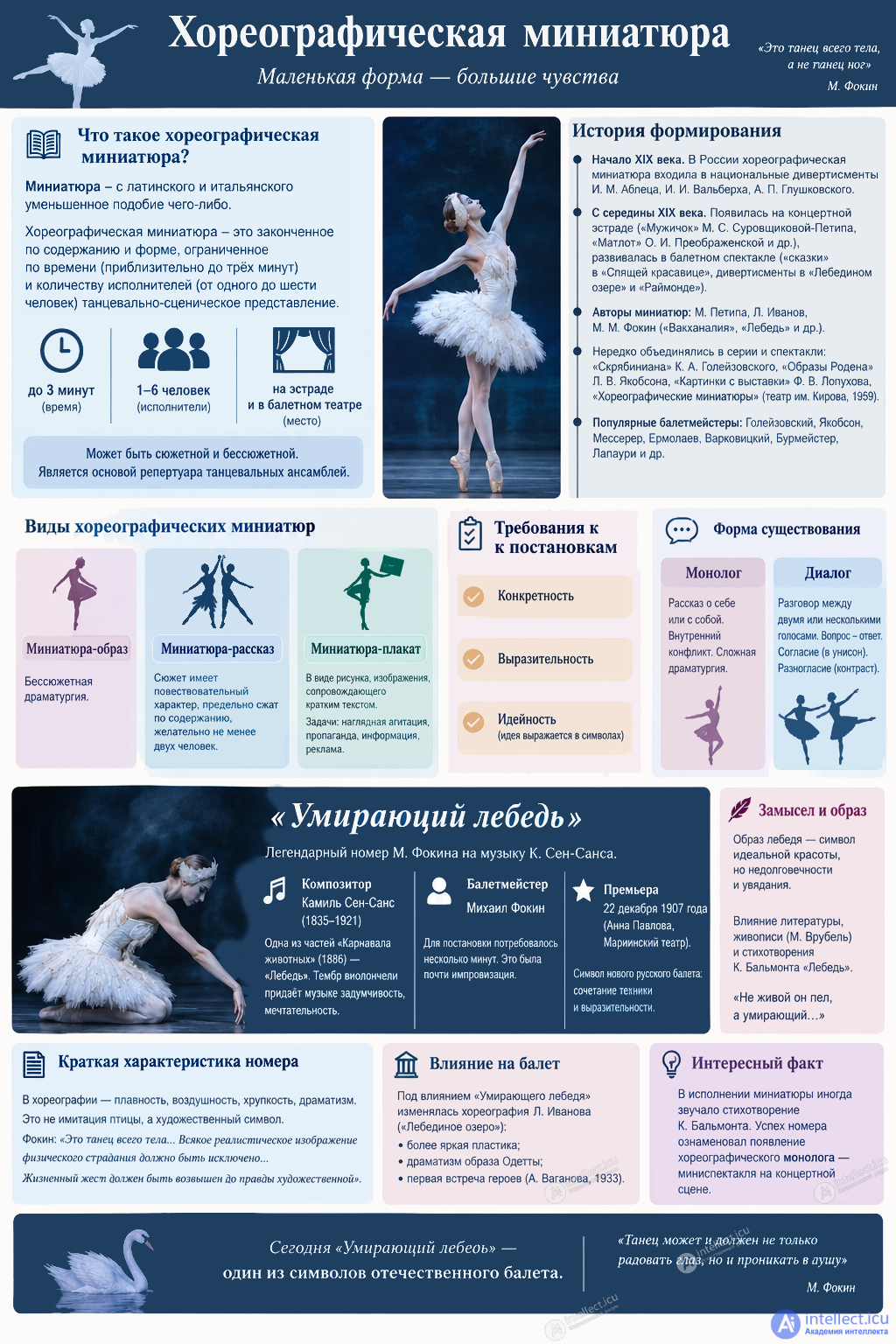
The story of how the choreographic miniature was created was well remembered by its author: «Pavlova once came to me and said: «The choir of the Imperial Opera Theatre has asked me to take part in their concert. Could you help me choose some music?» At the time I happened to be learning Saint-Saëns's «The Swan» on the mandolin, accompanied by a friend. «What if we take Saint-Saëns's «The Swan»?» I suggested. She realised at once that the role of the Swan suited her better than anything else. And I, looking at her slender, fragile figure, thought: «She was made for the Swan»... Staging the dance took only a few minutes. It was almost an improvisation. I danced in front of her, she — right behind me. Then she began to dance alone, while I followed beside her, showing how to hold her arms... This dance became a symbol of the new Russian ballet. It was a combination of perfect technique with expressiveness. Dance can and must not only please the eye but also reach the soul.» It is hard to overstate Anna Pavlova's contribution to realising the choreographer's idea. Her personality gave the image both scale and drama. However, the change of the original title to the one generally accepted in Soviet ballet — «The Dying Swan» — and the corresponding reinterpretation of the «bird» image came about not only under the influence of the brilliant ballerina. The image of the swan is one of the most widespread in Russian literature. At the turn of the twentieth century it was transformed: within this symbol of ideal beauty, emphasis came to be placed on its transience and inevitable fading. Recall the paintings of Mikhail Vrubel, as well as Konstantin Balmont's once-famous poem «The Swan»: «Not as one living did it sing, but as one dying, for that is why it sang in its final hour, that before death eternal, reconciling, it saw the truth — for the first time.» It is known that Fokine's two-minute miniature was sometimes performed accompanied by a reading of this poem. The success of Fokine's masterpiece marked the moment when, on the concert stage, in place of the showy classical variation, there came the choreographic monologue with its own plot and mood. Soviet choreographers took up this innovation, and their concert numbers became mini-performances with one or several performers.
The question of the mutual influence between Lev Ivanov's choreography in the second scene of Swan Lake and Fokine's The Swan is not simple, but it is an interesting one. The very choice of the swan image may have been subconsciously linked to the fact that both Pavlova and Fokine were outstanding interpreters of this classical ballet. The selection of movements for the heroines coincides, as does the final pose of the miniature with Odette's initial pose before the start of her duet with Siegfried. More interesting is the reverse influence. Under the influence of «The Dying Swan,» many additions and substitutions were made in Ivanov's choreography. Such, for example, is the now-canonical first meeting of the hero and heroine, composed by Agrippina Vaganova in 1933. Odette's movement began to draw closer to an imitation of a bird's motions. The character of the heroine also became more dramatic; in many performers an initial hopelessness appeared, which undoubtedly simplifies the dramaturgy of Odette's image, and indeed of the whole ballet. The text quoted at the start is not a description of the «content» of the number.
Rather, in these emotionally charged phrases the choreographer was trying to convey his message to future performers. There are a few more remarks by Fokine about the character he intended for «The Swan»: «This is a dance of the whole body, not a dance of the legs, as the old ballet dance used to be. The role of the arms is no less, if not more, important in this dance than the movements of the legs. Any realistic depiction of physical suffering must be entirely excluded. The living gesture from which the dance develops must be elevated above literal truth, to artistic truth. Reducing the dance to an imitation of a bird is a mistake made by many performers. The performance may be more lyrical or more dramatic. I allow for both kinds of interpretation and invite performers to follow the path suggested by their own individuality.» This last remark of the choreographer explains why Anna Pavlova and Vera Fokina, Galina Ulanova and Maya Plisetskaya, Galina Mezentseva and Uliana Lopatkina are all so different in this number. Today in Russia «The Swan» has become one of the symbols of Russian ballet.
1. Define the concept of the «choreographic miniature.»
2. When did the choreographic miniature take shape as a genre, and where? Name the balletmasters and examples.
3. Give examples of choreographic miniatures of the 20th century.
4. What requirements apply to the music and vocabulary of a choreographic miniature?
5. Types of choreographic miniatures.
6. Characterise the monologue-miniature.
7. Characterise the dialogue-miniature.
10. The authors and performers of the miniature «The Swan.»
11. What is the miniature «The Swan» about?
12. The history of the creation of the miniature «The Swan.»
Sign in and the lectures you have studied will be marked in this list.
Choose a course
Comments