
Lecture 6 min.
One of the most important elements of classical dance is the bending of the torso, which is performed in various forms of port de bras. It develops plasticity, flexibility of the spine, coordination of movement and expressiveness of performance, and helps to form a beautiful carriage. Bending of the torso is not an independent movement but is included in many dance combinations, underscoring the dancer's musicality and artistic expressiveness.
The term port de bras (French port de bras — «carriage of the arms», «movement of the arms») denotes a system of coordinated movements of the arms, head and torso. In the course of its execution, the torso smoothly inclines or bends forward, back and to the sides, creating a harmonious unity of all parts of the body.
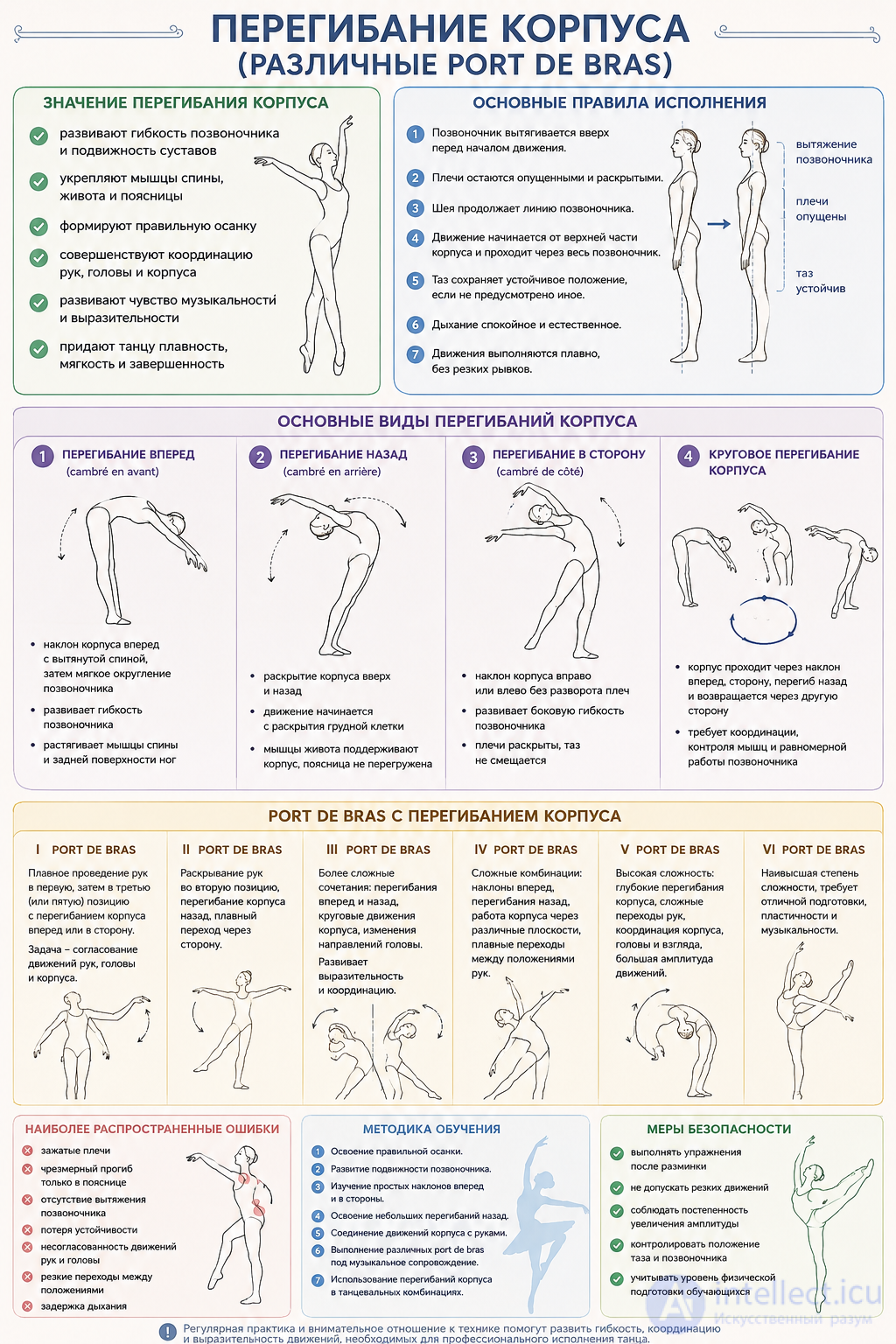
Bends of the torso perform several important functions:
When performing bends of the torso, the following requirements must be observed:
The torso smoothly inclines forward from the hip joints while the back stays stretched. A soft rounding of the spine then follows, and the torso returns to the starting position.
Purpose:
Features of execution:
One of the most difficult movements. The torso gradually opens upward and back while the stretch of the spine is maintained.
Basic requirements:
This movement requires good preparation and sufficient flexibility.
The torso inclines smoothly to the right or to the left without turning the shoulders.
Develops:
During the movement both shoulders remain open, and the pelvis does not shift.
The torso passes successively through a forward incline, a side bend, a backward bend, and returns through the other side.
This movement requires:
In the academic school several basic forms of port de bras are distinguished, each of which combines different positions of the arms, head and torso.
The simplest form.
It is performed by smoothly carrying the arms through the preparatory position into first, then into third (or fifth) position, with a soft bend of the torso forward or to the side.
The main task is to learn to coordinate the movement of the arms, head and torso.
Includes:
Develops plasticity and freedom of movement.
Contains more complex combinations:
Used to develop expressiveness and coordination.
Represents a more complex combination that includes:
Requires good preparation.
These forms are distinguished by a high degree of difficulty in execution.
They contain:
They are usually studied at the more advanced stages of training.
The following mistakes are often encountered when performing bends of the torso:
The training is built up gradually.
The sequence of work:
To avoid injury it is necessary to:
Bending of the torso in its various forms of port de bras is one of the most important means of forming the professional technique of classical dance. It fosters the development of flexibility, strength, coordination and musicality, and cultivates expressiveness and plasticity of movement. A skillful mastery of bends of the torso allows the dancer to command their body freely, to create expressive stage images and to achieve a high level of performing culture. It is for this reason that the study of the various kinds of port de bras occupies an important place in the training of ballet artists and students of choreographic schools.
Sign in and the lectures you have studied will be marked in this list.
Choose a course
Comments