
Lecture 10 min.
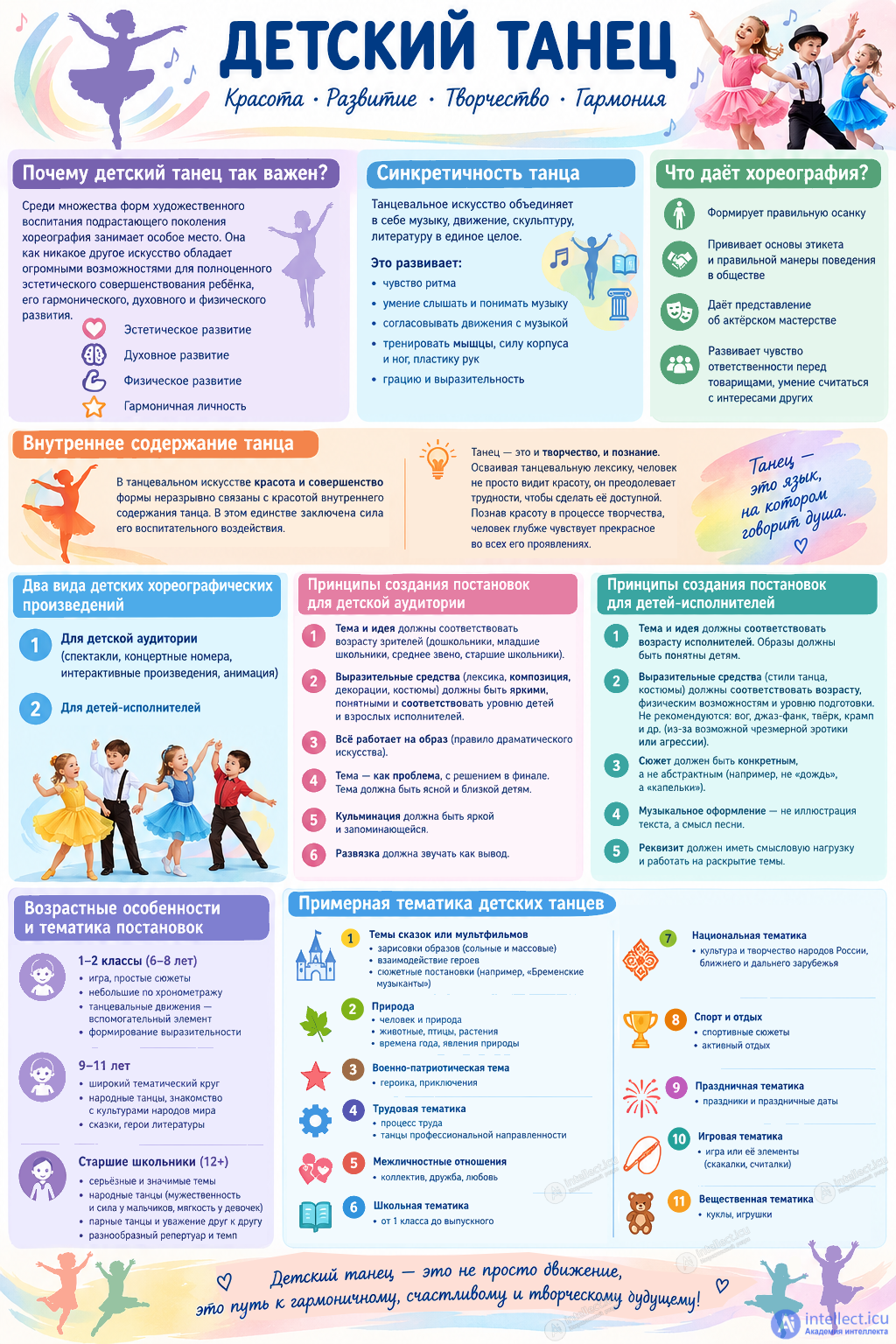
Among the many forms of the artistic education of the younger generation, choreography occupies a special place. Like no other art, it possesses enormous possibilities for the full aesthetic development of a child, for the child's harmonious, spiritual and physical growth. The syncretism of the dance art (syncretism being the fusion of heterogeneous elements (music, movement, sculpture, literature) into a single whole) implies the development of a sense of rhythm, the ability to hear and understand music and to coordinate one's movements with it, while simultaneously developing and training the muscles, the strength of the torso and legs, the plasticity of the arms, grace and expressiveness. At the same time, choreography classes place an enormous physical load on the body. Dance classes form correct posture, instil the fundamentals of etiquette and of proper behaviour in society, and give an idea of the actor's craft. Since the learning process takes place within a group, dance classes develop a sense of responsibility towards one's fellows and the ability to take the interests of other participants into account.
In the art of dance, beauty and perfection of form are inseparably linked with the beauty of the dance's inner content. This unity contains the strength of its educative effect; besides this, the performance of a dance carries within it elements of artistic creativity. The very process of learning to dance is active, creative, and awakens the artistic principle in a person. In mastering dance vocabulary, a person does not merely perceive beauty passively; he overcomes certain difficulties and does no small amount of work so that this beauty becomes accessible to him. Having come to know beauty through the process of creation, a person perceives and feels the beautiful more deeply in all its manifestations, both in art and in life.
Children's works of choreographic art can conventionally be divided into two kinds:
1) Choreographic productions for a child audience (performances, concert numbers, interactive works, animation)
2) Choreographic productions for child performers.
Let us examine the basic principles for creating choreographic
productions for a child audience:
- The theme and idea of a choreographic production for a child audience must correspond to the age of that audience. It should be remembered that the main age groups of children are as follows: preschoolers, younger schoolchildren, middle-school pupils (adolescents), and older schoolchildren (young men and young women).
- The expressive means (dance vocabulary, composition, set design, costumes) of such choreographic works (performances, concert numbers, etc.) must correspond to the level of adult performers, while at the same time vividly portraying the characters and clearly conveying the events taking place in the choreographic work. At the same time, if children take part in the production, the expressive means must correspond to their age and level of choreographic training.
- One must remember the basic rule of dramatic art – everything works for the image.
- The theme of such choreographic works should be presented as a problem and resolved by the end of the production. The theme must be clear to children of whatever age. Themes can be extremely varied: good and evil, positive and negative qualities, friendship and betrayal, love, feelings, and so on.
- When staging choreographic works for a child audience it must also be remembered that everything works towards the finale. Here the climax of the work must be the turning point in the revelation of the theme, and the resolution must sound like a conclusion.
- The climax must be vivid and memorable; it cannot be smoothed over, blurred, or sluggish.
Let us examine some of the rules for creating choreographic productions for child performers.
- The idea and theme of the production must correspond to the age of the performers. Children and adolescents must clearly understand what they are dancing about and who their characters are. The images proposed for embodiment must be known and understandable to children.
- The expressive means of choreographic works for child performers must strictly correspond to the children's age, physical capabilities and level of choreographic training. Special attention must be paid to the choice of dance style (some contemporary dance styles may be inadvisable for children to perform – vogue, jazz-funk, twerk, krump, and so on). It is no less important to approach the choice of costumes for child performers correctly. Today there is an enormous variety of styles and trends in contemporary dance, which can often be excessively erotic or aggressive for children to perform.
- The plot of the choreographic production and the acting tasks must be accessible to a child's imagination; concrete rather than abstract images are preferable - for example, not «rain» but «raindrops».
- A song is often used as the musical setting for a children's choreographic production. In this case the production should trace not an illustration of the words but the meaning of the song - not what is being sung, but what the song is about.
- Props are very often used in choreographic productions for children. These can be all kinds of objects that serve as an additional expressive means. It is important for the object in the production to carry meaning; it must work towards creating the images and revealing the theme and conception of the production. The object must remain active from the beginning to the end of the production.
The choice of subject matter for staging work must, above all, be based on the age-related characteristics of the children. For pupils in grades 1-2 it is built mainly on elements of play. At its heart should be an interesting and engaging dance content, of course a very simple one. The dance movements are of an auxiliary character. The main thing is to accustom children to spontaneity and expressiveness of performance; in doing so they develop an important quality - their movements become a means of creating a dance image and of revealing the content of the production.
For pupils in grades 1-2 one should stage productions that are short in running time. Their subject matter can be varied: fairy-tale plots – «Little Red Riding Hood and the Wolf», «The Seven Dwarfs», «Zaika-Zaznaika» (The Boastful Bunny), «The Turnip», and simple folk dances. Children aged 9-11 are the most active in class, yet have not yet lost the childlike spontaneity that so favourably distinguishes them from adolescents. The thematic range of productions for children of this age is wider. Folk dances can hold great importance in an ensemble's repertoire. By performing them, children become acquainted with the life, everyday customs and national characteristics of one people or another. A choreography teacher should draw material for creative work as often as possible from the inexhaustible spring of folk dance, including in a children's ensemble's repertoire more vivid and varied dances of the peoples of the world. One can create dance pictures, suites, one-act ballets. The themes vary widely: both fairy tales and works on contemporary subjects. Productions featuring beloved children's literary characters are recommended: «Buratino», «Cipollino», «Thumbelina».
Older schoolchildren differ significantly from younger ones. The subject matter of productions shifts towards greater seriousness and substance, both in content and in technical execution. Folk dances are foremost among these; in boys they should acquire traits of manliness and strength, and in girls, smoothness and softness. Children of this age willingly play adult roles in mass productions for younger children. Partnered dances should be planned for, cultivating a natural, respectful attitude of the boy towards the girl, and vice versa. The repertoire of a children's dance ensemble must without fail be varied. The choice of tempo for compositions is also very important. One must not stage only fast numbers; they should be alternated with smooth, slow dances.
Sample subject matter for children's dances:
1. Themes from fairy tales or cartoons
- A dance can be a sketch of the main characters' images, in solo versions («Vanka-vstanka», the Roly-Poly Doll), or in ensemble versions («Thumbelina and the Flowers»).
- It can reflect the plot through the interaction of the characters («Little Red Riding Hood and the Grey Wolf»).
- The plot can be based entirely on the storyline of a fairy tale or cartoon («The Bremen Town Musicians»).
2. The theme of nature, reflecting the relationship between man and nature, portraying images of animals, birds, plants, the seasons, and natural phenomena.
3. Military-patriotic themes, heroism, adventure.
4. Themes of labour: the work process, dances with a professional orientation.
5. Themes of interpersonal relationships: relationships among people in a group, the theme of friendship, of love.
6. School themes: everything that happens to children from grade 1 to graduation.
7. National themes: cultivating interest in and respect for the culture and creative work of the peoples of Russia and of neighbouring and more distant countries.
8. The theme of sport and leisure.
9. Festive themes: reflecting the motifs of holidays and festive dates.
10. Play-based themes: their content is a game or elements of one (skipping ropes, counting rhymes).
11. Object-based themes (dolls, toys).
1. Into which types can children's choreographic productions be divided.
2. What genres are included among choreographic works for a child audience.
3. What is distinctive about the choice of subject matter and expressive means needed for staging a choreographic work for a child audience.
4. Name one of the rules of dramatic art.
5. What themes can be proposed for staging a choreographic work for a child audience.
6. What is distinctive about the climax and resolution of a choreographic work for a child audience.
7. What must be given special attention when carrying out a choreographic production for child performers.
8. What should the images in a children's choreographic production be like.
9. Can a song be used as musical accompaniment for a children's choreographic production.
10. Props in children's dance, and their role.
Sign in and the lectures you have studied will be marked in this list.
Choose a course
Comments