
Lecture 10 min.
The work of a choreographer-director in a children's dance company is quite demanding. The director of such a company must combine the tasks of aesthetic education and moral upbringing of children with pedagogical and choreographic work. One of the main problems faced by the directors of choreographic clubs is the problem of ever-increasing demands placed on children's performances at various concerts held by their parent institutions. In addition, the director of a choreographic club must work under conditions of limited time, with students of average and weak ability, and, finally, must deal with a constant influx of new members and the partial attrition of existing ones. Under these circumstances, the choreographer must be able to choose the optimal path for achieving the goal of his work.
A modern teacher-choreographer must be able to use the material of his or her art to reveal to students the patterns linking form and content, and the ways in which life is reflected in the art of choreography. Generalizing the experience of leading choreographers has produced a number of recommendations that may be useful to directors of children's ensembles of any choreographic profile.
The director of an ensemble should combine the task of training the musculoskeletal system with developing the children's musical, acting and creative abilities. Additional methods that promote a better perception of dance movements, and that are not part of the professional methodology for teaching classical or folk dance, should also be used. Here we mean a variety of exercises and rhythmic movements that serve as preparatory exercises for the subsequent mastery of elements of classical, folk or contemporary dance. Many dance teachers and directors of choreographic ensembles have a solid stock of such movement-exercises, which they share at seminars and master classes. As for the director-choreographer's work with elements of the classical or folk dance system, what is needed here is such a «compression» of classical or folk dance movements that the use of a minimum of elements can achieve a maximum of correctness, dance quality, musicality and expressiveness.
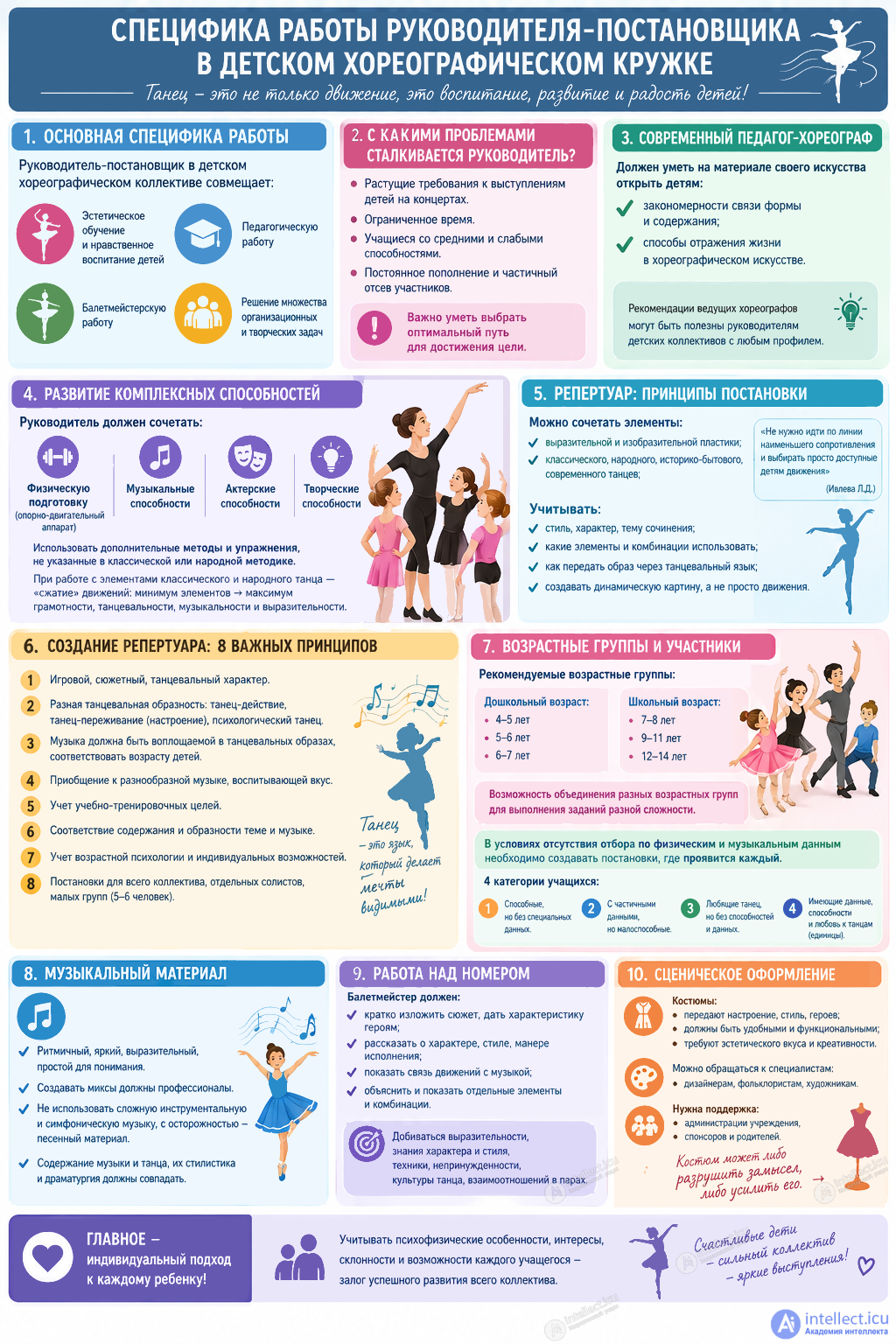
When creating the repertoire of a choreographic club, elements of expressive and pictorial plasticity can be combined with elements of classical, folk, historical-everyday and contemporary dance. In the view of L. D. Ivleva, when staging a dance one should not take the path of least resistance and simply pick movements that are easy for children. One must take into account the style and character of the piece, which combinations may include particular elements of classical dance, what can be drawn from folk or contemporary dance, and whether the most accessible movements – the dance step, the running step, the polka step, the waltz step, chassé, balancé and others, combined with pictorial and expressive plasticity in combinations of varied lines and turns of the body – will be justified within the image being created. The specific nature of dance language lies in the fact that, like a leitmotif, it can be repeated, varied and modified.
Therefore one should create not merely movements but a dynamic picture of them (by analogy with a picture of sounds in music). In this connection, the choreographer's task is the constant enrichment of his knowledge – on the one hand of his art and of music, and on the other of the developmental psychology of his students.
Building the repertoire is the most important issue in working with an ensemble across different ages and years of training, and the main problem faced by the directors of choreographic ensembles. When creating a specific repertoire, certain requirements must be observed, although it is impossible to compose «by recipe» a dance number that demands undoubted creative ability from the choreographer.
In creating a dance number, one must take into account the specific way in which dance reflects life. For one and the same age group, the most varied dances need to be created: 1. Of a playful, narrative, dance-driven character. 2. Different kinds of dance imagery should be used: dance-as-action, dance-as-feeling (mood), and psychological dance. 3. When choosing musical material, one should proceed from the possibility of embodying it in dance images appropriate to the children's age-related capabilities. 4. One must take into account the need to introduce students to a variety of music that cultivates good taste. 5. Educational and training goals must be taken into account. 6. In working out a choreographic number, its content and imagery must proceed from its theme, as dictated by the musical material. 7. One must bear in mind the developmental psychology of children, their capacity for concrete, abstract and associative perception and reproduction of the content of the number being staged, and proceed from the individual capabilities of the performers when staging the number. 8. Dance works must be created with the whole ensemble in mind, as well as individual soloists and groups of five or six (which makes it possible to work with two casts), since it is important, in concert performance, to involve all the children, based on their capabilities and abilities.
In children's choreographic ensembles the age range is quite wide; club members are usually grouped into several age groups, for example: 4-5, 5-6 and 6-7 years old – the three age groups in a preschool institution; 7-8, 9-11 and 12-14 years old – the main groups in a school club. When staging certain choreographic works, it becomes necessary to combine participants from different age groups, giving them tasks of varying difficulty.
In children's choreographic clubs there is often no selection of students by physical or musical aptitude; everyone who wishes to join is accepted into the ensemble. In such a situation the director must create productions that allow every member of the ensemble to show what he or she can do. This is another difficulty of working in a choreographic club, one that requires the choreographer to have creative imagination and a particular talent for selecting dance elements for the production. Students of children's choreographic ensembles can conditionally be divided into four categories:
1) those who are able, who quickly grasp and remember the material offered, but lack special physical aptitude, 2) those with partial special aptitude (leg extension, instep or jump, and flexibility), but who, as a rule, have limited ability, grasp the material poorly and remember it weakly, 3) those who show neither ability nor special aptitude, but who love dancing passionately, 4) those who have both aptitude and ability and a love of dance (there are, as a rule, very few of these). In light of this, the choreographer must take into account the individual traits of the children and try to find each member of the ensemble his or her own particular place within the choreographic production.
The director of a children's choreographic ensemble must remember that correctly chosen musical material – is the key to the success of a future choreographic production. Music is selected with the age-related characteristics of the children in mind. It should be rhythmic, vivid, expressive and easy for children to understand. Music mixes should be created by professionals, who competently select and splice together fragments of music. It is undesirable to use, for children's choreographic productions, music written for instrumental performance, or symphonic music, and song material also needs to be treated with caution. The director-choreographer should not forget that the content of the music and of the dance, and their style and dramaturgy, must coincide.
When beginning to teach a dance, the choreographer briefly explains the plot of the production, gives a description of the characters, if there are any, or explains what the particular dance is about. He should tell the children about the character, style and manner of performance, point out the connection between the movements and the music, and show how the individual movements and dance combinations should be performed. A competent teacher-choreographer begins in advance to introduce preparatory exercises and elements of future dance movements and combinations into the training work. It is in this way that children gradually master the movements of the dance and develop their performing technique, which is later reflected in the quality of the production. The choreographer must obtain from the performers expressiveness, knowledge of character and style, technique, and ease in performing the dance. Particular attention should be paid to the relationship within pairs, and to the culture of the dance as a whole.
The stage design of a choreographic work is the final accent before the members of the dance club meet their audience. A dance costume – is a special kind of clothing that conveys the mood of the dance and its style, and that characterizes the characters acting on stage. For this reason, it is impossible to design a stage production properly simply by choosing costumes from what is already available. The director of the club must have aesthetic taste, be able to combine colours, and take a creative approach to designing costumes for the production. Help in creating costume sketches should be sought from specialist designers, folklorists and artists. The colour of a costume, its cut, decorative quality, comfort and functionality can either undermine the choreographer's concept or, on the contrary, enhance and highlight the merits of the performers, the choreographer and the parent institution. In this work, the director certainly needs the help of the parent institution's administration, of sponsors, and, of course, of the ensemble members' parents.
The key to the successful development of an entire children's choreographic ensemble lies in applying an individual approach to the children, based on the psychophysical characteristics, interests, inclinations and capabilities of each student.
1. Identify the areas of activity of a choreographic club director
2. Identify the problems that arise in the process of working with a children's choreographic ensemble
3. How do you understand the recommendations for mastering the technique of performing dance elements
4. What must be taken into account when building the repertoire of a choreographic club
5. The specifics of working with children in a choreographic club
6. The characteristics of musical material for the repertoire of a choreographic club
7. What methods does a choreographic club's director-choreographer use in his work
8. What is the role of stage design in the choreographic productions of a dance club
Sign in and the lectures you have studied will be marked in this list.
Choose a course
Comments