
Lecture
INTENSION AND EXTENSION are concepts introduced by the Austrian logician and philosopher R. Carnap for the analysis of the meaning of linguistic expressions. The method of intension and extension represents a modification and further development of the semantic conception of the German mathematician and logician G. Frege. But whereas for Frege the starting and basic concept was that of a name, Carnap was oriented more toward the role of adjectives — he analyzed predicates. The statement "Socrates is a man" can be interpreted in two ways. One can hold that this statement ascribes to Socrates a certain property, "being a man". At the same time, this statement can be viewed as saying that the individual Socrates is included in the class of men.
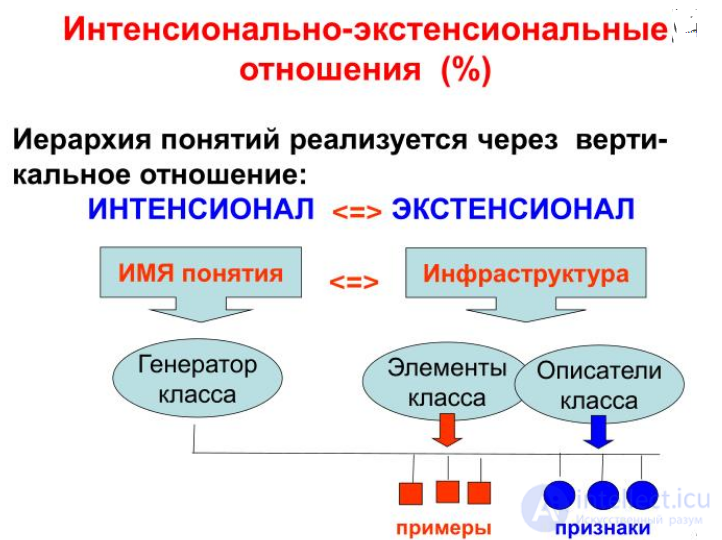
Intension (from Latin intensio — intensity, tension, effort) — a term in semantics denoting the content of a concept, that is, the set of conceivable features of the object or phenomenon designated by the concept. For example, the intension of the concept «Socrates» includes all the properties that Socrates possesses: human, male, Greek, philosopher, etc. Intension is opposed to extension, that is, the set of objects that can be named by a given linguistic unit.
The concept of intension was introduced by the German logician and philosopher R. Carnap for the analysis of the meaning of linguistic expressions. The so-called method of intensions and extensions represents a modification and further development of the semantic conception of the German mathematician and logician G. Frege.
The concept of intension arose from the need to revise the traditional categories of logic and linguistics in light of the antinomies of the naming relation. Such antinomies arise in certain contexts when an expression is replaced by one that is identical to it in referential meaning. For example, in the statement «Peter believes that Kabul is the capital of Pakistan», the proposition «Kabul is the capital of Pakistan» is not definitely false [for Peter], since the concept «Kabul» does not explicitly denote the capital of a specific state (that is, Peter may not know that the capital of Pakistan is not Kabul, and that Kabul is not the capital of Pakistan). When the concept «Kabul» is replaced by the referentially identical «capital of Afghanistan», the proposition «the capital of Afghanistan is the capital of Pakistan» arises, which is false and introduces a contradiction into the overall statement.
The intension of a concept is defined not only through its opposition to extension, as the domain of its referential reference, but also through its opposition to the linguistic form of the concept. For example, the words «brother» and «only-born» (there is an obvious error in this example: the word «only-born» means «the only child of one's parents» and is incompatible with the word «brother»; a brother can be full, paternal half-, maternal half-, step-, adoptive, etc.) share a common intension (they possess the same set of conceivable features of the object) but have different linguistic forms. Here, in opposition to the linguistic form, the intension acts as its signified, its significatum.
The concepts of intension and extension underlie the distinction between the so-called intensional and extensional contexts.
An intensional context is a set of statements in which substitution is permissible only for intensionally equivalent expressions, (that is, both the intensions and the extensions of the expressions matter for it). An extensional context is a set of statements in which substitution is permissible only for extensionally equivalent linguistic expressions (that is, only the extensions of the expressions matter for it).
For example, the extension of the term «human» is the class of humans. The predicates «a being capable of thought» and «a being having limbs» are extensionally equivalent, since both can be denoted by the term «human». The predicates «a being capable of thought» and «a being capable of producing tools» are equivalent not only extensionally but also intensionally, since both can be denoted by the term «human», and both express a property that constitutes the term «human».
Distinguishing such contexts is important when defining a concept. For example, from the definition of the concept «brothers in reason» as 1) «beings capable of thought» 2) «beings having limbs» 3) «beings capable of producing tools» — definition 2 should be excluded, since brothers in reason need not be humanoid.
Extension (from Latin extentio — extent, space, expansion) — a term in semantics denoting the scope of a concept, that is, the set of objects that can be named by a given linguistic unit (category). For example, the extension (category) of the concept «human» includes all objects possessing the property «being human» (Socrates is a human, a philosopher is a human, a thinking being is a human, etc.).
The concept of extension was introduced by the Austrian logician and philosopher R. Carnap for the analysis of the meaning of linguistic expressions. The so-called method of intensions and extensions represents a modification and further development of the semantic conception of the German mathematician and logician G. Frege.
The statement «Socrates is a human» can be interpreted in two ways. The statement can be viewed as saying that Socrates possesses a certain property, «being human» (Socrates is human). At the same time, the statement can be viewed as saying that the individual Socrates is included in the class of humans (Socrates is a human).
The example shows that a predicate (in this case «human»), can denote both the possession of a property (Socrates is human) and membership in a class (Socrates is a human). The class denoted by a predicate expression is precisely what is called the extension of that expression. That is, in this case «Socrates» belongs to the extension of the concept «human».
Thus extension is opposed to intension, which denotes the set of properties of a concept/term that actually constitute the concept/term in one's mental representation. That is, more precisely, the extension of a concept should be understood as the set of objects that satisfy the intension of the concept.
A special case of extension is the extension of a proper name. Such a singular extension is conventionally taken to be the object denoted by that name.
The concepts of intension and extension underlie the distinction between the so-called intensional and extensional contexts.
An intensional context is a set of statements in which substitution is permissible only for intensionally equivalent expressions, (that is, both the intensions and the extensions of the expressions matter for it). An extensional context is a set of statements in which substitution is permissible only for extensionally equivalent linguistic expressions (that is, only the extensions of the expressions matter for it).
For example, the extension of the term «human» is the class of humans. The predicates «a being capable of thought» and «a being having limbs» are extensionally equivalent, since both can be denoted by the term «human». The predicates «a being capable of thought» and «a being capable of producing tools» are equivalent not only extensionally but also intensionally, since both can be denoted by the term «human», and both express a property that constitutes the term «human».
Distinguishing such contexts is important when defining a concept. For example, from the definition of the concept «brothers in reason» as 1) «beings capable of thought» 2) «beings having limbs» 3) «beings capable of producing tools» — definition 2 should be excluded, since brothers in reason need not be humanoid.
In mathematics, the «extension» of a mathematical concept{\ displaystyle C} is a set that is defined by{\ displaystyle C}. (At present, this set may be empty. )
For example, the extension of a function is the set of ordered pairs that pair arguments with the function's values; in other words, the graph of the function. The extension of an object in abstract algebra, such as a group, is the underlying set of the object. The extension of a set is the set itself. The idea that a set can capture the notion of the extension of something is the idea underlying the axiom of extensionality in axiomatic set theory.
This kind of extension is used so constantly in modern set-theory-based mathematics that it can be called a tacit assumption. A typical effort in mathematics develops from an observed mathematical object requiring description, where the task is to find a characterization for which the object becomes the extension.
In computer science, some database textbooks use the term «intension» to refer to the database schema, and «extension» to refer to the specific instances of the database.
In metaphysics there is an ongoing dispute over whether, besides actually existing things, there also exist things that are non-actual or non-existent. If there are — if, for example, there are possible but non-actual dogs (dogs of some non-actual but possible species, perhaps) or non-existent beings (Sherlock Holmes, perhaps) — then these things may also figure in the extensions of various concepts and expressions. If not, then only existing, actual things can be in the extension of a concept or expression. Note that «actual» may not mean the same thing as «existing». There may be things that are merely possible but not actual. (Perhaps they exist in other universes, and those universes are other «possible worlds».) Actuality is possibly an alternative to the real world. Possibly, some real things do not exist (Sherlock Holmes, it seems, is an actual example of a fictional character one might think of; there are many other characters that Arthur Conan Doyle possibly invented, though it is Holmes he actually invented.)
A similar problem arises for objects that no longer exist. The extension of the term «Socrates», for example, seems (at present) to be a non-existent object. Free logic is one attempt to avoid some of these problems.

Comments