
Lecture
Developmental pedagogy – is a branch of scientific knowledge concerned with studying educational and upbringing activity and its specific character in children of different ages.
Developmental pedagogy is a field of pedagogical science and practice that studies and applies specific methods and strategies of teaching and upbringing, taking into account the age-related characteristics of children and adolescents. This field of pedagogy seeks to understand how a child's personality develops, and what changes occur in his or her cognitive, physical, social and emotional spheres at different stages of life.
Developmental pedagogy is also aimed at determining the best ways of interacting with children in accordance with their age-related needs and abilities, creating conditions for their optimal learning and development. Specialists in this field work with children from early childhood to adolescence, and also teach teachers and parents how to interact effectively with children at different stages of their lives.
In this lecture we will examine the main characteristics of developmental pedagogy, including the importance of adapting educational methods to age-related needs, the development of specific approaches to upbringing and instruction at different stages of childhood, and the role of teachers and parents in forming a well-rounded personality in children.
The object of study is the child, from the very moment of birth up to reaching the age of majority. Another name for the branch is the pedagogy of childhood. The subject matter of the science includes the methods and techniques, principles, means, and technologies for organizing educational and upbringing work at all periods of childhood. The pedagogy of childhood consists of: nursery pedagogy; preschool pedagogy; school pedagogy; higher-education pedagogy; and the pedagogy of the «third age».
DEVELOPMENTAL PEDAGOGY is a special group of pedagogical sciences that studies educational and upbringing activity and its characteristics within different age groups.
It includes:
Developmental pedagogy includes the following:
THE OBJECT OF DEVELOPMENTAL PEDAGOGY
The object of developmental pedagogy is the child, from the moment of birth to the transition into adulthood. Developmental pedagogy is otherwise known as the pedagogy of childhood.
THE SUBJECT MATTER OF DEVELOPMENTAL PEDAGOGY
The subject matter of developmental pedagogy includes the methods, regularities, means, and technologies for organizing the educational and upbringing process at different stages of childhood.
Developmental psychology — is a branch of psychological science that studies the facts and regularities of human development and the age-related dynamics of the human psyche.
The following branches of developmental psychology have been identified:
preschool childhood - when the child has a maximal need for the help of adults in satisfying basic life needs and a minimal capacity for self-protection from environmental influences;
early school-age childhood - a period in which the family continues to help satisfy the child's material-biological and emotional needs, but in which the social-cognitive needs are met for the most part by the school, and the child's capacity to withstand environmental influences remains slight;
later childhood, when the family's material and emotional functions are retained, but teachers and self-education, self-upbringing, partial independent satisfaction of material needs, full legal capacity, and a maximal capacity to withstand environmental influences come to the fore in satisfying the schoolchild's cognitive and social needs.
adolescent childhood is characterized by a high role of the family in satisfying the child's material and emotional needs, a maximally growing role of the educational institution and peers in satisfying needs of a social-cognitive character, a growth in the child's capacity to withstand the world around him, the emergence of legal responsibility, and the formation of heightened susceptibility to negative influences in the sphere of free communication.
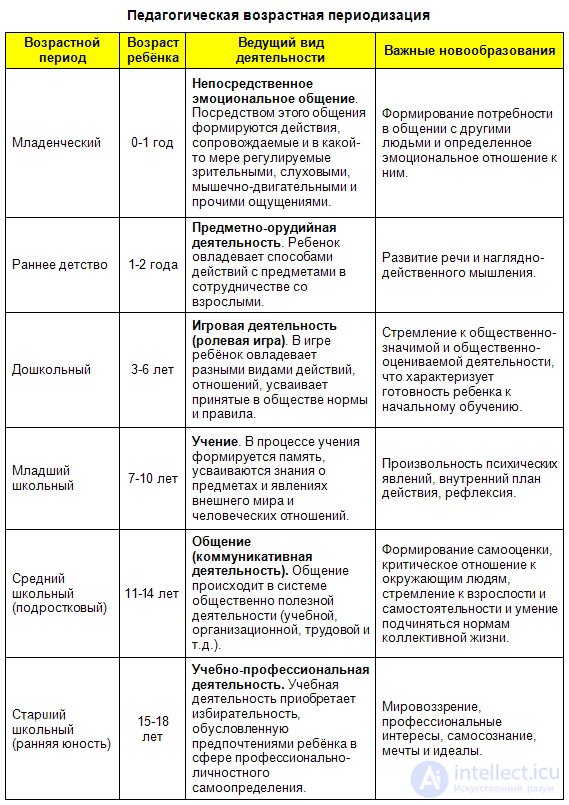
Developmental pedagogy concentrates on the following aspects of childhood:
Each of these aspects has specific content at every period of childhood
Characteristics of the Aspects of Developmental Pedagogy

Comments