
Lecture
Clinical teaching is teaching in the workplace or at the patient's bedside.
Models of clinical teaching: the Stanford Faculty Development Centre clinical teaching model, the Microskills teaching model, often called the «One-Minute Preceptor» AMEE Guide no. 34: Teaching in the clinical environment
Clinical teaching model
Stanford Faculty Development Centre
1. Promoting a positive learning climate
2. Teacher-learner interaction
3. Communicating goals: planning goals within the teacher-learner interaction
4. Promoting the understanding, application and consolidation of knowledge, abilities and skills
5. Evaluation
6. Feedback
7. Promoting self-directed learning.
The Microskills / «One-Minute Preceptor» teaching model, 5 steps (1)
1. Get a commitment: The teacher encourages learners to formulate their own opinion about the differential diagnosis and management approach. The teacher must create a safe learning environment so that learners feel secure enough to commit to a decision - even if it turns out to be wrong. 2. Probe for supporting evidence - The teacher should prompt learners to "think aloud" and justify the commitment they have just made regarding diagnosis, treatment, or other aspects of the patient's problem. Teachers should either confirm the learners' commitments or gently correct them if mistaken.
3. Teach general rules – what key information the learner should take away from a given case. It is often useful to describe to students what lesson they have learned while working with the patient.
4. Reinforce what was done correctly, in order to encourage them to continue in that direction
5. Correct mistakes: learners are often unaware of their errors and need feedback and recommendations in order to improve their performance.
McGee and Irby ambulatory teaching model: Preparation for the visit, Teaching during the visit, Teaching after the visit
The SNAPPS model
1. S ummarize briefly history and exam findings: briefly summarize the history and the examination findings
2. N arrow the differential diagnosis - narrow the differential diagnosis down to 2-3 possible diagnoses, taking responsibility for the choice.
3. A nalyse the differential diagnosis: – carry out an analysis of the reasoning by analyzing the findings or examining the evidence - compare and contrast the options. 4. P robe the preceptor by asking questions about uncertainties, difficulties, or alternative approaches - probe the preceptor by asking questions about doubtful points and alternative methods.
5. P lan management for the patients medical issues – draw up a plan for managing the patient.
6. S elect a case-related issue for self-directed learning.– Select a case-related issue for self-directed learning.
19 Bedside teaching:
12 practical tips.
1. Preparation
2. Planning
3. Orientation
4. Introduction to bedside work
5.Interaction: Clinical teachers should act as role models
6. Observation
7.Instruction: Clinical teachers should avoid asking learners impossible questions
8. Summarize (teacher for the learner, for the patient)
9. Debriefing
10. Feedback
11. Reflection
12. Preparation for the next meeting
Outcomes of the effectiveness of clinical teaching / work in the clinical setting: Treatment outcomes (morbidity, mortality, physiological parameters, clinical events such as stroke or heart attack, patient satisfaction, care experience). Treatment process (patient screening, preventive services, specific measures such as HbA1c for diabetes control, prescribing aspirin after a heart attack, etc.). Volume of services provided by the physician (volume of certain procedures).
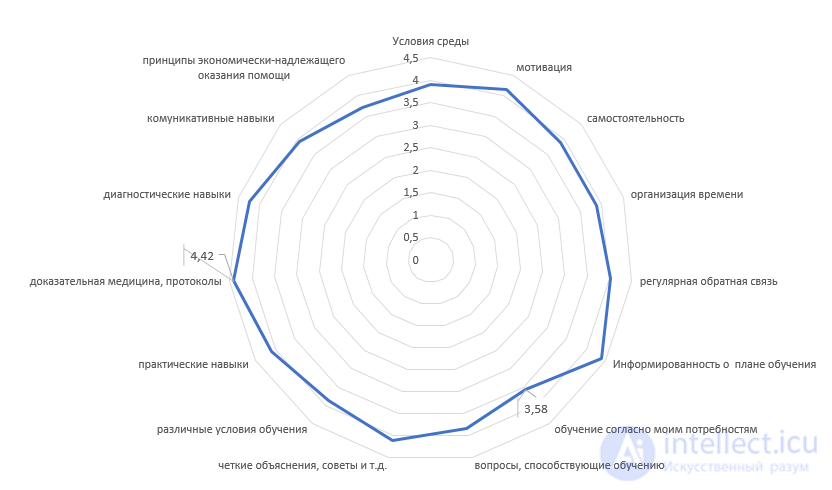
Outcomes of clinical teaching: use of survey instruments. The «Clinical Teaching Effectiveness Instrument» (CCTEI) questionnaire.

Comments