
Lecture
A teacher's career is the process of professional development and work in the field of education. A teacher is a person engaged in teaching and educating students or pupils. A teacher's career can be diverse and depends on the level of education, preferences and specialization.
Here are some key stages of a teacher's career:
Preparation: The first step toward a teaching career is obtaining an appropriate education. This may include obtaining a higher pedagogical education, certification, specialized courses and practical training.
Initial experience: Many teachers begin their careers as trainee teachers or teaching assistants in order to gain experience working with students and develop their skills.
Work at a school or educational institution: Teachers can work at various educational institutions, such as schools, universities, colleges, kindergartens, language centers and others.
Specialization: Teachers can choose a specific area of specialization, such as mathematics, literature, art, physics, sports and others. This allows them to become experts in their field and teach the subject better.
Professional development: Teachers must constantly develop their skills and knowledge by attending seminars and conferences, participating in training programs, and reading specialized literature.
Career growth: Over the course of a career, a teacher can move up the career ladder, becoming senior teachers, heads of educational institutions, methodologists, administrators, and so on.
Making a contribution: Teachers play an important role in shaping the future generation, which is why their work is important and valuable. They make a significant contribution to the education and development of students.
This article examines a teacher's professional advancement and various ways of building a career in this field. Scholars emphasize that a teacher's professional formation is an individual trajectory of professional growth, which can include uneven stages.
The question of when a teacher's career begins remains debatable. Some believe it begins upon graduation from an educational institution, others believe it begins with the start of employment, and still others date it to the establishment of a relationship with an employer or the receipt of a first employment record book.
A career, in the broad sense, is a sequence of stages of development in the important spheres of a person's life, such as family, work and leisure. It is also associated with changes in socio-economic status, status-role characteristics and forms of social activity. The core idea of a career is moving forward, and the more active this movement is, the more important a person's readiness for future events becomes.
In our country, the word "career" used to have a negative connotation, and "careerists" were considered negative characters in literature. Meanwhile, in the West the concept of "career" is widely used, and career guidance is even called the psychology of career.
A teacher's successful career depends on the correctness of their professional choice and professional self-determination. A professional choice can have consequences that can either be taken into account or ignored. Over the course of a lifetime, most people have to make many career-related decisions, and a career itself is a "series of alternating choices," as D. Super states.
Based on differences in personal characteristics, abilities and value orientations, each teacher builds their professional path according to their own uniqueness and attitude toward professional growth.
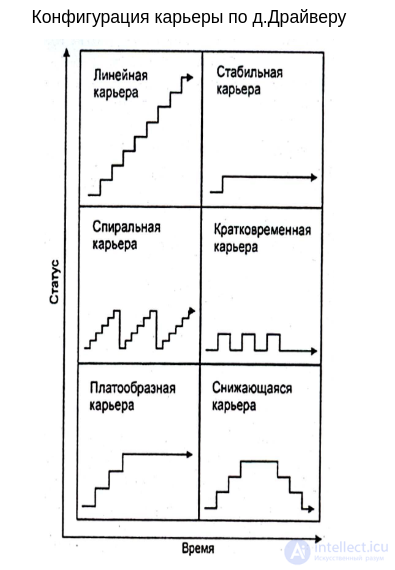
Let us consider the types of career that exist, using a graphical model presented by the American management specialist named Driver. The following types of career are described:
Linear career: A person chooses a particular field from the very start of their career and consistently advances up the hierarchical ladder within that field. Examples include a teacher who becomes the head of a subject-methods committee, then a deputy head, then a school principal, and so on.
Stable career: A person also chooses a field of activity from the very start but remains in it throughout their entire career. Although they raise their level of skill and income, they do not seek to climb the hierarchical ladder within their field. Examples include teachers, doctors and other specialists.
Spiral career: This type of career is typical of people who tend to change jobs every few years because they lose interest. They start with enthusiasm but then move on to a new job. This is typical of restless personalities.
Transitory career: A person frequently changes jobs without a clear goal and remains at a low level in the hierarchy. Such people may be unskilled or undisciplined workers.
Plateau career: A person reaches a certain level in their career, after which they do not advance further due to limitations in their skills or abilities. They remain at this level until retirement.
Declining career: A person starts out successfully, but for various reasons their capacity for work decreases, and they are demoted in the hierarchy or lose the ability to perform their duties.
Defining a goal in one's career is important, and success in a career is often determined by subjective expectations and goals, not only by public recognition.
To determine your idea of a successful life, you are invited to answer several questions:
Once you have determined your goals, you should think about how to achieve them. This includes planning and creating a personal and professional outlook:
Young specialists often find it difficult to determine ways of achieving their life goals and to organize the execution of their plans. However, there is a method that helps with this process, called the "elephant task." For example, learning a foreign language, mastering a personal computer, or writing a book are tasks so difficult that they can be compared in size to an elephant. Solving such tasks usually requires time and effort, just as it is impossible to eat an elephant in one sitting.
To solve the "elephant task", there are two approaches:
Many people torment themselves too much over difficult tasks that they cannot solve right away. Sometimes people are afraid to take on difficult tasks because of the obstacles on the way to achieving their goals, but it is important to remember that the job is never as hard as it looks once you actually start it.
What determines how other people form their impression of you?
The people around you perceive you and form their impression of you on the basis of several factors:
Information that they receive from you and about you. This can include your actions, words, deeds and communication with others. For example, some teachers acquire nicknames based on their personal traits and habits.
The social role that you play in society. For example, if you are a young teacher, for some this may mean that you have less experience, and if you are childless, people may think that you lack experience in raising children, and so on.
These factors influence how the people around you perceive and evaluate you.
Creating your own image is of great importance for professional development. An image is an impression that includes not only appearance but also a person's thinking and actions. An image can be either positive or negative, and it can also be professional or personal.
Image is important because it affects how the people around you perceive and react to you. For teachers, image is especially important, since it affects students' attitude toward and trust in the teacher. Image is formed on the basis of information about you and your social role.
Image can be changed and consciously shaped by transferring behavioral patterns from the conscious mind into the subconscious. This allows you to automatically display optimal behavior and influence how others perceive you.
What elements make up your image? Several groups of characteristics can be identified that affect how others see you:
Natural qualities, such as sociability, empathy, reflectiveness and eloquence, which can be continually improved.
Personal characteristics that depend on your upbringing and education, including moral values, mental health and interpersonal communication skills.
Life experience and professional experience, which can help you choose the right tactics in different situations.
The expression of all these qualities manifests itself through skills, such as the ability to communicate with people and the ability to look presentable and appropriate to the setting.
The formation of an image begins with recognizing the need and the goals, determining the desired impression and audience, and carrying out self-assessment and developing a formation strategy. This process includes analyzing the likelihood of achieving the goals and adjusting the image at each stage, as well as self-improvement and development.
The process of image formation includes the following key stages:
These stages help create and maintain the desired appearance and the impression you want to leave on other people.
Thus, already at the stage of your studies it is important to think about how you want other people to see you, and to try to adjust your attitudes and outward appearance in order to create a positive impression.
Do not forget the words of A. P. Chekhov — "everything about a person should be beautiful: face, clothing, soul, and thoughts".
In conclusion, I want to emphasize that professional development is closely linked to personal growth. As a teacher, you first and foremost shape yourself as a person, because, as an old and wise saying goes, you cannot give what you do not have yourself. It is also important to take technical aspects into account: mastering various teaching methods and techniques gives you room for creativity. Professional self-improvement does not take away your energy and time — on the contrary, it enriches you. For example, at the beginning of your career many problems arise with classroom management, the proper use of instructional time, and methodological preparation. That is why it is important to make use of every opportunity to master the profession better, such as additional courses in pedagogical disciplines and mandatory practical training. These courses will help you answer the following questions:
Having received answers to these questions, you will be able to form your own pedagogical vision, develop the skills necessary for successful pedagogical work, and find your bearings in today's educational environment after completing your studies at the university.
A career as an educator can be rewarding and fulfilling, but it also requires patience, hard work and continuous learning. Success in this field depends on the ability to connect with students, motivate them, and provide quality education.

Comments