
Lecture
Critical thinking (English critical thinking) — is a system of judgments that is used to analyze things and events, formulating well-grounded conclusions, and that makes it possible to render well-grounded assessments and interpretations, as well as to apply the results obtained to situations and problems. In a general sense, critical thinking is understood as thinking of a higher level compared to precritical thinking.
Critical thinking — is a person's ability to question incoming information, including their own beliefs.
Precritical thinking -is the phase of thinking that directly follows the emergence of language and is characterized by the fact that linguistic activity has not yet become its own object, in which "spirits" and mysticism play an important role, and ancient people with this kind of thinking took on faith the most incredible tales about magic and mythical creatures,
There is an opinion that the transition to a critical level of thinking in a given community is a necessary prerequisite for that community's civilizational development to begin.
Postcritical thinking - is a degraded form of critical thinking, with an absent logic and predominating feelings, characteristic of people in the 21st century.
Hybrid thinking - our own consciousness, given to us by nature, will harmoniously complement the capabilities of tens or hundreds of thousands of the world's most powerful computers.
In the narrow sense, critical thinking means «the correct evaluation of statements». It is also characterized as «thinking about thinking». One widespread definition is «reasonable, reflective thinking focused on deciding what to believe and what to do». A more detailed definition is «the intellectually disciplined process of actively and skillfully conceptualizing, applying, analyzing, synthesizing, and/or evaluating information gathered from, or generated by, observation, experience, reflection, reasoning, or communication, as a guide to belief and action».
The term «critical thinking» itself originates with the philosopher John Dewey, who most often used the term as «reflective thinking»: «active, persistent, and careful consideration of any belief or supposed form of knowledge in the light of the grounds that support it and the further conclusions to which it tends».
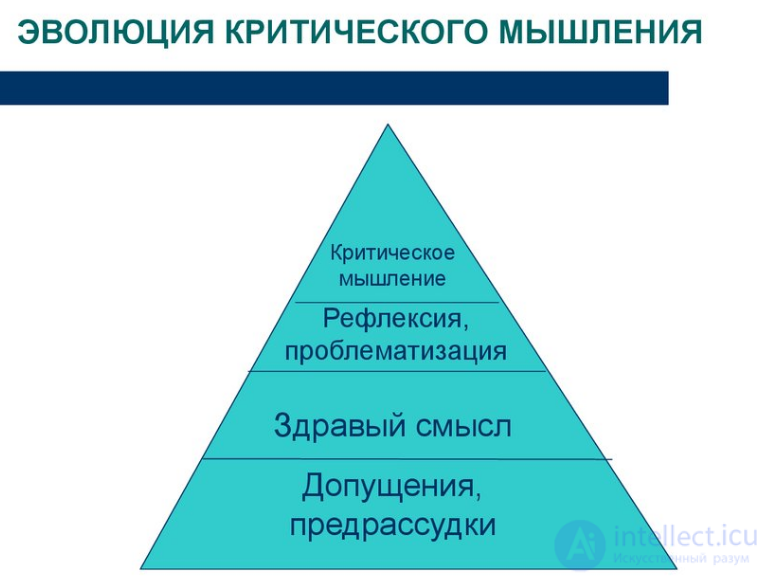
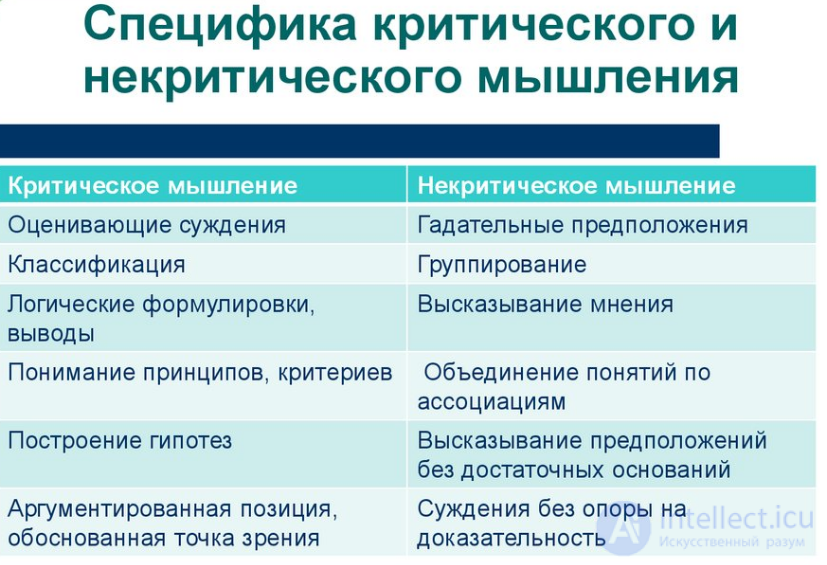
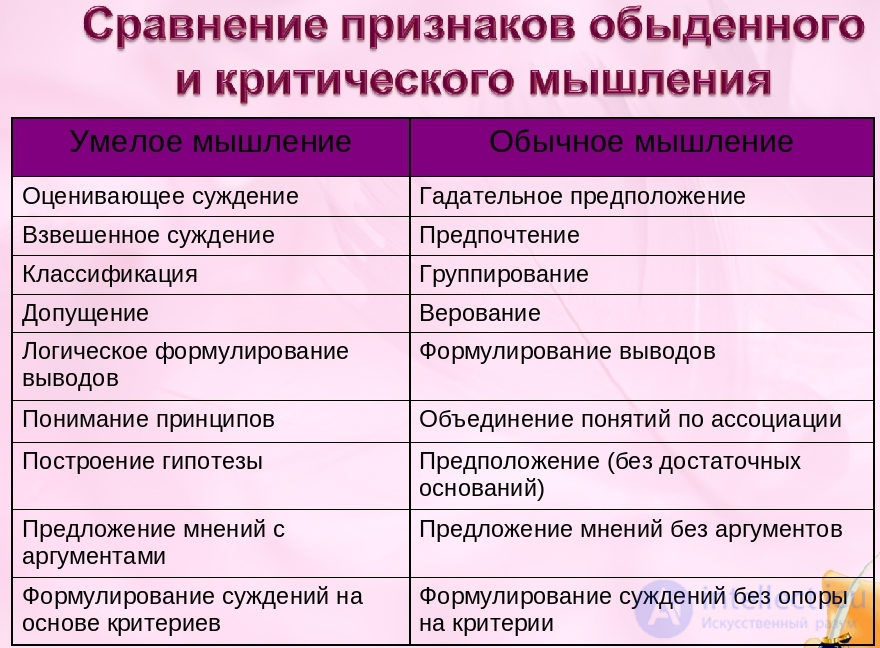
For further clarification of the question of what critical thinking is, Richard Paul (1995) proposed dividing critical thinking into weak and strong forms. He defines critical thinking in the weak sense as the thinking of a highly skilled but selfishly motivated pseudo-intellectual, preoccupied with their own advantage and not seriously considering the ethical consequences of their actions. A person with this kind of thinking is often highly educated, but applies their knowledge in pursuit of unjust and selfish goals. Critical thinking in the strong sense, on the other hand, is the thinking of a person who penetrates the logic of problems in order to study them objectively, without egocentric or sociocentric bias. In this sense, critical thinking is aimed at the wholehearted overcoming of obstacles on the path to truth.
The psychologist Diane F. Halpern regards critical thinking as the use of cognitive methods that are distinguished by being controlled, well-grounded and purposeful, and that increase the likelihood of achieving the desired final result. These methods are used in solving problems, formulating conclusions, probabilistic evaluation and decision-making, and require skills that are valid and effective for the specific situation and type of problem being solved. She further notes that critical thinking is characterized by the construction of logical inferences, the creation of mutually consistent logical models, and the making of well-grounded decisions about whether to reject a given judgment, agree with it, or temporarily postpone consideration of it. All of these definitions imply mental activity that must be directed at solving a specific cognitive task.
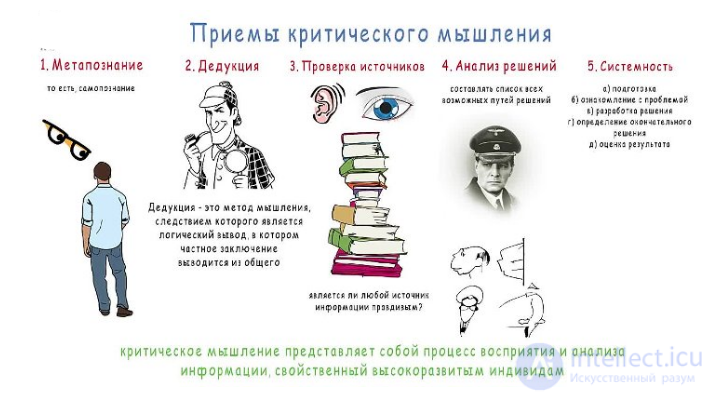
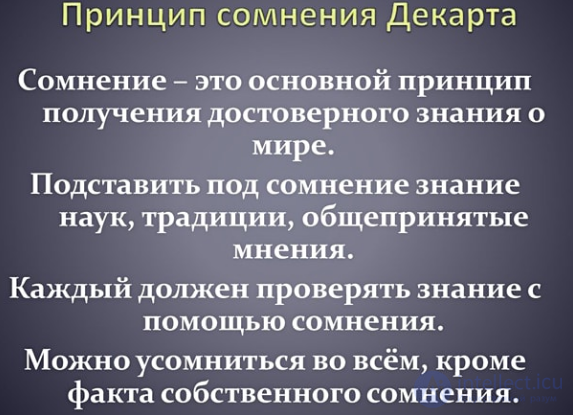
From a pragmatic point of view, critical thinking is regarded as a scientific approach to solving a wide range of problems – from everyday ones to professional ones. The idea of developing critical thinking arose in the USA and has its roots in the works of the well-known twentieth-century American psychologists William James and John Dewey. The founder of the Institute for Critical Thinking, Matthew Lipman [en], defined critical thinking as skillful, responsible thinking that arrives at correct judgments because it is based on criteria, corrects (improves) itself, and takes context into account. American society was among the first to begin turning into an information society, one characterized by accelerating changes. Information began to acquire qualitatively new functions, comparable to the basic functions of landownership in the Middle Ages or of capital in the Modern era. The information revolution contains an important anthropological component, implying the improvement not only of technology, but also of human beings themselves, above all of their thinking. Those who could not adapt to the new conditions of life often could not cope with new, complex questions, and moreover became easy prey for swindlers. In America this problem was taken seriously, and people began to seek new approaches to educating their citizens. M. Lipman began the practice of teaching critical thinking and linked the need for such teaching to the fact that a democratic society needs intelligent citizens, not merely rational ones. The teaching introduced the «Philosophy for Children» program, which made it possible to teach children to think from the earliest grades through to the end of school.
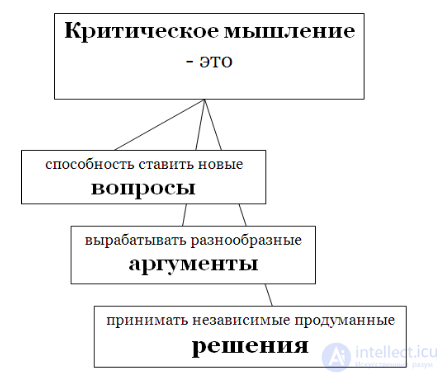
In the not-too-distant future, he supposes, the main capital will no longer be information itself, but its effective producer. Thus, the ability to process information will increase in value, and accordingly critical-thinking skills will become the key to success in the information society. The modern world, the scholar asserts, demands the constant improvement of thinking skills. This is the first weighty reason why critical thinking should be taught. Undoubtedly, the introduction of instruction oriented toward the development of critical thinking is a pressing methodological problem of contemporary education. The 21st century will be a time when it is precisely the mental abilities of individuals, rather than natural resources, capital and technology, that determine the decisive line between success and failure, between leaders and the led. The ability to think critically ensures scientific, technological and social progress and is a guarantee of democracy, and education plays a paramount role in its development.
This type of thinking is necessary for solving nonstandard practical problems. When we are confronted with real problems that cannot be solved using existing knowledge and skills, we then draw on the principles, strategies and procedures of critical thinking. This occurs when solving problem-based tasks, formulating conclusions, making probabilistic assessments, and making decisions. F. Stankato noted that critical thinking is the formulation of judgments regarding the truthfulness and reality of statements or of answers to problem-solving.
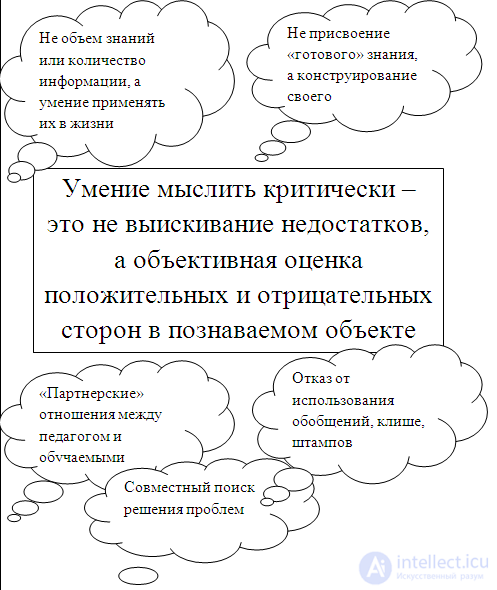
Thus, the main purpose of critical thinking is problem solving (solving tasks), and the chief result of critical thinking is a judgment. Putting forward hypotheses is one of the key skills in critical reasoning, since the presence of a problem presupposes the formulation of assumptions regarding its solution. Psychologically, critical thinking rests on a striving for creative inquiry and a thirst for knowledge. S. A. Terno developed a theory of the development of critical thinking in the learning process.
The set of key skills necessary for critical thinking includes observation, the ability to interpret, analyze, and draw conclusions, and the ability to make evaluations. Critical thinking applies logic and also relies on metacognition and broad criteria of intellectual quality, such as clarity, plausibility, precision, relevance, depth, breadth of outlook and fairness. Creative imagination, value orientations and, to a lesser extent, emotionality are also constituent parts of critical thinking:40.
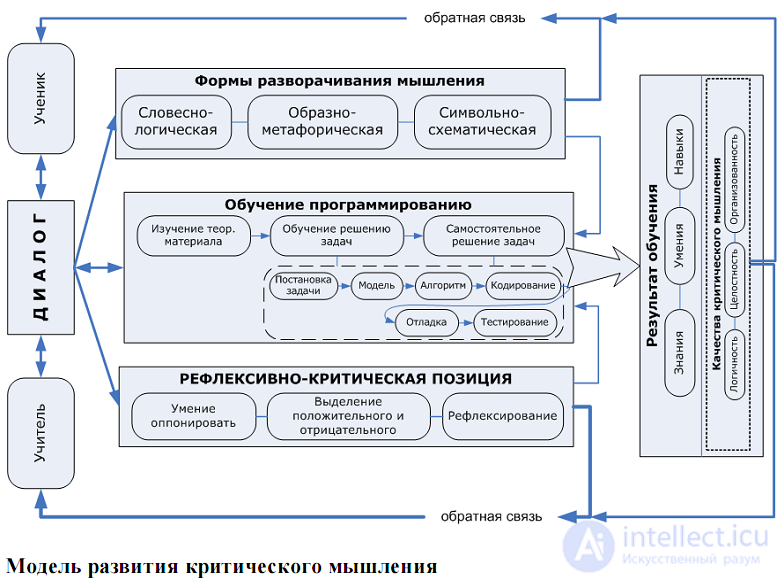
Critical thinking is part of the overall structure of thinking in the process of cognition and is a higher-order form of thinking. The structure of thinking is as follows:
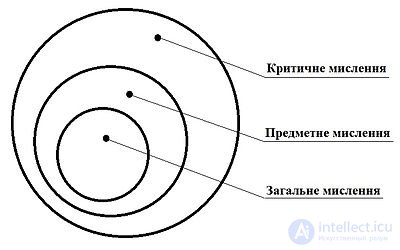
The structure of thinking
Each successive level includes the previous one:
1) general thinking is the general process of processing information;
2) subject-specific thinking is the process of processing information on a particular subject using methods of scientific inquiry, enriched with subject-matter and methodological knowledge;
3) critical thinking is the process of monitoring the course of general and subject-specific thinking and improving them. Each type of thinking has its own content-related and operational components.
One of the contemporary researchers, R. Ennis, names the following as the main and most important dispositions, that is, attitudes, of an ideal critical thinker:
A distinction is also made between two main components of critical thinking:
There exist approaches to the study of critical thinking, which can likewise be divided into two groups:
Thus, critical thinking constitutes an interdisciplinary field of research that includes elements of philosophy, logic, pedagogy and psychology. J. Dewey himself often quoted the classical philosophers, since it is precisely in the history of philosophy that we find examples of critical thinking and special treatises devoted to the improvement of our thinking. The fact is that philosophy represents nothing other than a succession of "research programs"[10]. It is meaningless to ask the question "what is thinking?" outside the context of the various research programs that have been proposed at different times by one thinker or another.
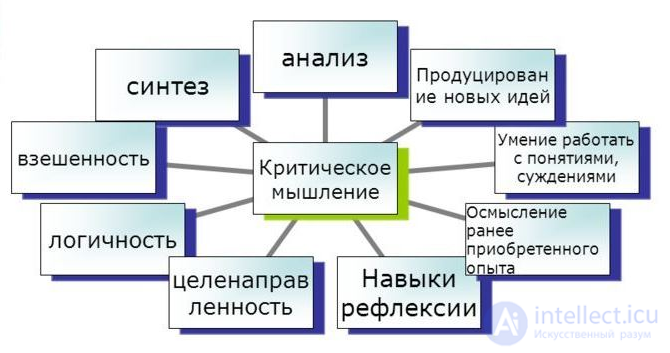
The structure of critical thinking
Fortunately, critical thinking is an acquirable SKILL. There are three simple ways that will help improve critical thinking skills:
1. Critically evaluate beliefs.
2. Argue logically.
3. Think in a well-rounded way.
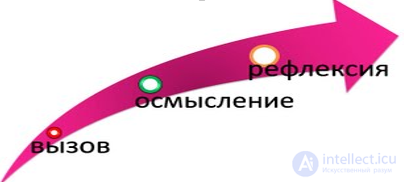
I. Evocation — awakening existing knowledge and interest in the information received, and activating life experience.
II. Comprehension of content (obtaining new information).
III. Reflection (comprehension, the birth of new knowledge).
Functions of the three stages of the technology for developing critical thinking
|
Stage |
Functions |
|
Evocation |
· Motivational (prompting engagement with new information, stimulating interest in the new topic). · Informational (bringing existing knowledge on the topic to the «surface»). · Communicational (conflict-free exchange of opinions). |
|
Comprehension of content |
· Informational (obtaining new information on the topic). · Systematizing (classifying the information obtained). · Motivational (maintaining interest in the topic being studied). |
|
Reflection |
· Communicational (exchange of opinions about the new information). · Informational (acquisition of new knowledge). · Motivational (prompting further expansion of the information field). · Evaluative (relating new information to existing knowledge, developing one's own position, evaluating the process). |
Examples
Evocation 1. «Brainstorming» «Thin and thick questions» Cluster «Culture»
Comprehension 2. Reading with annotations – searching for answers, filling in tables and clusters, composing tests.
Reflection 3 «Match dates and events, terms and definitions», «Duel», «Own game». «Unfinished sentences», «Traffic light», «Ladder of Success», «20 little people».
Evocation-stage techniques
True and false statements ("do you believe"), key words.
Clusters
Identifying the semantic units of a text and arranging them graphically in a certain order in the form of a cluster
Insert
While reading the text, it is necessary to make notes in the margins, and after reading the text, fill in a table where the marks become the column headings of the table. Information from the text is briefly entered into the table.
Effective lecture
The lecture material is divided into semantic units, and the delivery of each of them is built on the technological cycle "evocation - comprehension - reflection". The "Log book" technique is used to organize the activity.
Prediction tree
This technique helps build assumptions about how the plotline of a story or tale will develop.
Diaries and log books
Graphic forms of organizing material can become a leading technique at the comprehension stage. Log books are a generic name for various instructional writing techniques according to which students record their thoughts while studying a topic.
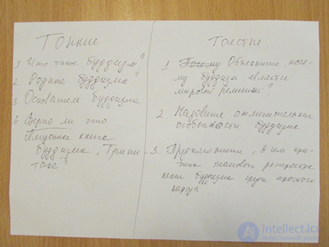
Thick and thin questions
The table of "Thick" and "Thin" questions can be used at any of the three phases of the lesson: at the evocation stage these are questions before studying the topic, at the comprehension stage it is a way of actively recording questions while reading or listening, and during reflection it demonstrates understanding of the material covered.
Tables
There are many ways of graphically organizing material. Among them, the most common are tables. Let us consider several tabular forms. These are the conceptual table, the summary table, the synthesis table, the KWL table, and the "What? Where? When? Why?" table.
Reading with stops
Working with literary texts. The features of literary texts and the possibilities for working with them.
Group work
A student absorbs quickly and thoroughly only what they immediately apply in practice or pass on to others after receiving new information. The purpose of the "Zigzag" technique is to study and systematize a large volume of material; for smaller texts the "Zigzag-2" technique (author Slavin) is used, and the "What do you think?" game is a card game for a group of 4 to 6 people.
Discussions
These are technologies that develop students' experience of collaborative activity. Whereas the "joint search" discussion touches on one aspect of the text, the "Cross-discussion" (Alvermann) allows the text to be seen as a whole, along with its idea and problems.
Writing
A technique that allows one to express their point of view on a person – the "Interview-based essay", creating a "personal" text. Forms of written reflection: Cinquain, Essay.
Reflection techniques
Oral form. The "Two-row round table" aims to exchange opinions on the problem most relevant to the participants. Written form. Portfolio
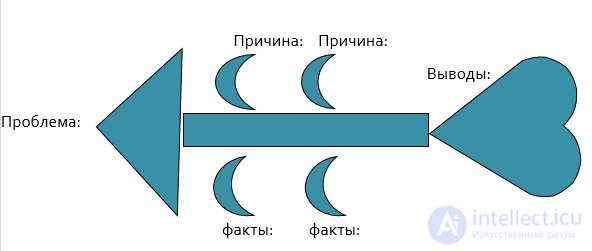
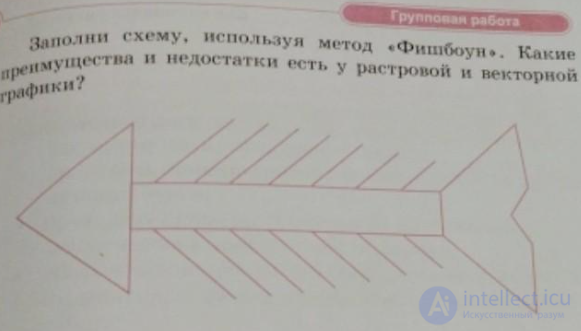
The "Fishbone" strategy
A model for posing and solving a problem, it allows one to describe and attempt to solve a whole range of problems (a field of problems).
The "RAFT" strategy
A socio-game task: R(ole) A(udience) F(ormat) T(opic).
Brainstorming is usually conducted in groups of 7-9 people
1. Creating a bank of ideas. The goal is to generate as many solutions as possible.
2. Analyzing the ideas. Find something useful, a rational kernel, in each idea.
3. Processing the results. The group selects 2-5 of the most interesting solutions and appoints a speaker who presents them to the class
Example:
«Religious extremism is an extreme form of expressing radical religious views». Suggest ways to combat it.
Topic: Buddhism
A cinquain (a five-line verse) is an unrhymed poem consisting of five lines, used as a didactic technique at the reflection stage.

example of a cinquain
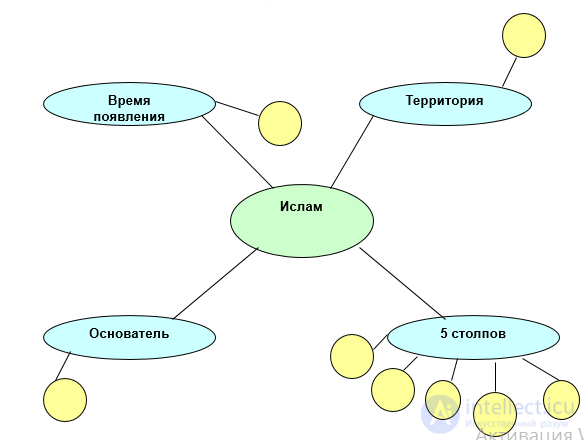
Cluster (bunch): involves identifying the semantic units of a text and arranging them graphically in the form of a cluster.
It is important, in the text you are working with:
1. To identify the main semantic unit in the form of a key word or phrase (the topic).
2. To identify the semantic units related to the key word (categories of information).
3. To flesh out the categories with opinions and facts contained in the material being learned.
Example of a cluster – Build a cluster on the topic: «Islam»
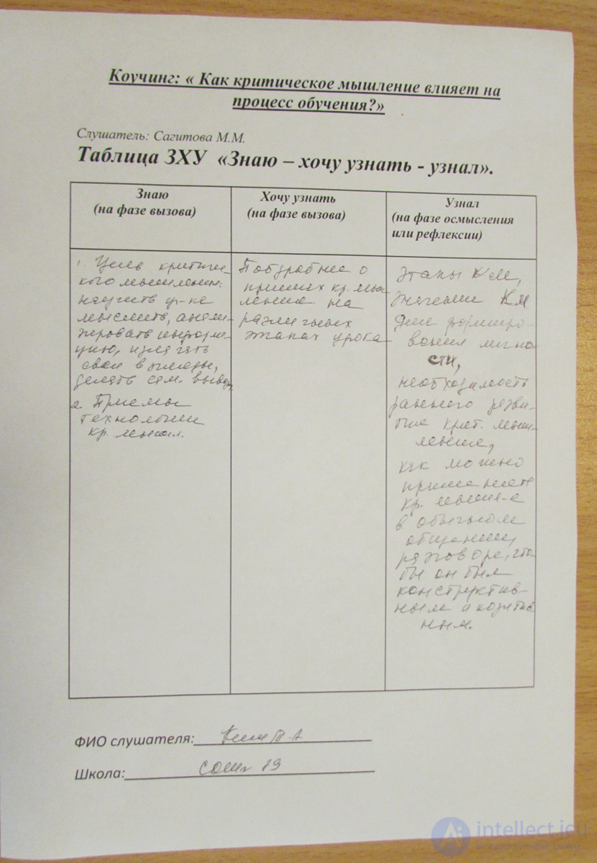
THE KWL TECHNIQUE «Know – Want to know – Learned» (K – W – L)
|
Know |
Want to know |
Learned |
|
They write down what they already know about this question, and group the proposed ideas and categories |
Controversial ideas and questions. The text is then read and answers to the questions are found. |
They write down what the students learned from the text. The answers are arranged parallel to the questions in the second column. |
THIN AND THICK QUESTIONS
|
Thin question:
|
Thick question |
|
who... what... when... can... will... could... what was the name of... was it... do you agree... §true...
|
give an explanation of why... why do you think... why do you believe... what is the difference... suggest what would happen if... what if...
|
Coaching: «How does critical thinking affect the learning process?»
FISHBONE
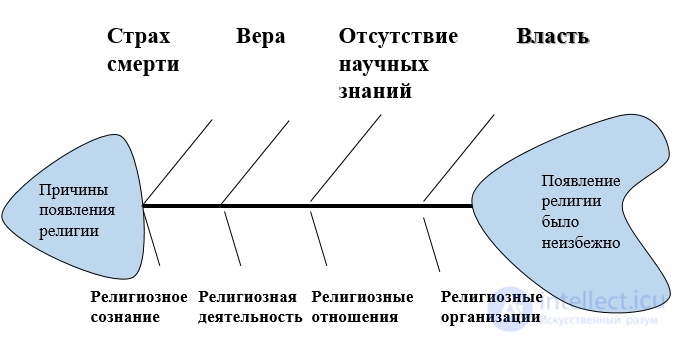
Fishbone: the head is the question of the topic, the upper bones are the main concepts of the topic, the lower bones are the essence of the concepts, and the tail is the answer to the question. Entries should be brief, consisting of key words or phrases that reflect the essence.
Example of Fishbone in a religious studies lesson. Topic: «The concept of religion. The structure of religion»
•Concepts and terms are written on the board, and they need to be arranged into a logical chain according to the topic.
•Example: the topic «Christianity».
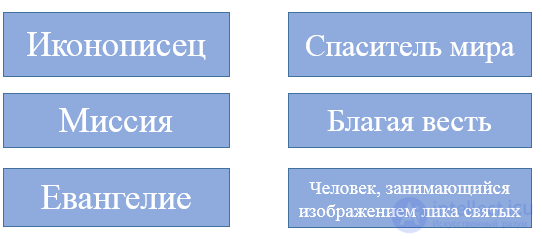
1. The first people on earth were named Adam and Eve
2. The reason for the expulsion from paradise was an Apple
3. Cain and Abel are the children of Adam and Eve
4. During the great flood, not a single person survived.
5. The great flood lasted 50 days
6. God destroyed Sodom and Gomorrah for the sins of their inhabitants
7. God tested Abraham's love for the Lord by ordering him to sacrifice his son
8. Gabriel was the name of the boy whom the Egyptian princess found in a basket
9. God created the world in 7 days
Thus, equipping students with the skills and qualities necessary
for life in the 21st century and in subsequent centuries is an important and stimulating
matter for educators, and one that cannot be so easily ignored.
Students must develop critical thinking and inquiry skills that will enable them to participate effectively and successfully in broader communicative processes
Alexander Wolfe and Alexander 2008
The use of Critical Thinking in history and religious studies lessons has made it possible to:
Alexander identified five ways of assimilating knowledge studied in practice:
Mercer identified three forms of argumentation in the course of classroom discussion:
The most important condition for the development of critical thinking is the creation of problem situations during study. The need to solve problems was noted by J. Dewey, M. Lipman, D. Kluster, D. Halpern, F. Stankato, N. Daud, S. Husina and other researchers. A contradictory situation is the triggering mechanism of critical reasoning, and problem-solving ensures mastery of the principles, strategies and procedures of critical thinking. The need for critical thinking arises when we encounter complex situations of choice that require careful reflection and evaluation.
A characteristic feature of this type of thinking is that the process of reasoning is non-standard and non-formulaic, with no ready-made model for the resolution. Problem-based learning provides internal motivation for students' learning activity; prompts the teacher to acquaint students with the rules of critical thinking; requires the use of problem-based teaching methods and interactive classes; and also orients students toward the written presentation of solutions to problems and the organization of reflection on these solutions. This means that the result of instruction in critical thinking consists of personal changes in pupils and students, that is, their development: they restructure their experience and acquire new knowledge and new ways of solving problem-based tasks.
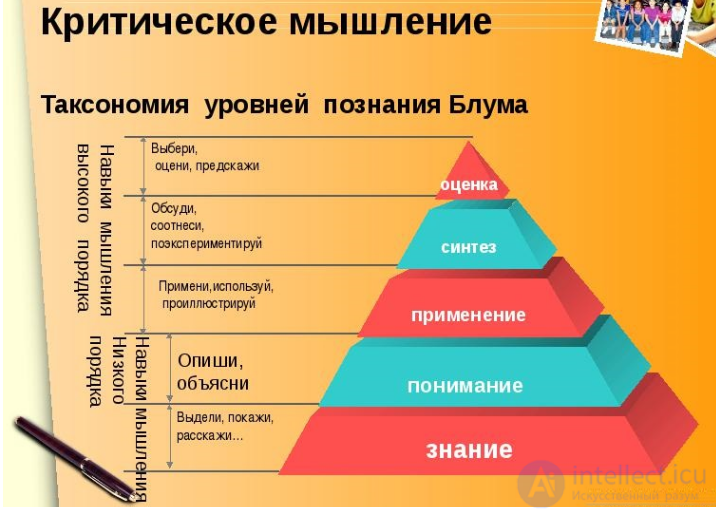
The operational level of thinking
It is responsible for the concept of objects and actions with them. It ensures the implementation of the necessary intellectual procedures; the use of operational systems that allow actions to be performed with knowledge; and the actualization of the intellectual skills and habits that a subject has developed and that are important for carrying out transactions.
Thinking is connected with long-term and working memory, which retains the visual, auditory, tactile, motor and emotional images of objects needed to solve a problem. Working memory recalls the necessary information at the right moment.
The object level of thinking
Its features are the perception of a problem situation and task, the identification within it of the essential conditions, the categorization of its substantive characteristics within a system of concepts, and the transformation of the concepts used into means of resolving the problem situation
The reflexive level of thinking
It is connected with intellectual reflection - an awareness of the essence of thinking as a system of one's own actions and their substantive foundations, a view from the outside of one's own intellectual activity. A person fixes the significant moments of the intellectual search, attempts to understand their meaning for solving the problem, evaluates the strategies used and the prospects, produces benchmarks for further search, and anticipates further steps.
Intellectual reflection is a factor in organizing thinking by determining the direction of a person's cognitive activity, the manifestation and identification of gaps, the evaluation of their «size», as well as the selection and creation of means for constructively overcoming them. It begins with doubt, but not uncertainty, when familiar techniques and strategies do not work. Signs of reflection are the fixing of actions (what am I doing?), a subject's question addressed to himself.
Intellectual reflection manifests itself in fixations and stock phrases ( «да» (yes), «да» (yes), «значит» (so), «ну вот» (well, there), «сейчас» (now), «так сказать» (so to speak), «значит так» (so then)), in questions ( «почему так?» (why is that?), «над чем тут думать?» (what is there to think about here?), «как получилось, что ...?» (how did it come about that ...?), «а что, задача решается?" (well, can the problem be solved?)), in evaluations ( «понятно, что ...» (it's clear that ...), «странно» (strange), «совсем ничего не понятно» (nothing at all is clear), « тут что-то не так » (something is not right here), « здесь надо иначе » (here it must be done differently)), in assumptions (« предположим, что ... » (suppose that ...), « мне кажется » (it seems to me), « можно сказать, что ... » (one could say that ...), « а может быть » (or perhaps)), and in assertions (« то тогда » (then), « значит » (so), « наверное » (probably)) .
The personal level of thinking
It manifests itself in the emergence of motivation to carry out the task, in attempts to productively resolve the contradictions underlying it; in the search for a solution, in the assessment of one's own efforts, well-being and individuality; and in the stimulation and activation of volitional determination, self-control and self-discipline for overcoming difficulties in the course of resolving the problem.
A characteristic feature of the personal level of thinking is its self-organization . The central point of mental activity is the intellectual problem. Its personal determinants show up in the choice of strategies for solving the problem task, which may be linked to an attempt to master the objective content of the task and to assess one's own efforts and intellectual capacities. A person's orientation toward mental activity is evidenced by an optimal amount of orientation within the objective world, its correspondence to the goals of the activity, the absence of emotions that block mental activity, and the sequencing of actions.
When faced with difficulties, a person tries to become aware of the obstacle, the gap in the situation, by formulating and verbalizing them, specifying the goals, optimizing the means of achieving them, and recording the results .
The communicative level of thinking
It involves working out the resolution through interaction with other people and positions, testing it against counterarguments, and the like.
The levels are listed in the order of their conventional arrangement one above another. The first and second levels carry out the substantive functions in the thought process; the third, fourth and fifth carry out regulative-semantic functions.
The course of the critical reasoning process in solving a problem task
| stages of reasoning | ||||
|---|---|---|---|---|
| level | generation of the problem | difficulty | restructuring | justification |
| communicative | ♦ ♦ ♦ | |||
| personal | ♦ ♦ ♦ | ♦ ♦ ♦ | ♦ ♦ ♦ | |
| reflexive | ♦ ♦ ♦ | ♦ ♦ ♦ | ♦ ♦ ♦ | |
| object-related | ♦ ♦ ♦ | ♦ ♦ ♦ | ||
| operational | ♦ ♦ ♦ | ♦ ♦ ♦ | ||
| events | awareness | blockage | insight | solution |
The decisive stage in the process of critical reasoning is the third stage, in which the restructuring of knowledge, modes of action, one's own attitudes and experience takes place, and in the end the idea of the correct resolution is found. This stage culminates in insight, that is, in emerging from the blockage onto the right path. Finding the right path is ensured by analysis-through-synthesis, which makes it possible to bring the object into new connections, and by virtue of this it comes to appear in new qualities that are fixed in new concepts; the object thus turns out to have new content; it is, as it were, turned each time to a different side of itself, and new properties become apparent in it .
In order for thinking to turn into a conscious, independent, reflexive, purposeful, well-grounded, controlled and self-organized process, a set of factors must be present:

Comments