
Lecture
Paired pedagogy – is a differently-positioned interaction of two teachers simultaneously throughout the entire day. One of the pair of teachers leads the children, while the other, playing along with him, constantly fails to understand something, gets confused, and makes mistakes. In this way he prompts the children to explain everything to him, to show him, and to correct him. These may be two caregivers, a caregiver and a specialist, or two specialists. Paired pedagogy can be used both in group and in individual instruction.
this should not be confused with the principle of paired pedagogy («the principle of individual action») – a rule of the direct, immediate influence and interaction of the teacher on an individual student
The role of paired pedagogy in the instruction and upbringing of preschool children:
The positions of one teacher in relation to another:
Practice has shown that the technology of paired learning allows even the weakest children to master knowledge, abilities, and skills faster and better.
this is not the same thing as paired pedagogy!
The technology of paired learning is one type of pedagogical technology, in which one participant teaches another member. There must be at least three participants in order to have the possibility of changing partners within the pairs. The technology of paired learning is a particular case of the technology of pair work.
The technology of paired learning is the basic, fundamental component of Collective Learning Sessions, which include:
Thanks to the combination of these forms of organizing instruction, individualization of learning actually takes place.
If there are only two students in a study group, then in this case paired learning is reduced to individual instruction, where there is a possibility of changing partners in the pairs.
In study pairings, the well-known pedagogical principles of "instruction" and "non-delayed use of knowledge" are practically implemented.
Features of group instruction and group work
The technology of paired learning is fundamentally different from the teaching-through-learning method developed in Germany in the second half of the 20th century by the French pedagogue Jean-Pol Martin. In "learning by teaching" direct instructions are retained, in which "one student teaches a group of students", that is, acting as a substitute for the teacher. In essence, "learning by teaching" is an exact repetition of the Bell-Lancaster system of instruction, known in Europe since the second half of the 18th century.
The technology of paired learning — is one of the types of pedagogical technologies in which one student teaches another (single) student. In this case, the presence of at least three participants is necessary so that there is a possibility of changing partners within the pairs.
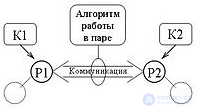
Basic diagram of the technology of paired learning
In the technology of paired learning there are exactly two partners (P 1 and P 2); each partner has his own piece of content, which is often called a «card» (C 1 and C 2); the communication of the partners is regulated by an explicitly given algorithm for the pair's work; there are other participants (one or more shown by dotted lines) with whom one can be exchanged in the pair; and sheets for recording the work done (not shown in the diagram).
Pairs of rotating composition (the "Brook" technique)
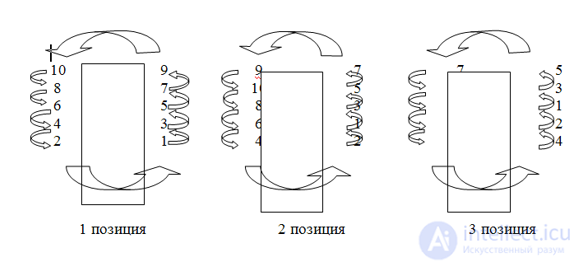
Types of pairs
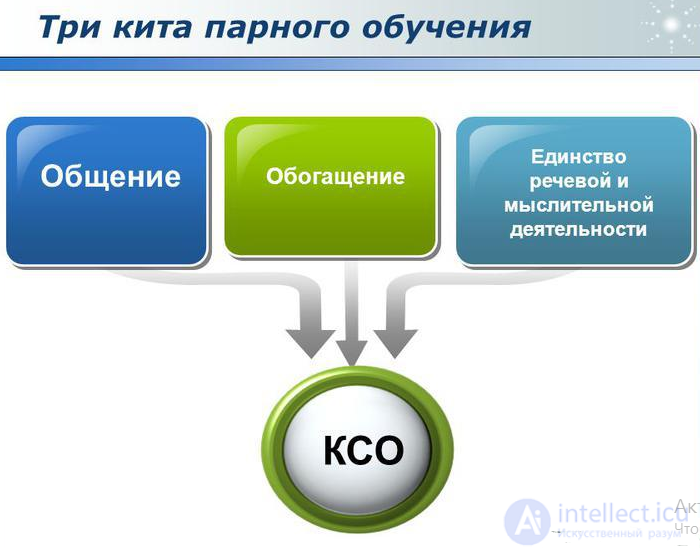
The three pillars of paired learning in CMI (a component of the collective method of instruction)
Achievement assessment sheet
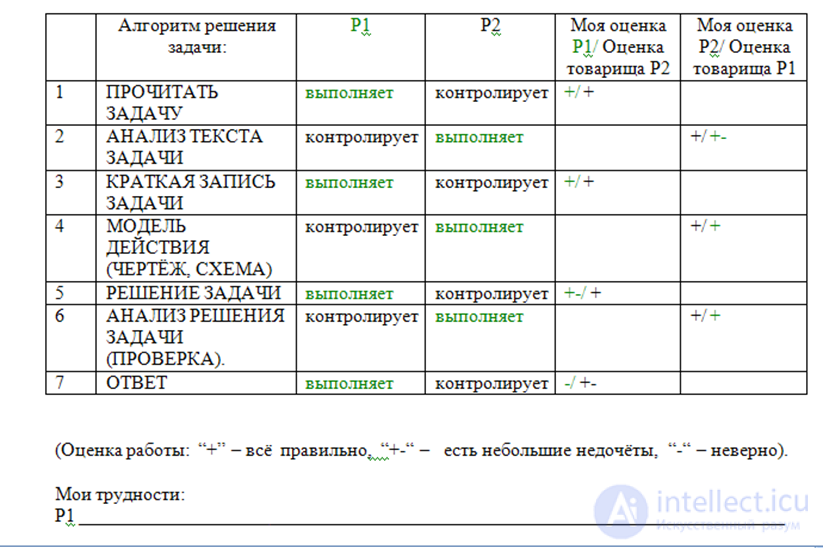

Assessment criteria in paired learning
The interaction of learning participants in pairs is used in two different forms of organizing instruction, named by V. K. Dyachenko as the paired and the collective:
The collective form is sometimes mistakenly considered a special case of the paired form. But this is not so. If communication in the paired form is characterized by autonomy and independence from other pairs, then in the collective form communication takes place within a group, and here the pairs are functionally and substantively dependent on one another: because the composition of the pairs changes, the results of the learning interaction are used by other members of the group. The expressions «pairs of shifting composition» and «dynamic pairs», used as synonyms for the collective organizational form, do not quite accurately reflect the essence of the matter.
The technology of paired learning is based on the interaction of two people. Such interaction is very common in ordinary life, since people are inclined to «face to face» communication. Paired interaction is also often used in instructional processes. But the important difference between paired interaction and the technology of paired learning is the presence of necessary and sufficient technological components:
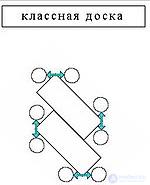
Different seating arrangements are possible for learners working in pairs. But it is not advisable for them to sit at a «round» table, otherwise they will get in each other's way, especially with cross communication when partners change (while remaining at their previous places).
When partners need to write their explanations in each other's notebooks, it is advisable to sit at the same table, without changing the traditional arrangement of tables in one or several rows.
G.O. Gromyko proposes the arrangement of tables shown in the figure. In his opinion, this seating arrangement requires half as many tables as seating «in rows of two per table». This frees up a great deal of space in the room for free passage from one group to another (for reference — one group needs about 10 square meters of area, including passageways).
In the view of V.V. Arkhipova , seating the partners of one pair «corner to corner» provides psychological comfort and convenience for working with content.
In a group of eight people, direct visual contact with any participant is possible.
Because «everyone hears everyone», parallel listening develops, which increases the effectiveness of instruction .
The following types of learning work in a pair are distinguished: discussion, joint study, teaching, practice and checking. Other types may also appear.
Types of work in a pair differ in:
To ensure productive work in a pair it is not enough merely to formulate the learning task competently or to call on students to be patient with their interlocutor. It is necessary to define a clear and consistent sequence of actions for the students that ensures their cooperation.
Learning activity in pairs can be used either as the main component of a lesson or as a supplementary one.
When learners' pair work is added to the organizational structure of frontally organized lessons (a lesson being one variety of these, for example), pair work can only be auxiliary, and its possibilities are very limited. (In certain methodological materials devoted to what is supposedly the collective method of instruction, this fact is precisely what is overlooked.) After all, in lessons the leading form of instruction is the group form (interaction within a group — a small one or within the framework of the whole class, where each speaker addresses a message to everyone at once). In connection with this, the lesson provides a common front — the same topic for everyone, approximately the same pace of studying it, a common start and end time for the class.
In this case the use of pair work makes it possible to consolidate and review material that was presented by the teacher to the whole class. Usually the students are occupied with one particular type of learning activity in pairs. Such work begins and ends for the students simultaneously.
This variant of using pair work can be compared to running in place (which, of course, does have undoubted benefits). But running in a gym offers more possibilities, and running in large open spaces offers still more.
In this case pair work is used mainly for studying new learning material (without a preliminary explanation from the teacher), and for mastering new methods of learning activity. But this requires restructuring the entire instructional process: the schedule of classes, the monitoring and assessment of students' activity, the construction of curricula, teachers' job duties, school management – that is, a transition from the classroom-lesson system to other forms of organizing the educational process, based on individual learning routes for the learners. In classes that are called collective, different forms of organizing instruction can be observed at the same time: some pupils work in pairs, others in groups, others with the teacher, and the rest independently. In the course of collective lessons, students master a significant share of new learning material independently (individually, in pairs, or in groups). Here the leading role belongs to work in pairs.
Paired learning is invariant with respect to the type of activity or content. It is used in practically all school subjects . Methodologists use the technology of paired learning at their methodological sections. TRIZ specialists teach engineers the theory of inventive problem solving in pairs.
Types of work used in paired learning
Discussion Analysis, evaluation, expressing one's own judgment about something.
Techniques of discussion:
10 Plan of work: Read the text (paragraph). Retell it in turn. Add to and correct each other. Ask each other 2 questions each. Express your attitude to what you have heard. How did you understand the main idea? Give titles to the parts (part).
Joint study
To jointly comprehend through learning, to assimilate in the course of instruction. As a result of specially organized communication, a common field of understanding should emerge. The common element must be present in the ideas of both students, they must reach agreement on what is common, and the common element must be materialized.
Teaching one another To convey to someone some knowledge or skills. The subject of instruction is the knowledge or methods of action possessed by the partner. Condition: The students joined in a pair must know different fragments of the content: one student knows one thing, the other – another.
Work plan: 1st student reads and suggests reproducing the first two lines of the poem; the second reproduces these lines under the control of the first student. Then the first reads two more lines, the second reproduces them. If difficulties arise, the first provides the necessary help; if this goal is achieved, the second suggests: -Try reading the first quatrain from memory right away. While I was teaching you, you should have memorized it all. Change of roles
Drill practice The purpose of mutual drilling is to initiate the partner's learning actions, indicating at the same time whether their answer is correct or not.
Checking To test in order to reveal students' knowledge. The subject of checking is the content of the actions for completing the task or question: the link between the logic, the train of thought in solving the task, and the answer. (Tests, practical assignments, control assignments, mutual dictations).
The technology of participants interacting in pairs finds application in various fields of activity — in those cases when people come together to solve some common task, for example, -
Owing to the fact that «paired-learning technology» gradually began to be used in non-educational processes as well, the broader concept of «technology of working in pairs» arose.

Comments