
Lecture
Preschool education, also known as kindergarten , pre-primary school , or play school (nursery school, pre-primary school, play school), is an educational institution or learning space offering education to young children before they begin compulsory education in primary school. It may be publicly or privately owned and may be subsidized from public funds.
A child preschool institution, or preschool educational institution — is a type of educational institution that implements general educational programs of preschool education of various orientations. A preschool educational institution (PEI) provides for the upbringing, instruction, supervision, care, and health improvement of children from two months to seven years of age.
Terminology varies by country. In some European countries, the term «kindergarten» refers to the formal education of children classified under ISCED level 0, with one or several years of such education being compulsory before children go on to primary school at ISCED level 1 .
The following terms may be used for educational institutions serving this age group:
Preschool education, like all other forms of instruction, is intended by the society that controls it to convey important cultural values to its participants. As a result, different cultures make different choices with regard to preschool education. Despite the variations, there are several common themes. Most importantly, a preschool institution is expected to increase a young child's ability to perform basic self-care tasks, such as dressing, feeding, and using the toilet.
The study of preschool education in China has been directly influenced by the reforms and progress of Chinese politics and economics. At present, the Chinese government has shown an interest in preschool education by implementing policies such as the Guidelines for Kindergarten Education (Trial Version) in 2001 and the National Long-Term Educational Reform and Development Plan (2010–2020) in 2010. It has been found that kindergarten education in China has changed dramatically since 1990. In recent years, various Western curricula and pedagogical models have been introduced in China, such as the Montessori program, Reggio Emilia, developmentally appropriate practice (DAP), and the project approach. Many kindergartens have encountered difficulties and problems in adapting these models to their programs. Consequently, a heated debate has arisen among early-childhood researchers and practitioners about how Western curricula can be adapted to the Chinese cultural context. Research has shown that the most important goal in advancing curriculum reform is to improve the professional knowledge of kindergarten teachers, such as their understanding of the concepts of play and pedagogy, as well as their perceptions of inclusiveness and of the kindergarten-based curriculum. In addition, family education and family cooperation in the process of a child's development cannot be ignored in the course of the reforms. Since the 1980s, preschool education in China has advanced significantly. In Tobin et al. 2009, which examines three cultures, continuity and change in preschool education systems are evident. The report on the «Zhongguo Xueqian Jiaoyu Fazhan» project by the Zhanlue Yanjiu Ketizu 2010 examines the development of the preschool education system in China and identifies the current state of preschool education development. The historical development of Chinese preschool education points to three distinct cultural strands — traditional culture, communist culture, and Western culture — that have shaped preschool education in China, as shown in the works of Zhu and Zhang 2008 and Lau 2012. In addition, the administrative authorities currently intend to establish an independent budget for the ECE sector in order to support preschool education in rural areas (Zhao and Hu 2008). Another goal of the Chinese government is to improve the quality of educational services for children living in rural areas. Many researchers have examined in detail important issues in preschool education, particularly teacher education. A preliminary study conducted by Hu and Szente 2010 (cited in the section «Inclusive Education for Young Children») found that Chinese kindergarten teachers have negative attitudes toward the integration of children with disabilities, since they lack sufficient knowledge and skills to work with this population. This indicates that kindergarten teachers need to improve their perceptions of children with disabilities. In addition, Gu 2007 focused on issues of professional development among new preschool teachers and put forward some possible suggestions as to how new teachers cope with key events in their day-to-day pedagogical practice. As for supporting families in the early development of their children at home, family upbringing needs to be purposeful, and cooperation between the kindergarten and the family should be strengthened. Teachers' attitudes toward family involvement are a vitally important aspect of teacher-family cooperation. Kindergarten teachers should therefore support family members in their role as the child's first teacher and build partnerships with the family, as shown in Ding 2007. In addition, kindergarten teachers should be regarded as active researchers in children's role-play. This supports the joint construction of their instructional knowledge regarding children's initiation/subjectivity in role-play (Liu, et al. 2003). Attitudes toward family involvement are a vitally important aspect of teacher-family cooperation. Thus, kindergarten teachers should support family members in their role as the child's first teacher and build partnerships with the family, as shown in Ding 2007. In addition, kindergarten teachers should be regarded as active researchers in children's role-play. This supports the joint construction of their instructional knowledge regarding children's initiation/subjectivity in role-play (Liu, et al. 2003). Attitudes toward family involvement are a vitally important aspect of teacher-family cooperation. Thus, kindergarten teachers should support family members in their role as the child's first teacher and build partnerships with the family, as shown in Ding 2007. In addition, kindergarten teachers should be regarded as active researchers in children's role-play. This supports the joint construction of their pedagogical knowledge regarding children's initiation/subjectivity in role-play (Liu, et al. 2003).
Preschool education in India has not yet gained government recognition. Although a complete draft curriculum has been prepared and, together with rules and regulations, sent out to the states. The governments of some states, such as Tamil Nadu and Karnataka, have implemented it and begun registering preschools. But other states have no clear regulations on preschool education.
In India, preschools, kindergartens, and daycare centers are in very high demand today. This sector is growing at a rate of 24.5% CAGR. But nearly 70% of the preschool market in India is still unorganized and run by local residents owing to the lack of government regulation. Franchised preschool networks account for 30% of preschools.
Starting in 2010, Ireland passed a law under which all children between the ages of 3 years 2 months and 4 years 7 months are entitled to attend preschool free of charge. Before this law was passed, there was a large number of children who did not attend any preschool education program. The programs on offer operated on a voluntary basis and required parents to pay a high fee for each child. This left many families with no option but to keep their children at home. The government soon realized that a large number of children were having difficulties in the early years of primary school, and that parents were being forced to stay at home, remaining unemployed. After the government introduced the free preschool scheme, the preschool enrollment rate in Ireland rose to approximately 93%. [40] [41]
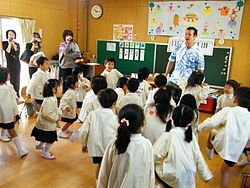
Young children in a kindergarten in Japan
In Japan, the primary goals are the development of social skills and a sense of belonging to the group. Classes typically have up to 40 students, in order to reduce the teacher's role and improve peer interaction. Participation in group activities is highly valued, so some schools, for example, consider a child who stands motionless near a group activity to still be participating. Children are taught to work harmoniously in large and small groups, and to develop responsiveness, kindness, and social awareness. The most important goal is to provide a rich social environment that increasingly isolated nuclear families are unable to provide; unstructured play time is valued.
Children are allowed to resolve disputes with one another, including fighting. Most behavioral problems are explained by a child's inadequately expressed emotional dependency. Remedies include accepting the child, rather than treating with medication or punishment. In Japanese culture, success is explained by effort rather than innate talent, which prompts teachers to disregard innate differences between children, encouraging and extolling persistence. They work to ensure that all pupils meet the standard while each of them realizes their own individual potential. Although preschool institutions vary a great deal, most of them are aimed at age-appropriate personal development, for example empathy, rather than academic programs. Academic programs tend to be more common among Western and Christian preschool institutions. [42]
Under the Law on Education (Article 6 of 1991, most recently amended in April 2016), preschool education is part of non-formal education. According to Article 7 of the Law, «the purpose of preschool education is to help a child satisfy their innate cultural (including ethnic), social and cognitive needs». Although the provision of preschool education is an independent function of the municipality, the Law regulates the preschool curriculum so that it is «prepared in accordance with the criteria for preschool curricula approved by the minister responsible for education, science and kindergartens»; in accordance with the Law, ownership may be public (state or municipal) as well as private, and is carried out by preschool educational institutions, general education schools, freelance teachers or other educational establishments» (Article 7, Part 4). Ownership of preschool educational institutions (namely,
Preschool education in North Korea is universally available and provides for various activities such as dancing, mathematics, drawing and the Korean language, as well as basic skills such as using a spoon and respecting one's elders. North Korean early-childhood education includes themes common to North Korean propaganda. Storylines include the life of Kim Il-sung, the Japanese occupation of Korea, and the Korean War. Children are taught to enjoy war games and to hate the miguk nom, the «American bastards».
Preschool education in Turkey begins at age 5, and primary education begins at age 6.
In the United Kingdom, preschool education in nursery classes or schools is funded by local authorities for children aged two to four. Preschool education may be provided by childcare centers, playgroups, kindergartens and nursery classes in primary schools. Private, voluntary or independent (the PVI sector) preschool provision is also available throughout the United Kingdom and ranges from structured preschool education to a service offering childcare.
Nurseries in England are also called FS1; this is the first foundation year before children move on to primary school or infants.
The learning objectives of kindergarten are more specific than those of childcare, but less demanding than those of primary school. For example, the Scottish system of early learning and the Curriculum for Excellence define expected outcomes even at this age. In some areas kindergarten services are provided on a paid or limited basis, while other public bodies fund kindergarten services.
England
A voucher system for kindergartens was introduced in England and Wales under the Major government, providing 15 hours a week of free childcare or education for three- and four-year-olds, most of it delivered through reception classes in primary schools. It was replaced under the Blair government, which funded provision directly through local education authorities. Thus every child in England, from the first term of school after their third birthday, is now entitled to 15 hours a week of free childcare. Preschools in England follow the Early Learning Goals set out by the Early Years Foundation Stage, for education provided under the Department for Children, Schools and Families, for children who move into the first year of school at the age of four. This school year is usually called the reception year. The goals of preschool learning cover the core areas of education without being tied to a particular subject. These areas include
Until the mid-1980s, kindergartens admitted pupils only for the final year (three terms) preceding their enrollment in primary school, but now pupils attend kindergarten for four or five terms. It is also common practice for many children to attend nursery much earlier. Many kindergartens have facilities for taking on the care of infants, using the «Early Years Foundation Stage» framework as a guide to give every child the best start toward becoming a competent learner and a skillful communicator.
Wales
Provision in Wales followed that of England prior to devolution and has since diverged. Preschool education in Wales is now provided on a part-time basis for children aged 3–4 (nursery) and on a full-day basis for children aged 4 to 5 (reception). Since 2005 it has been a statutory duty of all local education authorities to ensure sufficient preschool education in their area for children, starting from the term following their third birthday.
The current curriculum for young children in Wales, developed by the Welsh Assembly Government Department for Children, Education, Lifelong Learning and Skills, is set out in the booklet «Desirable Outcomes for Children's Learning before Compulsory School Age». Nevertheless, since 2008 a new «Foundation Phase» has been in effect across Wales, covering children aged 3 to 7, with an emphasis on «learning through play», which covers seven areas of learning:
Northern Ireland
In Northern Ireland, applications for kindergarten places can be submitted from age 3 onward. Preschool education is also provided by PreSchools., also called play schools or play groups. A nursery school is permitted to enroll up to 26 children per class, and the curriculum is delivered by a qualified teacher and a nursery assistant. A children's preschool institution that implements the same educational program may likewise admit no more than 26 children per session. However, the staffing rules differ. A preschool institution must have a supervisor holding an NVQ Level 3 qualification in childcare (or equivalent). There must be one qualified and vetted adult for every 8 children. Applications for funding are submitted through PEAG (the Preschool Education Advisory Group). Both nurseries and preschool institutions are inspected by the Education and Training Inspectorate. Preschool institutions are also subject to inspection by local social services.
Scotland
In Scotland, a voucher system for providing part-time preschool provision was introduced in parallel with England and Wales under the government of the First Minister, but with an emphasis on age-appropriate education rather than simply childcare, and avoiding the use of reception classes in primary school. Children are now entitled to a place in a nursery class upon reaching the age of three. This gives parents the opportunity to obtain two years of preschool education free of charge before starting primary school, i.e. before the first year of compulsory education. Preschoolers aged three are referred to as being in nursery, and children aged four as being in pre-school. Preschool education in Scotland is planned at the early level of the Curriculum for Excellence, which defines outcomes and experiences across the following eight areas of learning:
Responsibility for reviewing care standards in Scottish nurseries lies with the Care Inspectorate.
In the United States, kindergartens are found in a wide variety of settings. In general, preschool education should be voluntary and promote children's development through planned programs. A preschool is defined as «center-based programs for four-year-old children that are wholly or partly funded by state education agencies and that are implemented in schools or under the direction of state or local education agencies». [53] Preschools, both private and school-sponsored, are available to children aged three to five. Many of these programs follow the same curriculum as preschool.
In the United States, preschool education emphasizes individuality. Children are often allowed to choose from a variety of activities, using a learning-center approach. During this time some children draw or color, some play house, some do puzzles, and some listen to the teacher read aloud. Activities vary from session to session. Each child is assumed to have certain strengths and weaknesses that should be encouraged or improved by teachers. A typical belief is that «children's play is their work» and that by allowing them to choose the type of play, the child will satisfy their developmental needs. Preschools also embrace American ideas of fairness, such as the rule of law and the idea that everyone is innocent until proven guilty. Teachers actively intervene in disputes and encourage children to resolve them verbally («use your words») rather than physically. Children may be punished with a time-out or required to apologize or make amends for misbehavior. Teachers help children explain what happened before a decision on punishment is made. Self-expression of language skills is emphasized through informal communication with teachers and through structured group activities such as show-and-tell exercises that allow a child to describe an experience to an adult. Resources vary depending on students' economic circumstances, but are generally better equipped than in other cultures. Most programs are not state-subsidized, which makes preschools relatively expensive, even though staff tend to receive low wages. The student-to-teacher ratio is lower than in other cultures, ideally around 15 students per group. Parents and teachers view teachers as an extension of, or partial substitute for, parents, and therefore emphasize personal relationships and consistent expectations at home and at school. [54]
In the United States, students who may receive special education receive services in preschool settings. After the enactment of the Individuals with Disabilities Education Act (IDEA) 101-476 in 1975 and its amendments, PL 102-119 and PL 105-17 in 1997, the education system shifted from self-contained special education classrooms toward inclusion, prompting special education teachers to practice in more diverse settings. As at other stages of the life of a child with special needs, an Individualized Education Program (IEP) or an Individualized Family Service Plan (IFSP) is an important way for teachers, administrators and parents to establish guidelines for a partnership to help the child succeed in preschool.
Cooperative preschools
Formally dating back to 1916, cooperative preschools are common across much of America and focus on providing a preschool environment for children and parents that aligns with the ideas of cooperation.
Head Start
The goal of the Head Start and Early Head Start programs is to improve the school readiness of young children from low-income families. These programs serve children from birth to age five, pregnant women, and their families. Head Start was established by the federal government in 1964 to help meet the needs of low-income preschoolers.
The Office of Economic Opportunity launched the Head Start project as an eight-week summer program in 1965. It was then transferred in 1969 to the Office of Child Development of the U.S. Department of Health, Education, and Welfare. Today it is a program within the Administration for Children, Youth and Families of the Department of Health and Human Services. The programs are administered locally by school systems and nonprofit organizations.
Among institutions of this type, the most common is the kindergarten. In addition, the following types of preschool institutions also exist in Russia:
a general-developmental kindergarten with priority given to the implementation of one or several areas of children's development (intellectual, artistic-aesthetic, physical, etc.);
The main tasks of a preschool institution in Russia are:
In the Russian Federation in 2007, there were more than 45,000 preschool childcare institutions, in which 4,800,000 children were being raised (61.3% of children under the age of 7, which nearly approaches the 1991 level of 63.9%). At the same time, a number of regions still have waiting lists for a place in a preschool institution, which sometimes forces parents to submit an application for admission to a preschool institution almost immediately after the child's birth. According to Rosstat data, the waiting-list figures for preschool educational institutions amounted to about 1 million children at the beginning of 2007.
In recent years, short-stay groups for children and various centers of preschool education — physical-fitness and health-improvement centers, centers for the early correction of child development, and others — have been actively introduced into the practice of preschool educational institutions. It should be noted that the network of short-stay groups is developing not in opposition to, and not instead of, traditional full-day preschool institutions, but alongside them.
Alongside the traditional operating modes of preschool educational institutions (12-hour and round-the-clock modes of children's stay), since 2000 10-hour and 14-hour modes have also been used (in many cases the 14-hour mode is most preferable for parents and less costly than the round-the-clock mode). This makes it possible to increase the accessibility of preschool education for various categories of parents.
In addition, new models are currently being tested in parallel with the development of traditional forms of preschool education: preschool groups based at general-education institutions, preschool groups based at supplementary-education institutions, as well as the systematic education of preschool-age children under conditions of family upbringing.
The number of groups in a preschool educational institution is determined by the founding body based on their maximum capacity, as adopted in calculating the budgetary financing standard. In groups: from 2 months to 1 year — 10 children; from 1 year to 3 years — 15 children; from 3 years to 7 years — 20 children. In mixed-age groups: where the group includes children of two ages (from 2 months to 3 years) — 8 children; where the group includes children of any three ages (from 3 to 7 years) — 10 children; where the group includes children of any two ages (from 3 to 7 years) — 20 children.
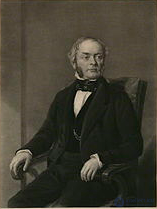
Samuel Wilderspin, one of the founders of preschool education. 1848, engraving by John Rogers Herbert.
In an era when only children who had already learned to read and write at home were admitted to school, there were many attempts to make school accessible to orphans or to the children of women who worked in factories.
In 1779, Johann Friedrich Oberlin and Louise Scheppler founded in Strasbourg an early institution for the care and instruction of preschool children whose parents were absent during the day. At about the same time, in 1780, similar childcare institutions were opened in Bavaria. In 1802, Pauline zur Lippe founded a preschool center in Detmold.
In 1816, Robert Owen, a philosopher and pedagogue, opened the first British and, probably, the first school in the world for young children, in New Lanark, Scotland. In connection with his enterprise involving cooperative factories, Owen wanted children to receive a good moral upbringing so that they could work. His system was successful in raising obedient children with basic literacy and numeracy. [10]
Samuel Wilderspin opened his first infant school in London in 1819 [11], and then founded hundreds more. He published numerous works on this subject, and his work became a model for infant schools throughout England and beyond. Play was an important part of Wilderspin's educational system. He is credited with inventing the playground. In 1823, Wilderspin published a book « On the Importance of Education for Young Children» based on this school. The following year he began working for the Infant School Society, telling others about his views. He also wrote «The Infant System for Developing the Physical, Intellectual and Moral Faculties of All Children from One to Seven Years of Age»
In accordance with the legislation (the Law on Education), the legal relations between a preschool educational institution and the parents (legal representatives) are governed by an agreement between them, which may not restrict the rights of the parties established by law. On the basis of the agreement and in accordance with its statutory goals and objectives, a preschool educational institution has the right to implement supplementary educational programs, as well as to provide additional paid educational services beyond the educational programs that determine its status, taking into account the family's need for such additional educational services. It is important to note that paid educational services may not be provided in place of educational activity financed from budgetary funds. The average amount of the parental fee in the constituent entities of the Russian Federation ranges from 176 rubles per month in Oryol Oblast to 2,129 rubles per month in the Yamalo-Nenets Autonomous Okrug. The share that the parental fee constitutes of the total expenditures of preschool educational institutions on maintaining a child also varies: from 7% in Oryol Oblast to 31.9% in Tyumen Oblast. At the same time, Ruling No. 5-P of the Constitutional Court of the Russian Federation of May 15, 2006, and Federal Law No. 207-FZ of December 5, 2006, «On Amendments to Certain Legislative Acts of the Russian Federation Regarding State Support for Citizens with Children,» establish limits on the amount of the parental fee, namely — the parental fee must not exceed 20% of the expenditures on maintaining a child in a preschool educational institution. For certain categories of citizens (in particular, for parents with 3 or more children), the amount of the parental fee must not exceed 10% of the expenditures on maintaining a child in a preschool educational institution.
The most important years of learning begin at birth. During these early years, people are capable of absorbing more information than later on. The brain grows fastest in the first years of life. Highly qualified teachers and preschool institutions can have a long-term effect on improving the learning outcomes of low-income students.
The areas of development in preschool education vary. However, the following main topics are usually proposed.
Preschool education systems observe standards with respect to structure (administration, class size, student-to-teacher ratio, services), processes (the quality of the classroom environment, teacher-child interaction, etc.), and the alignment (standards, curriculum, assessments) of components. The curriculum is designed for different ages. For example, counting to 10 is usually expected after the age of four.
Some studies challenge the benefits of preschool education, finding that preschool education can be harmful to cognitive and social development. A study of 14,000 preschool institutions, conducted by the University of California, Berkeley, and Stanford University, found that although early reading and mathematics provide a temporary cognitive boost, preschool education has a detrimental effect on social development and cooperation. Studies have also shown that the home environment has a greater influence on future outcomes than the preschool institution.
New evidence is emerging that high-quality preschool institutions are based on play rather than on attempts to provide early formal instruction in academic subjects. «Playing with other children away from adults is how children learn to make their own decisions, control their emotions and impulses, see things from others' points of view, reconcile differences with others, and make friends,» says Dr. Peter Gray, a Boston College professor and an expert on the evolution of play and its vital role in child development. «In short, play is how children learn to control their own lives.»
Preschool institutions use various teaching methods, such as Montessori, Waldorf, Head Start, HighScope, [29] the Reggio Emilia approach, Bank Street, and Forest kindergartens.
While most American preschool programs are still based on tuition payments, support for some degree of government funding for preschool education has grown over the years. As of 2008, 38 states and the District of Columbia had invested in at least some preschool programs, and many school districts provided preschool services on their own using local and federal funds. The United States spends 0.04% of its GDP, or 63 billion dollars, on preschool education.
The benefits and challenges of public preschool reflect the funding available. Funding can vary among federal, state, and local government appropriations, private sources, and parental fees. The problem of funding public preschool arises not only from limited sources but also from the cost per child. As of 2007, the average cost in the lower 48 states was $6,582. Four categories determine the expenses of public preschool institutions: staffing ratios, staff qualifications, facilities and transportation, and health and nutrition services. These costs depend heavily on the cost and quality of the services provided. The main staffing factor affecting cost is teacher qualifications. Another determining factor in cost is the length of the school day. Longer sessions cost more.
Collaboration has helped fund programs in several districts. Collaboration with a regional Head Start organization and other private preschool institutions helped fund a public preschool in one district. «We are very pleased with the collaboration. It really added a dimension to our program that has been very positive.» The National Head Start Bureau is seeking new opportunities to collaborate with public schools. Thorn Schultz of the Bureau states: «We strive for partnership to the greatest extent possible, whether it's funds or resources, so that children get everything they need to be ready for school
Curricula for preschoolers have long been a subject of debate. Much of this revolves around content and pedagogy: the extent to which academic content should be included in the curriculum, and whether formal instruction or child-initiated inquiry, supported by adults, is more effective. Proponents of an academic curriculum are more likely to favor an emphasis on basic skills, especially literacy and mathematics., along with structured, predetermined activities to achieve related goals. Internationally, there is strong opposition to this type of curriculum for early childhood care and education, and support for a broad curriculum that fosters the overall development of the child, including health and physical development, emotional and spiritual well-being, social competence, intellectual development, and communication skills and abilities. The type of document that emerges from this point of view is likely to be more open-ended, offering a framework that teachers and parents can use to develop curricula specific to their context.

Comments