
Lecture
Educational environment – is a psychological-pedagogical reality, a combination of already established historical influences and deliberately created pedagogical conditions and circumstances aimed at the formation and development of the student’s personality .
From the point of view of synergetics, the educational environment – is a systemically formed space in which the interaction of the subjects of the educational process with the external environment is realized, as a result of which the individual traits of the student’s personality are revealed .
Researchers identify an important feature of the educational environment as a system: the subject of the educational process (the person) is himself a system. Thus, being within the field of the educational environment, he displays an active character of its cognition, which ultimately manifests itself in the mutual influence of the subject and the environment .
In a broad sense, the educational environment can be understood as «any sociocultural space within which the process of personality development takes place, whether spontaneously or with varying degrees of organization» [5].
The concept of the «environment» as a set of conditions surrounding a person and influencing him in a certain way already appears during the era of the Enlightenment.
During this period, the term «environment» is regarded as:
J.J. Rousseau was one of the first to begin interpreting the «environment» as a field for personality development. In the scholar’s opinion, in order to form an effective educational system it is necessary to create a special «educational environment» in which the needs and capabilities of the student would be balanced. Such an environment makes it possible to develop an inner core, freedom of choice, and independence, since it implies an emphasis not on the quantity of knowledge received, but on the ability to choose one’s own individual path in learning, and on independence in decision-making .
He pays particular attention to the self-development of the personality and the child’s acquisition of subjective experience. In this connection he proposes the creation of an educational environment as a support for the student’s self-knowledge and for building his own educational path .
In Russian pedagogy, the concept of «environment» began to enter scholarly usage at the beginning of the 20th century. «The pedagogy of the environment was developed by S.T. Shatsky, the social environment of the child is described in the works of P.P. Blonsky, and the surrounding environment in those of A.S. Makarenko» .
In the understanding of Russian pedagogues, the object of the educational process is not the student’s personality, but the conditions that surround him. External conditions are understood to mean interpersonal and intergroup relations, while internal conditions refer to the student’s emotional portrait, self-assessment and reflection, and value picture of the world.
The process of personality development must also be studied with regard to the natural surroundings. In doing so, the natural surroundings exist and exert influence at several different levels. Urie Bronfenbrenner identifies four such levels:
1. Microsystem — «a complex of relations between the developing person and the immediate environment, including the person himself» (family, school, peers, etc.).
2. Mesosystem — the set of microsystems
influencing one another. This concerns the interrelations between the family, the school,
and the peer group.
3. Exosystem — «an extension of the mesosystem, encompassing other special structures, both formal and informal, which do not themselves include the developing person, but which affect the immediate conditions in which the person finds himself».
4. Macrosystem — «the predominant institutional patterns of a culture or subculture, such as the economic, social, educational, legal and political systems, of which the micro-, meso- and exosystems are concrete manifestations».
V.I. Panov systematized models of the educational environment in his works.
The educational environment of the secondary school (EESSch) – is the set of conditions, processes, phenomena and technologies in the secondary school that directly affect the instruction and upbringing of the schoolchild, the comprehensive development of his personality and his socialization as a whole. The school environment is formed both artificially, under the influence of the subjects of management, and as a result of spontaneous self-organization. This is a dual process in which its components cannot be separated (Fig. 1).
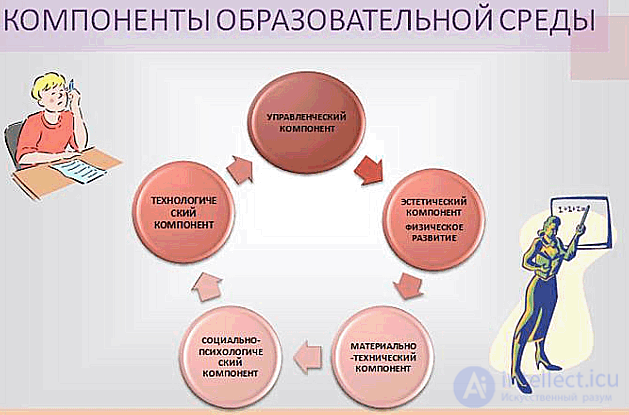
Fig. 1
By definition, the environment is a complex system of components, which includes a number of subsystems:
The school building, teaching equipment, educational and methodological literature, and information-based educational technologies – all of this is the material and technical component. Its example clearly shows the importance of the educational environment for shaping an attitude toward learning activity. At present, a teenager experiences the influence of a whole range of factors. Computer information technologies, including the Internet and computer video games, have already had an impact on the socialization of a generation. A similar situation was described by the sociologist and ethnographer M. Mead: “Today, in every part of the world where all people are connected by the Internet system, young people have come to share a common experience – an experience that older generations never had and never will have. This gap between generations is entirely new”. It is possible to bridge this gap by creating, in elementary school, a technological environment that meets the requirements of the 21st century.
The problem of textbooks is an important one. The content of the texts studied in class and at home as homework assignments takes on special significance because the volume of books read by a student outside the curriculum is currently decreasing. At present, a significant place in the structure of a student's free time at our gymnasium is occupied by watching television programs, which by the 7th grade even exceeds the time spent walking with friends. In this situation, the content of instructional texts becomes a factor in shaping an attitude toward learning activity.
A special place is occupied by the situation in which a teenager is unreceptive to verbal influence because the language is not the child's native one. We have this problem too. However, given stable motivation, this factor does not act for long, since adolescence is distinguished by a high receptiveness to language.
A reasonable question arises: “How can the degree of comfort of the educational environment be determined?” Naturally, there are traditional methods, for example an individual conversation with the student, and we do not intend to abandon them. The gymnasium has long and successfully used a method such as color-mood assessment. Everyone knows well how effective it is, especially in elementary school. This method probably has only one drawback: the absence of a differentiated approach. The student feels bad, feels “not himself”… But what was the cause of the discomfort? An individual conversation can answer this question, but there is not always time for one. Moreover, the result of an individual conversation cannot be presented visually, in graphic form, for a teacher's presentation at a parents' meeting, an administrative meeting, and so on. Thus, for all their effectiveness, traditional methods do not allow for full-fledged monitoring of the educational environment.
The educational environment as a whole and its individual components have become objects of diagnostics using a method fairly traditional for schools – the questionnaire survey. Its use makes it possible to turn to the main subject of school life – our student – and to base management decisions on a sincere (the survey methodology is a guarantee of this) and unbiased opinion about the school environment surrounding them.
DEE (digital educational environment) is a part of the educational environment involving the application of modern digital technologies.
It presupposes the implementation of 4 main directions in the development of the education system:
However, a significant part of the professional educational community believes that incorporating a substantial share of the distance-learning component into the educational process may lead to negative consequences not only in the educational but also in the social sphere. It could cause a significant decline in the level of students' knowledge and increase social stratification among citizens.

Comments