
Lecture
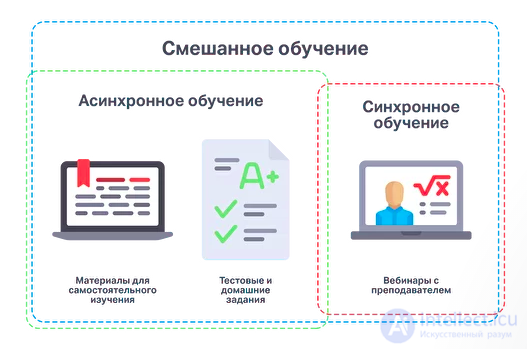
Blended learning is an approach to instruction that combines online learning materials and opportunities for interactive engagement with traditional in-classroom teaching methods. It requires the physical presence of both teacher and student, with the student retaining some degree of control over time, place, path, or pace. While students continue to attend conventional schools in the presence of a teacher, face-to-face classroom sessions are combined with computer-based activities relating to content and delivery. Blended learning is also used in professional-development and training settings. Blended learning is a combination of traditional forms of classroom instruction with elements of e-learning. In blended learning, the instructional process combines synchronous activities (face-to-face instruction) with asynchronous ones — self-study materials and homework assignments. In doing so, the learner personally decides on the path, time, place, and pace of learning.
Blended learning is highly context-dependent, which makes a universal account of it difficult. In some reports it is claimed that the lack of consensus regarding a strict definition of blended learning has created difficulties in researching its effectiveness. A well-cited 2013 study broadly defines blended learning as a combination of online learning and face-to-face interaction, in which the online component effectively replaces part of the face-to-face interaction rather than supplementing it.
In addition, a 2015 meta-analysis, which historically examined a comprehensive review of evidence-based research on blended learning, found commonalities in defining blended learning as «considered to be a combination of traditional f2f [face-to-face] forms of instruction with interactive learning modes based on technology-mediated learning, in which all participants in the learning process are at times separated by distance». This report also found that all of these evidence-based studies concluded that student performance was higher under blended learning compared with either fully interactive or fully face-to-face instruction.
«Blended learning» is sometimes used together with « personalized learning » and differentiated instruction.
The terms «blended learning», «hybrid learning», «technology-mediated instruction», [13], «learning over the Internet» and «mixed-mode learning» are often used interchangeably in the research literature. [14]
Although the concepts underlying blended learning were first developed in the 1960s, the formal terminology used to describe it did not take on its current form until the late 1990s. One of the earliest uses of the term appears in a 1999 press release in which Interactive Learning Center, an Atlanta-based education company, announced a change of its name to EPIC Learning. The release noted that «the Company currently operates 220 online courses, but will begin offering its Internet courses using the Company's blended-learning methodology». [15]
The term «blended learning» was initially vague and covered a broad range of technologies and pedagogical methods in various combinations (some of which did not use technology at all). In 2006, the term became more specific with the publication by Bonk and Graham of the first « Handbook of Blended Learning ». Graham questioned the breadth and ambiguity of the term's definition and defined «blended learning systems» as learning systems that «combine face-to-face instruction with computer-based instruction». [16]
In a report titled «Defining Blended Learning», researcher Norm Friesen suggests that in its current form, blended learning «denotes the range of possibilities presented by combining the Internet and digital media with established classroom forms that require the physical co-presence of teacher and students".
Technology-based instruction emerged as an alternative to instructor-led training in the 1960s on mainframe and minicomputers. The chief advantage of blended learning is scale, whereas a single instructor can only teach a limited number of people. [17]
One example is PLATO (Programmed Logic for Automated Teaching Operations), a data-driven system developed by the University of Illinois. PLATO, in particular, had a long history of innovation and offered coursework ranging from elementary to college level. [18] Mainframe-based instruction had a number of interface limitations, which gave way to real-time satellite video in the 1970s. The advantage here was in serving people who were not as computer-literate. The main problem was the expense required to carry out this work.
In the early 1990s, CD-ROMs became the dominant means of delivering technology-based instruction, since the bandwidth of 56k modems could not support very high-quality audio and video. A limitation of CD-ROMs was tracking the completion of coursework, so learning management systems emerged as a way of making it easier to track progress. The aviation industry made active use of this to track how well someone was doing in a course, how much time had been spent, and where someone had left off. AICC, the Aviation Industry Computer-Based Training Committee, was formed in 1988, and companies such as Boeing used CDs to train personnel.
Modern blended learning is delivered online, although CDs can still be used if the learning management system meets the institution's standards. Some examples of channels through which online instruction for blended learning can be delivered include webcasting (synchronous and asynchronous) and online video (live and recorded).
Solutions such as Khan Academy have been used in classrooms as platforms for blended learning. [19]
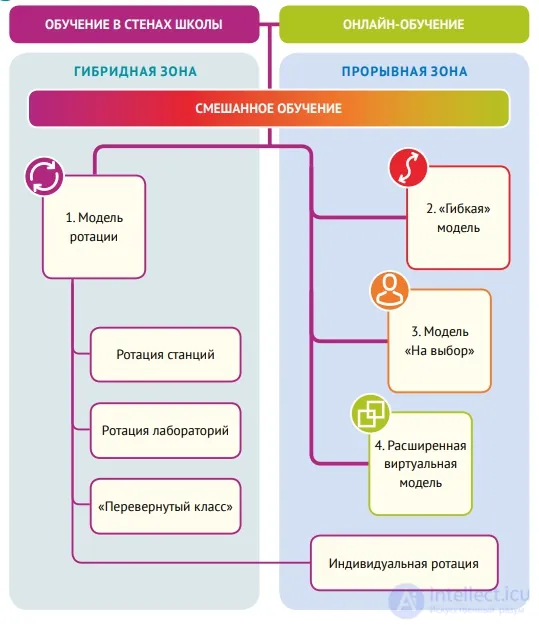
There are more than 40 models of blended learning, but not all of them are equally effective.
There is no single consensus regarding the definition of blended learning. Some academic studies have suggested that it is a redundant term. However, various models of blended learning have been proposed by certain researchers and educational research centers. These models include:
It is important to note that even blended learning models can be blended together, and many implementations use some, many, or even all of them as dimensions of a larger blended-learning strategy. For the most part, these models are not mutually exclusive. [29]
There are many components that a blended learning model can include, among them «instructor-delivered content, e-learning, webinars, conference calls, live or online sessions with instructors, as well as other media and activities such as Facebook, email, chats, blogs, podcasting, Twitter, YouTube, Skype and web forums».
The simplest model to implement. It makes it possible to minimize frontal work (the teacher explains, the children listen) and makes it possible to implement interactive forms of work in the lesson.
Students work at home in an online learning environment, using their own internet-connected electronic devices: they familiarize themselves with the material or review what has been studied. In class, the material is consolidated and worked with, which may take the form of project activity, a seminar, or other interactive forms. This blended-learning model can be used in schools for students starting from grades 3-5.
The most effective blended-learning model in elementary and middle school. It requires the availability of computers or tablets in the classroom and the use of learning management systems (for example, Moodle).
All students are divided into groups by type of learning activity: work with the teacher, online learning, and project work. Each group works in a separate part of the classroom – a station. The stations have different purposes: work with the teacher – obtaining feedback from the teacher; online learning – developing skills of independent work, personal responsibility, self-regulation, and the ability to learn; project work – applying knowledge to solving practical problems, developing communication skills, and obtaining feedback from classmates.
During the lesson, students move from station to station so as to visit each one. The composition of the groups changes from lesson to lesson depending on the pedagogical task .
Instead of three stations, one can organize two: work with the teacher and online work; or four: work with the teacher, online work, work on a collective project, and individual independent work.
The "Lab rotation" blended-learning model assumes that part of the students' classes take place in a regular classroom, while for one lesson they move to a computer classroom (laboratory), where they work individually in an online environment. In the online environment, students can study new material, consolidate what has been covered, practice various skills, and also work on their own project. If this model is implemented in a school, learning becomes most effective when teachers create a shared online space for children across several subjects. This blended-learning model is suitable for schoolchildren of any age, provided the online environment is age-appropriate. Examples of online environments for schoolchildren: the "Open School" platform and Khan Academy.
The basis of the flex blended-learning model is that students are not limited in time to any particular type of learning activity. Students independently draw up their work schedule and choose the topic and pace at which they will study the material. This model relies for the most part on an online environment. The teacher works with small groups or individually with students who need help .
This model is most effective for teaching senior-grade schoolchildren, university students and adults, since it requires a developed skill of self-organization.
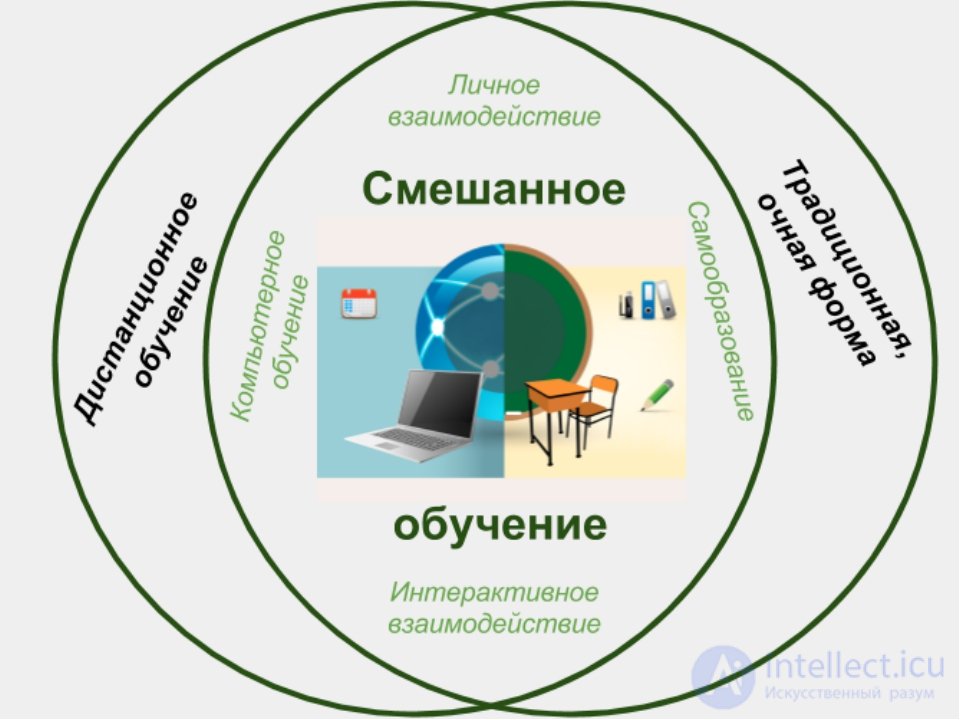
Blended learning is reported to be more effective than purely in-person or purely online classes. [30] Blended learning methods can also lead to higher student achievement than in-person instruction. [31]
By using a combination of digital learning and one-on-one personal interaction, students can work independently through new concepts, which frees teachers to communicate with and support individual students who may need personalized attention. «Rather than using the lowest common denominator, as in a traditional classroom, teachers can now streamline their instruction to help all students reach their full potential». [32]
Proponents of blended learning argue that incorporating «asynchronous internet communication technology» into higher-education courses serves «to facilitate simultaneous independent and collaborative learning». [33]
This incorporation is a major factor contributing to student satisfaction and success in such courses. It has been found that the use of information and communication technologies improves students' attitudes toward learning. [34]
Thanks to the incorporation of information technology into classroom projects, communication between instructors and distance-learning students has improved, and students have been better able to assess their own understanding of the course material using «computerized qualitative and quantitative assessment modules». [35]
Blended learning can also reduce the cost of education, although some argue about whether blended learning is inherently cheaper than traditional classroom instruction. [36]
Blended learning can reduce costs by turning classrooms into an online space, and essentially replaces expensive textbooks with electronic devices that students often bring to class. E-textbooks, which can be accessed digitally, can also help reduce the textbook budget. [32] Proponents of blended learning cite the ability to collect data and customize instruction and assessment as two of the main advantages of this approach. [37]
Blended learning often includes software that automatically collects data on students and measures their performance, providing teachers, students and parents with detailed data on students. Tests are often graded automatically, providing instant feedback. Students' login activity and time on task are also measured to ensure accountability. [32] Schools with blended-learning programs can also reallocate resources to improve student performance. [38]
Students with special talents or interests that go beyond the available curricula use educational technology to develop their skills or to exceed the limits set by their grade level. [39] Blended learning allows for individualized instruction, replacing the model in which the teacher stands in front of the class and everyone is expected to keep the same pace. «Blended learning allows students to work at their own pace to make sure they fully understand new concepts before moving on». [32]
A classroom environment that includes blended learning naturally requires students to demonstrate greater autonomy, self-regulation and independence in order to succeed. If teachers offer some form of initial program orientation before implementing blended learning strategies, this can better prepare students to navigate the various components with confidence and develop a stronger sense of independence.
Some online educational institutions connect students with instructors using web-conferencing technology to form a digital classroom. These institutions borrow many of the technologies that popularized university-level online courses. Some of the benefits of blended learning, especially at the K-12 level, can be found within the broader concept of educational technology . It is also one of the most effective ways of delivering personalized learning at scale .
Blended learning supports the use of standards as a way of managing quality and ease of use. This includes several kinds of standards: interoperability standards such as the SIF specification from A4L or the Learning Tools Interoperability specification from the IMS Global Consortium, or academic standards such as state standards and the Common Core State Standards, which encourage the integration of technology across many subjects. [32]
A learning management system, or a combination of systems, helps create a stronger sense of an online community in which discussions can be held to better assist students. [40]
This virtual learning environment helps professors communicate with students without a physical presence, making it a «virtual café.» Many schools use this online tool for online lessons, classwork, question-and-answer forums, and other school-related work. [41] Blended learning has produced positive results within the online community. Such results have been compared and shown to be similar to the results of Alcoholics Anonymous and Weight Watchers. [40]
The benefits of blended learning depend on the quality of the programs implemented. Some indicators of excellent blended learning programs are «facilitating student learning, effectively disseminating ideas, demonstrating an interest in learning, effective organization, showing respect for students, and objectively assessing performance.» [42]
Without successful planning and execution, blended learning can have drawbacks in its technical aspects, since it is heavily dependent on the technical resources or tools through which blended learning is delivered. These tools must be reliable, easy to use, and up to date if they are to have a substantial impact on the learning process. [33]
IT literacy can become a serious obstacle for students trying to access course materials, making the availability of high-quality technical support paramount. [34] Another aspect of blended learning that can be difficult is group work, owing to the challenges of managing it in an online environment.
It has been reported that the use of lecture-recording technology can cause students to fall behind on the material. A study conducted at four different universities found that only half of the students watched lecture videos on a regular basis, and almost 40% of students watched several weeks' worth of videos in a single sitting. [44] This has additional implications for the instructor, both regarding how many online resources need to be made available to the learner and regarding ensuring that they are pitched at the right level for the intended learner.
From the instructor's point of view, it has recently been noted that providing effective feedback takes more time (and is therefore more costly) when using electronic means compared with traditional (e.g., paper-based) assessments. [45] Using e-learning platforms can take longer than traditional methods and may also entail new costs, since e-learning platforms and service providers may charge instructors user fees.
Another critical issue is access to network infrastructure. Although the digital divide is narrowing as the Internet becomes more widespread, many learners still do not have comprehensive and ubiquitous access to the Internet — even in their own classrooms. Any attempt to incorporate blended learning strategies into an organization's pedagogical strategy must take this into account. [46] This is why learning centers are built with good Wi-Fi connectivity, in order to address this problem.
The term «21st-century literacy» was coined by the National Council of Teachers of English to describe the social nature of learning, which is supported by the ability to collaborate using digital technologies in education. These «new skills» are described as «the skills that learners will need for the society in which they will work,» including «strong communication and collaboration skills, technological knowledge, innovative and creative thinking skills, and the ability to solve problems.» [47] This set of skills and understanding will «prepare the workforce or citizens for a changing, interconnected world.» [
These literacies are dynamic because of their ability to be connected to one another. According to the NCTE, active and successful participants in this 21st-century global society must be able to:

Comments