
Lecture
Recoding of information – is the translation of information from one form into another, used for a specific purpose. Recoding of information- is the process of consciously actualizing an engram that was associated in past experience with a signal perceived at the given moment. Unlike successive perception, here the engram that is actualized belongs to a coding system different from that of the signal. A common type of such recoding of information is translation from one language into another at some intermediate level of foreign-language proficiency. In this case, on perceiving a word in a foreign language, a person has to actively recall how that word sounds in their native language, after which the understood word arises involuntarily. This level of assimilation of two associated codes is quite characteristic of the work of a human operator or trainee with various kinds of artificial languages (alphabets). In addition, an even more common act of recoding information in an operator's activity is the translation of artificial signals into a figurative representation of the real situation. For example, the literature describes facts indicating that pilots, on perceiving instrument readings, can recode them into an image of the flight. The results of research into the features of performing even relatively simple recoding tasks indicate that identifying the psychological operations within transforming actions can only be approximate. recoding of information is an action that one should strive to exclude from the algorithms of an operator's work. Therefore, artificial (symbolic and other) languages should be brought as close as possible to natural languages; at the very least, their design should rely on the associations habitual and developed through life and professional experience (G.M. Zarakovsky).
recoding of information is the representation of information in figurative form. Recoding of information – is the operation of converting signs or groups of signs from one sign system into signs or groups of another sign system. The means of recoding is a correspondence table between sign systems, which establishes a one-to-one correspondence between the signs or groups of signs of two different sign systems. Example: the decimal system, the binary system, text - diagram.
The problem of understanding the meaning of educational scientific and technical information is especially acute for first-year students given weakened pre-university preparation. The effectiveness of perceiving educational information depends on how well the informational learning environment matches the student's level of cognitive and general academic readiness and their psychophysiological capabilities.
Information – is encoded data or information about any fact, phenomenon, object or process that is generated, transmitted, and perceived by one system or another. Here information is denoted as meaningful data and information that is represented only in encoded form. Any information always presupposes the existence of a system of its own within which it is able to circulate – to be generated, encoded, processed, transmitted and perceived. Moreover, the source of information transmits it, while the receiver receives it.
"Since the volume of memory is equal to a limited number of “cells” of information, we can increase the amount of information per memory cell by building larger and larger cells, in such a way that each cell contains more information than before", – this is how Miller writes about the possibility of increasing the informational "output" of working memory. The scientist calls the process of enlarging the cells recoding.
Recoding – is a process in the course of which previously isolated elements are combined into organized structures. One of the most natural examples of enlarging the cells of short-term memory is the creation of meaningful words out of a stream of letter stimulation. For example, try reproducing the following sequence of letters after reading it once:
O – pause 2 s – R – pause 2 s – V – pause 2 s – I – pause 2 s – M – pause 2 s – X – pause 2 s – T – pause 2 s – O – pause 2 s – O – pause 2 s – N – pause 2 s – Yu – pause 2 s – A – pause 2 s – R.
You most likely failed to manage it! Now try to memorize the following sequence:
ARVI – MFA – UN – RSA.
Although the number of letters in both sequences is identical, the second sequence is reproduced from the first presentation, because matching it against familiar letter abbreviations allowed you to form richer memory cells. In other words, in the first case retaining the information required 13 cells (and there are only six of them!), while in the second case it required only four!
In 1980, the psychologists Anders Ericsson, Herbert Simon and Bill Chase decided to expand the concept of recoding. They invited a graduate student who, for an hour a day, three times a week, over the course of more than a year and a half, memorized arbitrary sequences of decimal numbers. Incredibly, by the end of the experiment the subject's memory span had increased markedly: whereas at the beginning he could memorize seven digits, by the end he could memorize as many as seventy-nine. On hearing a sequence of seventy-nine completely random digits, the young man could reproduce it without error; moreover, he even recalled some sequences that he had learned on previous days.
George Miller, Anders Ericsson, Herbert Simon and Bill Chase proved that if the information to be memorized is encoded using complex encoding algorithms, human memory works much more effectively.
No less interesting, in terms of practical implementation, is the operational mechanism «Recoding» (fig. 2), which, in our opinion, also indirectly belongs to the methods of associative learning and helps to improve the quality with which learners assimilate the educational material.
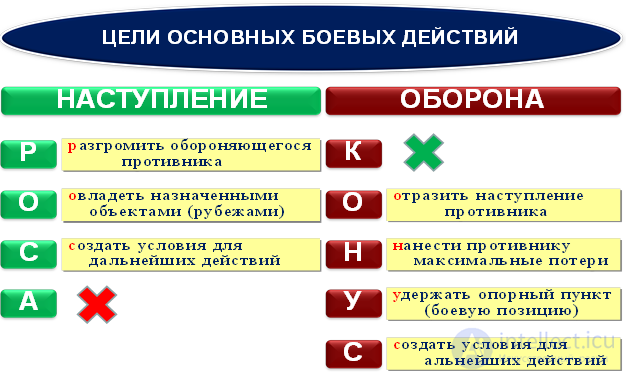
Fig. 0. Application of the operational mechanism «Recoding»
Figure 0 shows a possible application of this operational mechanism using the example of teaching the discipline «Tactical Training», where the operational mechanism «Recoding» is applied to the objectives of the main types of combat tactical actions (see fig. 0), evoking certain associations in the learners and aiding the memorization and reproduction of this educational information.
In particular, when studying the objectives of an offensive, the teacher gives the students the verbal-visual association «ROSA» (dew), and when studying the objectives of a defense, «KONUS» (cone), recoding the educational information according to the principle of «representing information in figurative form». Then, in the first case, we cross out the last letter «A», and in the second the first letter «K», and from the remaining letters of the visual association we get a «memory jog» that allows us to recall and reproduce, from these letters, the objectives of offense and defense as types of the main combat tactical actions. Here again, in studying this discipline, the learners receive from the teacher not only «auditory» information but also visual information, which makes it possible to memorize the educational information by associating it with the proposed recoding of the information into figurative form.
The difficulties present-day students face in mastering the curriculum are due to the following reasons:
Information explosion. The need to master an enormous amount of information, which the learner, in light of the modern competency-based approach to higher education, must perceive, understand, assimilate and apply. The need to become familiar with a large number of new technical terms.
Cognitive deficits. Weak school-level geometric-graphical training, insufficiently developed spatial conceptions of an object's shape,
an inability to analyze spatial forms from their depictions and to synthesize geometric fragments into a coherent image, a lack of skills in
working with textbooks and reference literature; insufficient development of oral and written speech; a limited vocabulary; difficulties in shifting from
concrete-figurative thinking to verbal-logical thinking when mastering course material; an insufficient ability to think logically, compare facts and draw
appropriate conclusions; poor retention of educational material (both verbal and graphic) and difficulty operating with it, fragmented ("clip") thinking, and so on.
A problem arises here: the teacher has learned to transform information (the instructional material) using a particular pedagogical technology and tries to convey the information they have transformed to the student. The student, upon receiving this information, transforms it again, doing so unconsciously and intuitively, since they do not know the mechanism of information conservation. Where is the student's agency (subjecthood)? The student will only become a subject when they know and apply the law of conservation of information and themselves choose the mechanism for transforming information, rather than engaging in the spontaneous transformation of already-transformed information, or recoding.
The law of conservation of information, for learning theory, can be expressed as follows: information is retained in the subject's consciousness for as long as the process of transforming new information does not reduce the level of uncertainty in understanding the object being studied.
For some time it was believed that acoustic coding dominates in this memory subsystem, i.e., that any information entering this subsystem must necessarily be converted into a sound form. After all, the very word "repetition" evokes an association with the mental rehearsal of material aloud! The first to formulate this position was R. Conrad in 1964, who presented subjects with strings of consonant letters and found that, immediately after presentation, the subjects made errors based on similarity of sound rather than similarity of spelling. For example, when reproducing the letters, they confused "b" and "g" rather than "t" and "g". Indeed, working memory (and, indeed, the entire human psyche as a whole) is best adapted for operating with spoken language. Mental processes proceed with great difficulty when the possibility of articulation is suppressed. Try, for instance, reading the following paragraph while saying "so-so-so" out loud. Isn't it true that you seem to see the letters, yet find it hard to grasp the meaning?
However, for recognizing the existence of other, non-verbal forms of coding in short-term memory, the research of Roger Shepard (1971) proved important. He showed subjects images of three-dimensional figures made up of chains of cubes arranged in space (Fig. 8.7). The subjects had to compare pairs of figures and decide whether they were identical or different. They solved such tasks easily, despite the fact that the stimulus material Shepard used was practically impossible to put into verbal form and thus to code acoustically.
Thus, acoustic-verbal coding predominates in working memory, but imagery-based codes can also be used when verbalization is difficult.
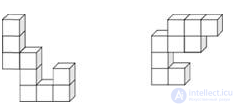
Fig. 8.7. Are these figures identical? Material for experiments on "mental rotation" (after R. Shepard, 1971)
The main ways of representing scientific-and-instructional information are: verbal, graphic, and symbolic (Fig. 1). A complete fragment of information,
described by one method or another, is called a text
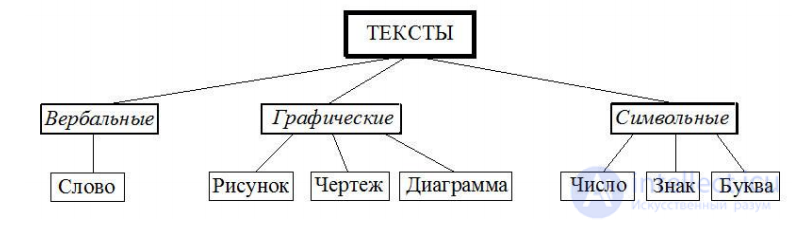
Fig. 1. Ways of representing educational information
The verbal (verbal-descriptive) method is dominant in the learning process. Declarative information is traditionally presented in the form of lectures, textbooks, and instructional-methodological aids, in oral or written form, in the native or a foreign language. Verbal presentation of information is fairly cumbersome in volume and requires considerable mental effort to extract the meaning and key concepts from the overall thread of the text. Perceiving it requires the capacity for logical thinking, a sufficient vocabulary, a level of cognitive and general academic readiness adequate to the demands of higher education, and a well-developed verbal intelligence.
Symbolic (formulaic, analytical, sign-based) method involves recording a fragment of information as a set of symbolic signs: letters, digits and standard symbols from some specific alphabet, organized according to clearly defined rules accepted in the field of knowledge being described. This method makes it possible to "compress" information, to describe the objects being studied, the relationships between them, and algorithms of action, compactly, and to see particular examples within general classifiers of surfaces. However, this requires a certain mental preparation, knowledge of the corresponding sign alphabet, the ability to operate by its rules, a capacity for abstract, algorithmic thinking, and a well-developed mathematical
intelligence.
Graphic method represents information in the form of a graphic image – a drawing (in axonometric or perspective projection), a technical drawing, a graph, a diagram, or a map. Perceiving information in the form of an image relies on visual thinking and graphic intelligence.
Graphic image – is a well-known, though difficult to define, phenomenon, an outstandingly effective means of modeling and communication, easily grasped by a person through sensory experience, but extraordinarily difficult to formalize. The importance of information-and-communication technologies (ICT) for conveying and transforming graphic information can hardly be overestimated, especially for the population of hearing-impaired students.
Of all the diversity of sign systems and languages created by world culture, graphic language, owing to a number of its properties (visual clarity, conciseness,
universality), is unique in the communicative process, which has allowed it to take a predominant place in the presentation of scientific-and-technical information and to become a professionally oriented language in engineering design-and-creative activity. Spatial-figurative thinking, and the manipulation of forms ("gestalts"), underlie the entire creative, generative process.
This method of representing information is primordial and natural in the formation of thinking. Before a child masters written speech, they convey information in the form of drawings.
let us examine one of the components of cognitive learning technology – the recoding of information, in other words, visual translation as the establishment of links between verbal text (a word), graphic text (a drawing) and symbolic text (a formula), the purpose of which is to use various methods (languages) of presenting information and to develop skills in translating from one language to another. Various combinations of such recoding are shown in Fig. 2.
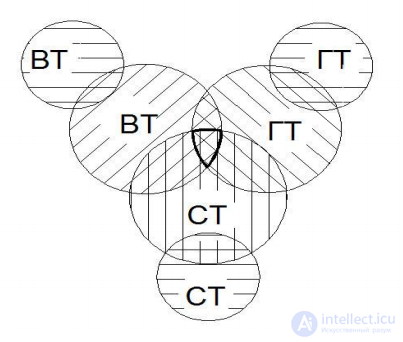
Fig. 2. Different variants of recoding texts: verbal text (VT) ↔ graphical text (GT);
verbal text ↔ symbolic text (ST); verbal text ↔ verbal text;
graphical text ↔ symbolic text; graphical text ↔ graphical text;
symbolic text ↔ symbolic text.
Note that for students with hearing impairments, additional recoding of the text into sign form is sometimes necessary in order to increase the informational and content accessibility of the educational material. Sign language, as a means of communication, provides additional support in the process of perceiving educational information. The criterion for understanding the meaning of a text is students' ability to independently represent the text not only verbally, but also in the form of drawings, diagrams, graphs, tables, symbolic notation, formulas and numerical notation, and so on.
Let us consider a number of examples of text recoding used in the engineering graphics course.
Recoding - Verbal text ↔ verbal text
A typical example from this group of possible recoding methods is the creation of abbreviations that condense verbal information which occurs quite often in texts of varying complexity, for example:
GOST – state standard;
ESKD – Unified System for Design Documentation.
Recoding: Verbal text ↔ graphical text
Presenting verbal texts in the form of a drawing (various graphical images) helps develop a more varied perception of the text, compensates for a shortage of vocabulary and technical terminology, and reveals the essence of the objects being described and the relationships between them.
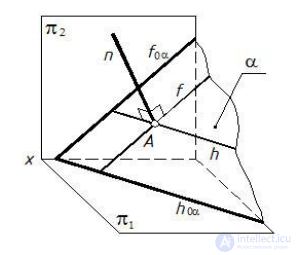
Theorems of descriptive geometry can be described both verbally and represented by a pictorial image or an orthogonal drawing (Fig. 3).
| Verbal text | |
| «If a line n is perpendicular to a plane α, then the horizontal projection of the line is perpendicular to the horizontal projection of the horizontal trace of the plane, and the frontal projection of the line is perpendicular to the frontal projection of the frontal trace of the plane» |
|
Graphical text |
|
 |
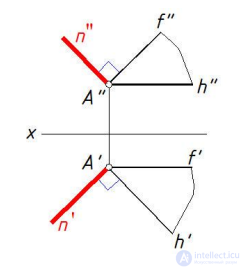 |
Fig. 3. Recoding of a descriptive-geometry theorem
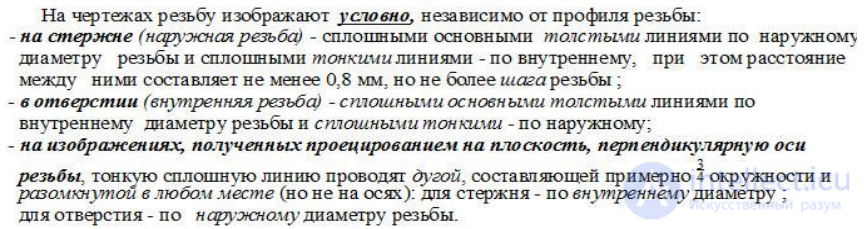
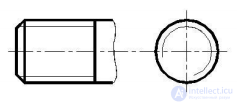
Students' first introduction to the concept of a «Thread», alongside a verbal description of the rules and conventions of its standard representation, requires a graphical explanation, which is necessary for composing and reading technical texts (Fig. 4).
Graphical text
| Verbal text | |
 |
|
| Graphical text | |
 |
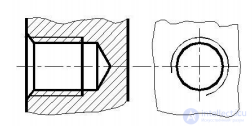 |
Fig. 4. Recoding of verbal text into graphical text
Recoding: Verbal text ↔ symbolic text
Recoding verbal text into symbolic text (a formula) is expedient when composing algorithms for solving positional or metric problems of descriptive geometry, for example, the problem of constructing a plane tangent to a surface at a point given on it (Fig. 5).
| Verbal text | Symbolic text |
| 1. Draw the auxiliary lines l1 and l2, belonging to the surface α and passing through the point L on the surface. 2. Draw the straight lines t1 and t2, tangent to the auxiliary lines l1 and l2 at the point L. 3. The plane τ, defined by the lines t1 and t2 will be tangent to the given surface at its point L. |
l1  Lα Lαl2  Lα Lαt1  l1 l1t2  l2 l2τ (t1 , t2)  α α |
Fig. 5. Recoding of verbal text into symbolic text
The theorem of descriptive geometry on the parallelism of lines, which in verbal form reads: "If lines are parallel, then their
same-name projections are parallel", can be compressed into the formula: a ׀׀ b <=> a' ׀׀ b' ^ a" ׀׀ b".
The reverse problem – translating symbolic text into verbal text arises when decoding the conventional designations of standard threads and threaded products. For example:
– M20x1.5 – a metric thread with a nominal diameter of 20 mm, a fine pitch of 1.5 mm, right-handed, single-start;
– G1LH – a cylindrical pipe thread with a size designation of 1 inch, left-handed;
– Tr20x8(P4) – a trapezoidal, two-start, right-handed thread with a nominal diameter of 20 mm, a lead of Ph = 8 mm, and a pitch of P = 4 mm;
– Bolt M12x40 GOST 7798-70 – a design-1 bolt with a thread diameter of 12 mm, a length of 40 mm and a coarse thread pitch.
Recoding: Graphical text ↔ symbolic text
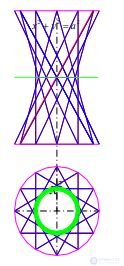
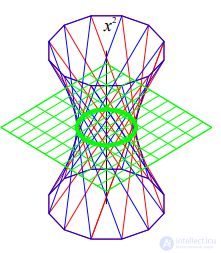
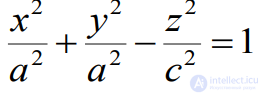
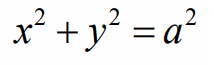
One way of broadening one's scientific outlook is to establish interdisciplinary connections, for example, in the algebraic proof of the result of
a graphical construction of the section line of a one-sheeted hyperboloid of revolution by a plane perpendicular to its axis.
Fig. 6 shows an example from a student's presentation at a conference devoted to the use of graphical images in various fields of science.
Fig. 6. Recoding of graphical text into symbolic text
| Graphical text | symbolic text |
|
z=0 |
  |
Recoding: Graphical text ↔ graphical text
In the first stages of instruction, first-year students often find it difficult to picture the object being studied from its orthogonal projections. To minimize the deficit in spatial intelligence, it is useful and effective to present the displayed objects in a pictorial form.
Thus, Fig. 7 shows the initial data for completing the homework assignment «Constructing images» in orthogonal projections and the pictorial
images of the given figure. This kind of recoding significantly increases the content accessibility of the educational material, as confirmed by the excerpt below.
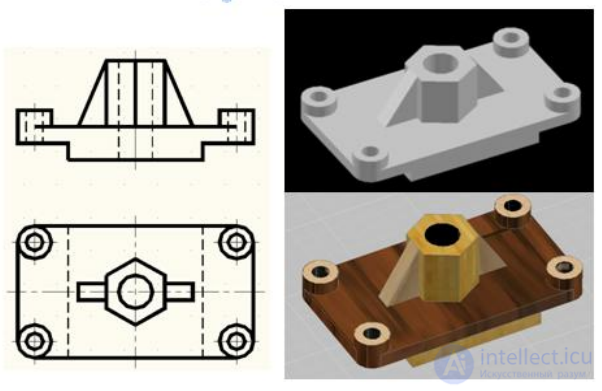
Fig. 7. Different variants of graphical representation of an engineering-graphics assignment
Recoding: Symbolic text ↔ symbolic text
A symbolic description of a cylindrical surface of revolution can be given either as an algebraic equation x2 + y2= R2, or from the standpoint of the kinematic generation of the surface, in the form of its determinant, which includes the generatrix g, the axis of rotation i, and the condition that this generatrix rotates about the axis while remaining parallel to it: Ф (g, i); [g = Ri (g)].
However, the most complete understanding of the meaning of educational information is provided by its integrated presentation.
Thus, understanding the cause-and-effect relationships in constructing the lines of conic sections is most productive when combining verbal text, graphic
accompaniment, and also symbolic representation structured in tabular form. (Fig.8) shows an example from a lecture notebook on descriptive geometry.
| Verbal text | 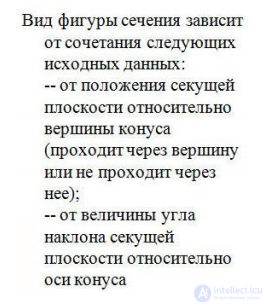 |
| Graphic text | 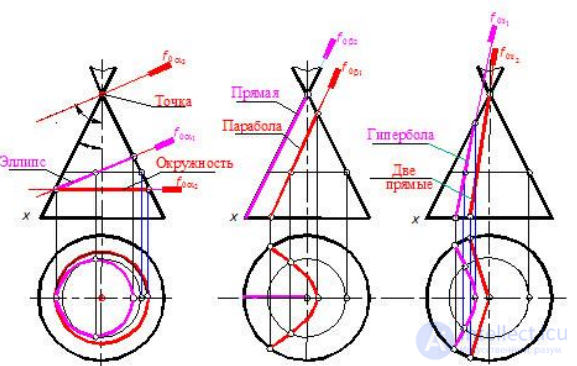 |
| Symbolic text | 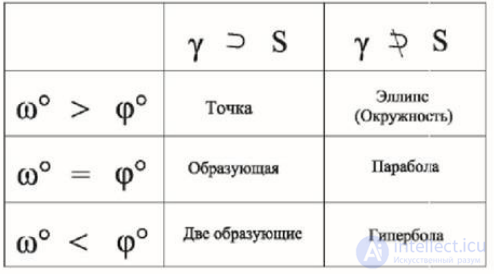 |
Fig. 8. Integrated presentation of the topic "Lines of conic sections"
The algorithm for constructing the line of intersection of surfaces is likewise assimilated most effectively when presented in an integrated form (fig. 9). Illustrating educational information with video fragments brings emotional richness to the process of its perception.
| Verbal text | Symbolic text |
| 1. Introduce an auxiliary surface γ. 2. Determine the lines of intersection of the auxiliary surface γ with each of the given ones (α and β). 3. Find the point of intersection L of the resulting auxiliary lines. 4. Repeat the first three steps n times. 5. Draw the sought line of intersection l through the resulting points |
Introduce γ γ  α = a α = aγ  β = b β = ba  b = L1 b = L1L1 ...Ln l  L1 ... Ln L1 ... Ln |
| Graphic text | Video fragment |
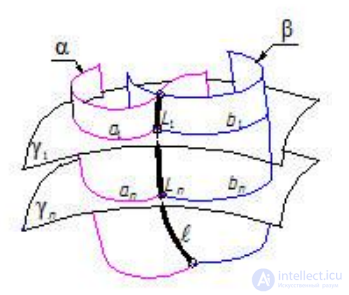 |
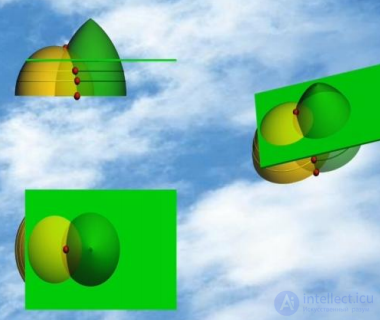 |
Fig.9. Integrated presentation of the algorithm for constructing the line of intersection of surfaces
There are four conditions for organizing mathematical instructional material that promote students’ understanding of educational information:
These conditions are realized through tasks. Let us present a typology of tasks and examine the methodology for working with them based on the implementation of the identified conditions for organizing instructional material in the study of algebra in grades 7-9.
The following can be chosen as the bases of the typology:
Based on the presence or absence, in the text of the tasks, of a requirement to recode the information, we divided all mathematical tasks into two large groups. We defined the first group as «tasks in which the information is presented in different ways» and assigned to it tasks that do not require the students to recode information, and the second as «tasks in which the information requires translation into another mode» and assigned to it tasks requiring the students themselves to recode the material presented in them. We divided these groups into three types as follows: tasks of the first and second types make up the first group, and tasks of the third type make up the second group.
Tasks of the first type are presented predominantly using one method of coding (iconic, symbolic, or verbal) and presuppose a solution in that same mode. Moreover, tasks presented predominantly by an iconic method are divided into tasks presented by an image-iconic method and tasks presented by an image-graphic method. Recodings (i.e., translations from one mode of presentation to another), whether in the statement or in the solution of these tasks, are absent. It should be noted that there are no tasks presented exclusively by the iconic method of coding: all tasks presented by this method presuppose verbal comments (for example, in the requirement of the task «complete the graph of the even function»). Verbal comments containing the wording of the requirements are also presupposed by many tasks presented predominantly by the symbolic method of coding. We also take into account that in tasks presented verbally there will be numbers present: it has historically come about that we perceive numbers just as naturally as words.
Tasks of the second type are those in whose text the information is presented by different methods of coding. In solving tasks of this type, the student need not recode the information from one mode into another: he need only correlate the same information presented in different ways, thereby finding the solution to the task. The information in the statement of these tasks is presented by different methods of coding, and there are no independent recodings in the process of solving the task. Moreover, given that such tasks should be offered to students at the initial stage of learning to recode, the most suitable ones, as was shown in the previous section, are tasks requiring the choice of the correct answer and tasks requiring the establishment of correspondences. Thus, we identified one more basis for the typology. By the specific nature of the requirement, tasks of the second type can be divided into: tasks requiring the choice of the correct answer; tasks requiring the establishment of correspondences; tasks whose conditions are presented by different methods of coding (i.e., tasks presented by two (three) methods of coding and requiring an answer to be given in one of them).
We classify as tasks of the third type those tasks in solving which the student will have to recode the information, that is, to translate the information from one mode of presentation into another and to present it in a mode (or modes) of coding different from that of the statement. Since in the text of a task the information can be presented in a verbal, symbolic, or iconic mode, and can be translated from one mode into another, within tasks of the third type we identified tasks involving symbolic-verbal, verbal-iconic and iconic-symbolic recodings. Given that iconic presentation of information may or may not presuppose the students’ ability to read a legend (image-graphic presentation of information as opposed to image-iconic presentation of information, which does not require this skill of the students), we identified tasks involving within-image recodings. Tasks that include not one but several recodings we called tasks with complex recodings.
Thus, to the three bases identified above for the typology of tasks we will add one more: the specific nature of the recoding in the process of solving the task (for tasks of the third type). So, the bases of the typology of task material we have developed are:
Relying on the bases identified, one can schematically represent the typology of mathematical tasks as follows: Let us examine the methodology for working with the identified types of tasks in the process of teaching algebra, based on the implementation of the conditions for organizing instructional material identified in the previous section. Work with algebraic instructional material includes the following stages:
In conclusion, we would like to add that in our work with students of the technical university we use all of the above-listed combinations of recoding. For the successful creation of a cognitive learning environment that ensures understanding of the educational information offered (especially for students who are deaf or hard of hearing), it is necessary to develop and apply instructional materials based on information and communication technologies, in which verbal, graphic and symbolic texts must be organically combined, mutually supporting and reinforcing one another in the unity of the verbal and iconic components of thinking. Such a methodological approach makes it possible to minimize students’ cognitive deficits and promotes the formation of their professional competencies within the framework of state
educational standards

Comments