
Lecture
Awareness of knowledge on the part of the individual is expressed in an understanding of the connections between items of knowledge and the paths by which they were obtained, in the ability to prove them, and in an understanding of the principle by which these connections operate and the mechanism of their formation. [16, 34]
To understand the awareness of knowledge, three questions must be answered:
The awareness of knowledge can be characterized by the following features:
The ability to regroup and transform material, and to creatively apply descriptions of phenomena and laws, is manifested as the awareness of knowledge.
Awareness and durability of knowledge. According to I.Ya. Lerner, the awareness of knowledge is expressed in an individual's understanding of its connections and the paths by which it was obtained, and in the ability to prove the existence of these connections and the mechanism of their emergence and operation. To these features the author also adds an understanding of the arrangement and subordination of the connections between items of knowledge, and the ability to distinguish essential from non-essential connections.
The durability of knowledge consists in the stable retention in memory of the essential elements of knowledge and in the readiness for their utilization. The durability of knowledge depends significantly on interest in studying the material.
These features of the awareness of knowledge are characteristic of the final stage of assimilation. The formation of these features, however, occurs gradually: at different stages of instruction, either not all of the features are characteristic of the knowledge being acquired, or different features are realized at different levels.
It is worth noting that, in preparing a lesson, the teacher needs to consider which features of awareness, and at what level, can be realized in that lesson. Sometimes this can be determined on the basis of the requirements of the curriculum or the content of the textbook, but it is advisable to make certain adjustments to the methodological recommendations, taking into account the characteristics of the particular class.
We cannot judge the degree to which a student is aware of a piece of knowledge until he demonstrates it in practical activity. I.Ya. Lerner identifies three forms in which awareness is expressed:
For this last way of expressing awareness of knowledge, one needs not only knowledge itself but also the mastery of such forms of activity as habits and skills.
Let us now turn to answering the third question posed at the beginning of this section, namely: how does awareness relate to the other qualities of knowledge? It turns out that some qualities influence its formation, while in others it is itself manifested. Thus, depth and systematicity are necessary for the formation of awareness, since they concern the connections between items of knowledge; systematicity determines the recognition of the place of particular items of knowledge within a coherent theory. Efficiency, that is, mastery of modes of activity, is an important condition for awareness, while flexibility acts as a form in which awareness is expressed. The higher this flexibility, and the better its features are mastered, the more it is manifested in the successful creative activity of students. Other qualities of knowledge — generality and concreteness, compactness and expandedness — serve as a means or a form in which awareness is expressed. By generalizing knowledge or making it concrete, by compressing or unfolding it, a student can also reveal the awareness of that knowledge. But these forms alone do not guarantee that all the features of awareness will be manifested. The teacher must master all of these features personally in order to guide students' activity in acquiring all the qualities of knowledge.
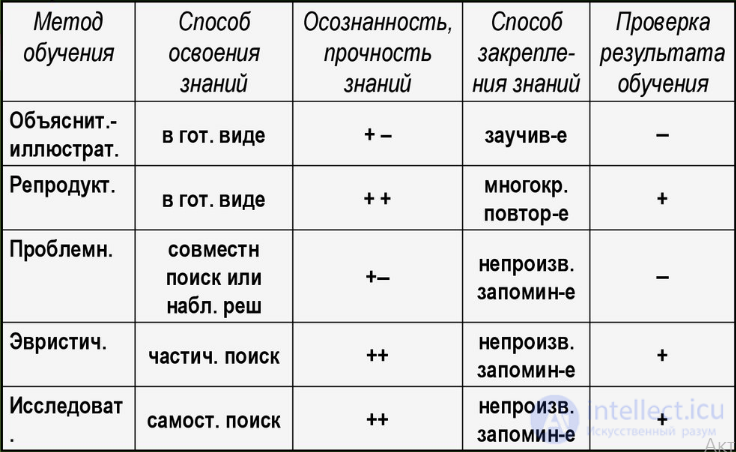
To develop awareness, any method that organizes one or another form of cognitive activity can be used.
In explanatory-illustrative and problem-based presentation, the teacher needs to pay attention to the nature of the connections, emphasize what is essential in the description of a phenomenon, prove the basic propositions, and connect theory with practice.
The partially exploratory method is designed to give students a certain degree of independence in becoming aware of knowledge.
The reproductive and research methods presuppose a set of corresponding tasks, namely:
The methods described for achieving the qualities named above have a direct bearing on the formation of the last quality of knowledge — durability.
Durability consists in the stable retention in memory of a system of essential knowledge and the methods of applying it, or in the readiness to derive the necessary knowledge on the basis of other supporting knowledge. [16, 38]
Let us note that, in the modern learning process, achieving the durability of knowledge should not rely on the work of memory, but should instead proceed from its awareness and from the means by which such qualities as systematicity, systemicity, efficiency, flexibility, depth, and generality are achieved.
An important role in ensuring the durability of knowledge is played by a positive emotional attitude toward learning activity, toward its object — knowledge, and toward the process of cognition. Interest in learning, a sense of responsibility, and collectivism are among the most important conditions for the durability of knowledge.
In conclusion, let us note that the main purpose of the foregoing was to show what system of qualities the knowledge attained in the learning process must satisfy. But such qualities of knowledge can be achieved only on condition of the systematic monitoring of students' mastery of skills and habits in the course of their independent activity, when the teacher pays attention not only to the degree to which particular habits and skills have been mastered, but also to the formation of certain qualities of knowledge. It is precisely with this kind of organization of monitoring that students' knowledge will be complete, and, consequently, the student's personality as a whole will develop fully.
Before proceeding to construct a system of ongoing assessment for fifth-grade students, attention should be paid to the psychophysiological characteristics of students of middle-school age.

Comments