
Lecture
The goal of teaching spelling in school is to develop students' relative literacy, i.e., the ability to write words in accordance with the spelling rules studied at school, and certain words with unverifiable orthograms, in accordance with the required spelling minimum.
Cognitive goals: - introducing the basic concepts of spelling. Practical goals: - developing spelling skills.
The content of spelling instruction consists of spelling theory, or spelling concepts (rules), and spelling skills.
Spelling concepts include: the orthogram, the spelling rule, the spelling fact, the identifying features of orthograms, the position of orthograms, the conditions for choosing orthograms, actual and non-actual orthograms, and the spelling dictionary.
An orthogram – is a spelling governed by a spelling rule. Several types of orthograms are distinguished: the letter, the space, solid (joined) spelling, the hyphen, and the dash used for line-division. A spelling rule – is an instruction that specifies the norm of writing and the conditions that determine that norm.
A spelling fact – is a spelling that has to be memorized by sight: words with unverifiable orthograms, individual morphemes, individual function words.
The identifying features of orthograms – are the linguistic and graphic markers by which the point of application of a rule is determined.
Spelling skills include: spelling vigilance, the ability to make a well-grounded choice of orthogram, the ability to write words correctly according to spelling rules, and the ability to find and correct spelling errors.
SPELLING METHODOLOGY
Spelling methodology is a branch of the methodology of teaching the Russian language that describes the process of developing students' spelling skills and habits.
| Goal of spelling instruction | The development of a relative level of spelling literacy, understood as the ability to use, when writing words, both letter-based and non-letter graphic means of writing, in accordance with the accepted rules of spelling. |
| Objectives of spelling instruction | · - to introduce schoolchildren to the basic spelling concepts; · - to develop students' spelling skills on the basis of these concepts; · - to teach them to write words with unverifiable orthograms; · - to develop in children the need and the ability to use a spelling dictionary; - to create the necessary conditions (prerequisites) for teaching schoolchildren spelling. |
| Content of instruction | Spelling concepts. The Grade 5 curriculum includes two concepts: orthogram and spelling dictionary. In the textbooks (in observation materials, in exercise assignments) the following concepts are used: letter-orthogram, space-orthogram, solid (joined) spelling, separate (split) spelling, hyphen, type of orthogram, verifiable orthogram, unverifiable orthogram (or unverifiable spelling), conditions for choosing an orthogram, identifying features of orthograms. The remaining concepts — spelling, non-orthogram, spelling error, letter orthogram, non-letter orthogram, line-division dash — are used by the teacher in the instructional process. A spelling fact is a separate linguistic phenomenon whose spelling the student memorizes "by sight," as well as a linguistic phenomenon by means of which a particular spelling of a word is justified. Words with unverifiable orthograms are also spelling facts. Spelling facts also include individual morphemes and orthograms studied at school, for example the prefixes ending in з and с, пре- and при-, не- and ни-; the suffixes -ек (-ик), -ок (-ек); the roots -кос- (кас-), -гор- (-гар-) and others; and individual function words, for example the conjunctions чтобы, также and the particles -ка, -то. Spelling rules. A spelling rule is a special, brief instruction that lists the conditions for choosing a particular orthogram1. Depending on how the conditions of choice are listed, formulations of spelling rules are of two kinds: descriptive and regulative. Descriptive spelling rules list the conditions for choosing an orthogram, or the conditions prohibiting a given spelling. Regulative spelling rules indicate the courses of action students should take when choosing an orthogram from among several possible spellings. Spelling skills and habits. Skills and habits are the intellectual-motor actions of students. In spelling work they manifest themselves in children's choice of orthograms and in fixing them in the written word. The following types of spelling skills and habits are developed at school: · - locating orthograms in words; · - writing words with the types of orthograms studied, including words with unverifiable spellings; · - justifying orthograms; · - locating and correcting spelling errors. |
| Spelling memory | Auditory memory consists in memorizing phonemes within morphemes by ear. This memorization takes place in the process of writing, i.e., when phonemes are rendered by means of letters. Various types of dictation are used in class for this purpose. Visual memory manifests itself in the process of writing from dictation and in copying. In class, visual memory manifests itself through the use of various types of copying exercises, as well as dictations with visual preparation. Speech-motor (kinesthetic) memory relies on the syllable-by-syllable spelling pronunciation of words, as a result of which the phonemic composition of the word being studied becomes fixed in the muscular movements of the speech organs. Speech-motor memory is used in teaching children the spelling of words with unverifiable orthograms. Motor memory consists in the student writing the same word down repeatedly. Neither the methodology nor school experience provides data on the number of repeated writings needed for any given word. |
| Developing students' spelling vigilance | The choice of correct spellings in words begins with locating orthograms in them according to their markers. The markers, or identifying features of orthograms, are the following features of words: phonetic (unstressed vowels, sibilants, ц, etc.), lexico-grammatical (proper names and proper designations, etc.), lexical (prepositions, conjunctions, particles), and structural (the presence of certain prefixes or suffixes, compound words). |
| Principles of spelling methodology | General principles: - reliance on the connection between the study of spelling and the study of grammar and phonetics, which determined the parallel, distributed introduction of spelling material alongside the study of phonetic, morphemic, word-formation and morphological material; - reliance on the identifying features of orthograms. Specific principles: - the principle of comparing sounds in a weak position with sounds in a strong position within a given morpheme; - comparing a sound with its phonetic environment; - the principle of comparing a proper name or proper designation with a common noun; - comparing the semantics of a word with its structure; - the principle of comparing a part of speech with a sentence element; - the principle of observing the syllabic composition of a word. |
| Spelling exercises | 1. Copying (with or without additional tasks). 2. Various types of dictation. 3. Summaries (expository writing) and essays. 4. Spelling analysis. 5. To teach students to write words with unverifiable spellings, the following are used: syllable-by-syllable orthographic pronunciation of the word; repeated writing of the word; etymological analysis of the word; compiling tables of words with unverifiable spellings; selecting cognate words. |
METHODOLOGY OF PUNCTUATION
The methodology of punctuation is a branch of the methodology of teaching the Russian language that describes the process of developing students' punctuation skills and habits.
| Goals of teaching punctuation | To develop in students a relative punctuation literacy, understood as the writer's ability to correctly use punctuation marks to divide sentences and text into meaningful segments, and the reader's ability to understand what has been written in a way adequate to the writer's intention. |
| Objectives of teaching punctuation | Cognitive objectives: - revealing the purpose of punctuation and punctuation marks; - introducing the basic unit of punctuation — the punctuation-semantic segment — and the types of semantic segments; - familiarizing students with the functions of punctuation marks, the conditions for their placement, and the identifying features of semantic segments that require punctuation marks to be set off; - mastering the punctuation rules included in the curriculum. Practical objectives: - to develop students' punctuation awareness (vigilance); - to teach them to place punctuation marks in accordance with the punctuation rules studied; - to develop the ability to justify the choice of punctuation marks; - to teach children to find punctuation errors and correct them. |
| Content of the work | 1. Punctuation concepts: - the punctuation-semantic segment; - the punctuation norm — the use or non-use, sanctioned by a specific rule, of a punctuation mark or marks in a sentence and in a text; - to set off semantic segments in oral speech, intonation (rhythm and melody) is used, while in writing special graphic means called punctuation marks are used, which are divided into sentence-level marks (comma, parentheses, etc.) and text-level marks (paragraph indentation, a line under the text of a page to separate it from a footnote, etc.). Some punctuation marks (period, question mark, exclamation point, ellipsis) perform a dual role: they are used both within a sentence (in a terminating function) and within a text (in a dividing function). 2. The punctuation rule. The list of conditions for choosing where to place a mark and for choosing the necessary mark is included in a special instruction called a punctuation rule. Each punctuation rule corresponds to its own semantic segment, set off by punctuation marks. Punctuation rules either permit the placement of a mark (marks) of punctuation or prohibit it. The first type of rule is called positive, the second — negative. 3. Punctuation skills. The following types of punctuation skills are developed in school: - finding, within communicative units, semantic segments that require punctuation marks to be set off; - placing punctuation marks in accordance with the punctuation rules studied; - justifying the choice of where to place a mark and the choice of the necessary punctuation mark; - finding punctuation errors and correcting them. |
| Developing punctuation awareness (vigilance) | Within communicative units — the sentence and the text — there are markers, called identifying features, by which a semantic segment can be detected and its boundaries determined. The identifying features are: morphological features of semantic segments — the presence of participles, adverbial participles, interjections, conjunctions, and certain particles; syntactic features — the presence of two or more grammatical bases, or of elements that complicate a simple sentence (forms of address, parenthetical words, set-off constructions, reported speech, series of homogeneous parts); phonetic (rhythmic-melodic) features — vocative, cautionary, enumerative, and other types of intonation; and semantic features — cause, contrast, sequence, and so on. |
| Structure of the school punctuation course | Punctuation, owing to its attachment to the communicative unit — the sentence — is studied in parallel with syntax. 1. Elementary stage. Elementary information on punctuation is given in the primary grades in the form of a list of individual punctuation marks (period, question mark, exclamation point, comma) and certain punctuation rules concerning the use of punctuation marks at the end of a sentence, and the comma between homogeneous parts not joined by conjunctions, and those joined by the conjunctions а (a — "and/but") and но (no — "but"). Propaedeutic stage. The next stage in the study of punctuation is Grade 5, in which propaedeutic information on the punctuation of both simple and complex sentences is given: punctuation marks at the end of a sentence; commas between homogeneous parts in asyndeton, with the conjunctions а, но (a, no — "and/but", "but") and the single conjunction и (i — "and"), a colon after a generalizing word; punctuation marks with forms of address; a comma between simple clauses within a complex sentence, in asyndeton and with the conjunctions и, а, но, чтобы, потому что, когда, который, что (i, a, no, chtoby, potomu chto, kogda, kotoryy, chto — "and", "and/but", "but", "in order to", "because", "when", "which/who", "that"); punctuation marks with direct speech placed before and after the author's words; a dash before lines of dialogue. In Grade 7, information is added on placing commas with participial and adverbial-participial phrases. Main stage. Systematic work on punctuation is carried out in Grades 8-9. In Grade 8, work is done on the punctuation of the simple sentence and of sentences with direct speech. Review of the punctuation norms covered in Grades 5 and 7 is combined with new variants of these norms, and new semantic units are also introduced — set-off (isolated) parts of the sentence and parenthetical words, phrases, and clauses. In Grade 9, the rules for using punctuation marks to divide simple sentences within a complex sentence are studied. |
| Principles of the methodology of punctuation | The principle of observing the logical-objective information expressed in a sentence. The principle of observing the structure of a sentence. The principle of observing the rhythm and melody of a sentence. |
| Punctuation exercises | 1. Copying (with or without additional tasks). 2. Various types of dictation. 3. Summaries (expository writing) and essays. 4. Punctuation analysis. 5. Graphic dictation. |
- a gap between learning the spelling rule and
forming the corresponding skill;
- the spelling action based on the rule not yet being
fully formed (in lessons, children spend too much time
memorizing the rule, while practicing its application
in writing only occasionally and monotonously);
- the error made becoming fixed in the student's memory;
- a difference between the types of activity involved in
practice and in testing: in practice exercises the
omitted letters serve as a signal to apply the rule, while
in a dictation there is no such signal;
- students' lack of the ability to compare oral and
written speech, and to correctly choose letters under
conditions of strong phonetic interference. (V.A. Sidorenkov)
Most common serious (gross) errors:
- spelling of unstressed vowels;
- vowels after sibilants and «Ц» (ts);
- doubled consonants;
- voiced and voiceless consonants in the middle and end of words;
- hard and soft consonants (the absence of the soft sign Ь, or its
use where it is not needed);
- the separating soft sign Ь and hard sign Ъ;
- the spelling of prefixes, suffixes, case
and verb endings;
- adverbs (written together or separately, with or without the soft sign Ь).
Minor errors include errors:
- in exceptions to all the rules;
- in the capitalization of letters in compound
proper names;
-in the joined or separate spelling of
prefixes in adverbs formed from
nouns with prepositions;
- in cases requiring the distinction between NOT and
NOR (none other than…).
Knowing a rule will not protect a student from mistakes;
this knowledge must be turned into skills.
To teach a student to write correctly,
it is necessary to define a spelling
minimum of rules and words, which may include
no more than 3-4 thousand words. The criteria for selecting words into
this minimum are:
a) frequency of use (in the language in general and in the speech
of students of the given age);
b) the persistence of errors in these words.
A.V. Tekuchev answers this question as follows: «Neither the system
of our spelling nor the system of rules would justify
themselves if they were such that a literate person doing the writing
would always be forced to remember all the rules and
pedantically apply now one, now another…» Under
normal conditions, one resorts to the help of a rule during
the period of studying it in class; then, as it becomes reinforced,
one resorts to the rule ever less often, but at a moment of difficulty
one can always turn to it again. Naturally,
a literate person subsequently forgets most rules,
but he knows how to use them at the level of skills.
In this connection, two cases should be distinguished: when
literacy has been brought to such a degree that one no longer needs
to use the rules, or when a rule has been forgotten
because it was poorly mastered by the student».
Spelling rules must be
accessible, not unwieldy, as
far as possible easy to remember,
sufficiently clear, and not allowing
for a double interpretation.
The tasks of teaching spelling
are: the prevention of errors,
the mastery of the correct spelling of words, and
the development of the corresponding skills.
The number of errors increases from grade to grade.
This indicates that
a great many rules accumulate and it becomes
problematic to keep them in memory. That is,
the rule does not work. The main difficulty
in mastering spelling lies in the fact that
the introduction of a spelling rule and the process
of the formation of skills built on the basis of
the rule cannot coincide in time.
A contradiction arises between knowledge
of the wording of a rule and the inability
to write words correctly according to that rule,
between the spelling material studied
and the spelling patterns that the student
actually uses in writing.
This phenomenon, to which methodologist scholars have
repeatedly drawn attention (N.N. Algazina, S.I. Lvova, G.N. Pristupa, M.M.
Razumovskaya, N.S. Rozhdestvensky, M.V. Ushakov and others),
is explained by the fact that the process of the formation of spelling
skills on the basis of rules requires time and the mandatory
observance of a staged sequence. However, the teacher, fearing to fall behind
the syllabus, does not devote the necessary attention to the step-by-step
practicing of spelling rules, and does not differentiate
the lexical material covered by these rules according to
the degree of difficulty of mastery. Therefore a significant proportion of
students, from topic to topic, from stage to stage, fail to achieve
the mandatory results of spelling instruction. This leads to
a growing accumulation of gaps, which at first hinders the student
from continuing to learn, and can then remove him entirely from participation in
the normal instructional process and lead to a loss of interest in
the subject, since the assessment of a student’s success in the subject
is carried out mainly according to a spelling criterion.
1. Studying spelling while mastering grammatical
material hinders the awareness of the norms of spelling as
a system.
2. It is difficult for students to memorize and master the large volume
of spelling and punctuation rules studied
in a disjointed way. In the school curriculum, in connection with the mastery of
grammatical topics, 71 spelling patterns are studied.
3. Under the established system of teaching spelling,
«spelling patterns of different natures are studied side by side».
These topics are not combined, not systematized in
the student’s mind.
4. The established system of mastering practical topics in
the study of grammatical material (for all its
soundness) does not make it possible to bring
spelling abilities to the level of a stable skill.
This methodology was developed by the practicing teacher
Tatyana Yakovlevna Frolova. A large place in lessons of
the Russian language is devoted to work on mastering spelling
on the basis of generalized-comparative rules,
algorithms, generalizing tables, and graphic schemes. This
makes it possible to carry out a generalization of what has been studied, the consequence
of which is the systematic character of spelling knowledge and
the absence of the fading of spelling rules.
Methodologists assert that the formation of a stable
skill requires no less than 30 days. The structure of the
Russian language course does not allow students to retain
practical abilities, bring them to automaticity, and
keep them in memory for a long time.
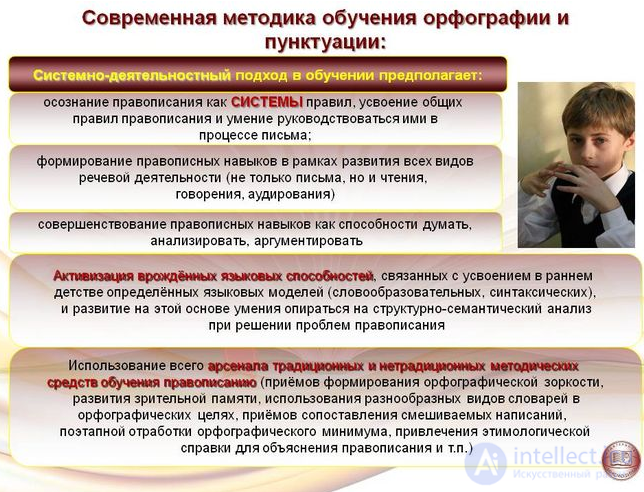
The methodology of intensive spelling instruction presupposes:
1. Compact study of «Spelling» as an
independent or system-forming section.
2. Teaching correct spelling on the basis of a classification
system that presents the material being studied in groups,
united by identifying features or by
a single basis.
3. Reducing the volume of material studied by
combining rules with a common identifying feature
into a single unit of information, into one accessible
generalized-comparative rule.
4. Teaching spelling on the basis of the necessary and
sufficient theoretical material, actualized
and studied in the logic of mastering spelling and
punctuation topics.
5. Ensuring the reliability of mastering spelling
material through a system for describing methods of applying
the rule.
The technology of the applied methodology of intensive spelling instruction
1. Graphic markings of spelling patterns as a technique for
intensifying spelling instruction.
Graphic markings help to memorize a rule better and faster.
When necessary, students, having
looked at the graphic scheme, easily recall
the rule and apply it. The most reliable and efficient
memory is visual memory. It instantly reproduces
the information, which the student then need only read off.
This means it is necessary to translate verbal formulations into
graphic ones. This is how graphic schemes arise.
-LAGA-, -LOZH- (predLAGat’, predLOZHit’).
-TSI-, -TSIYA (TSIfra, TSIrk, akaTSIYA, aviaTSIYA, porTSIYA,
tradiTSIYA)
-TSYN, -TSY, -TSY (SestriTSYN, tsariTSYN, bezliTSY,
krugloliTSY, ogurTSY, molodTSY)
Students become acquainted with the wording of the rule,
then the teacher gives a graphic scheme of the rule,
proposing that students reproduce with its help
the verbal form of the spelling pattern being studied.
Then part of the scheme is erased, and the students must
restore it to its original form.
Then the entire scheme is erased, and the student, relying on
visual memory, reproduces the verbal
wording.
After the rule has been mastered, in the visual
memory ends up storing a graphic
equivalent of the verbal formulation.
Classification of mnemonic techniques:
Letter-sound mnemonics (the presence of identical letters and
sounds; partial, incomplete similarity is also acceptable).
Rhymes. Shared stress patterns.
Belonging to the same word-formation type.
Association tales.
Schematic-pictorial mnemonics.
For example, we know that the genitive plural of nouns usually causes enormous difficulty, but
the suggested mnemonic rhymes considerably simplify
the assimilation of the material:
Уважают человека у туркмен, татар, узбеков,
У таджиков и армян, у монголов и цыган,
У якутов и тунгусов, у башкир и белорусов,
У киргизов и грузин, у бурят и осетин («People are respected among the Turkmens, Tatars and Uzbeks, the Tajiks and Armenians, the Mongols and Gypsies, the Yakuts and Tunguses, the Bashkirs and Belarusians, the Kirghiz and Georgians, the Buryats and Ossetians» — a rhyme illustrating the irregular zero-ending genitive plural of these ethnonyms).
In a children's tale the gingerbread man (kolobok) could roll along the grass
without little boots, without boots, without socks and without stockings.
Rhymes cope well with the function
of memorizing the stress in words:
Посреди пустынных вод проходил нефтепрово'д («Through the deserted waters ran an oil pipeline», with the stress falling on the last syllable of nefteprovo'd).
Как у нашей Марфы
Есть в полоску шАрфы!
Долго ели тОрты –
Не налезли шОрты!
Хороши и вблизи
Французские жалюзи! (a rhyme for memorizing the fixed stress in шАрфы «scarves», тОрты «cakes» and шОрты «shorts», words that are commonly mis-stressed).
For memorizing voiceless consonants:
«СТёПКа, ХоЧеШь ЩеЦ? — Фи!» («Styopka, do you want some shchi? — Ugh!»), whose capitalized letters spell out all the Russian voiceless consonants,
and «ФоКа, ХоЧеШь ПоеСТь ЩеЦ?» («Foka, do you want to eat some shchi?»), which does the same.
For memorizing voiced consonants:
«Мы Же Не ЗаБыВаЛи ДРуГ ДРуГа!» («We didn't forget each other!»)
and «ГДе ЖиЗНь БыЛа В МиРе + Й» («Where life was in the world», plus the letter Й), the capitalized letters of which spell out all the Russian voiced consonants.
Confusion of the prefix С- with the letter З in words:
There is no prefix «З-» – every schoolchild knows this.
Зги, здесь, здание, здоровье («zgi» [as in the idiom «not a zgi to be seen», i.e. pitch dark], «here», «building», «health») are exceptions in which the initial З belongs to the root, not to a prefix,
so write С з- and be well (a play on the set phrase «на здоровье», «you're welcome»).
Rhymed algorithm
«В существительных на –ЦИЯ
Мы всегда напишем –ИЯ.
И под корнем, посмотри,
Тоже пишем букву И.
А в концовке –ЦЫН,-ЦЫЙ,-ЦЫ
Пишем только букву -Ы.» («In nouns ending in -ЦИЯ we always write -ИЯ; likewise, in the root we also write the letter И; but in the endings -ЦЫН, -ЦЫЙ, -ЦЫ we write only the letter -Ы» – a rhymed rule for spelling И or Ы after the letter Ц).
The teacher's main task is to develop the ability to formulate
a spelling problem. To solve a spelling
problem, one must answer the question: «What needs to be found out?». To
choose the right rule, it is necessary to identify
the spelling pattern (orthogram).
Exercises that promote the development of spelling
vigilance:
- selecting words with the same spelling pattern as the one found in
the given exercise;
- grouping spelling patterns;
- writing out a text with letters omitted, whose correct spelling
causes difficulty;
- dictation with a dot (when writing the word, the student must
underline the spelling pattern);
Which answer option lists the series of words in which the omitted letters are
only unstressed vowels of the root that can be checked by stress. What
identifying features of the spelling pattern did you note.
А. бл.. стеть, возл..гать, пок..заться
Б. пр..ближаться, р..скошный, зад..ржать
В. пом..риться, ут..щить, сож..леть.
Г. пр..ложить, приг..рел, приб..рать.
Read and find the phrases in which the consonant spelling patterns are governed by a single rule.
А. удалить зуб, вырастить гриб, улыбка ребёнка, сильный дождь (remove a tooth, grow a mushroom, a child's smile, heavy rain)
Б. Съесть лимон, встроить шкаф, беспокойный характер,
задержать рейс (eat a lemon, build in a wardrobe, a restless character, delay a flight).
Such types of exercises make it possible to carry out analysis,
comparison and classification of the spelling patterns studied.
The system of work on generalized-comparative rules
● Announcing the spelling topic (the students
formulate the lesson topic under the teacher's guidance,
drawing on the material provided).
● Reading through the generalized-comparative rule,
identifying the basic theoretical knowledge and skills
that need to be activated or acquired in order
to master the generalized-comparative rule.
● Activating or studying the basic material.
● Creating a motivational situation when studying
the spelling topic.
● Identifying the diagnostic feature of the spelling pattern
on the basis of an extended anticipatory or generalizing
block in orthography, e.g. о – ё after sibilants, and the like.
● Introducing the generalized-comparative
rule:
a) in its generalized form;
b) drafting, under the teacher's guidance,
the generalized-comparative rule on the basis of
an analysis of the particular rules that make it up.
● Retelling the generalized-comparative
rule based on various models for describing
the ways of applying it, in the form of an algorithm,
an algorithm-formula, a rhymed algorithm,
a diagram, an illustration, a line of reasoning, etc.
● Teaching the graphic method of marking
the spelling pattern (the graphic recording of mental
actions).
The graphic recording of mental actions –
is a fundamentally important link in the development of
literate-writing skills. The internal verbalization
of the spelling action is the most essential
element, without which the student's transition to a
skill is impossible, since to form a skill the student
must pass through three forms of performing
the spelling action:
1. The material form (having a plan for performing
the action, reference materials, diagrams, tables);
2. The verbal form (the student says aloud, in what
order and what they will do);
3. The mental form (all operations are carried out
mentally, silently to oneself).
This type of activity makes it possible to successfully
master spelling material with the help of
illustrations and chains of verbal associations, and
it also promotes the realization of the creative
potential of students with a visual-figurative type of
thinking.
Example:
● Task: Come up with examples of association words
on the topic «In Winter». Explain which
spelling pattern in the root will serve as the basis for
selecting words on the proposed topic.
Students note the spelling pattern «checkable
unstressed vowel in the root» and conclude
that the words, phrases, and later
the sentences they compose will include
words containing this particular spelling pattern.
The result of the students' work becomes
an associative-verbal chain: снежинка (snowflake),
снеговик (snowman), ледокол (icebreaker), кататься (to go for a ride), на санях (on a sled), ледяной (icy),
картина (a picture), ледовый (ice, adj.), дворец (palace), каток (skating rink), холодный (cold),
праздновать (to celebrate), тропинка (a path), занесло (снегом) (snowed in / drifted over with snow),
Простоквашино (Prostokvashino, a place name from a well-known Russian cartoon), поля (fields), снегирь (bullfinch), деревья (trees),
кормушки (bird feeders), сосульки (icicles), and so on.
As a homework assignment, it would be logical to suggest
composing a text based on the associative-verbal
chain on the topic «In Winter», using in doing so the noted
spelling pattern in the words. The mini-project has been successfully completed.
This experience implements a personality-centered
approach to teaching spelling. Its use
will make it possible to bring into the learning process, in turn,
students with different types of thinking. Students with well-developed
logical thinking are asked to describe the way
of applying the rule on the basis of an algorithm-formula, a diagram,
a graphic diagram, or a model of reasoning. Students with
a visual-figurative type of thinking describe the
way of applying the rule, relying on an illustration
that reflects, in images, the order in which the rule is applied.

Comments