
Lecture
A skill is the capacity for an activity, developed through repetition and brought to automaticity.
Any new mode of action, initially proceeding as something independent, expanded, and conscious, can subsequently, as a result of repeated repetitions, come to be carried out as an automatically performed component of an activity.
A substantial part of a skill constitutes a procedure that requires minimal conscious effort to perform and that resides in procedural memory.
In philosophy, the concept of skill (habitus) was developed by Thomas Aquinas. He classified it under the category of quality (qualitas), although with respect to action a skill appears as a potentiality (potentia). By means of skill, health (sanitas) and virtue (virtus) were defined
Unlike a habit, a skill, as a rule, is not associated with a stable tendency toward actualization under particular conditions.
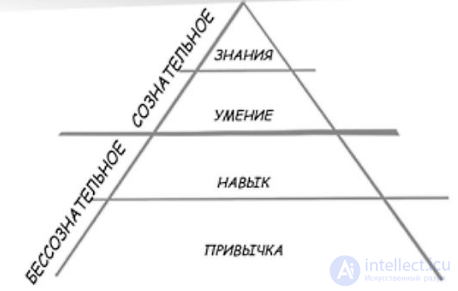
The concept of skill is part of the KSH triad (knowledge — ability — skill) — one of the concepts developed within Soviet pedagogy.
The individual stages in the formation of a motor skill have been traced in detail in the works of the Soviet psychologist N. A. Bernstein.
A distinction is made among motor skills, intellectual skills, and perceptual skills.
A motor skill is an automated influence on an external object by means of movements aimed at transforming it, repeatedly carried out before.
An intellectual skill consists of automated techniques and methods for solving mental tasks encountered previously.
A perceptual skill consists of automated sensory reflections of the properties and characteristics of well-known objects that have previously been perceived on numerous occasions.
The development of a skill is a process achieved through the performance of exercises (purposeful, specially organized, repeated actions). Through exercises, the mode of action is refined and consolidated. Indicators of the presence of a skill are that a person, on beginning to perform an action, does not think in advance about how they will carry it out and does not single out separate particular operations within it. Thanks to the formation of skills, an action is performed quickly and precisely, and one can concentrate on developing and acquiring new knowledge, abilities and skills.
The formation of a skill is influenced by:
Different combinations of these factors produce different patterns in the process of skill formation: rapid progress at the beginning and slower progress at the end, or the reverse; mixed variants are also possible.
Theories of the mechanisms of skill formation, and of the necessary factors and conditions without which it cannot take place, are a particular case of the theory of learning (научение).
Jump to search
An ability is a mode of performing an action that has been mastered by the subject, made possible by the totality of acquired knowledge and skills. It is formed through exercises and creates the possibility of performing an action not only under habitual conditions but also under changed ones.
An ability is command of the practice of applying knowledge.
Abilities presuppose, first and foremost, exteriorization. An ability is command of a complex system of mental and practical actions necessary for the purposeful regulation of activity by means of the knowledge and skills available to the subject.
A dynamic stereotype is a complex conditioned-reflex response, developed through repeated repetitions (the presentation of positive and negative stimuli). It is a coordinated system of conditioned-reflex processes that forms stable habits and skills (occupational, play-related, sporting, cognitive, etc.), as well as adaptation to habitually changing environmental conditions (for example, to the change of seasons or to the level of light during the day).
The significance of the dynamic stereotype lies in its preparation (programming) of precise, timely responses of the organism to habitual, similar situations without an excessive expenditure of nervous energy. The concept of the «dynamic stereotype» was introduced by I. P. Pavlov, who explained that the term «dynamic» denotes the possibility of its alteration, disruption, and subsequent restoration .
The successful development of a dynamic stereotype is influenced by: a person's attitude toward the environment in which the stereotype is developed; the complexity of the stereotype; age (the older a person is, the more difficult it is to develop a new stereotype and to alter an old one); and the type of nervous system .
The breakdown of a dynamic stereotype can become a cause of neuroses (more often in weak and inert types of nervous system), and be accompanied by painful emotions due to the difficulty of restructuring toward a new dynamic stereotype (for example, a sharp change of surroundings or climate, the cessation of habitual relationships or occupations, a change of profession or way of thinking, retirement, etc.).
«…Often,» wrote I. P. Pavlov, «painful feelings upon a change in one's usual way of life, upon the cessation of habitual occupations, upon the loss of loved ones — not to mention intellectual crises and the breakdown of beliefs — have their physiological basis to a considerable extent precisely in the change, in the disruption of the old dynamic stereotype, and in the difficulty of establishing a new one.» — Complete Collected Works, vol. 3, book 2, 1951, pp. 243–44
Also it is noted that dynamic stereotypes are arranged in layers (depending on the time of their formation). Some dominate, others may be inhibited and become activated in corresponding situations (for example, relapses of old relationships when a person finds themselves back in former living conditions). An important property of the dynamic stereotype is the possibility of its becoming more complex (through the accumulation of new impressions on top of the old ones). The system of dynamic stereotypes determines actions and relationships and, in this way, constitutes the character of the personality .
The phenomenon of the dynamic stereotype helps to describe and explain the mechanisms of behavior (including pathological, unproductive behavior) and to change it .
We divide cognitive strategies into macro-abilities and micro-skills not in order to draw a definite and clear boundary between the elementary skills of critical thinking (micro-skills) and the process of organizing these elementary skills, but rather in order to provide teachers with a way of thinking on two levels of instruction. We use these two levels when examining the most complex abilities. As examples, let us consider learning to play the piano, learning to play tennis, mastering the art of ballet, or mastering the profession of surgeon. In each of these areas there is a level of skill training based on elementary actions. For example, practicing elementary ballet positions at the barre, practicing scales on the piano, or practicing a variety of tennis strokes against a wall. It is often necessary to return to this micro-level in order to guarantee that the basic abilities have been mastered. Nevertheless, one does not learn to dance ballet at the barre. Playing the piano is not merely scales. And hitting a tennis ball against a wall is not yet playing tennis. It is necessary to move to the macro-level in order to achieve real results. The same is true of critical thinking. Learners must study the basic principles: what a claim consists of, what a consequence consists of, what a conclusion and an inference are, what it means to isolate a problem, what it means to provide arguments or evidence in support of a statement, and how to identify a contradiction or a sentence that is unclear in meaning.
But a person thinking critically in any actual situation, as a rule, does something more complex and integrated than this. Situations in which, thinking critically, we do only one elementary thing are rare. As a rule, we are compelled to combine or make use of a whole set of elementary critical-thinking skills. For example, when we read (a macro-ability), we are compelled to use a great many elementary micro-skills of critical thinking; moreover, we must use them in a coordinated way with one another. We might begin by reflecting on the meaning of the title. We might then begin reading the preface or introduction and move on to identifying the main problems or purposes on which the book or story is focused. Next we might begin to determine the meaning of individual sentences that seem unclear to us. We might consider various interpretations of them. Moving further, we would no doubt draw on our own experience as a source of possible examples confirming the author's words. Or we might first identify the assumptions the author makes. All of these separate steps would form an internally integrated activity: an attempt to understand what we are reading. In this case, as always, the whole is greater and more important than the parts. We do not read in order to practice the micro-skills of critical thinking. We use the micro-skills of critical thinking in order to read, or better, in order to read clearly and correctly. Keep this principle of interdependence in mind, as we now move on to consider various strategies.

Comments