
Lecture
Pedagogical mise-en-scène is a term that can be interpreted in different contexts, but it usually refers to a scenario, role-play or dramatization that is used for educational purposes to help students understand and assimilate particular instructional or upbringing concepts.
The word "mise-en-scène" has a theatrical origin and refers to the arrangement of actors on a stage. In the context of pedagogy, "pedagogical mise-en-scène" is used to denote the arrangement of the participants of the educational process and their interaction during a lesson or in another educational situation. This concept helps teachers analyze and optimize the educational process, taking into account the interaction between the teacher and the students, as well as among the students themselves.
A pedagogical mise-en-scène can reflect, for example, how students sit in the classroom, how the teacher organizes them, what groups form during the work, and what relationships arise among the participants. Analyzing the pedagogical mise-en-scène allows teachers to better understand classroom dynamics and to adapt teaching methods to the current situation more effectively.
Here are several ways in which a pedagogical mise-en-scène can be used:
Learning through play: In kindergartens and elementary grades, teachers can use pedagogical mise-en-scènes to teach material through play situations. For example, children can act out scenarios related to mathematics, reading or social skills.
Preparing for real situations: In professional training and coaching, pedagogical mise-en-scènes can be used to prepare specialists for real situations. For example, medical students can act out patient-and-doctor scenarios in order to learn how to interact with patients.
Developing social skills: Pedagogical mise-en-scènes can help students develop social skills such as communication, cooperation, conflict resolution and empathy. Students can play different roles and work through situations that may arise in everyday life.
Supporting upbringing moments: Educators and parents can use pedagogical mise-en-scènes to discuss important upbringing topics with children, such as safety, health, friendship and kindness.
An important aspect of pedagogical mise-en-scènes is that they allow students to actively participate in the learning process and apply knowledge in practice, which contributes to a deeper understanding and assimilation of the material.
The classical mise-en-scène in school is a special arrangement of the participants of the pedagogical process that plays an important role in organizing the lesson. This mise-en-scène, despite the presence of the teacher, is evaluated not only by the teacher's presence, but above all by how much it contributes to the upbringing tasks.
The classical school mise-en-scène is the traditional arrangement of students in rows, facing the board. It is considered effective if the students are actively engaged in the learning process and keep pace with the rhythm of the teacher's explanations. However, if there is no such engagement, this arrangement can hinder understanding and assimilation of the material, and in such cases changes need to be made.
To improve the situation, students can be asked to quickly move the desks apart, freeing up the center of the classroom. This simple technique can help create a clearer rhythm for the lesson and improve student engagement. When the rhythm of the lesson becomes more pronounced and the students are engaged, they gladly return the desks to their usual places, restoring the familiar mise-en-scène, which has become more convenient for a particular kind of work.
A pedagogical mise-en-scène performs several important functions:
Propaedeutic function - creating a "here and now" situation for students, preparing and priming them for active participation in the lesson, whether it is a task-oriented or play-based process.
Diagnostic function - allows the analysis of a complex mise-en-scène in order to determine the system of relationships within the group and the readiness of the participants of the pedagogical process for joint action.
Psychological function - providing optimal conditions for the comfort and well-being of the participants of the pedagogical interaction.
Morally-oriented function - directing students' attention toward other participants, emphasizing the importance of mutual attention and interest.
Communicative function - the ability of the mise-en-scène to include and exclude part of the audience from active communication, which is useful for organizing discussions and group work.
Expansion of the scope of perception - the ability of the mise-en-scène to change the surroundings, to transform the perception of the situation and the people involved, which contributes to better understanding and engagement of the participants.
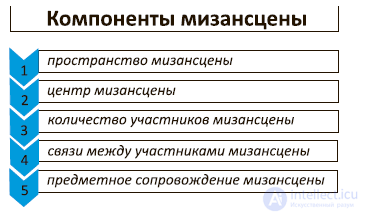
The main components of a mise-en-scène in pedagogy include the following elements:
Space: These are the boundaries within which the interaction between the teacher and the students unfolds. By observing the space, one can understand the relationships within the group. The space can vary depending on the educational context and can be organized so as to make the learning more effective.
Center of the mise-en-scène: This is the object or subject that carries value-laden content or reveals it under general attention. The center of the mise-en-scène can be the focal point around which the lesson is built.
Number of participants: The teacher must know and take into account all the participants of the mise-en-scène. It is important to anticipate the moments when the mise-en-scène changes and the center of relationships shifts as the active participants change.
Connections between the participants of the mise-en-scène: These connections are dynamic and subtle elements of the mise-en-scène, manifested in the intonations and gestures of the participants. They can affect the effectiveness of teaching and upbringing.
Object accompaniment: Elements that carry information, such as teaching aids, drawings, etc. They can be used to provide visual support for the lesson and to ensure a deeper understanding of the material.
When preparing a mise-en-scène, it is important for the teacher to remove unnecessary objects from the students' field of view in order to focus attention on the necessary material. The material environment of the lesson should be a visual background corresponding to the specific topic of the lesson.
A pedagogical mise-en-scène must be clearly defined by the genre of the lesson, its goals and objectives. This helps create an atmosphere that matches the educational goals and ensures effective interaction between the teacher and the students.
There are certain rules to keep in mind when staging a pedagogical mise-en-scène:
Staging for an intergroup discussion: In the case of an intergroup discussion, it is advisable to arrange the chairs in the shape of the letter "U" or in a circle. This promotes a more open and equal discussion among students.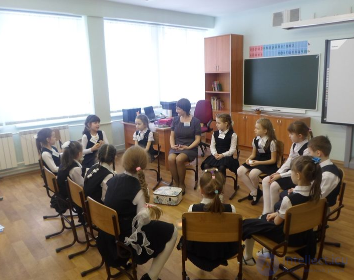
Teamwork: If teamwork is planned, the chairs should be arranged so that the teacher can move around freely and the students do not get in each other's way. It is important to provide a comfortable environment for collaborative work.
Tests: When administering tests, it is important to ensure the autonomy of each student and give them the opportunity to concentrate. This may include seating students in an order that rules out cheating and ensures a fair assessment.
Student activity: When a student answers at the board orally or recites a poem, it is better for the teacher to step into the background, becoming part of the crowd. This helps create an atmosphere in which the student feels more comfortable and at the center of attention.
These rules of pedagogical mise-en-scene help teachers create adapted and effective educational environments, taking into account different situations and lesson goals.
There are various options for pedagogical mise-en-scenes, each suited to particular situations and goals:
Authoritarian seating: This is the classic option, in which students sit in rows and the teacher conducts a traditional lesson, explaining the material. The teacher occupies the position of authority and the main source of information.
Democratic seating (creative semicircle): In this seating arrangement, the teacher places themselves in the position of a facilitator, while the students sit in a semicircle. This format promotes more equal interaction and supports a creative atmosphere.
"Round table": The round-table mise-en-scene is used for conducting conversations, discussions, brainstorming sessions and poetry evenings. The teacher takes a neutral position, which promotes a free exchange of opinions and ideas among students.
Discussion seating (one teacher between two rows): This option is used to elicit the opinions and points of view of students. The teacher takes on the role of arbiter, facilitating discussion and the resolution of disputes.
Radial, or competitive seating (two teachers between two lines of rows): This is a format in which two teachers work between two rows of students holding different approaches. The teachers take on the roles of mentors and advisors, conducting a dialogue and a contest of ideas.
Group seating (teacher in the center of several groups of students): This option allows work to be organized by groups. The teacher acts as a generator of ideas and coordinator of group activity.
The choice of a specific mise-en-scene depends on the objectives of the lesson, the learning goals and the characteristics of the students. The variety of mise-en-scene options helps adapt the educational process to different situations and ensure more effective interaction between teacher and students.
The conclusions drawn from the concept of pedagogical mise-en-scene include the following key points:
Adaptation to the genre of interaction: The mise-en-scene is created taking into account the pedagogical genre of instruction and the interaction between teacher and students. This means that the mise-en-scene format may vary depending on the goals and nature of the lesson.
Ensuring creative activity: The main purpose of the mise-en-scene is to create optimal conditions for the mental and practical creative activity of students. The mise-en-scene can stimulate interaction and the exchange of ideas, which promotes more active learning.
Testing the audience: The process of designing a mise-en-scene should include a stage of testing the audience. This allows the mise-en-scene to be adapted to the specific needs and reactions of the students.
Respect for the individual: At the heart of mise-en-scene design lies respect, attention and interest toward each student as an individual. The mise-en-scene is created with the needs and characteristics of each student in mind.
Dynamism and mobility: The mise-en-scene should be dynamic and mobile, which promotes active learning and interaction. This allows for better adaptation to the changing needs of the lesson.
Student participation: Students can be involved in creating the mise-en-scene, which promotes their more active participation in the educational process and allows their opinions and needs to be taken into account.
Adjustment of the mise-en-scene: The mise-en-scene is subject to adjustment as relationships and practical tasks change. This is important for ensuring the effectiveness of instruction in different situations and at different stages of the educational process.

Comments