
Lecture
Higher education, or higher professional education, is the level of professional education that follows secondary general or vocational education. It comprises a body of systematized knowledge and practical skills that make it possible to solve theoretical and practical problems within a professional field, using and creatively developing the current achievements of science, technology and culture. The term «higher education» is also understood to mean the training of highly qualified specialists for branches of the economy, science, technology and culture in various types of institutions of higher learning
In Australia, the term «higher education» refers to continuing one's studies after obtaining a high school certificate. It also applies to any education a student receives after completing compulsory schooling, which in Australia occurs at the age of 17. Options for higher education include university, technical and further education, or private universities.
It is most likely a calque of the French enseignement supérieur, meaning «higher education,» using the archaic sense of the word «higher» — «more elevated
Higher education is acquired at institutions of higher learning — universities, academies, institutes, higher schools, and some colleges. In some countries there exist their own traditional names or variations of the names listed.
The system of higher education in different countries is based on a one-, two-, three-, or four-level structure. Under a four-level structure, graduates with higher education are divided into bachelors, specialists, masters, and doctors of philosophy. Under the two-level system of education adopted, in particular, in Russia, the division is into bachelors (first level), masters and specialists (second level) (with those who entered universities before 2011, and specialists who had already graduated, unlike later entrants, belonging to the first level and being entitled to free second-level education), and holders of an academic degree.
Higher education can be obtained through full-time, part-time (distance), evening (part-time-evening), or free-form study (distance education), as well as through external studies. Moreover, in some countries, depending on the form and goals of study, the number of subjects studied, the level of training, and so on, students are divided into «regular,» «conditional,» «special,» «occasional,» «auditing,» and similar categories.
Depending on the form of study, the country, the system, and the field, the length of study required to obtain higher education ranges from 4 to 9 years.
The emergence of a higher level of education took place in the countries of the Ancient East more than a thousand years before our era. At that stage, young people studied philosophy, poetry, and the laws of nature known at the time, and acquired knowledge of minerals, celestial bodies, plants, and animals.
In Alexandria, in the V—III centuries B.C., during the era of Hellenism, schools of an advanced type began to be established, in which philosophy, philology, medicine, and mathematics came to be studied separately as a result of the differentiation of science.
In Ancient Greece, which paid great attention to the education of the young, a higher level of education was provided for. In the IV—III centuries B.C., one of the ideologists behind the establishment of a higher level of education was Plato. He wanted to attract to this education a small portion of gifted aristocratic youth (young men) who had shown an aptitude for abstract thought and the ability to study subjects not in their applied sense but from a philosophical-theoretical standpoint. For example, under this system astronomy was to be studied not for applied purposes — navigation — but for reflection on the infinity of the universe. Moreover, it was assumed that those who completed this level of education at the age of 30 and showed exceptional talent could continue their education until the age of 35 with a view to becoming rulers of the state. A similar view was held in the III century B.C. by Aristotle, who believed that a third, higher level of education was necessary for the development of a person's natural abilities in the threefold unity of the physical, moral, and intellectual directions.
Further differentiation of science only contributed to the greater emergence of this third, higher level of education. However, the definition of higher education in the modern sense took shape only in the Middle Ages.
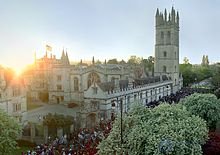
From the 10th century, universities existed in Salerno, Pavia, Bologna, and Paris — places of pilgrimage for inquiring minds. There, law, Latin, philosophy, medicine, and mathematics were studied. Oxford University, the oldest in the English-speaking world, was founded around 1117 by the English clergy, who decided to give their clergymen an education (unlike their continental counterparts, they were often illiterate). The choice fell on Oxford, one of the kingdom's largest cities. But it was only under Henry II that it became a true university town. If, over time, members of high society passed through it almost as a matter of course, in the Middle Ages that was still far off. Only clergymen studied there; they rented rooms from local residents and were often poor.
In the 11th century the first higher secular medical school opened in Salerno (Italy).
In the 11th—12th centuries, secular institutions of higher learning appeared in Europe, in which instruction and scholarly work were interconnected within a unified educational process. The instruction at these schools was based on both theoretical research and observation and experience.
In the 12th—13th centuries, the first universities arose in many European countries (Italy, Spain, France, England). At these, there were essentially only three faculties — theology, medicine, and law. Instruction at the first universities lasted 5—6 years.
In 1209, the University of Cambridge was founded by a group of professors and students who had fled the city of Oxford after a clash between townspeople and students.
In 1348, the first university in the Slavic countries opened in Prague — Charles University.
Medieval higher education pursued, first and foremost, the goal of substantiating theological dogmas. It was only in the 14th—16th centuries that science and education gradually freed themselves from scholasticism. This was facilitated by major scientific discoveries and advances in medicine during the Renaissance in Italy. Among the prominent representatives of science of that time were Leonardo da Vinci, N. Copernicus, J. Kepler, G. Galilei, R. Descartes, I. Newton, and G. Leibniz. The scholastic school was sharply criticized by the English philosopher F. Bacon. Humanist writers and educators of that time — Vittorino da Feltre, Erasmus of Rotterdam, L. Vives, F. Rabelais, M. Montaigne — spoke out against the monopolization of education by the Catholic Church. They proposed new teaching methods based on the development of independent critical thinking.
The invention of printing in the 15th century was of exceptionally great importance for the development of higher education and of education as a whole.
In 1632 in Kiev, by merging the Kiev Brotherhood School and the Lavra School, the Kiev-Mohyla Collegium was created, where Church Slavonic, Latin and Greek were studied, along with theology and the «seven liberal arts» — grammar, rhetoric, dialectic, arithmetic, geometry, astronomy and music.
At this time, support for a continuous, tiered system of education with an academy as its highest level was found in the works of the Czech humanist educator and public figure, in effect the founder of pedagogical science, Jan Amos Comenius.
In the 17th century, scientific laboratories began to be established, proclaiming the principle of free scientific research and teaching. In these years, in France, England and Germany the first state scientific academies were created, and scientific journals began to be published systematically.
The development of science, technology and navigation at the turn of the 17th—18th centuries led to increased demand for specialists with higher education (the so-called «men in state service» in Russia).
In 1687 the first institution of higher learning was organized in Moscow — the Slavic-Greek-Latin Academy, whose graduates included L. F. Magnitsky, V. K. Trediakovsky and M. V. Lomonosov. On 28 January (8 February) 1724, Peter the Great issued a decree on the founding of the St. Petersburg Academy of Sciences and a university with an attached gymnasium . It is notable that whereas the Paris Academy of Sciences had been created as a counterweight to the University of Paris, Peter ordered that the academy and university, which opened after his death, be created in harmonious unity.
Mikhail Lomonosov played an important role in the establishment of Russian higher education; in 1758 he was entrusted with «oversight» of the Academy of Sciences. He developed an original curriculum in which, in the first year of study, «so that one might gain an idea of all the sciences, so that everyone could see in which science he had greater ability and inclination», attendance at all lectures was compulsory; in the second year, attendance only at specialized cycles of lectures; and in the third year, students were assigned to individual professors for «practice in a single science».
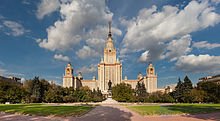
Through the efforts of Mikhail Lomonosov, Moscow University was founded in 1755. Among its first professors were N. N. Popovsky, A. A. Barsov and other students of Lomonosov.
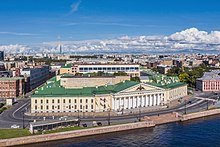
As a result of the invention of the steam engine, a transition took place from manufactory production to factory production. This was followed by the Industrial Revolution. This contributed to the emergence, in the second half of the 18th century in England and then in other countries, of the first technical educational institutions providing systematic engineering education. In Russia the first such institution was the School of Mathematical and Navigational Sciences, founded by Peter I, followed by the Engineering School in St. Petersburg, headed by Abram Petrovich Hannibal, the great-grandfather of A. S. Pushkin; but the oldest still-existing mining-and-technical school in Russia is the Mining School (now the St. Petersburg State Mining University), founded in 1773.
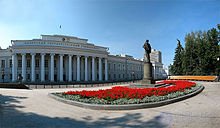
On 17 November 1804, Kazan University was founded in Kazan. Already in the first decades of its existence it became a major center of education and science. A number of scientific fields and schools took shape within it (mathematical, chemical, medical, linguistic, geological, geobotanical and others). A particular source of pride for the university is its outstanding scientific discoveries and achievements: the creation of non-Euclidean geometry (N. I. Lobachevsky), the discovery of the chemical element ruthenium (K. K. Klaus), the creation of the theory of the structure of organic compounds (A. M. Butlerov), the discovery of electron paramagnetic resonance (E. K. Zavoisky), the discovery of acoustic paramagnetic resonance (S. A. Altshuler), and many others.
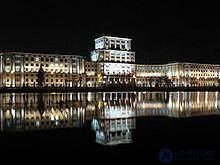
In 1830 in Moscow, by decree of Nicholas I, a Trade School was established (later the Imperial Higher Technical School, now Bauman Moscow State Technical University). Its scholars and instructors — A. V. Letnikov, N. A. Shaposhnikov, P. K. Khudyakov, A. P. Sidorov, A. P. Gavrilenko, V. I. Grinevetsky and others — in effect created the Russian system of systematic higher technical education, based on a close connection between theoretical instruction and practical exercises on the basis of production workshops and laboratories. This system came to be known abroad as the «Russian methods of instruction» and was awarded top prizes and honors at international exhibitions (in Philadelphia in 1876 and in Paris in 1900).
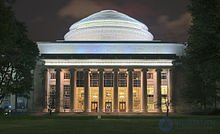
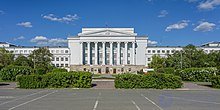
In 1861 the Commonwealth of Massachusetts approved the charter of William Barton Rogers for the founding of the «Massachusetts Institute of Technology and Boston Society of Natural History» (now the Massachusetts Institute of Technology). William Barton Rogers wanted to create a new form of higher education that would meet the challenges of the rapidly developing science of the mid-19th century, to which classical education was pathologically incapable of giving an adequate response. After the charter was adopted, Rogers set about seeking funds, developing a curriculum and choosing a suitable location for the institute. Rogers's plan, as it is now known, was based on three principles: the educational value of useful knowledge, the necessity of learning by doing, and the union of the professional and the liberal-arts sciences. MIT was a pioneer in the use of instruction for laboratory work. Its philosophy was — «not the manipulations and momentary details of science, which can be applied only in practice, but the knowledge and understanding of all the basic scientific principles together with their explanations». Because of the Civil War, which began a few months later, the first classes at MIT were held only in 1865, in rented premises of a merchant's building in a suburb of Boston.
In the 1870s—1880s, an attempt was made in many countries of Western Europe and America to open access to higher education for women. In Russia this was carried out by admitting women to the Medical-Surgical Academy, and later by opening Higher Courses for Women in Moscow, Kazan, St. Petersburg and Kiev. However, it was only after the October Revolution that women in Russia obtained rights to education, including higher education, equal to those of men.
In the 1914—1915 academic year, 127,400 people were studying at 105 higher education institutions in Russia.
In 1950, Article 2 of the First Protocol to the European Convention on Human Rights obliged all signatory parties to guarantee the right to education.
In 1966, the United Nations, in the International Covenant on Economic, Social and Cultural Rights, guaranteed the right to higher education, which states: «higher education shall be made equally accessible to all, on the basis of capacity, by every appropriate means, and in particular by the progressive introduction of free education».
In the 1970—1971 academic year, 4.6 million students were studying at 805 higher education institutions in the Soviet Union. Of these, 43.6% were in engineering-technical and economics specialties, 35.6% in the humanities and natural sciences, 7.7% in agriculture, and 7.1% in medicine. Their instruction involved 327,200 scientific-pedagogical staff, including 10,400 doctors of science and 95,300 candidates of science.
A major impetus for the development, convergence and harmonization of higher education in Europe was given by the so-called Bologna Process. Its beginning can be traced back to the mid-1970s, when the Council of Ministers of the EU adopted a Resolution on the first program of cooperation in the field of education. The official starting date of the process is considered to be June 19, 1999, when, at a special conference in the city of Bologna, the ministers of education of 29 European states adopted the declaration «The European Higher Education Area» , or the «Bologna Declaration». Subsequently, intergovernmental meetings were held in Prague (2001), Berlin (2003), Bergen (2005), London (2007) and Leuven (2009). At present, the Bologna Process unites 46 countries.
Russia joined the Bologna Process in September 2003 at the Berlin meeting of European education ministers. In 2005, in Bergen, the Bologna Declaration was signed by the Minister of Education of Ukraine. Higher education institutions of Russia, Ukraine, Kazakhstan and all the countries of the CIS and Europe take part in implementing the main directions of the Bologna Process.
According to data for the year 2000, Russia had 562 (45.9%) state higher education institutions, including 338 (26.0%) subordinate to the Ministry of Education of the Russian Federation, and 662 (54.1%) non-state institutions (of which 203, or 15.5%, had state accreditation). These institutions had 4,739,500 students enrolled, including 2,624,300 in full-time programs.
In 2005, there were 495 students per 10,000 residents in Russia, compared with 445 in the USA, 240 in Germany, 276 in the United Kingdom, and 233 in Japan.
Based on 2012 results, the Organisation for Economic Co-operation and Development calculated the share of people with higher education among the population aged 25 to 64 in the 37 member countries of the organization. Based on this calculation, the company Wall St. identified the 10 countries with the highest share of people with higher education among the adult population:
|
Russia — 54% |
New Zealand — 41%
|
According to the global QS Higher Education System Strength Rankings 2016, the top ten countries with the best higher education systems were the USA, the United Kingdom, Germany, Australia, Canada, France, the Netherlands, China, South Korea and Japan.
After attending kindergarten (French: école maternelle), primary school (French: école élémentaire), middle school (French: collège) and high school (French: lycée), a pupil can enroll in a university, but may also stop at this point. In France, higher education is represented by 87 universities, of which five are non-state Catholic institutes and three are national polytechnic institutes of the university type. Specialized institutes are attached to the universities: 113 technological, 66 vocational and 30 pedagogical. Higher education in France is free of charge (with the exception of living costs)
After completing a two-year course of A-levels, students can obtain either vocational or higher education.
Vocational education (Further education — FE) includes vocational training courses and some courses leading to higher education (a bachelor's degree). The term «further education» is used to designate courses for those who left school at the age of 16. There are more than 600 state and private further education colleges in the United Kingdom. These institutions offer various training programs, including English language courses, programs preparing students for the General Certificate of Secondary Education and A-levels, and vocational courses.
Higher education (Higher education — HE) includes bachelor's degree programs, postgraduate programs (master's, doctoral degree) and MBA. The term «higher education» denotes study at universities, colleges and institutes that offer academic or doctoral degrees.
Belarus has two leading universities in its national education system: Belarusian State University, founded on October 30, 1921, and the Academy of Public Administration under the aegis of the President of the Republic of Belarus, established on January 29, 1991. The status of a leading university in the republic is enshrined in law and has two variants: leading university in the national education system and leading university in a given field. Several universities hold the status of leading university in a field (in particular, the Belarusian National Technical University, the Belarusian State University of Informatics and Radioelectronics, the Belarusian State Medical University and others).
In Belarus, university students can obtain academic degrees: bachelor and master.
University graduates can continue their education and obtain postgraduate education by entering an aspirantura (postgraduate program) and then a doctorantura (doctoral program). It is also possible to take retraining courses and obtain a second higher education. Education is free of charge.
Higher education is based on the Higher Education Act of 1995 and consists of four levels. The network of higher schools in Bulgaria includes universities, specialized higher schools and colleges.
The German higher education system is distinguished by the diversity of its types of institutions. There are a total of 409 higher education institutions in Germany, of which 104 are universities and 203 are universities of applied sciences. Obtaining a first higher education was, until recently, free of charge at almost all institutions, both for Germans and for foreigners. Tuition fees were introduced experimentally in many federal states in 2006, at a rate of 500 euros per semester. However, soon after North Rhine-Westphalia, tuition fees were abolished by all the federal states by 2013. In other states, fees may be charged to students who have exceeded the prescribed period of study by several semesters («several» again being defined differently in each state) or who are obtaining a second higher education. The total number of students in Germany is nearly 2 million, of whom 48% are women, and 250,000 are foreign students. The teaching staff numbers about 110,000 people. Approximately 69,000 Germans study abroad. Until 2010, in the course of the Bologna Process, German universities were required to restructure their curricula according to the new model. However, this did not affect medical and legal education, which are still not divided into bachelor's and master's programs to this day. At many humanities faculties, the study of an additional subject is also mandatory.
A significant number of higher education institutions are state-run and subsidized by the government. There are comparatively few private institutions — 69.
Higher education in Ireland is called «third-level education» (Third Level education). Upon graduation, a graduate is awarded a bachelor's degree (Bachelor Degree). Higher education can be obtained at state universities and various colleges.
Italy's higher education system consists of universities, technical universities, university colleges, and academies. The education system has three stages.
Young people attend universities, other state higher education institutions, and colleges offering various study programs.
Higher education in Malta is provided only by the University of Malta, which has a huge number of departments, branches, and representative offices.
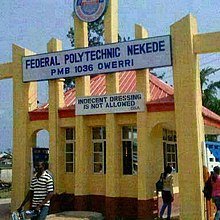
Tertiary education refers to post-secondary education obtained at universities (public or private), mono-technical colleges, polytechnics, and colleges of education. After completing secondary education, students may enroll in a higher education institution or obtain vocational training . Students must pass the entrance examination of the Joint Admissions and Matriculation Board (JAMB), as well as the Senior School Certificate Examination (SSCE) or the General Certificate Examination (GCE), and clear various cutoff marks in order to be admitted to a higher education institution.
Egypt has both private and public higher education institutions. Public higher education in Egypt is free; students pay only a registration fee. Private education costs more.
The main universities in Egypt are: Cairo University (100,000 students), Alexandria University, Ain Shams University, and Al-Azhar University (Egypt's oldest institution of higher education, with a 1,000-year history).
The leading private universities in Egypt are: The American University in Cairo, the German University in Cairo, and the French University in Egypt.
This category includes years 4 and 5 of technology colleges and specialized training colleges.
Technical colleges are provided for under the first article of Japan's education law, as are universities and junior colleges, which are very often referred to as higher education institutions offering two-year programs, whereas specialized training institutions are provided for under Article 124 of the law as a category of specialized training school. Both are ordinary educational organizations, but specialized training institutions are not «schools» under the law. Moreover, they do not offer higher education.
A student who has completed lower secondary school may enroll in a technology college, but years 1, 2, and 3 belong to secondary education and are not covered in this article. A technology college is a special educational system that combines secondary and higher education. Graduates of the school are equivalent to graduates of the lower years of college.
Although specialized training institutions are not «schools» under the law, they are schools in the eyes of the public. Most of their courses last two years, but some last one, three, or four years. Graduates of courses lasting more than two years are considered equivalent to graduates of junior colleges, and graduates of four-year courses have in recent years been able to enroll in university graduate programs.
Japan has about 600 universities, including 425 private ones, in which about 2.5 million students are enrolled at any given time. The most prestigious are the national universities in Tokyo, Kyoto, and Osaka, and the private universities of Chuo, Nihon, Waseda, Meiji, Tokai, and Kansai. In addition, Japan has a widespread practice of «dwarf» higher education institutions, in which 200—300 students study across 1—2 faculties. Entrance examinations to higher education institutions in Japan are paid
42 % of Japan's population has higher education
Monaco has only one higher education institution — the International University of Monaco.
Students enter high schools (고등학교, 高等學校) in the Republic of Korea at age 17 and graduate after the third year at age 19. Schools may be divided into specialized departments corresponding to the interests of a given student and matching his or her career path. For example, there are «science» high schools (Science high school), foreign language schools, and arts schools. All of them require fairly difficult entrance examinations. High schools can also be divided into public and private. Such schools do not confer any particular specialization but simply prepare their students for admission to college. For students who, for whatever reason, do not want to pursue a college education, there are vocational schools specializing in technology, agriculture, or finance, which students can enter immediately after graduating from school. The schedule of high schools is often arranged so that after an intensive «self-study» session at such a school, students return home after midnight. The curriculum, which includes about eleven subjects, is often considered quite grueling, so some students prefer to enroll in private academies called «hagwons» (학원, 學院) in order to expand their academic knowledge. The core subjects include Korean and English, mathematics, and various social and natural sciences. The specific subjects and their level of instruction may vary from school to school, depending on the specialization of such institutions.
Unlike middle school, attending high school is not compulsory. Nevertheless, according to OECD estimates, in 2005 97 % of young Koreans completed high school. This is evidently the highest percentage among all countries
Despite many problems in secondary education, higher education in the USA is considered one of the best in the world. The USA has more than three thousand higher education institutions of various kinds. In 2001, they enrolled 515,000 foreign students out of 17.5 million students overall, of whom 60 % were from Asia. Recently, however, tuition at both private and public universities has been becoming ever more expensive. Annual tuition ranges from $5,000 at a state university to $40,000 at Harvard, and although generous scholarships are given to poor students, they are often insufficient for middle-class students, whose families lose proportionally the most from their incomes. From the 2002—2003 to the 2003—2004 academic year, tuition at state universities rose by 14 %, and at private universities by 6 %, which was still higher than the rate of inflation over the same period.
In American colloquial speech, all higher education institutions are usually called college, even if they are not colleges but universities.
US higher education institutions can be divided into three types, whose representatives, as a rule, differ greatly from one another, mainly in size and atmosphere.
The higher education system in the United States is decentralized and regulated independently by each state, with accreditation playing a key role in ensuring that institutions meet minimum standards. It is large and diverse, comprising institutions that are privately run as well as institutions that are owned and operated by state and local government authorities. Some private institutions are affiliated with religious organizations, while others are secular, and they enroll anywhere from a few dozen to tens of thousands of students. In short, there is a wide range of options, which are often determined at the local level. The U.S. Department of Education presents a broad range of higher-education institutions and detailed information on the national educational structure, accreditation procedures, and links to state as well as federal agencies and organizations.
The Carnegie Classification of Institutions of Higher Education provides one framework for classifying American colleges and universities in various ways. Higher education in the United States also includes a range of nonprofit organizations that promote the professional development of people working in higher education and help raise awareness of related issues, such as services for international students and full campus internationalization.
In Australia, the term «higher education» refers to continued study after obtaining a high-school certificate. It also refers to any education a student receives after completing compulsory schooling, which in Australia occurs at the age of 17. Options for higher education include university, technical and further education, or private universities.
Specialized training schools were incorporated into the category of miscellaneous schools by the education law then in force when it took effect in 1947. Article 83 of the law provided for them, and they were indeed miscellaneous in nature.
Since, at that time, miscellaneous schools included educational organizations whose classes were held only a few times a week, some educational organizations, including the later specialized training schools, were dissatisfied with the system. In addition, there were many problems arising from their being classified as miscellaneous.
Some educational organizations, authorized under a particular condition, were converted into miscellaneous schools after the law was reformed on January 1, 1957, but they still remained within the miscellaneous-school system. Since that reform, the law did not extend to many other educational organizations.
While the law allowed for various formats to be used — for example, schools that provide information about their education, and schools with no such provisions at all. Many problems still remained, and in January 1976 specialized training schools were established. They comprise three courses: post-secondary, upper-secondary, and general courses. Schools offering higher education for graduates of upper-secondary school and people with an equivalent education are called specialized training colleges. The upper-secondary course is intended for graduates of lower-secondary school, and anyone may enroll in the general course. The latter stands alongside the miscellaneous schools that exist today.
Since 1994, graduates of specialized training colleges have been able to obtain a diploma. The law does not provide for a diploma in the way it does for the associate degree that graduates of technical colleges can obtain, but it is likewise a publicly recognized qualification.

Comments