
Lecture
Vocational training occupies a key place in the education system, since it is precisely this training that forms the competencies necessary for performing work functions in a specific field of activity. The theory and methodology of vocational training examine the pedagogical foundations, patterns and methods of organizing the educational process aimed at developing students' professional knowledge, practical skills and personal qualities. Amid the rapid development of technology and constant changes in the labor market, the flexibility of methodology, the use of innovative forms of instruction, and the integration of theoretical preparation with practical activity acquire particular importance.
The introduction to vocational training is concerned with examining a system for preparing specialists aimed at forming in students the knowledge, abilities and skills necessary for performing a specific professional activity. Vocational training occupies an important place in the education system, since it provides for the preparation of personnel for various branches of the economy, production and the service sector. It is oriented not only toward the assimilation of theoretical knowledge but also toward the development of practical abilities, the development of professional thinking, and readiness for real work activity.
The concept of vocational training is defined as a purposeful pedagogical process of forming professional competencies, including the mastery of specialized knowledge, the development of practical skills, and the cultivation of professionally significant personal qualities. In the course of vocational training, students master the technologies for performing work, become familiar with equipment, tools and working conditions, and also learn to apply the knowledge gained in practical situations. Particular attention is given to developing responsibility, independence, and the capacity for professional growth.
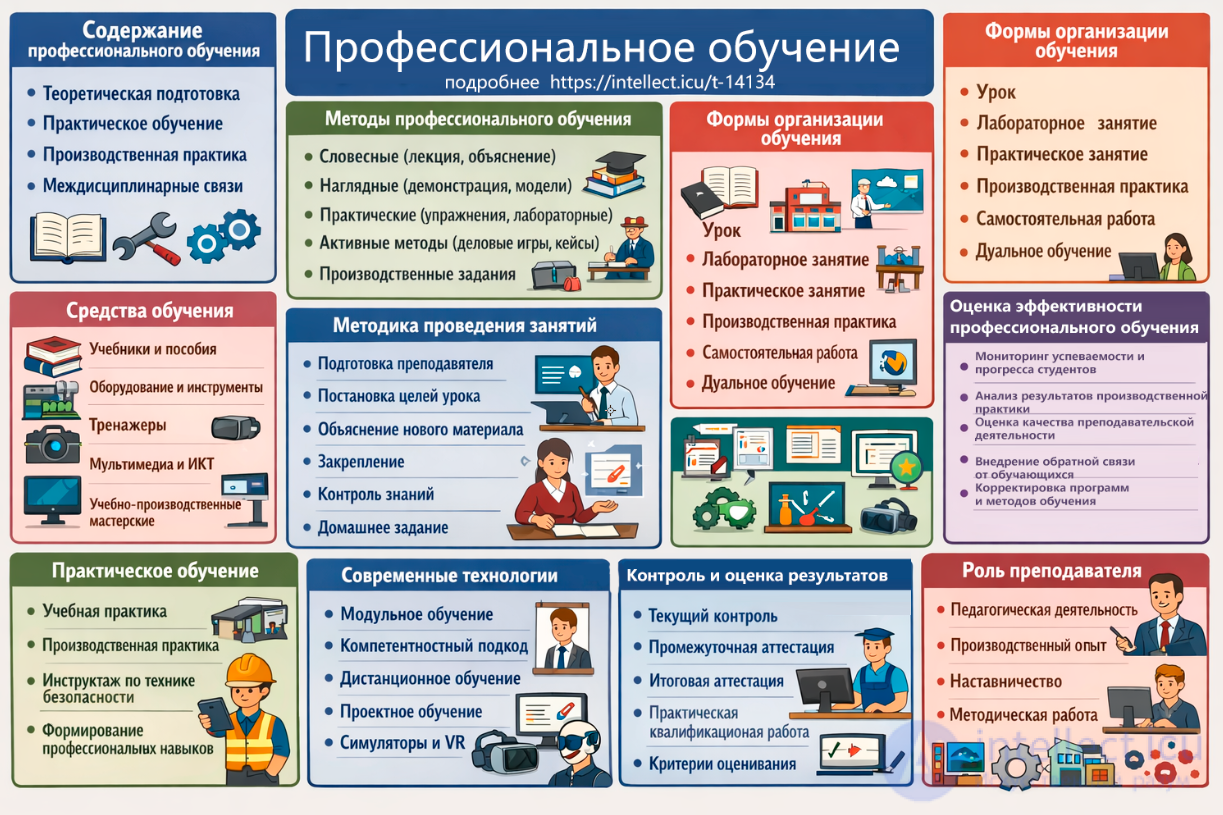
The goals of vocational training consist in preparing qualified specialists capable of effectively performing professional duties, adapting to changes in the production sphere, and improving their skills. The main tasks include forming professional knowledge and abilities, developing practical skills, cultivating work discipline, forming a culture of labor, developing professional thinking, as well as preparing students for independent activity and further professional growth. An important task is also to develop students' ability to work in a team and to observe occupational safety requirements.
The difference between vocational training and general education lies above all in its practical orientation. General education is oriented toward the comprehensive development of the personality and the formation of basic knowledge in various subjects, whereas vocational training is aimed at preparation for a specific work activity. In vocational training, a significant place is occupied by practical preparation, on-the-job training, work with equipment, and the performance of real professional tasks. In addition, the content of vocational training is determined by the requirements of the specific profession and by qualification characteristics.
The role of vocational training in preparing specialists lies in forming professional competence and readiness to perform work functions. Thanks to vocational training, the preparation of personnel in demand in the labor market is ensured, along with improvement in the quality of work performed and the development of the economy. It contributes to forming in students a lasting interest in the profession, developing a sense of responsibility for the results of their work, and readiness for continual advancement of qualifications. Thus, vocational training is an important stage in the formation of a specialist and the foundation of his or her successful professional activity.
The regulatory and legal foundations of vocational training define the requirements for the content, organization and outcomes of specialist preparation. They are formed at the international and national levels and ensure a unified approach to the quality of vocational education. Global trends in the regulatory and legal governance of vocational training are aimed at increasing the mobility of specialists, the comparability of qualifications across different countries, the development of a competency-based approach, and orientation toward labor market requirements. International recommendations and agreements contribute to the unification of educational standards and the introduction of modern instructional technologies.
State educational standards establish mandatory requirements for the structure of educational programs, the conditions for implementing instruction, and the outcomes of mastering a trade or specialty. They define the list of competencies a graduate must possess, the volume of academic workload, the ratio of theoretical to practical training, as well as requirements for the material and technical support of the educational process. State standards ensure a uniform level of specialist preparation and guarantee the quality of vocational education.
Qualification requirements represent a set of requirements for the knowledge, abilities, skills and professional qualities necessary for performing a particular work activity. They determine the level of a specialist's preparation, his or her functional duties, and the degree of responsibility. Qualification requirements are used in developing educational programs, organizing practical training, and conducting final certification. They also serve as a benchmark for employers in evaluating the professional preparation of graduates.
Curricula and syllabi give concrete form to the content of vocational training. The curriculum defines the list of disciplines, the sequence of their study, the distribution of instructional time between theoretical and practical classes, as well as the forms of knowledge assessment. Syllabi reveal the content of individual disciplines, the objectives of instruction, the topics of classes, and the expected outcomes. They ensure the systematic nature of instruction and the logical sequence in which professional competencies are formed.
Occupational standards establish requirements for the work functions and for the knowledge and abilities needed by workers in a given trade. They are developed taking into account the needs of the labor market and modern production technologies. Occupational standards are used in developing educational standards, syllabi and qualification requirements. Their introduction contributes to a closer connection between vocational training and the real conditions of work activity, and to improving the quality of specialist preparation.
The principles of vocational training represent the fundamental provisions on which the organization and implementation of the educational process in training specialists are built. They determine the requirements for the content, methods, and forms of instruction, ensuring the effectiveness of forming professional knowledge, abilities, and skills. Observing these principles makes it possible to create conditions for the high-quality training of learners and their successful professional activity.
The principle of scientific rigor presupposes that the content of vocational training must correspond to the current level of development of science, technology, and technologies. Learners must receive reliable knowledge based on scientific facts, regularities, and theories. This ensures the formation of correct professional thinking and the ability to navigate modern production processes. In addition, the principle of scientific rigor promotes the development of analytical abilities and readiness for further professional improvement.
The principle of linking theory with practice is one of the key principles in vocational training. It stipulates that theoretical knowledge must be reinforced by practical activity. Learners not only study the theoretical foundations of the profession, but also apply them when performing practical assignments, laboratory work, and on-the-job practice. Such an interconnection promotes deeper assimilation of the material, the formation of professional abilities, and preparation for real working conditions.
The principle of systematicity and sequence means that instruction must be built logically, with a gradual increase in the complexity of the content. New knowledge and skills are formed on the basis of previously studied material. This approach ensures the integrity of professional training, prevents overloading learners, and promotes the firm assimilation of educational material. The sequence of instruction makes it possible to form a stable system of professional knowledge and abilities.
The principle of accessibility presupposes taking into account the level of preparation of learners, their age characteristics, and individual capabilities. The educational material must be presented in understandable language, and the assignments must correspond to the level of difficulty, gradually increasing in complexity. Observance of the principle of accessibility promotes the effective assimilation of knowledge, increases motivation to learn, and reduces the likelihood of difficulties arising in mastering the profession.
The principle of individualization of instruction provides for taking into account the individual characteristics of learners, their abilities, pace of assimilating material, and professional interests. The instructor uses various methods and forms of instruction, differentiated assignments, and individual consultations. This makes it possible to form professional competencies more effectively and to create conditions for revealing the potential of each learner.
The principle of professional orientation means directing the content and process of instruction toward future professional activity. All the disciplines studied and practical assignments must be connected with the specific profession and reflect real production tasks. This approach promotes the formation of a stable interest in the profession, the development of professional thinking, and the readiness of learners to perform labor functions.
The content of vocational training is determined by the totality of knowledge, abilities, and skills that a learner must master for the successful performance of professional duties. It is formed taking into account the requirements of the profession, qualification standards, and the needs of modern production, combining theoretical preparation, practical training, and professional experience. Comprehensive content ensures the formation in learners of professional competence and readiness for effective labor activity.
Theoretical preparation is the foundation of vocational training and is aimed at the assimilation of the knowledge necessary for understanding the principles and regularities of the profession. It includes the study of the fundamentals of professional activity, technologies, tools and methods of work, safety rules, and regulatory requirements. Theoretical preparation forms the base for the practical application of knowledge and the development of professional thinking, allowing learners to analyze situations and make informed decisions.
Practical training is oriented toward the formation of professional abilities and skills through the performance of specific assignments, the practicing of operations, and work with equipment. Practical classes help to reinforce theoretical knowledge, develop professional skills, and the ability to act in conditions close to a real production environment. This approach ensures the gradual mastery of the profession, from simple actions to more complex professional operations.
On-the-job practice is an important element of vocational training and represents learners' work directly at an enterprise or in an educational-production workshop. It makes it possible to gain experience in performing real professional tasks, to master work processes, and to become acquainted with the organization of labor in practice. On-the-job practice forms professional thinking, discipline, responsibility, and the ability to work in a team.
Interdisciplinary connections ensure the integration of various fields of knowledge necessary for professional activity. In vocational training it is important to combine the fundamentals of related disciplines, such as mathematics, physics, computer science, chemistry, or economics, depending on the profession. This allows learners to see the complete picture of professional activity, to understand the interconnections between theory and practice, and to apply knowledge effectively in complex tasks.
Thus, the content of vocational training represents a harmonious combination of theory, practice, and interdisciplinary knowledge, ensuring the formation in learners of professional competence and readiness for successful labor activity.
Methods of vocational training are systematized ways of transmitting knowledge and forming professional abilities and skills in learners. Their choice depends on the goals of the class, the nature of the material being studied, the level of preparation of the learners, and the conditions under which instruction is conducted. The comprehensive application of various methods makes it possible to ensure the assimilation of theoretical knowledge, the development of practical skills, and the formation of professional competence.
Verbal methods include lectures, explanations, stories, conversations, and briefings. They are aimed at transmitting information, clarifying the theoretical foundations of the profession, and familiarizing learners with the rules and norms of work and methods of performing tasks. Verbal methods are convenient for the mass transmission of knowledge and for forming in learners a general professional picture; however, to reinforce skills they must be combined with practical classes.
Visual methods include demonstration and the use of models, diagrams, drawings, and video and multimedia materials. These methods allow learners to see the process of performing operations, the structure of equipment, technological schemes, and the results of work. Visual methods promote better understanding of the material, speed up the assimilation of complex professional concepts, and facilitate the transition from theory to practice.
Practical methods involve the active participation of learners in learning activities through exercises, laboratory work, practical assignments, and training exercises. They develop professional skills and the ability to apply theoretical knowledge in practice, and cultivate precision, attentiveness, and independence. Practical methods create the conditions for gradually mastering a profession and preparing for real production activity.
Active learning methods include business and role-playing games, case methods, discussions, and project activities. They stimulate thinking, initiative, and a creative approach to solving professional problems, develop analytical and communication abilities, and the ability to work in a team. Active methods make it possible to model real production situations and develop decision-making skills under conditions of uncertainty.
Production assignments consist of learners performing real work operations at an enterprise or in training-production workshops. These assignments make it possible to consolidate the knowledge and skills acquired under conditions as close as possible to real professional activity, and develop responsibility, work discipline, and professional independence.
Thus, methods of professional training should be used in combination, ensuring a harmonious combination of knowledge transfer, the formation of practical skills, and the development of professional competencies, which ensures the successful training of specialists.
The forms of organizing professional training are structured ways of conducting the educational process that ensure the effective assimilation of knowledge, the development of abilities and skills, and the formation of professional competence. Each form has its own characteristics, tasks, and role in training specialists, making it possible to combine theoretical preparation with practical skills and the experience of real professional activity.
The lesson is the basic form of organizing instruction, in the course of which the teacher systematically conveys theoretical knowledge, explains professional concepts, and demonstrates methods and techniques of work. The lesson ensures the orderly assimilation of material, the formation of ideas about the profession, and the preparation of learners for practical classes.
The laboratory session is aimed at consolidating theoretical knowledge through experiments, observations, and research. It allows learners to study phenomena and processes on the basis of factual data, analyze results, and draw conclusions. Laboratory sessions promote the development of analytical abilities, precision, and the ability to work with equipment and instruments.
The practical session is focused on developing professional abilities and skills through the performance of specific tasks, the practicing of operations, and the modeling of real work processes. Learners gain experience in the practical application of knowledge, master technological techniques and methods of work, which contributes to their preparation for professional activity.
Production practice (internship) is a form of training in the course of which learners work directly at an enterprise or in a training-production workshop. It ensures the mastering of real professional tasks, familiarization with the organization of labor and production processes, and the development of discipline, responsibility, and professional independence. Production practice plays a key role in forming readiness for real work activity.
Independent work involves learners completing assignments outside of classroom time, including studying educational literature, doing exercises, and preparing reports and projects. It develops self-organization skills and research abilities, fosters responsibility for learning outcomes, and contributes to a deeper mastery of the profession.
Dual training is a combination of instruction at an educational institution and work at an enterprise. This form allows learners to simultaneously acquire theoretical knowledge and apply it in practice under real production conditions. Dual training contributes to a high degree of specialist training, their adaptation to labor market requirements, and the formation of practical professional skills.
Thus, the variety of forms of organizing training ensures the comprehensive development of professional competencies, combining theory, practice, independent work, and production work experience, which makes the training of specialists more effective and purposeful.
Learning aids in professional training are material and informational resources used to convey knowledge, develop abilities and skills, and organize the practical activity of learners. They play a key role in ensuring the quality of professional training, help to visually demonstrate processes, model real work situations, and create conditions for the safe and effective mastery of a profession.
Textbooks and manuals are the main source of systematized information for learners. They contain theoretical material, instructions for performing professional operations, and examples and assignments for reinforcing knowledge. Textbooks and methodological manuals help form ideas about the profession, provide a basis for independent work, and serve as a guide in preparing for practical classes and examinations.
Equipment and tools are used to organize practical classes and production training. They allow learners to master the skills of working with professional equipment, tools, and materials, to master technological processes, and to prepare for real work activity. The use of modern equipment helps improve the quality of training and the adaptation of specialists to the requirements of modern production.
Simulators are specialized devices or software that imitate the operation of equipment, technological processes, or professional operations. They make it possible to safely and effectively practice skills, model complex production situations, and analyze errors. Simulators are especially important for training in complex and costly processes, where hands-on practice may be limited for reasons of safety or resources.
Multimedia and information and communication technologies (ICT) include the use of computers, presentations, video lessons, interactive simulations, and online platforms. These tools make learning visual, interactive, and dynamic, make it possible to visualize complex processes, conduct distance learning, and expand opportunities for independent study of material. ICT increases learner motivation and contributes to a deeper assimilation of knowledge.
Training-production workshops are specially equipped premises where learners can perform practical assignments and production operations under conditions as close as possible to real professional activity. Workshops make it possible to combine instruction with practice, provide access to professional equipment and materials, and create conditions for developing professional skills, discipline, and responsibility.
Thus, the variety of learning aids ensures a comprehensive approach to training specialists, combining theoretical and practical preparation, the use of modern technologies, and the modeling of real production conditions, which increases the effectiveness of professional education.
The methodology for conducting classes in professional training is a set of techniques and actions of the teacher aimed at the effective assimilation of knowledge by learners, the development of professional abilities and skills, and the development of competence and independence. It includes the stages of preparing, conducting, and monitoring the educational process, ensuring the systematic and purposeful nature of instruction.
The teacher's preparation is an important stage that determines the quality of the class. At this stage, the teacher analyzes the objectives of the lesson and the content of the material, selects methods and means of instruction, and prepares teaching aids, equipment, and demonstration materials. Preparation also includes thinking through the order of practical assignments, forms of knowledge testing, and methods of individual work with learners.
Setting the objectives of the lesson involves clearly defining what learners should learn by the end of the class. Objectives are formulated as expected results: what knowledge should be assimilated, what abilities and skills acquired, and what competencies developed. Clearly set objectives make it possible to structure the material and choose appropriate teaching methods and assessment criteria.
Explaining new material is the central element of the class. The teacher presents the theoretical foundations of the professional activity, explains the rules and techniques for performing tasks, and demonstrates technological processes or operations. The explanation should be clear, logical, and accessible to learners, accompanied by examples and illustrations, and, where necessary, — by a demonstration using equipment or models.
Reinforcement of the material is aimed at the firm assimilation of knowledge and the development of practical skills. For this purpose, exercises, practical assignments, laboratory work, and discussions are used. Reinforcement allows learners to apply theory in practice, identify and correct mistakes, and develop independence and confidence in their actions.
Knowledge testing is carried out to assess the assimilation of material and the level of development of professional competencies. It can be ongoing — during the class through oral answers, tests, and practical exercises — or final, through tests, projects, or production assignments. Testing helps identify gaps in knowledge and adjust further instruction.
Homework serves as a continuation of learners' work outside of class and is aimed at deepening knowledge, developing independent work skills, and reinforcing material. It may include studying additional literature, completing practical assignments, and preparing projects or reports. Homework contributes to the development of discipline, responsibility, and professional independence in learners.
Thus, the methodology for conducting classes ensures the logical and purposeful organization of the educational process, combines theoretical and practical preparation, testing and independent work, which contributes to the effective professional training of specialists.
Monitoring and assessment of results in professional training are among the most important elements of the educational process, ensuring the verification of knowledge assimilation, the development of abilities and skills, and the level of learners' professional competence. An effective monitoring system makes it possible to identify gaps in training, adjust the educational process, and motivate students toward more active learning activity.
Ongoing monitoring is conducted regularly during the mastering of educational material and is aimed at assessing the understanding of theoretical knowledge and the performance of practical assignments. It may take the form of oral answers, written tests, exercises, laboratory work, and practical assignments. Ongoing monitoring helps the teacher promptly track the level of learners' preparation, identify difficulties, and adjust the instructional process in a timely manner.
Interim assessment is conducted after the completion of the study of a particular block of subjects or educational module and serves to assess the degree of assimilation of the program material. It may include testing, tests, project assignments, practical classes, or oral examinations. Interim assessment makes it possible to objectively evaluate learners' achievements and prepare them for the final knowledge check.
Final assessment is conducted at the end of the training course, academic year, or educational program and is aimed at a comprehensive assessment of the level of a specialist's preparation. It includes verification of theoretical knowledge and practical abilities and skills, and the ability to apply knowledge in real or simulated production situations. Final assessment may be conducted in the form of examinations, credit tests, projects, or comprehensive practical work.
The practical qualification work is a special form of final assessment, in the course of which the learner performs a real or simulated professional task reflecting the key job functions of the chosen profession. It makes it possible to assess the ability to apply knowledge and skills in practice, the level of independence, and the accuracy and quality of the work performed. The practical qualification work is the basis for awarding a qualification category or professional grade.
Assessment criteria define objective indicators by which learners' knowledge, abilities, and skills are evaluated. These include the completeness and correctness of completed assignments, the quality of practical work, compliance with technological and safety requirements, and the ability to analyze and solve professional problems. Clearly defined criteria make it possible to ensure fairness and transparency of assessment, and also give learners benchmarks for improving their competencies.
Thus, monitoring and assessment of results in professional training ensure systematic observation of the development of professional competencies, stimulate learners toward mastering the profession, and form the basis for objective certification and the advanced training of specialists.
Practical training is a key component of vocational education and is aimed at forming in learners the professional abilities, skills, and competencies necessary to perform labor functions under real conditions. It ensures the transition from theoretical preparation to the mastery of practical actions, develops independence, responsibility, and the ability to apply knowledge in professional activity.
Educational practice is conducted in specially equipped classrooms, laboratories, or workshops and is aimed at reinforcing theoretical knowledge through the performance of practical assignments, exercises, and experiments. In the course of educational practice, learners master technological operations and methods of working with tools and equipment, learn to analyze the results of their activity, and adjust their actions in accordance with the requirements of the profession.
On-the-job practice is conducted directly at enterprises or organizations where real professional tasks are performed. It allows learners to become acquainted with the organization of labor, technological processes, working conditions, and requirements for specialists; it forms experience in performing professional duties within a team and develops the ability to adapt to real production conditions. On-the-job practice promotes the formation of professional discipline, responsibility, and skills for effective interaction with colleagues.
Safety briefing is an integral part of practical training and is aimed at preventing occupational injuries and ensuring compliance with labor protection norms. It includes the study of rules for the safe handling of equipment and tools, norms of conduct in production, actions in emergency situations, and requirements for the use of personal protective equipment. Regular briefing forms in learners a habit of safe work and professional responsibility for their own health and the health of others.
The formation of professional skills occurs gradually in the process of educational and on-the-job practice, combining theoretical knowledge with practical actions. Learners develop the ability to perform labor operations accurately and effectively, make decisions in professional situations, monitor the quality of their work, and observe the requirements of technology and safety. The gradual improvement of professional skills ensures readiness for independent activity and successful integration into the professional community.
Thus, practical training is the foundation for the formation of professional competence, ensuring the active mastery of a profession through the combination of educational and on-the-job practice, observance of safety procedures, and the systematic development of practical skills.
Modern technologies of vocational training are aimed at increasing the effectiveness of specialist training, accelerating the assimilation of knowledge, forming practical skills, and developing professional competencies in accordance with the requirements of the modern labor market. They employ innovative pedagogical approaches, information and communication technologies, and methods of active learning, which makes the educational process more visual, interactive, and result-oriented.
Modular training represents the organization of the educational process in the form of separate interconnected modules, each of which is devoted to a specific topic or professional competency. Such a structure allows for more flexible construction of instruction, concentration on individual skills, combination of theory with practice, and evaluation of results upon completion of each module. Modular training promotes individualization of the process and makes it possible to adapt the program to the level of preparation of the learners.
The competency-based approach is oriented toward forming in learners not only knowledge, but also practical abilities, skills, and personal and professional qualities necessary for successful activity in the profession. This approach presupposes the purposeful development of professional competence, the capacity for independent problem-solving, critical thinking, communication, and adaptation to changes in the professional environment.
Distance learning uses information and communication technologies, allowing learners to acquire knowledge and perform practical assignments remotely, without constant presence in the classroom. It includes online courses, webinars, video lectures, electronic textbooks, and interactive platforms. Distance learning ensures flexibility in mastering the material, the possibility of an individual pace of learning, and expands access to vocational education.
Project-based learning involves learners carrying out real or simulated projects that reflect professional tasks and problems. This method promotes the development of analytical and organizational skills, the ability to work in a team, make decisions under conditions of uncertainty, and use interdisciplinary knowledge. Project activity forms a practical orientation for instruction and helps learners apply knowledge in specific professional situations.
Simulators and VR technologies make it possible to model work processes, equipment, and production situations in a safe virtual environment. The use of simulators and virtual reality provides the opportunity for the repeated repetition of operations and the practicing of complex and dangerous actions without risk to health and material resources. These technologies increase the visual clarity of instruction, accelerate the formation of skills, and improve the preparation of specialists for real professional activity.
Thus, modern technologies of vocational training ensure the integration of theory and practice, develop professional competencies, create an interactive and safe educational environment, and contribute to the training of specialists who meet the modern requirements of the labor market.
The role of the instructor in vocational training is key, since it is the instructor who organizes the educational process, ensures the assimilation of knowledge and the formation of abilities and skills, and also promotes the development of learners' professional competence. The instructor serves as the connecting link between theory and practice, directs and monitors the learning process, and creates conditions for the effective mastery of the profession and the professional growth of students.
The pedagogical activity of the instructor includes planning, conducting, and analyzing lessons, using a variety of methods and means of instruction, as well as organizing practical and laboratory work. The instructor ensures the systematic and consistent nature of instruction, clarifies complex professional issues, stimulates interest in the profession, and forms in learners the ability to apply knowledge in professional activity.
A teacher's practical work experience is an important factor in the quality of vocational training. A teacher with practical experience in the relevant field is able to convey to students real knowledge of technologies, processes, equipment, and the specifics of professional activity. Such experience makes it possible to demonstrate examples from practice, to model real production situations, and to prepare students for working conditions at an enterprise.
Mentoring involves providing individual support and guidance to students in the process of mastering a profession. The teacher performs the role of mentor, guides students, helps them overcome difficulties, and advises them on issues of professional development and professional ethics. Mentoring fosters the development of responsibility, independence, professional thinking, and motivation for further growth in the profession.
A teacher's methodological work includes developing curricula, programs, methodological materials, and assessment criteria, and organizing the educational process in line with modern requirements. It is aimed at improving pedagogical technologies, introducing new teaching methods, using modern tools and technologies, and raising the quality of specialist training.
Thus, a vocational education teacher performs a complex role, combining pedagogical activity, practical experience, mentoring, and methodological work, which ensures the effective training of specialists, their professional growth, and their successful adaptation to the requirements of modern production.
Assessing the effectiveness of vocational training requires a systematic, multi-level approach that makes it possible not only to record current results but also to forecast the further development of the educational process. First and foremost, the progress and academic performance of students are monitored: regular knowledge checks, testing, assessments, and analysis of grade dynamics make it possible to identify the strengths and weaknesses of each student, as well as to determine the overall trend within the group. The next important stage is the analysis of the results of hands-on practical training, in which students apply the knowledge they have acquired under real conditions. Here, the level of professional competencies is assessed, along with the ability to work independently, the ability to interact with a team, and the ability to solve practical tasks.
Equally significant is the assessment of the quality of teaching activity: teaching methods, the accessibility and structure of the material, and the use of modern technologies and interactive forms of instruction are analyzed. For the sake of objectivity, feedback from students is introduced into the process, which makes it possible to identify their satisfaction with the program, their perception of the difficulty of the material, and the effectiveness of their interaction with teachers.
On the basis of the data obtained, programs and teaching methods are adjusted: curricula are updated, new pedagogical technologies are introduced, the practical orientation of courses is strengthened, and the individual needs of students are taken into account. Such a comprehensive approach ensures an increase in the quality of vocational education, its compliance with labor market requirements, and the formation of specialists ready for successful professional activity.
Thus, the theory and methodology of vocational training constitute a comprehensive field of pedagogy that ensures the effective formation of professional competencies. It combines scientific foundations, practical methods, and modern educational technologies, making it possible to train specialists capable of independent activity, professional growth, and adaptation to new conditions. The development of this field is an important condition for raising the quality of education and the competitiveness of specialists in the labor market.

Comments