
Lecture
In sociology and psychology, poisonous pedagogy, also called black pedagogy (from the original German name Schwarze Pädagogik), refers to any traditional child-rearing method that modern pedagogy considers repressive and harmful. It includes behavior and communication that theorists consider manipulative or violent, for example corporal punishment. Poisonous pedagogy is a teaching method based on pressure, fear and violence. This teaching method, which involves physical and psychological violence, has been observed mainly in dictatorial regimes shaped by pressure and fear.
This concept was first introduced by Katharina Rutschky in her 1977 work Schwarze Pädagogik. Quellen zur Naturgeschichte der bürgerlichen Erziehung . The psychologist Alice Miller used the concept to describe child-rearing approaches that, in her view, damage the child's emotional development. Miller argues that this presumed emotional damage contributes to adult behavior that harms other people. She explains how poisonous pedagogy, in the name of «raising children», leads to dysfunctions and neuroses of every kind. For example, in her book « For Your Own Good» she discussed its overall effect on three different lives: Adolf Hitler, Jürgen Bartsch, and Christiane F.., while in «The Body Never Lies» she discusses the influence of childhood trauma and suppressed emotions on the human body.
These theorists describe «poisonous pedagogy» as what happens when a parent (or teacher, nurse, or other caregiver) believes that a small child's behavior shows that the child is infected with «the seeds of evil», and therefore tries to weed out and get rid of the evil through emotional manipulation or brute force. Simple examples include beating children as punishment for lying, or mothers who refuse to feed their newborn until a set time in order to «teach it the patience that will serve it later in life».
Poisonous pedagogy , as defined by Katharina Rutschky, is aimed at instilling in the child a social super-ego, building a basic defense against drives in the child's psyche, hardening the child for later life, and the instrumental use of body parts and feelings in the service of socially defined functions. These theorists argue that, although not explicitly, «poisonous pedagogy» serves as a rationalization of sadism and a defense against the feelings of the parent or other person involved.
As methods, Rutschky argues, «poisonous pedagogy» uses initiation rites (for example, internalizing the threat of death), the application of pain (including psychological pain), totalitarian surveillance of the child (control of the body, behavior, obedience, prohibitions on lying, etc.), taboos on touch, denial of basic needs, and an extreme striving for order.
The Roman poets Plautus, Horace, Martial, and Juvenal described corporal punishment in schools. This is also written in the Bible, Proverbs 13:24. « He who spares the rod hates his son, but he who loves him disciplines him promptly ». Corporal punishment was widespread across all these civilizations.
The expression «spare the rod and spoil the child» comes from the Bible, Proverbs 13:24, and was adapted by Samuel Butler in the satirical poem « Hudibras» .
In the 18th century, widespread notions about the evil nature of children or about taming them reflect superstitions and a desire to train people as if they were animals.
One German book on child-rearing from the 18th century stated: «These early years have, among other things, the advantage that force and coercion can be used. As they grow older, children forget everything they encountered in early childhood. Thus, if a child's will can be taken away, they will later not remember that they ever had a will".
In Germany, parents' right to punish was abolished by a change in the law in 2000. Claudia Nolte, Federal Minister for Family Affairs from 1994 to 1998, wanted to preserve parents' right to use moderate spanking, contrary to the view of Alice Miller in her 1980 book For Your Own Good .
Miller wrote: «I understand« black pedagogy »as a method of child-rearing aimed at breaking the child's will, so as to make him an obedient subject, through the open or hidden use of force, manipulation, and repression".
A relevant criterion in defining poisonous pedagogy is whether the manipulative approach reveals behavioral problems in the parents, such as blindness to feelings, cruelty, or a tendency toward violence, or whether strong negative emotions such as anger or hatred appear – emotions against which the psyche of an adolescent or infant, with its age-related limitations, cannot defend itself. [
Miller also concluded, as a result of her therapeutic work, that she needed to «work through» her own childhood in order to better understand her clients. She believes that «poisonous pedagogy» is behavior that is passed down from generation to generation through euphemization and sanitization.
Other subjects addressed by the controversial author Katharina Rutschky are child-rearing, feminist critique, and abuse.
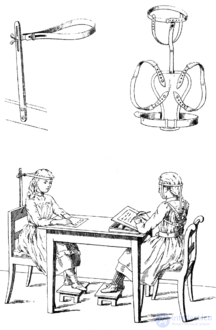
Moritz Schreber's apparatus, forcing children to sit up straight
Influential proponents of various forms of corporal punishment include Kellogg, Moritz Schreber, and others.
Katharina Rutschky, who worked at FU Berlinas a member of SDSu. a. studied under Klaus Mollenhauerand the psychoanalyst Gerhard Mätze, and later worked as a teacher, in 1977 published an extensive volume collecting pedagogical writings from several centuries, which she had originally gathered for a planned doctoral dissertation titled « Black Pedagogy» . Her involvement in these educational works was seen as a contribution to the defense of the anti-authoritarian educational movement of that time.
In her commentaries, Rutschky interpreted historical texts using the terminology of Sigmund Freud's psychoanalytic theory . She believed that upbringing is a modern phenomenon that arose only in the 19th century. In light of psychoanalytic theory, the super-ego is the seat of morality in the psychic household of socialized individuals ; The function of the educator (parent, teacher) responsible for the child's moral development consists, according to Rutschky's interpretation, in establishing a super-ego in the child. This implies that the child is the educator.will be subjected .
According to Rutschky, instinctual defense plays a central role in this education . Sexuality will be, because they call forth instinctive, overflowing behaviors that are considered especially dangerous in black pedagogy; the young person must be distracted from it by strict educational measures. Rutschky assumed that the educator himself was narcissistically disturbed, suffered greatly from a cruel super-ego, and feared the still unrestrained child. To overcome this fear and fend off his own tormenting impulses, the educator subjects the child to an «educational initiation».«, followed by instrumental threats of death, physical and psychological violence, pain, punishment, control, surveillance, hardening and a taboo on sexuality. Education here serves as an alibi and a rationalization, by means of which the educator masks his own sadism . the love between mother and child from despised in the context of black pedagogy as « monkey love » and branded as the cause of any deficiency of character and of the child's foolishness.
Alice Miller began her career as a psychoanalyst, but later distanced herself from psychoanalysis in order to regard herself as a «researcher of childhood». She recognized the mechanisms of «black pedagogy» named by Rutschky using the tools of psychoanalysis in her first theoretical home («black psychoanalysis»), and finally turned away from it in a process of theoretical reconsideration (Miller 1979, 1980, 1983).
Initially, at the center of their critique was child-rearing aimed at the one-sided adaptation of the child's behavior to parental needs. Miller suggested that such upbringing led to the formation of a «false self» in the child. false self is a concept about the fact, that the English psychoanalyst Donald Winnicott introduced into psychoanalytic discourse in 1960, to characterize the behavior of people who do not show authenticity, because they, apparently, have built a facade around themselves for their self-protection
While «The Drama of the Gifted Child» (1979), still dominated by the internal psychoanalytic school dispute (drive theory versus self psychology according to Kohut ), she cites Rutschky's collection of texts in detail in «In the Beginning There Was Education» (1980) and adopts his term «black pedagogy», which she compares with her own experience as a therapist and case histories from her earlier practice. She adopts Rutschky's term as a fundamental concept of ideology critique, while at the same time going beyond Rutschky's psychoanalytically grounded critique.
«(...) with the aim of characterizing an attitude that manifests itself, more or less openly, not only in fascist ideologies but in various others as well. Contempt for and persecution of the living, creative, emotional element in the child and in ourselves permeate so many areas of our lives that we no longer notice them. With varying intensity and under various sanctions, but almost everywhere there is a tendency to get rid of the childlike – that is, the weak, helpless, dependent being – as quickly as possible, in order finally to become a big, independent, capable being worthy of respect. If we encounter this being again in our children, we will persecute it by the same means used on us, and we call this upbringing».
For Miller, black pedagogy was not an educational position tied to a specific intellectual-historical context (the Enlightenment, philanthropism, Herbartianism , National Socialism ) and could be explained by it, but rather an educational situation that stood outside of history and arose solely from the abuse of power by educators acting out of a dangerous psychic state:
«By «black pedagogy» I mean an upbringing aimed at breaking the child's will, making him an obedient subject through the open or hidden use of force, manipulation, and blackmail».
As a consequence, this critique led to an explicitly anti-educational position in the tradition of Ekkehard von Braunmühl . According to Miller, there is no such thing as «white pedagogy», as Rutschky's term implies. The problem lies in the pedagogical stance as a whole, which serves only the needs of adults and passes on their problematic socialization, for example by passing on the humiliation they once suffered, compelling others to repeat it. The victims of upbringing become the perpetrators of upbringing: «Pedagogy is needed not by children, but by educators» [23].
In the book «Thou Shalt Not Be Aware» (1983), Miller worked out how children can be made not to notice, when, against them, are applied forms of violence, including sexual violence, in the name of «education» . Miller showed how later people glorify the violence they experienced in childhood, and pass it on to the next generation as parents. [24] [25] Miller also saw the transfiguration and concealment of parental authority in psychoanalysis, which she called, in this context, «black psychoanalysis»
Alice Miller defines poisonous pedagogy as all types of behavior that, in her view, are intended to manipulate children's characters through force or deception. Her attention is focused not only on spanking (although she said that «every slap is a humiliation» and she explicitly opposes corporal punishment), but also on various other forms of manipulation, deception, hypocrisy, and coercion which, she argues, are commonly used by parents and teachers against children.
Professor of sociology Frank Furedi considers such claims to be too sweeping and detached from reality. Furedi calls many supporters of a complete ban on physical punishment opponents of all forms of child punishment. He views the underlying agenda as a crusade against parents and argues that some studies of the effects of spanking are far less clear-cut than the claims made on their behalf by those he calls «anti-spanking zealots».
Social psychologist David Smail asserts that society bears most of the responsibility for individuals' dysfunctional behavior, but has yet to address this problem in any meaningful way
Developmental psychologist James W. Prescott conducted research in the 1970s into the bond between primate infants and mothers, and noted a connection between disruption of the infant-mother bonding process and the emergence of violence and fear-based behavior in young primates. He suggests that the same dynamics operate in humans through the disruption of empathy.
In 1975, Prescott identified the connection between violence and disruption of the infant-mother bonding process in human societies, drawing on cross-cultural research into aboriginal societies and statistical analysis of these cultures' practices regarding the natural process of child-mother bonding, together with a study of historical attitudes toward children drawn from European literature and historical data. [11]
He concluded that a disrupted process of infant-mother bonding was an absolute predictor of the emergence of violence, hierarchy, rigid gender roles, dominance psychology, and violent territorial conquest. Interference with and disruption of natural adolescent sexuality also formed part of the overall picture. This finding was unexpected. Most societies were peaceful, and the number of extremely violent societies was low.
Prescott states that the research showed that over time destructive practices become the «norm», and as generations grow up and pass these practices on, the society in question begins to display a clear lack of empathy, and violence becomes codified. In his view, the history of poisonous pedagogy is the history of the codification of these harmful practices. It is on these that present-day inherited practice is based. [11]
Recent research into living aboriginal communities and a review of historical data from early contacts and other recorded observations over the past 400 years have shown that most aboriginal cultures do not punish children. The data show that children are treated with far greater respect, trust and empathy than was previously believed.
The concept of «black pedagogy» was often classified in the specialized literature as scientifically untenable. Indeed, as early as 1992 Zvi Lothane subjected the corresponding branding of Moritz Schreber, the father of Daniel Paul Schreber to comprehensive criticism; Rutschky had classified Schreber as one of the main representatives of «black pedagogy».
On the other hand, Rutschky and Miller have been accused of taking a narrow view of enlightenment and philanthropy. As explained by Christian Grabau (University of Tübingen) in 2013, punishment for charitable purposes was neither the first resort nor merely a tool of oppression. The primary means of instruction in this pedagogy were observation and listening, and only afterward exercises and commands.
In 2014, Juliane Kühn complained that Rutschky had not formulated a definition of the term «black pedagogy». Rutschky indiscriminately calls «black pedagogy» everything that, according to today's pedagogical theory and practice, contradicts the humane meaning of education – leading a child to maturity. Rutschky selected the source texts collected in her book from the corpus of Enlightenment literature and philanthropists in such a way that they represent what she herself calls «black pedagogy».
In 2016, Michael Milburn and Sherry Conrad likewise criticized Miller for continuing his analysis as though upbringing took place in a vacuum, without historical context: «How we treat our children reflects who we are and what we believe as a society. Our social and political views, our institutions and our educational practices shape the next generation of citizens, who, through their social institutions and their political behavior, in turn create the world in which their children will live.»

Comments