
Lecture
Teaching — is a two-way process carried out by the instructor (teaching) and the students (learning). Instruction, teaching and learning — are three types of activity inseparably linked into a unified system, each of which in turn possesses systemic qualities. Any activity consists of a certain sequence of actions, and actions consist of a set of operations.
An operation, an action, an activity necessarily includes a control component, which manifests itself in instruction, teaching and learning in the form of pedagogical monitoring that follows the activity of both the student and the instructor.
Monitoring — is the most important part of instruction, involving the determination of the extent to which the goals of instruction have been achieved. In addition, monitoring also carries educational and character-building functions. Thanks to monitoring, students correct their knowledge and cognitive activity and acquire new knowledge. The character-building significance of monitoring is varied; in particular, it accustoms a person to constant and responsible academic work and instills discipline. Monitoring develops independence in the student along with such personal qualities as self-control and self-assessment.
Monitoring of a student’s cognitive activity is important for the instructor. This is feedback that speaks to the quality of teaching. Low learning outcomes indicate the low quality of the instructor himself, his inability to adapt to the existing level of knowledge of the students. The identification of typical errors often points to shortcomings in the teaching method being used.
Monitoring in instruction manifests itself in the assessment of knowledge. Assessment of knowledge — is a process consisting in determining the degree of correspondence between the knowledge (skill, ability) formed in the student and the knowledge specified by the goals of instruction. Thus, the starting point of knowledge assessment is the determination of the goals of instruction and the final and intermediate results that students must achieve.
I.Ya. Lerner, in creating a system of qualities of knowledge, notes that a person’s knowledge is manifested only in his activity. In all, I.Ya. Lerner lists 6 pairs of qualities of knowledge.
They are examined in more detail in the following articles
It is known that the dependence of the productivity of instruction on the quantity, quality, completeness, timeliness (operational efficiency), depth, and objectivity of monitoring is one of the general laws of the didactic process. For its practical implementation, it is necessary to define concepts and clarify the dependencies between the factors that determine the effectiveness of monitoring. In modern pedagogical theory there is still no established approach to defining the concepts of «control», «checking», and «record-keeping».
Often they are confused, used interchangeably, and applied sometimes with the same and sometimes with different meanings.
Thus, I.P. Podlasy believes that «the general generic concept is «control», meaning the identification, measurement and assessment of the knowledge and skills of learners. Identification and measurement are called checking. Therefore checking is a component part of control, whose main didactic function is to ensure feedback between the teacher and the students, to give the teacher objective information about the degree of mastery of the material, and the timely identification of shortcomings and gaps in knowledge. There is no doubt that it is important to check the quality of individual pieces of knowledge acquired by students. But this knowledge is not acquired by students in isolation from one another, but within a certain system specified by the curriculum and the textbook. Each piece of knowledge is an element of a system of knowledge, and only within this system can it be truly understood. Therefore we consider it appropriate in our work to devote some attention to the problem of defining the system of qualities of knowledge, that is, we will attempt to answer the question: what is knowledge, and what should it be like.
Since we want to talk about knowledge in a substantive way, it is necessary to define this concept. It turns out that in the literature knowledge is defined in different ways. For example, I.Ya. Lerner gives the following possible interpretations of this concept: «… in one normative publication, knowledge is interpreted as «spiritual activity, a reflection of objective reality, considered from the point of view not of the process but of the result»; another dictionary designates knowledge as «an ideal reproduction, in linguistic form, of the objective, regular connections of the practically transformable objective world». [16, 7]
All these definitions are correct and at the same time insufficient for the pedagogical study of «knowledge». Pedagogy is interested in knowledge primarily as a result of the process of assimilation. Since the process of assimilation passes through a number of stages, it is important to clarify the concept of «knowledge» as the result of each of these stages.
Under any organization of instruction in new educational material, the student goes through three stages of its assimilation. Therefore one can speak of three levels of assimilation.
The first stage consists in the conscious perception of information about the object of assimilation and its memorization.
Another stage, or level, of assimilation represents the assimilation of ways of applying knowledge according to a model, including easily recognizable variations of this model.
And finally, the third stage, or level, of assimilation consists in the learner’s readiness to creatively apply the assimilated information in a new, unfamiliar situation.
For pedagogy, knowledge at the first level of assimilation can be defined as «consciously perceived and memory-fixed objective information about certain objects of reality. At the final stage, knowledge can be defined as objective information about an object, assimilated to the level of awareness of its external and internal connections, the ways of obtaining information, and readiness to apply it in similar and unfamiliar situations. Or, in short, this is information assimilated at the level of its creative application». [16, 9]
We will keep in mind this last definition of knowledge, since only it presupposes the full value of a person’s knowledge in the entire set of qualities inherent to it.
So, the concept of «knowledge» has been defined. But we posed the question of clarifying the system of qualities of knowledge, so it is natural to also define the concept of «quality». Quality is the customary name for a property of an object that constitutes its stable, permanent characteristic revealing its essence.
In the pedagogical literature many qualities of knowledge are described in detail, but what is important for us is to define precisely the system of qualities of students’ knowledge, so in writing this work we turned to the work of I.Ya. Lerner «Qualities of Students’ Knowledge. What Should They Be?», which allowed us not only to identify the qualities of knowledge that form the system, but also to learn the ways of achieving these qualities, as well as to see the influence of some qualities on others.
For convenience of presentation, we will devote a separate subsection to each pair of qualities.
Let us note once again that we are not interested in social knowledge, but in the knowledge of the individual, that is, the knowledge that must be conveyed to the student in the process of instruction. Therefore we will examine the qualities of knowledge precisely from this angle.
The generalized system of trans-subject indicators of learning attainment is presented as follows.
The generalized indicators of the formation of habits coincide with the indicators of the formation of skills. However, since a habit presupposes the automation of actions, the time taken to perform it is usually also assessed, for example by measuring reading speed, mental arithmetic speed, and so on.
The knowledge quality system (KQS) — a set of interacting qualitative characteristics forming an integral whole, designed to achieve the goals of the learner's personal development and to help unlock his or her creative potential. In order to assess the quality of knowledge and form an idea of the KQS, it is necessary to identify these qualities and briefly characterize them. The elements of the KQS are: depth; generality; concreteness; systematicity; mobility; awareness; compactness; elaboration; consistency; flexibility; completeness; durability. I.Ya. Lerner divides the qualities of knowledge into two groups: (Fig. 64) .
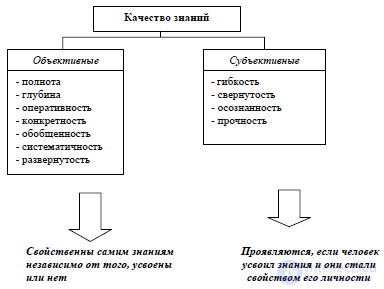
Fig. 64. Assessment of knowledge

Comments