
Lecture
The most important characteristic and precondition for the effectiveness of educational activity is the pedagogical culture of the teacher and educator. Its main purpose is to help improve the educational process and increase its productivity. The pedagogical culture of a teacher (educator) is a generalized characteristic of their personality that reflects the ability to persistently and successfully carry out educational activity in combination with effective interaction with students and pupils.
«An effective teacher first thinks, analyzes their own activity and the innovations of colleagues, and only then applies them in practice»
(H. Wong)
Pedagogical culture is the highest degree of correspondence between the development of a teacher's personality and professional preparedness and the specifics of pedagogical activity. It is a personally mediated pedagogical professionalism that makes it possible to carry out pedagogical activity at the highest level of its social, humane, moral, properly pedagogical, scientific, and specialized criteria. It is rightly said that pedagogical work is not a profession but a life's calling. Only the one for whom such work has become a personal need is truly cultured and professional – a need whose satisfaction brings the highest joy, and whose achievements bring a sense of fulfillment without which the teacher cannot imagine themselves. The striving to master and embody the indicators of pedagogical culture in one's deeds should be inherent in every teacher, for otherwise they will shortchange their students, even distort them in some way, failing to fulfill not only their professional but also their human duty. One can imagine what an «educated teacher» with C's in their diploma will do to their students. It is roughly the same as going under the knife of a C-grade certified surgeon.
Outside of such a culture, pedagogical practice turns out to be paralyzed and ineffective. The culture of the teacher (educator) performs a number of functions, including:
Pedagogical mastery is the most important and structure-forming component of pedagogical culture. It is expressed in stable psychological-pedagogical knowledge, and in the pedagogical exactingness and pedagogical tact of the teacher and educator.
There are many definitions of pedagogical culture, but for the most part they are merely variants of one and the same thing. In practice, they merely divide, name, and structure its numerous components differently (there are definitions containing up to 30 main elements and hundreds of detailed ones). Speaking of the essentials, pedagogical culture can be represented as including five main components of the teacher's personality and preparedness, forming a systemic unity and meeting both the general and the special requirements of pedagogical work (Fig. 1).
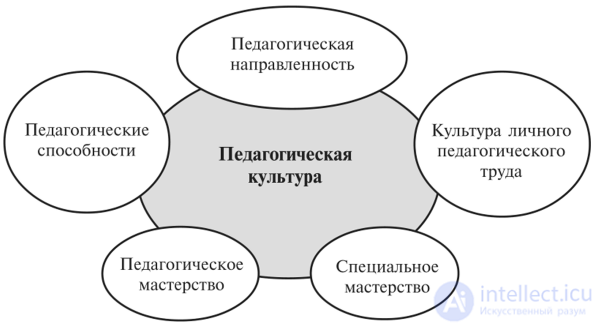
Fig. . Pedagogical culture of the subject of pedagogical activity
Pedagogical orientation of the personality — a system of a teacher's motivations that determines the irresistible attraction of pedagogical activity and the complete engagement of all their strength and abilities in it. A teacher possessing a high culture relates to pedagogical activity not as work or a profession, but as a life's calling, a civic responsibility, a way of life, their vital-professional stance, and hence their enthusiasm, passion, and self-sacrifice. As it is said in religious scripture: «For where your treasure is, there your heart will be also». For a professionally cultivated teacher, to do something insufficiently professionally, «sloppily», or in a slipshod manner is above all a failure to respect oneself, a poisoning of one's own conscience. As the Ukrainian philosopher H. Skovoroda (1722—1794) rightly noted: «What can be more harmful than a person who possesses knowledge of the most complex sciences but lacks a good heart? He will use all his knowledge for evil». Pedagogical orientation is characterized by:
• a socially mature, scientifically correct, progressive, creative conception of activity — a spiritual, civilized, humane, democratic pedagogical creed, a pedagogical worldview;
• pedagogical purposefulness — love for the human being, a selfless striving to help them by every means become a fully realized and successful person in life; an active civic stance as a participant in building in Russia a civilized, genuinely humane, democratic, law-governed state and moral society, and one who also prepares the younger generation for such participation;
• pedagogical fullness of aspirations and activity, ensuring the unity of upbringing, education, instruction, and development of people: «Without participation in educational work, all of a teacher's pedagogical culture and all their knowledge is dead baggage» ; one cannot be a professional teacher if one limits one's pedagogical contribution to the mere formal conducting of classes and instruction, while withdrawing from the upbringing, education, and development of students, disregarding the interests of the educational institution and its teaching staff, being able to but unwilling to help a colleague, seeing shortcomings and ways to eliminate them but considering that «it's not my business»;
• pedagogical interests — in the human problems of the life of society and the activity of the state, in every person, their life, their future, preparing them for it, helping them in it, and the scientific and effective conduct of activity;
• pedagogical enthusiasm and attachment — a passionate, enthusiastic engagement in the work with complete self-dedication; an insatiable striving to achieve its maximum effectiveness, intolerance of anything that diminishes it, constant searching, pedagogical optimism, unremitting work on oneself; attachment to pedagogical work for one's whole life. Even understanding that not everything can be achieved, they try with all their might to sow the good, the bright, and the eternal, and to fight human injustice, immorality, and stupidity;
• pedagogical selflessness — benevolent, enthusiastic, difficult work with people at the call of the heart and without mercenary personal monetary calculation; personal gain is not a priority for them, and from the outside they may even look like an idealist, a person «not of this world». Such a stance wins over many people, especially young people who feel a touch of a pure source of human spirituality, which involuntarily evokes respect, awakens reflection on one's own life stance, a feeling of faith in the actual existence of lofty human values, and impulses to imitation. Genuine teaching is in some ways even akin to selfless dedication, especially in today's conditions.
B.S. Gershunsky writes about the teacher: «...this is a thinker, who feels the full weight of the sacred responsibility placed upon them for the fate of the Person entrusted and entrusting themselves to them, for that person's spirituality, intelligence, and physical health, for the future of their own country and of the whole World, of all human civilization» .
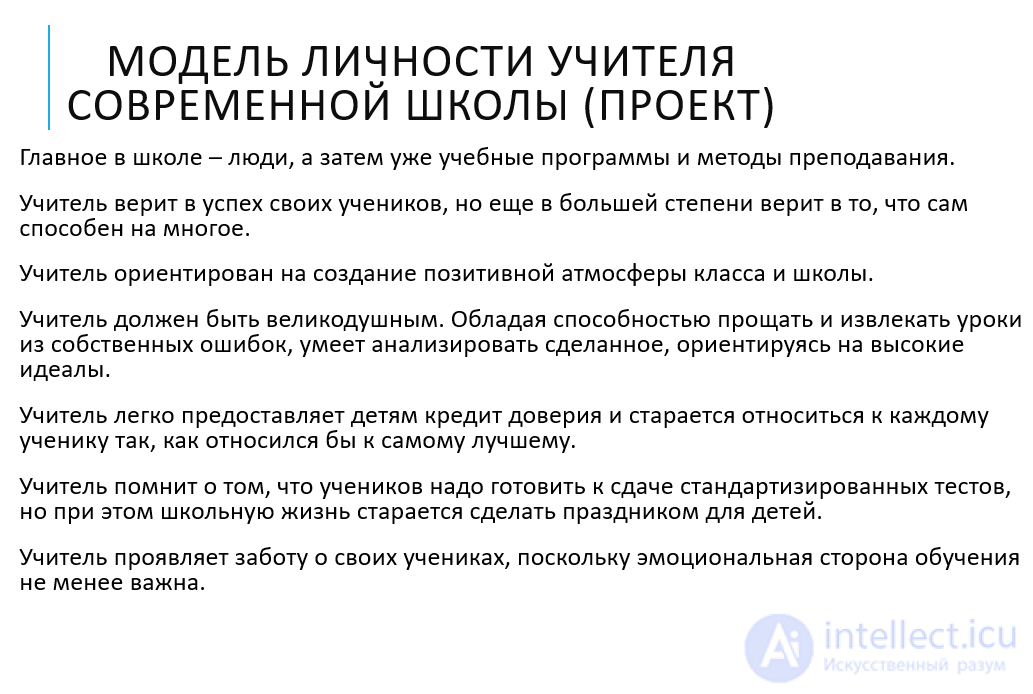
The person who organizes the instructional and upbringing process at school is the teacher. It can be said that this is a person who has special training and is professionally engaged in this professional activity. A person who has taken his place behind the teacher’s desk bears responsibility for everything, and is expected to know and be able to do everything. It is precisely the responsibility for the fate of each student, of the rising generation, of society and of the state that characterizes the position of teacher. Whatever the result of teachers’ work is today, such will our society be tomorrow. It is difficult to imagine another activity on which so much depends in the fate of each individual and of the whole nation.
Teaching work belongs to a very complex type of activity. But most people do not fully understand exactly what a teacher does, limiting themselves to pointing at the external, visible characteristics of his activity. A pedagogical function is a prescribed direction for a teacher’s application of professional knowledge and skills. Of course, the main directions of application of pedagogical effort are the teaching, education, upbringing, development and formation of students. In each of these, the teacher performs a multitude of concrete actions, so that his functions are often hidden and not always explicitly implied. And yet the main function of the teacher is the management of the processes of teaching, upbringing, development, and formation.
|
What should the teacher and the lesson be like for me to learn well? (17 students) |
The components of a teacher’s success (10 teachers) |
||||
|
1 |
It all depends on the student |
1 |
1 |
I love my work |
YES 10 |
|
2 |
They should love the students |
1 |
2 |
I love children |
YES 10 |
|
3 |
The teacher’s good mood |
6 |
3 |
I always go to class in a good mood |
YES 8 Not always 2 |
|
4 |
Help in a difficult moment, understand the students’ problems Forgive the student |
3 2 |
4 |
I understand the students’ problems |
YES 9 Did not answer 1 |
|
5 |
Good discipline in class |
2 |
5 |
My classes have good discipline |
YES 5 Not always 5 |
|
6 |
Explain unclear assignments in an accessible way |
4 |
6 |
I provide timely help to students |
YES 6 Not always 3 Did not answer 1 |
|
7 |
Little time to prepare homework Large volume of homework |
8 |
7 |
I select the optimal volume of homework |
Yes 10 |
|
8 |
Explain the material clearly and in an interesting way |
12 |
8 |
I explain the material clearly and in an interesting way |
Yes 5 Find it hard to answer 2 Not always 1 Did not answer 2 |
|
9 |
The student as the teacher’s helper |
1 |
9 |
I involve students in preparing the upcoming lesson |
Yes 3 Sometimes 7 |
|
10 |
Working on the computer, the Internet |
6 |
10 |
Using the computer produces positive results |
Yes 4 No 1 Find it hard to answer 2 Did not answer 3 |
|
11 |
Lessons that are not boring There should be more visual presentation, demonstration material, and practical work |
6 10 |
11 |
Using new approaches in one’s work produces positive results |
Yes 9 Find it hard to answer 1 |
|
12 |
Good relationships A fair teacher |
10 4 |
12 |
I treat ALL students the same |
Yes 9 Not always 1 |
|
13 |
Sports clubs, events |
8 |
13 |
I maintain friendly relations in the class and teach students to assess their own achievements |
1 |
The teacher is called upon not to teach but to guide learning, not to raise but to direct the processes of upbringing. And the more clearly he understands his main function, the more independence, initiative and freedom he grants his students. A true master of his craft remains, as it were, off-camera in the educational process. Consequently, the core of pedagogical labor lies in managing all those processes that accompany the formation of a person. In order to determine what a teacher actually does, and what the characteristic feature and distinctiveness of his labor is, researchers have devised and implemented dozens of models. Let us examine one of them. To give concrete form to the management function, we shall use the concept of a «pedagogical project», by which we mean any conceived and completed undertaking: a lesson, a homeroom hour, the study of a topic or unit, the organization of an olympiad, or a school celebration. The teacher is obliged to manage all these undertakings. At the preparatory stage, the teacher's first function is goal-setting. The goal is a key factor of pedagogical activity; it ideally anticipates and directs the movement of the joint labor of the teacher and his students toward their common result. The essence of the management process consists precisely in coordinating actions along the line of coincidence between goal and result, minimizing the inevitable discrepancies arising from the high dynamism and unpredictability of the behavior of the participants in the pedagogical system. Management of the pedagogical process is based on knowledge of the students: the level of their preparedness, their capabilities, their upbringing, and their development. This is achieved through diagnosis. Without knowledge of the particularities of the physical and mental development of schoolchildren, the level of their intellectual and moral upbringing, the conditions of classroom and family upbringing, and so on, it is impossible to set a correct goal or to choose the means of achieving it. Inseparably linked with diagnosis is forecasting. It is expressed in the teacher's ability to foresee the results of his activity under the given concrete conditions. Having obtained a diagnosis and relying on a favorable forecast, the professional teacher proceeds to draw up a project of educational and upbringing activity. The projective function of the teacher consists in constructing a model of the forthcoming activity, choosing the methods and means that will make it possible to achieve the goal under the given conditions and within the established time, identifying concrete stages for achieving the goal, formulating particular tasks for each of them, determining the types and forms of assessment of the results obtained, and so on. Diagnosis, forecast, and project become the basis for developing a plan of educational and upbringing activity, the drawing up of which completes the preparatory stage of the pedagogical process.
At the next stage, that of implementing intentions, the teacher performs an informational, organizational, evaluative, monitoring, and corrective function. The teacher's organizational activity is mainly connected with involving students in the planned work and cooperating with them in achieving the intended goal. And finally, at the concluding stage of any pedagogical project, the teacher performs an analytical function, the main content of which is an analysis of the completed undertaking: how effective the work carried out was. In addition to his direct professional functions, the teacher performs social, civic, and family functions. Of particular importance are the human qualities of the teacher, which become professionally significant prerequisites for creating favorable relations in the educational and upbringing process. Among these qualities are humanity, kindness, patience, decency, honesty, responsibility, fairness, reliability, objectivity, generosity, respect for people, high morality, optimism, emotional balance, a need for communication, interest in the lives of one's charges, benevolence, self-criticism, friendliness, restraint, dignity, principledness, responsiveness, emotional culture, and much more. A mandatory quality for a teacher is humanism, that is, an attitude toward the growing person as the highest value on earth. Humane relations are made up of interest in the student's personality, sympathy for the student, help to him, respect for his opinion, high demands regarding his learning activity, and concern for the development of his personality. A teacher is always an active, creative personality. He acts as the organizer of the everyday creative life of schoolchildren. Pedagogical leadership of a collective as complex as a class obliges the educator to be inventive, quick-witted, persistent, and always ready to resolve any situation. The teacher is a model to be emulated, encouraging students to follow him. A professionally necessary quality of a teacher is self-control. A professional must always retain the leading position. Students should not see or sense any breakdowns, confusion, or helplessness. An indispensable professional quality of a teacher is fairness. It is important that evaluative judgments correspond to the level of development of the schoolchildren. The educator must be demanding – this is the most important condition for his successful work. A sense of humor helps the teacher neutralize the tension present in the pedagogical process. Separately, mention should be made of the teacher's professional tact as a special skill in building relationships with his charges. Pedagogical tact is the observance of a sense of proportion in communicating with students. Personal qualities in the teaching profession are inseparable from professional ones. These usually include qualities acquired in the process of professional training, connected with obtaining specialized knowledge, abilities, ways of thinking, and methods of activity. Among them are command of the subject taught, methodology of teaching the subject, psychological training, general erudition, broad cultural horizons, pedagogical mastery, command of the technologies of pedagogical labor, organizational abilities and skills, command of communication technologies, oratorical skill, and others.
Scholarly enthusiasm is an obligatory teacherly quality. Without it, the process of moral upbringing is impossible. Scholarly interest helps to form in students an interest in their subject.
Love for one's professional work is a quality without which there can be no teacher.
Before determining the essence of professional-pedagogical culture, it is necessary to actualize such concepts as "professional culture" and "pedagogical culture". The isolation of professional culture as an attributive property of a particular professional group of people is the result of the division of labor, which caused certain types of specialized activity to become separate. A profession, as an established socio-cultural phenomenon, has a complex structure that includes the object, means and outcome of professional activity: goals, values, norms, methods and techniques, models and ideals. In the course of historical development, professions also change. Some of them acquire new sociocultural forms, others change only slightly, and still others disappear entirely or undergo substantial changes. A high level of professional culture is characterized by a developed capacity for solving professional tasks, that is, by developed professional thinking. However, developed professional thinking can turn into its opposite when it absorbs other manifestations of the personality, disrupting its integrity and all-roundedness. Reflecting the contradictory, dialectical nature of human activity, professional culture is a certain degree of mastery, by the members of a professional group, of the techniques and methods for solving specialized professional tasks. The concept of "pedagogical culture" has long been part of the practice of pedagogical activity, although its holistic theoretical study has become possible only relatively recently. In connection with the analysis of the specific features of pedagogical activity and the study of teachers' pedagogical abilities and pedagogical skill, this problem has been reflected in the works of S. I. Arkhangelsky, A. V. Barabanshchikov, E. V. Bondarevskaya, Z. F. Esareva, N. V. Kuzmina, N. N. Tarasevich, G. I. Khozyainov, and others. With the beginning of the active development of the culturological approach in philosophy, sociology, pedagogy and psychology, studies have been carried out devoted to individual aspects of pedagogical culture: questions of the methodological, moral-aesthetic, communicative, technological, spiritual and physical culture of the teacher's personality are being studied. In these studies, pedagogical culture is regarded as an important part of a teacher's overall culture, manifested in the system of professional qualities and in the specific character of pedagogical activity. A teacher's professional-pedagogical culture acts as a part of pedagogical culture as a social phenomenon.
The bearers of pedagogical culture are people engaged in pedagogical practice at both the professional and non-professional levels. The bearers of professional-pedagogical culture, in turn, are people called upon to carry out pedagogical work, the components of which are pedagogical activity, pedagogical communication, and the personality as a subject of activity and communication at the professional level. To understand the essence of professional-pedagogical culture, one must bear in mind the following propositions, which reveal the connection between general and professional culture and its specific features:
Taking these methodological foundations into account makes it possible to substantiate a model of professional-pedagogical culture, whose constituent components are the axiological, technological and personal-creative components. The axiological component of professional-pedagogical culture is formed by the totality of pedagogical values created by humanity and incorporated, in their own distinctive way, into the holistic pedagogical process at the present stage of the development of education.
In the course of pedagogical activity, teachers master ideas and concepts and acquire the knowledge and skills that make up the humanistic technology of pedagogical activity, and, depending on the degree of their application in real life, evaluate them as more or less significant. Knowledge, ideas and concepts that at a given moment carry great significance for society and for a particular pedagogical system act as pedagogical values. A teacher becomes a master of their craft, a professional, to the extent that they master and develop pedagogical activity while recognizing pedagogical values. The history of the school and of pedagogical thought is a process of constant evaluation, rethinking, and establishment of values, and of transferring known ideas and pedagogical technologies into new conditions. The ability to see something new in what is old and long known, and to appreciate it properly, is an indispensable component of a teacher's pedagogical culture. The technological component of professional-pedagogical culture includes the methods and techniques of a teacher's pedagogical activity. The values and achievements of pedagogical culture are mastered and created by the individual in the course of activity, which confirms the fact of the inseparable connection between culture and activity. The humanistic orientation of pedagogical activity makes it possible to investigate the mechanism for satisfying the individual's diverse spiritual needs. In particular, it makes it possible to examine how the needs for communication, for obtaining new information, and for passing on accumulated individual experience are satisfied — that is, everything that underlies the holistic educational process. Pedagogical activity is technological by its very nature. In this connection, an operational analysis of pedagogical activity is required, one that makes it possible to view it as the solving of diverse pedagogical tasks. Among these we include the totality of analytical-reflexive, constructive-prognostic, organizational-activity, evaluative-informational and correctional-regulatory tasks, the techniques and methods of solving which constitute the technology of a teacher's professional-pedagogical culture. Pedagogical technology helps to understand the essence of pedagogical culture; it reveals the historically changing methods and techniques and explains the orientation of activity depending on the relations taking shape in society. It is precisely in this case that pedagogical culture performs the functions of regulating, preserving and reproducing, and developing pedagogical reality. The personal-creative component of professional-pedagogical culture reveals the mechanism of mastering it and of its embodiment as a creative act.
The process by which a teacher appropriates the pedagogical values that have been developed takes place at a personal-creative level. In mastering the values of pedagogical culture, a teacher is able to transform and interpret them, which is determined both by his or her personal characteristics and by the nature of his or her pedagogical activity. It is precisely in pedagogical activity that the contradictions of an individual's creative self-realization are revealed and resolved: the cardinal contradiction between the pedagogical experience accumulated by society and the specific forms of its individual, creative appropriation and development; the contradiction between the level of development of a person's powers and abilities and self-negation, the overcoming of that development, and so on. Thus, pedagogical creativity is a form of human life activity whose universal characteristic is pedagogical culture. Pedagogical creativity demands of the teacher an appropriate need, special abilities, individual freedom, independence, and responsibility. It becomes evident that pedagogical culture is a sphere for the creative application and realization of a teacher's pedagogical abilities. In pedagogical values, the individual objectifies his or her own powers and mediates the process of appropriating moral, aesthetic, legal, and other relations, that is, by acting on others, the individual creates himself, determines his own development, and realizes himself in activity. An analysis of the philosophical, historical-pedagogical, and psychological-pedagogical literature, a study of the experience of school teachers' work, and theoretical generalizations make it possible to conclude that professional-pedagogical culture is a measure and mode of the creative self-realization of a teacher's personality in the various forms of pedagogical activity and communication directed at mastering and creating pedagogical values and technologies. This account of professional-pedagogical culture makes it possible to place the concept within a categorical series: the culture of pedagogical activity, the culture of pedagogical communication, and the culture of the teacher's personality. Professional-pedagogical culture appears as a universal characteristic of the various forms of a teacher's activity and pedagogical communication, revealing and ensuring the development of the needs, interests, value orientations, and abilities of the individual in relation to pedagogical activity and pedagogical communication. Professional-pedagogical culture is a concept of a higher level of abstraction, one that is made concrete in the concepts of "the culture of pedagogical activity", "the culture of pedagogical communication", and "the culture of the teacher's personality".
Pedagogical values are objective, since they are formed historically in the course of the development of society, education, and general secondary schooling, and are fixed in pedagogical science, as a form of social consciousness, in the shape of specific images and conceptions. In the process of preparing for and carrying out pedagogical activity, a teacher masters pedagogical values and subjectivizes them. The level of subjectivization of pedagogical values is an indicator of a teacher's personal and professional development, of his or her pedagogical culture, as a measure of the realization of the ideally valuable and of the transformation of the potential (the ought) into the actual (the is). As the conditions of social-pedagogical life change, and as the needs of society, the school, and the individual change, pedagogical values likewise change and are reassessed. Nevertheless, they serve as relatively stable points of reference by which teachers measure their lives and their pedagogical activity. The interweaving of the universal human values of goodness and beauty, justice and duty, equality and honor into the palette of pedagogical values, together with mastering them and deepening the world of pedagogical values, creates the material foundation on which the edifice of a teacher's professional-pedagogical culture is built. A teacher's subjective perception and appropriation of universal human cultural-pedagogical values is determined by the richness of his or her personality, the orientation of his or her professional activity, professional-pedagogical self-awareness, and his or her personal pedagogical system, and thus reflects the inner world of the individual. In this connection, S.L. Rubinstein's assertion is justified, namely, that a value-based attitude remains a way of reflecting reality in human consciousness. The degree to which an individual appropriates pedagogical values depends on the state of pedagogical consciousness, since the fact of establishing the value of one or another pedagogical idea or pedagogical phenomenon takes place in the process of the individual's evaluation of it. The criterion of evaluation, and its result, is a generalized image formed on the basis of psychological-pedagogical knowledge, the results of one's own activity, and the comparison of that activity with the activity of others. The images of an individual's pedagogical consciousness may or may not coincide with the conceptions developed in society or in a professional group regarding the goals, content, subject, and object of pedagogical activity, and regarding everything that ensures a teacher's pedagogical competence and the appropriateness of his or her activity.
A teacher's professional-pedagogical consciousness performs a complex regulatory function. It structures, around a single personal core, the entire variety of methods of instructional, upbringing, methodological, and socio-pedagogical activity that are mastered and carried out. A.N. Leontiev notes that the varied activities of a subject intersect with one another and are linked into nodes by relations that are objective and social in nature, and into which they necessarily enter. In his view, it is these nodes that form the "personality decor" that we call the self. The hierarchy of a teacher's forms of activity stimulates the development of individuality. The teacher accumulates this diversity by standing at the center of a specially structured and organized activity. In the course of his or her activity, each teacher, as an individual, actualizes only that portion of professional and pedagogical values that is vitally and professionally necessary for him or her. This feature of necessary professional initiative is given to the teacher in his or her consciousness in the form of a "professional self", against which the teacher's individualized professional-pedagogical experience, and the experiences, convictions, professional ties, and relations associated with it, are calibrated. Professional consciousness is directed at analyzing various aspects of the teacher's self and of his or her professional activity, and is meant to determine the boundaries and prospects of personal meaning, that is, the internally motivated, individual significance for the subject of this or that action or deed. It allows the teacher to achieve self-determination and self-realization, and, ultimately, to resolve for himself or herself the problem of the meaning of life. Representing not only a system of the most general judgments and knowledge about activity, about oneself, about others, and about society, pedagogical consciousness is at the same time a product and a result of exclusively individual experience, a special mechanism of a teacher's professional formation that makes it possible to turn the universality of pedagogical culture into an individual sphere of activity. Pedagogical values, being both a condition and a result of the corresponding activity, exist at different levels: the individual-personal, the professional-group, and the socio-pedagogical. Socio-pedagogical values reflect the character and content of the values functioning in various social systems, manifesting themselves in social consciousness in the form of morality, religion, and philosophy. This is a set of ideas, norms, and rules that regulate the activity of society in the sphere of education.
Group pedagogical values represent a set of ideas, concepts, and norms that regulate and guide pedagogical activity within particular educational institutions.
The totality of such values has a holistic character and acts as a cognitive-active system possessing relative stability and repeatability. These values serve as guidelines for pedagogical activity within particular professional groups (teachers at a school, lyceum, or gymnasium; instructors at a college, technical school, or university). Personal-pedagogical values are complex socio-psychological formations that reflect the goals, motives, ideals, attitudes and other worldview characteristics of a teacher's personality, which make up the system of his or her value orientations. The latter, representing an axiological self, is given to the individual not as a system of knowledge, but as a system of cognitive formations linked with emotional-volitional components, accepted by the individual as his or her own inner guideline that prompts and directs his or her activity. The consciousness of each particular teacher, accumulating socio-pedagogical and professional-group values, builds its own personal system of values, the elements of which take the form of axiological functions. Among such functions one can include the concept of shaping a specialist's personality, the concept of activity, ideas about the technology of constructing the educational process at school, about the specifics of interaction with students, about oneself as a professional, and so on. The integrative axiological function, uniting all the others, is the individual concept of the meaning of professional-pedagogical activity in a teacher's life.
The concepts of "pedagogical culture" and "pedagogical activity" are not identical, but they are unified. Pedagogical culture, being a personal characteristic of a teacher, appears as a way of carrying out professional activity in the unity of goals, means and results. The diverse types of pedagogical activity, forming the functional structure of the culture, have a common subject matter as its resulting form in the shape of specific tasks. Solving these tasks presupposes the exercise of individual and collective capabilities, and the very process of solving pedagogical tasks constitutes the technology of pedagogical activity, characterizing the way in which a teacher's professional-pedagogical culture exists and functions. An analysis of the concept of "technology" shows that, whereas at first it was associated mainly with the sphere of human production activity, in recent times it has become the subject of many psychological-pedagogical studies. The increased interest in pedagogical technology can be explained by the following reasons: • the diverse tasks facing educational institutions presuppose the development not only of theoretical research, but also of the working out of questions of technological support for the educational process. Theoretical research reveals the logic of cognition, from the study of objective reality to the formulation of laws and the construction of theories and concepts, while applied research analyzes pedagogical practice, which accumulates scientific results; • classical pedagogy, with its established regularities, principles, forms and methods of instruction and upbringing, does not always respond promptly to the scientific substantiation of many scientific ideas, approaches and methods; it lags behind, and often even holds back, the introduction of new techniques and methods of pedagogical activity; • the widespread introduction of information technology and computer equipment into the educational process has required a substantial change in traditional methods of instruction and upbringing; • general pedagogy remains very theoretical, while the methodology of instruction and upbringing is very practical, which is why an intermediate link is needed that can actually connect theory and practice.
Considering pedagogical technology in the context of professional-pedagogical culture, it is legitimate to single out in its structure such an element as the technology of pedagogical activity, which fixes the totality of techniques and methods for the holistic implementation of the pedagogical process. Introducing the concept of "technology of pedagogical activity" into scientific use presupposes constructing a model based on the ideas of a systemic, holistic approach, viewing pedagogical activity as a process of solving diverse pedagogical tasks that are, in essence, tasks of social management. The technology of pedagogical activity is viewed through the prism of solving a set of pedagogical tasks relating to pedagogical analysis, goal-setting and planning, organization, evaluation and correction. The technology of pedagogical activity thus represents the implementation of techniques and methods for managing the educational process at school. A pedagogical task, expressing the unity of the goal of the subject of the activity and the conditions under which it is solved, must meet a number of requirements, for the fulfillment of which pedagogical actions are carried out as ways of solving pedagogical tasks. The ways of solving a task can be algorithmic or quasi-algorithmic. The algorithmic method is used when the procedure for solving the task consists of effective operations and does not contain ambiguously determined branchings. The quasi-algorithmic method of solving a task contains ambiguously determined branchings, defined by the conditions of the task actually posed. In pedagogical practice, quasi-algorithmic methods of solving tasks predominate. A high level of task-solving in a teacher's activity is due to the presence of diverse models and solution constructs fixed in the individual's memory. Often an adequate solution is not found not because there are no adequate methods of solution "in the stores" of memory, but because the teacher (often a beginner) does not see and does not accept the very situation that requires a solution. Based on the specifics of a teacher's pedagogical activity and the logical conditioning and sequence of his or her actions and operations in carrying it out, the following binary groups of pedagogical tasks can be distinguished:
The named tasks can be regarded as independent systems, representing a sequence of actions and operations that characterize the concrete types of technologies of a teacher's pedagogical activity. An analysis of the structure of pedagogical activity makes it possible to identify a system of actions, since the concept of a pedagogical action expresses that which is common to all concrete types of pedagogical activity, yet is not reducible to any single one of them. At the same time, a pedagogical action is that particular thing which expresses both the universal and the whole richness of the individual case. This makes it possible to ascend from the abstract to the concrete and to recreate, in cognition, the object of pedagogical activity in its integrity. The identified groups of pedagogical tasks are typical for a teacher as a subject of professional activity, yet they nonetheless presuppose their creative, individual-personal solution in concrete pedagogical reality.
Representing a constantly enriching value potential of society, pedagogical culture does not exist as something given, materially fixed. It functions by being included in the process of an individual's creatively active mastery of pedagogical reality. The professional-pedagogical culture of the teacher objectively exists for all teachers not as a possibility, but as a reality. Mastering it is accomplished only by, and through, those who are capable of creatively unpacking the values and technologies of pedagogical activity. Values and technologies acquire personal meaning only in the process of creative searching and practical realization. In contemporary science, creativity is regarded by many researchers as an integrative, system-forming component of culture. The problem of the interrelationship of personality, culture and creativity found its reflection in the works of N.A. Berdyaev. Considering the global question of the interaction between civilization and culture, he held that civilization is, in a certain sense, older and more primary than culture: civilization denotes a socio-collective process, whereas culture is more individual, connected with the personality, with the creative act of the human being. In the fact that culture is created by the creative act of the human being, N.A. Berdyaev saw its ingenious nature: "Creativity is fire, while culture is the cooling of fire". The creative act resides in the space of subjectivity, while the product of culture resides in objective reality. The creative character of pedagogical activity conditions a special style of the teacher's mental activity, connected with the novelty and significance of its results, giving rise to a complex synthesis of all the psychic spheres (cognitive, emotional, volitional and motivational) of the teacher's personality. A special place in it is occupied by a developed need to create, which is embodied in specific abilities and their manifestation. One such ability is the integrative and highly differentiated ability to think pedagogically. The capacity for pedagogical thinking, which by its nature and content is divergent, provides the teacher with the active transformation of pedagogical information and a way beyond the boundaries of the temporal parameters of pedagogical reality. The effectiveness of a teacher's professional activity depends not so much, or not only, on knowledge and skills, as on the ability to use the information given in a pedagogical situation in various ways and at a rapid pace.
A developed intellect allows a teacher to understand not separate, individual pedagogical facts and phenomena, but pedagogical ideas and theories of instructing and raising students. Reflectiveness, humanism, an orientation toward the future, and a clear understanding of the means necessary for professional improvement and the development of the student's personality are characteristic properties of a teacher's intellectual competence. Developed pedagogical thinking, which ensures a deep, meaningful understanding of pedagogical information, refracts knowledge and modes of activity through the prism of one's own individual professional-pedagogical experience and helps one acquire a personal meaning in professional activity. The personal meaning of professional activity requires the teacher to have a sufficient degree of activity and the ability to manage and regulate his or her behavior in accordance with pedagogical tasks that arise or are specially set. Self-regulation, as a volitional manifestation of the personality, reveals the nature and mechanism of such professional traits of a teacher's personality as initiative, independence, responsibility, and so on. In psychology, properties as personality traits are understood to be stable features of an individual's behavior that recur in various situations. In this connection, the point of view of L.I. Antsyferova deserves attention, regarding the inclusion, in the structure of personal properties, of the ability to organize, monitor, analyze and evaluate one's own behavior in accordance with the motives that prompt it. In her opinion, the more habitual a given behavior is, the more generalized, automated and abbreviated this ability becomes. Such an understanding of the genesis of properties allows one to present, as the basis of these formations, holistic acts of activity together with the psychological dominant states arising on their basis. A creative personality is characterized by such traits as a readiness to take risks, independence of judgment, impulsiveness, cognitive "thoroughness", critical judgment, originality, boldness of imagination and thought, a sense of humor and a propensity for joking, and so on. These qualities, identified by A. N. Luk, reveal the features of a genuinely free, independent and active personality. Pedagogical creativity has a number of features (V. I. Zagvyazinsky, N.D. Nikandrov): it is more regulated in time and space. The stages of the creative process (the emergence of a pedagogical concept, its development, the realization of its meaning, etc.) are rigidly linked to one another in time and require a prompt transition from one stage to another; whereas in the activity of a writer, an artist or a scientist, pauses between the stages of the creative act are quite permissible and often even necessary, in a teacher's professional activity they are practically excluded; the teacher is limited in time by the number of hours allotted to studying a particular topic, section, etc. In the course of a lesson, anticipated and unanticipated problem situations arise that require a skilled solution, and the quality of that solution, the choice of the best solution option, may be constrained owing to this feature, owing to the psychological specifics of solving precisely pedagogical tasks; there is a delay in the results of a teacher's creative searches. In the sphere of material and spiritual activity, the result is materialized immediately and can be correlated with the goal set; whereas the results of a teacher's activity are embodied in the knowledge, skills, habits, and forms of activity and behavior of the students and are assessed only quite partially and relatively. This circumstance significantly complicates making a well-founded decision at a new stage of pedagogical activity. A teacher's developed analytical, prognostic, reflective and other abilities make it possible, on the basis of partial results, to foresee and forecast the outcome of his or her professional-pedagogical activity; there is co-creation between the teacher and the students and colleagues in the pedagogical process, based on a unity of purpose in professional activity. An atmosphere of creative searching within the teaching staff and the student body serves as a powerful stimulating factor. A teacher, as a specialist in a particular field of knowledge, demonstrates to his or her students, in the course of the educational process, a creative attitude toward professional activity; there is a dependence of the manifestation of a teacher's creative pedagogical potential on the methodological and technical equipping of the educational process. Standard and non-standard teaching-and-research equipment, technical provisioning, a teacher's methodological preparedness, and the students' psychological readiness for joint searching characterize the specifics of pedagogical creativity; there is the teacher's ability to manage his or her personal emotional-psychological state and evoke appropriate behavior in the students' activity. This is the teacher's ability to organize communication with students as a creative process, as a dialogue, without suppressing their initiative and inventiveness, creating conditions for full creative self-expression and self-realization.
Pedagogical creativity, as a rule, takes place under conditions of openness and public visibility of the activity; the class's reaction can stimulate the teacher toward improvisation and freedom, but it can also suppress and restrain the creative search. The features of pedagogical creativity identified above make it possible to more fully understand what conditions the combination of the algorithmic and creative components of pedagogical activity. The nature of creative pedagogical work is such that it inherently contains within itself certain characteristics of normative activity. Pedagogical activity becomes creative in those cases when algorithmic activity does not produce the desired results. The algorithms, techniques and methods of normative pedagogical activity mastered by a teacher come into play in an enormous number of non-standard, unforeseen situations, the resolution of which requires constant anticipation, the introduction of changes, corrections and regulation, which prompts the teacher to display an innovative style of pedagogical thinking. The question of the possibility of teaching and learning creativity is entirely legitimate. Such possibilities are inherent, above all, in that part of pedagogical activity which constitutes its normative basis: knowledge of the regularities of the holistic pedagogical process, awareness of the goals and objectives of joint activity, readiness and ability for self-study and self-improvement, and so on. Pedagogical creativity, as a component of professional-pedagogical culture, does not arise on its own. Its development requires a favorable culture-creating atmosphere, a stimulating environment, and objective and subjective conditions. As one of the most important objective conditions for the development of pedagogical creativity, we consider the influence of the sociocultural, pedagogical reality, the specific cultural-historical context in which the teacher creates during a given time period. Without recognizing and reflecting on this circumstance, it is impossible to understand the true nature, source and means of realizing pedagogical creativity. Other objective conditions include:
The subjective conditions for the development of pedagogical creativity consist of:
The teacher enters into interaction with pedagogical culture in at least three respects: first, when he assimilates the culture of pedagogical activity, acting as an object of socio-pedagogical influence; second, he lives and acts in a particular cultural-pedagogical environment as a bearer and transmitter of pedagogical values; third, he creates and develops professional-pedagogical culture as a subject of pedagogical creativity. Personal characteristics and creativity manifest themselves in the varied forms and methods of a teacher's creative self-realization. Self-realization serves as the sphere for the application of an individual's creative capabilities. The problem of pedagogical creativity has a direct bearing on the problem of the teacher's self-realization. For this reason, pedagogical creativity is a process of self-realization of the individual psychological and intellectual powers and abilities of the teacher's personality.
The meaning of the teaching profession is revealed in the activity carried out by its practitioners, which is called pedagogical activity. It represents a special kind of social activity aimed at transmitting the culture and experience accumulated by humanity from older generations to younger ones, creating conditions for their personal development, and preparing them to fulfill particular social roles in society. Pedagogical labor is a type of professional activity whose content is the teaching, upbringing, education, and development of learners (children of various ages, pupils of schools, technical colleges, vocational-technical schools, higher education institutions, advanced training institutes, supplementary education establishments, and so on). One may particularly single out the point of view concerning the problem of pedagogical abilities. Pedagogical activity has great creative potential, which is why special abilities are so important in carrying it out. The "Russian Pedagogical Encyclopedia" states that mastering pedagogical activity "turns out to require a fairly rigid structure of abilities and qualities, a particular socio-psychological predisposition of the personality". This indicates that a person lacking the ability to communicate with people, organizational and communicative abilities — in a word, abilities for pedagogical activity — will not be able to become a true professional. The main prerequisite for a teacher's successful performance of his professional functions is his personal pedagogical culture. A teacher's pedagogical culture presupposes the revival and self-realization of the creativity of both the teacher and his charges. The phenomenon of culture is defined through the dialogue and mutual interpenetration of past, present, and future cultures. Pedagogical culture can be viewed as communication between two individuals at various moments in the transmission of human culture. A teacher's general culture serves as the point of reference for his qualification and professional growth. What, then, makes up the content of a teacher's general culture? This is, above all, life attitudes and priorities regarding universal human values — truth, love, goodness, beauty, freedom, and so on. The core of an individual's general culture is education and upbringing in their harmonious unity. An indicator of a teacher's overall development is the level of his cognitive processes: thinking, attention, perception, memory, and imagination.
The effectiveness of professional pedagogical activity is also largely determined by the degree of development of the emotional-volitional sphere, by the richness and "discipline" of one's feelings, that is, by the ability to restrain oneself, not to give in to moods, and to heed the voice of reason. Special studies and practice testify to the important significance of the peculiarities of a teacher's character. Qualities such as energy, sociability, independence, optimism, and a sense of humor contribute to the successful solution of didactic and upbringing tasks. Many have heard it said that a true teacher must be born, not made. This is so, if we are speaking of a bright gift, a great talent. But I believe that any teacher who wishes to work with children, to pass on to them his knowledge and experience, can become a master with a capital letter, whose lessons will resemble an actor's performance in a fairy-tale play, where everything is clear and interesting. And for this, one must constantly work on oneself: enrich oneself spiritually, develop and actualize one's creative potential and those personal qualities that contribute to a beneficial influence on others; master progressive ideas and technologies in the field of pedagogy and the methodology of teaching and upbringing; study the experience of leading teachers; and firmly believe in one's own success.
3. A teacher's pedagogical culture is:

Comments