
Lecture
One of the most important tasks of the modern institution of higher education is to form in students knowledge whose qualitative characteristic is systematicity. This is achieved, above all, through appropriate methods of structuring content.
As applied to higher education, the content of education became an object of scholarly interest only from the second half of the 20th century onward. For a long time, the content of higher-education instruction was regulated by standard curricula oriented toward subject-fragmented instruction, to the detriment of the integral development of the personality. This was to a certain extent fostered by the principles used in creating curricula, including the use of network schedules in the process. As a result, a large number of academic disciplines were selected and the order of their sequence determined, but no conditions were created for preparing a specialist possessing systemic knowledge.
An examination of the essence of the concept of «content of education» reveals two points of view on this matter:
1. it is a system of knowledge, abilities and skills, mastery of which will contribute to the comprehensive development of the student's personality, as well as to the acquisition of a professional qualification in accordance with the needs of society;
2. it is a system of knowledge, abilities and skills, as well as intellectual and moral values, the assimilation of which ensures the comprehensive development of the personality and the professional formation of the specialist.
At first glance the difference between the definitions is insignificant, but the inclusion of an element in the form of «intellectual and moral values» means accepting these values as a constituent component of the content.
Contemporary practice in higher education is oriented toward a multi-stage process of forming the specialist. Hence the approach to structuring the content of education must be correspondingly adequate. In our understanding, the content of higher education is a system of interrelated elements which, possessing internal integrity, proceeds from a substantive model of the forthcoming activity, ensures the continuous professional and personal development of the student, and is in turn an element of a broader system — the content of lifelong education. In other words, the content of higher education can be regarded as a multilevel model comprising several levels: general (incomplete) higher education; basic higher education; and complete higher education. Their unity constitutes the system of the content of higher education. This system appears in the form of yet another structure:
Such a construction of content can be achieved through the application of the principles of systemic character and systematicity. Their use ensures the following characteristics of the content of education: internal unity and integrity; mutual balance, proportionality and harmony of the elements of content; unity of division into parts and the whole; a sufficient basis ensuring the achievement of the ultimate goals of instruction; and continuity and consistency.
These characteristics make it possible to view the content of higher education as a unity of purpose and meaning, in which the system is realized through: the experience of cognitive activity, fixed in the form of its results — knowledge; the experience of productive activity, fixed in the form of the methods of its implementation (skills and habits); the experience of creative activity, fixed in the form of problem tasks; and the experience of moral and worldview values, fixed in the form of ideals, convictions, views, and principles of behavior.
Thus, the content of modern higher education appears as a multicomponent system.
The study of the problem of the content of university education dictates the search for approaches to its construction. One of these is associated with the use of the idea of systemic character.
Within the framework of the systemic approach, two main types of specific scientific research can be distinguished with respect to the problem of the content of education. In one case, the systemic approach makes it possible to describe a complex object in its «already-formed» state, as it were synchronically, and to identify within it the composition and structure that ensure its stable existence. In such a description, the leading type of connections between the elements of the system is structural-functional. In the other case, the systemic approach makes it possible to describe a complex object — such as the content of higher education — as the result of the development of the system's initial element, as it were diachronically. The leading type of connections here is genetic, i.e., developmental connections.
Based on the foregoing, the content of modern multilevel education can be approached in two ways. On the one hand, it can be viewed as a series of hierarchized structural-functional subsystems (the content of incomplete, basic, and complete higher education). On the other hand, the content can be viewed genetically, from the standpoint of the origin of the system's integral properties.
From the standpoint of the systemic approach, the block-modular method of representing the content of higher education, based on the use of enlarged didactic units, turns out to be highly effective. First, blocks and modules can be viewed as independent parts of the whole, since they carry a specific dose of information. Second, the information contained in them can have the widest possible range of complexity and depth while maintaining a clear structure and unity of goals. Third, blocks and modules make it possible to synthesize key problems and to «link» together disciplines belonging to different fields of knowledge (for example, fundamental and humanities disciplines). Fourth, morphological analysis of block-modular constructions shows that they are free of informational overload and multiple tautology, and reveal a greater number of logical connections. Finally, modularity is one of the ways of achieving effective instruction.
In the content of university education being constructed today, four blocks are distinguished: the socio-humanitarian block (the educational area of «socio-humanitarian knowledge»); the general scientific block (the educational area of «general scientific knowledge»); the general professional block (the educational area of «general professional knowledge»); and the specialized block (the educational area of «specialized knowledge»). It should be noted that distinguishing several knowledge blocks within the structure of the content of university education by no means excludes the integration of various educational-problem fields. On the contrary, within each of the blocks it is possible to achieve the fundamentalization of students' knowledge and the formation of a systemic understanding of the scientific picture of the world, which is ensured by a system of content lines represented by a set of disciplines — both core and elective. A discipline serves as the basic structural-functional unit of the entire system of educational content for a given field of specialist training in a university. In the logic of systemic analysis, such a construction makes it possible to implement the principle of ascent from the abstract to the concrete, with an orientation toward identifying the ultimate units of education.
The entire totality of blocks and modules constitutes the content of the educational-professional program (EPP), which is a normative-regulatory document ensuring the balance of content, a unified approach to its presentation, an orientation toward advanced education, and an organic combination of the interests of the individual and the state. The integrity of the EPP is achieved through the totality and consistency of the implementation of its content elements and goals.
Thus, it can be stated that the EPP is a metasystem, including integral knowledge subsystems — blocks (educational areas) — which break down into modules represented by core and elective disciplines.
In a systemic approach to constructing the content of education, it is not enough merely to identify the method of analysis; it is also necessary to establish the connections within the system being designed. We have termed these connections system-forming.
As noted in the literature and confirmed by experience in the practical construction of curricula, identifying systemic connections is an exceptionally complex task. In our view, it can be carried out at three levels: the metasystem, blocks and modules, and academic disciplines. Here the content must be viewed, above all, as a series of hierarchized structural-functional subsystems, each of which represents a relatively stable system of logical connections and relations. The connections and relations between the levels of educational content (general, basic, and complete higher education) we have termed macrostructural; the connections between all the blocks and their modules — mesostructural; those between modules and disciplines within a single block — microstructural; and those between disciplines of a single module — local.
In identifying connections and relations, we proceeded from the premise that the structural model of educational content belongs to the class of ideal models, since it performs its cognitive functions not as a materialized instrument of cognition but as a mental construction upon which mental transformations can be performed. The identification within the structural model of all the logical connections and relations existing among the content elements that make it up constitutes precisely such transformations. These connections ensure the structural-functional unity of the model and give rise to integrity as its integrative property. The system of logical connections and relations among the elements of the structural model of content is relatively stable and constitutes a certain invariant that does not depend on the level or the methods of its unfolding.
The structural model of the content of modern higher education is also characterized by the presence of subordinative connections and relations between the levels of content and its elements, by their subordination and coordination, indicating the particular place of each within the integral system. A subordinative connection is characterized by the internal dependence of levels and elements on one another, whereby one level or element determines the existence of another. The functional interaction of all the elements of content ensures a certain final result — the formation of systemic knowledge, and the attainment of a certain level of education or professional qualification.
Another way of systematically describing the content of higher education is aimed at identifying system-forming connections of a genetic nature. Such a description presupposes the following sequence of actions on the part of the researcher: an empirical analysis of the developed state of the object; identification of the genetically initial, simplest structure; and identification of the pattern of development, i.e., the unfolding of this simplest structure into a complex whole. We used this approach in our experimental work when constructing a system of educational information within a specific academic discipline. Let us dwell only on some general aspects of the problem.
In determining the content of experimental curricula for academic disciplines, we proceeded from the general scientific principle of scientific rigor. The essence of its application consisted in justifying the quantity and quality of the material selected.
According to the definition of I.Ya. Konfederatov, the content of a science is a system of knowledge possessing qualitative and quantitative characteristics. Guided by this definition, we understood the qualitative characteristic as everything that expresses the depth of scientific penetration, and the quantitative characteristic as the volume of material. This approach makes it possible to approach the content of disciplines differently depending on the ultimate goals of instruction and the particular level of education being obtained.
Another principle for structuring the content of an academic discipline is the principle of systematicity, the degree of implementation of which determines such characteristics of students' knowledge as completeness, depth, durability, awareness, and others. In this connection, the development of the content of disciplines should be carried out by selecting from the science the most important and fundamental elements that constitute its system of ordered knowledge.
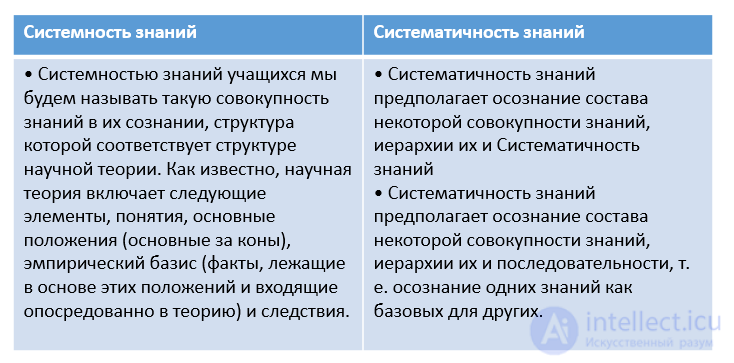
A system of knowledge presupposes that the learner assimilates the concepts and sections of a given discipline in their logical connection and continuity. If a learner formulates some concept, then they most likely also know the concepts on which it is based. As L.Ya. Zorina notes, «the systematicity of a student's knowledge means the presence in his mind of only content-logical connections».
In the pedagogical literature it is customary to distinguish two groups of systematic construction of content - with logical systematicity and with alogical construction.
If the relations between different elements of content in a given construction can be defined as logical, then the systematicity of such a construction can be called logical. Here we mean such relations as sequence, causality, coordination, subordination, opposition, similarity, difference, and so on. These are joined by spatial, temporal, and quantitative relations. In different university academic disciplines, individual elements of content are connected with one another by various relations, with some becoming predominant. For example, in mathematical disciplines the systematic construction of content relies mainly on relations of sequence; in biology and physics, cause-and-effect relations and relations of similarity or difference are used, and so on.
In addition to logical constructions, there are constructions based on other principles. In particular, V.L. Borzenkov points to two more possible ones: the didactic and the componential principles. In the first case, the structuring of educational material within an academic discipline takes into account the composition and ratio of old and new, simple and complex, verbal and visual, abstract and concrete, and so on. The componential principle presupposes the construction of educational material on the basis of elements of scientific knowledge, which the author classifies as facts, concepts, categories, principles, laws, theories, problems, hypotheses, methods, and the like.
According to N.M. Mochalova and R.A. Smirnova, the main ways of transforming educational material are algorithmization, changes in the sequence of presentation of different sections of an academic discipline, the introduction of new knowledge and its recomposition in light of new scientific achievements, the structuring of information according to the level of generality of its components, and the transfer of knowledge.
Some researchers also believe that the structuring of information serves not only as a principle for constructing an academic discipline, but also as a means of pedagogical influence that raises the level and quality of students' assimilation of knowledge in a given discipline. However, in our opinion, this is achieved only on the condition that the logical structure is determined by the goals of instruction, the state of development of the science, the significance of the academic discipline for the future profession, and the level of the initial preparation of students and instructors.
As we can see, when examining the construction of educational content, various approaches emerge. At the same time, they all come down to one thing - any construction must conform to the principle of logical systematicity.
Among the logical constructions of the content of university disciplines, two varieties can be distinguished - linear systematicity and structural systematicity.
Linear systematicity is a construction of content in which, as far as possible, identical logical relations are used between the elements of content. In such a construction, the learning process constantly involves a transition to new material, which is what gave the construction its name. It represents a chain of elements of content in which the preceding link serves as the basis for the following one. In addition, there is also a semantic dependency here - each subsequent element of content depends on the preceding one. All elements of content in such a construction are understood as equivalent, and none of them is put forward as the determining one.
Structural systematicity is a construction of content in which, as far as possible, identical logical relations are also used between its elements, but above all between those chosen as the main ones from the entire body of knowledge. This core knowledge has a linear construction. But in addition to the core content, derivative content relating to various elements of the core is also used in the construction.
Thus, in addition to the chain of interconnected elements of the core content, additional chains are also formed, as it were perpendicular to the first one and composed of elements of derivative content. Such a construction of content is no longer one-dimensional and linear, but takes on the form of a two-dimensional plane. At the same time, the elements of derivative content need not be connected by the same relations as the elements of the core content. Moreover, if, for example, the vertical chain of derivative content belonging to one element of the core content is built on relations of one type, then another chain of it, relating to another element of the core content, need not use the same type of relations.
The integral construction of content, carried out in the manner described above, forms a structure whose backbone is the core content. The rest of the content - additional or derivative - is grouped around it. The elements of the core content, constructed on the linear principle, are directly connected with one another, while the elements dependent on them, for example those of the derivative content, have a direct connection only with one of the elements of the core content and an internal connection among themselves. With other elements of the core content and the derivative content belonging to them, they are connected only indirectly.
Structuring the content of academic disciplines on the basis of structural systematicity has particular didactic properties. First of all, the content it includes carries different weight: the core content is fundamental, while the derivative content is secondary. The degree of importance of the derivative content depends on its function of substantiating and developing the core content. Mastering the entire content structure involves two different aspects of it: breadth and depth. In a linear construction, attention is focused on the breadth and completeness of knowledge. In a structural construction, by contrast, a variety of relations can be employed, through which the content is assimilated more deeply. Moreover, in our view, the advantage of structural systematicity lies in the fact that, by envisioning the structure of a given field of knowledge, we can mentally grasp its entire system of elements united by that structure — something that a linear construction makes impossible.
Let us turn to examining the concept of «systematicity of knowledge».
According to S.A. Shaporinsky, systematicity of knowledge is one of the defining features of a theory. In the study of university disciplines, a scientific theory serves as the basic didactic unit of content. For this reason, the research of pedagogical scholars is aimed at ensuring that the central place in the content of instruction is occupied by the leading ideas of each science — its generalizing, foundational scientific theories.
From a philosophical standpoint, the term «theory» can be used in two senses. First, in the most general sense, as a form of activity of socially developed man, directed at acquiring knowledge of both natural and social reality, which together with practice constitutes the combined activity of society. In this sense, the concept of theory is synonymous with social consciousness in its highest and most developed forms of organization. As the supreme product of organized thought, it mediates every human relation to reality and is a condition for the truly conscious transformation of that reality.
In the narrow sense, a theory is a form of reliable scientific knowledge about a certain set of objects, representing a system of interconnected statements and proofs and containing methods for explaining and predicting the phenomena and processes of a given subject area, i.e., all the phenomena and processes described by that theory.
In the scientific literature, a theory is understood as a body of knowledge united into a system on the basis of certain general propositions. In other words, it is a system of knowledge permeated by general propositions. These general propositions are often called the ideas of the theory. The nature of the general propositions can vary. Qualitative and quantitative regularities can serve as such general propositions.
Science distinguishes theories of different levels. The highest level is the deductive theory. In a fully formed deductive theory, two parts are distinguished — the foundations and the consequences. The foundations of a theory include the following elements: a group of concepts, basic propositions, and the empirical basis — scientific facts underlying the propositions of the theory and entering into it indirectly.
The basic propositions of a deductive theory (postulates) are statements that cannot be logically derived from other knowledge within the same theory, but are generalizations of experience and are verified by experiments (direct, but more often indirect). The formulation of the postulates reflects the scientist's particular vision of the empirical material. The form of the basic propositions can vary; they may be expressed as principles, model hypotheses, or mathematical hypotheses.
Certain requirements are placed on the postulates of a theory: they must neither contradict one another nor follow from one another. Consequently, the theory as a whole is required to be logically consistent: in each of its parts it must satisfy its own initial premises.
Any theory is valid within a certain domain, that is, it has limits of applicability, which are usually delineated with the emergence of a new, more general theory into which the previous one enters as a special case.
In the natural sciences, deductive theories are found in physics and chemistry. They employ the apparatus and models of mathematics (mathematized scientific theories). More widespread are the so-called descriptive theories, examples of which include Charles Darwin's theory of evolution, the physiological theory created by I.P. Pavlov, and various contemporary psychological and pedagogical theories, among others. Such theories directly describe a particular group of objects; their empirical basis is usually quite extensive, and the theories themselves are concerned above all with the task of ordering the facts pertaining to them.
Unlike deductive theories, in descriptive theories the laws are formulated not at the beginning of the theory but as the material unfolds. These laws, like the theory as a whole, are formulated mainly in ordinary language, drawing on specialized terminology from one or another field of knowledge as needed. Moreover, the correctness of the proofs given in them is usually not verified, except through experimental testing. Descriptive theories are predominantly qualitative in character.
Thus, each theory is characterized by a relatively small number of concepts that are independent of one another (for example, in Newton's theory there are four — mass, force, momentum, and impulse of force). The second element of a theory is the basic propositions, or laws, which are likewise independent of one another (for example, in Newton's theory there are three). The third element of a theory is the consequences, which depend on the basic laws and among which there exists their own subordination. To derive the consequences, in addition to the basic laws, additional knowledge often has to be invoked (for example, deriving consequences in Newtonian mechanics requires invoking the law of universal gravitation, the law of independence of the action of forces, and others).
Thus, a theory contains both coordinate (i.e., independent) knowledge and subordinate knowledge.
L.Ya. Zorina proposes representing the structure of a theory in the learner's mind as a matrix model (using classical mechanics as an example):
Different elements of a theory are linked by different relations — connections. That is why, in the picture of knowledge connections within a theory, another dimension is distinguished — depth, which captures the content of any given element of the theory. In this connection, one can speak of a «three-dimensional matrix», or a matrix with volumetric connections.
If the body of knowledge concerning a theory in the learner's mind forms such a matrix with volumetric connections, then that learner's knowledge is systemic. L.Ya. Zorina writes in this regard: «If a certain body of knowledge in the learner's mind forms a system (concepts, basic propositions, consequences), then we speak of the systemic character of the assimilation of knowledge».
In the educational process, a scientific theory is represented within three fundamentally different systems: upon initial acquaintance — in the textbook or in the teacher's explanation; in the final form — in the learner's mind; and in the learner's own presentation of it.
These systems differ from one another in that they are built on different types of connections between elements — linear, content-logical, and volumetric. For learners to develop systemic knowledge, according to L.Ya. Zorina, they themselves must restructure the knowledge initially acquired twice: first compressing it in their minds by converting linear connections into volumetric ones, and then unfolding the knowledge again by converting the volumetric connections back into linear ones.
As is well known, instruction in its most general form consists of three interconnected components: the content of education, teaching, and learning. The connections and relationships between these components, appearing in the structure of instruction, on the one hand, as relationships between the educational material and the teacher, on the other, between the educational material and the learner, and finally, as a kind of synthesis of these types of connections, as relationships between the teacher and the learner, form the basis of the epistemological, psychological, and properly didactic study and analysis of various aspects of knowledge and methods of cognitive activity. However, in order to examine these connections and relationships, it is first necessary to understand the nature of the educational material itself.
Of course, the phenomenon called knowledge is so complex that it is not possible to reflect all its aspects in a few judgments or definitions. We adhere to the generalized definition of knowledge formulated by P.V. Kopnin: «Knowledge, as a necessary element and precondition of the practical relationship of a person to the world, is a process of creating ideas that purposefully and ideally reflect objective reality in the form of his activity and exist in the form of a certain linguistic system.
As we can see, this definition reflects various aspects of knowledge: knowledge as a reflection of the real world in human consciousness; as the relationship of the subject to the object of cognition; as a method of activity; as a certain linguistic and sign system reflecting real actuality.
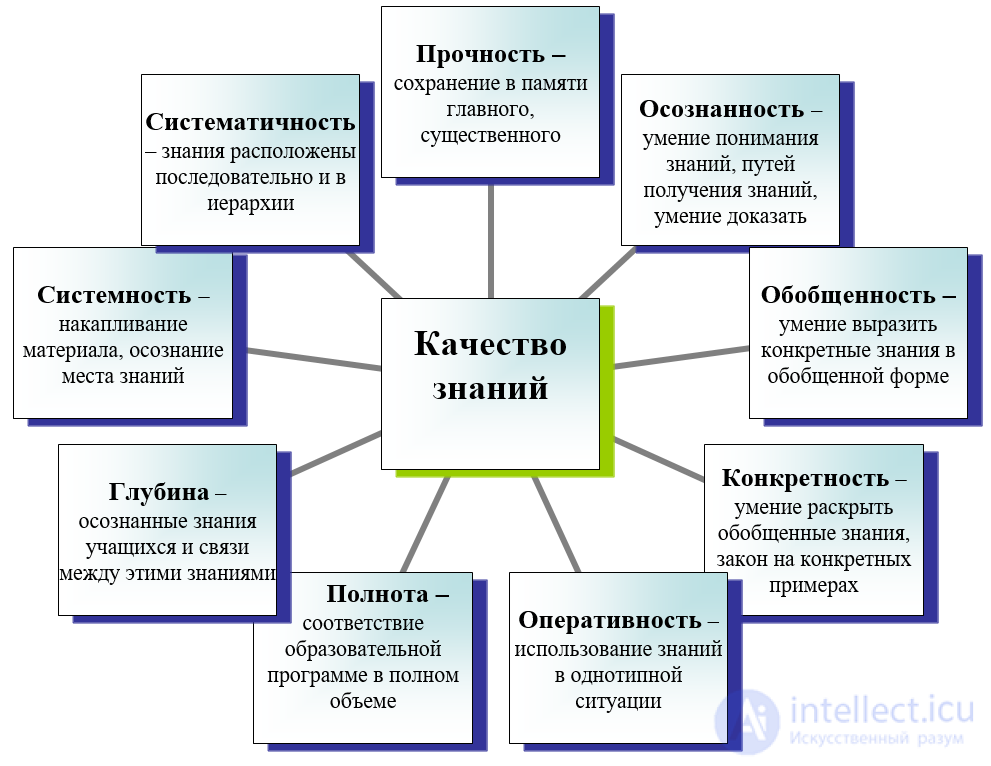
The knowledge formed in a student must possess a number of characteristics. Such characteristics may be:
Any branch of scientific knowledge (mathematics, biology, chemistry, physics, history, and others), studied at a higher education institution and considered as a science, represents a certain established system of knowledge. And as a system, it naturally possesses an internal structure, a certain structure that includes a set of certain elements, parts, closely connected with one another. Thus, in any science one can distinguish a certain set of elements — theories (in physics — the theory of mechanics, the theory of electricity, molecular theory, and others; in history — the theory of war and peace, and others), each of which can be designated as a substructure. At the same time, any theory acts as a system of statements or propositions connected with one another in a certain way. They describe the laws governing the functioning of the object of cognition, explain them, and also help to form hypothetical assumptions relating to the unknown elements of the structure of the object being studied. In turn, any theory can be broken down into its basic elements — concepts, laws, ideas, principles, rules.
Consequently, when we speak of scientific knowledge mastered by a student as a subject of cognition, we have in mind not separate fragments, but all those elements (features) that characterize a given scientific branch as a whole and that ensure the systematic nature of this knowledge.

Comments