
Lecture
Pedagogical management in education is a field of managing educational institutions and instructional processes that is oriented toward increasing the effectiveness of educational organizations and the quality of education. Pedagogical management is a coordinated task of actions and resources for improving the pedagogical and didactic process that teachers carry out as a group in order to direct their practice toward achieving goals.
This discipline combines the principles of management with the special features of the educational sphere. Here are the key aspects and tasks of pedagogical management:
Planning and organization: Effective management of educational institutions begins with the development of strategic plans and their subsequent organization. This includes allocating resources, defining goals, and developing curricula.
Personnel management: Pedagogical management includes the recruitment, training and development of teaching staff. It also includes evaluating and motivating teachers so as to achieve high educational standards.
Quality of education: Assessing and raising the quality of education are key tasks of pedagogical management. This includes evaluating educational outcomes, introducing modern teaching methods, and continuously improving curricula.
Financial management: Managing an educational institution's budget, optimizing expenditures, and attracting financial resources to ensure quality education.
Involvement of society and parents: Interacting with society, parents and other stakeholders in education in order to support educational goals and build partnership relations.
Innovation and use of technology: Introducing modern educational technologies and methods to increase the effectiveness of the educational process.
Data assessment and analysis: Collecting and analyzing data on the course and results of instruction in order to make informed managerial decisions.
Compliance with standards and legislation: Observing the regulatory requirements and laws governing the educational sphere.
Development of educational partnerships: Establishing cooperation with other educational institutions and organizations for the exchange of experience and resources.
Today there is growing interest in the integrity of the pedagogical process from the standpoint of management science, which in turn draws attention to the problems of pedagogical management. Pedagogical management is held to be a complex of principles, methods, organizational forms and technological techniques for managing pedagogical systems, aimed at increasing
the effectiveness of their functioning and development.
Pedagogical management has its own specific character and patterns inherent to it alone. Its specific character lies in the distinctiveness of the subject,
product, instrument and result of the labor of the teacher (manager). The object of the labor of the manager of the educational process (the teacher)
is the activity of the managed subject (the learner), the product of the labor is information, and the instrument of labor is the word, speech, and so on.
A pressing problem of both theoretical and practical pedagogy at the present stage is the search for ways of overcoming
contradictions in pedagogical management. One of the problems of modern education is the mismatch between teachers' knowledge and qualifications
and contemporary requirements in the area of educational content, pedagogical technologies, and also technologies for managing
educational institutions. The problem of the effectiveness of pedagogical management in the educational sphere can be solved only if
high competence and corresponding professional mastery of every teacher is ensured.
The educational process is a holistic pedagogical system, and competent management of it requires a systemic approach. However, one should
remember that the process of education is not a sum or set of some sequential elements, but purposeful educational and upbringing
activity, and that it is not only managed «from outside», but can also be «self-managed from within». Observation, analysis and evaluation of the effectiveness
of the real educational process from the standpoint of a systemic activity-based approach are the most important condition for implementing, among other things, a scientific approach
both in the theory and in the practice of pedagogical management. On the whole, the educational process as an activity-based system is in constant
and continuous development, possessing a colossal capacity for self-improvement provided there is a clear scientific organization
of its management, and, conversely, shows a tendency to regress in the absence of, or with poor, organization. To manage the cognitive and self-educational
process means, first and foremost, to direct, help and correct on the basis of clear planning, organization and control of this process as a
whole.
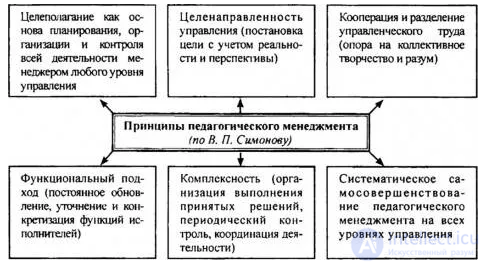
Management of the educational process is carried out by the teacher on three levels: strategic, tactical and operational.
According to M.E. Duranov, the strategic level of management is connected with implementing the long-term development of the individual, the institution, the organization, the higher education institution.
The tactical level of management functions as operational management, called upon to solve the current tasks of the system's functioning.
The following levels of management in education are the operational and tactical levels.
Operational pedagogical management is the management of the internal educational process at the level of departments/units. It comes down to making decisions and carrying out actions in a specific situation.
Tactical pedagogical management is the sphere of managerial activity of the teacher at the primary level (level of management): the instructor, the master of vocational training.
In the view of M.N. Lukoshenko and S.D. Reznik, from the standpoint of management theory it is appropriate to speak of four levels of management in a higher education institution: instructor – department – dean's office – rector's office.
First level: the primary level, or the level of the immediate instructional process (lectures, seminars, practical classes) – the instructor.
Second level: organization and coordination of the work of a group of instructors united by an educational field – the department.
Third level: management at the level of supporting the educational process, the unification of several departments of a related field – the faculty and its leadership – the dean's office.
Fourth level: organization of all areas of the higher education institution's work – instructional-methodological, upbringing-related, social welfare and others – as components of specialist training – the rector's office and its services (departments and directorates).
Types of management at different levels of pedagogical management
|
Level of pedagogical management |
Type of management |
||
|
by goals (obtaining the educational task) |
by deviations (implementation of the decision taken) |
by results (monitoring) |
|
|
Strategic |
60% |
30% |
10% |
|
Operational |
40% |
30% |
30% |
|
Operational-tactical |
20% |
20% |
60% |
Strategy (Eng. strategy) - a generalized model of the actions necessary to achieve the stated management goals based on selected criteria (indicators) and the effective allocation of resources.
Varieties of strategic management in the broad sense include:
Mission (from Eng. mission - vision) - a clearly expressed global goal of an organization's existence. Consequently, the mission of an educational system is a clearly expressed global goal of the existence of the educational system (institution, organization). It usually declares the goal and principles of the organization's work, defines the most important distinguishing features of the product, the attitude toward the consumer, and the competitive position in the market of educational services.
Strategic pedagogical management (strategic pedagogical governance) – is a complex of measures that includes an analysis of the potential of the educational institution and the external environment, the formulation of the mission and main goals, the development of strategies, the formation of strategic plans, and the management of their implementation.
Strategic pedagogical management is a complex of principles, methods, organizational forms and technological techniques of strategic management of education, aimed at increasing the effectiveness of education in achieving the mission of the educational system.
Strategic pedagogical management (governance) presupposes the presence of five elements:
The need to develop a strategy for educational institutions in the 21st century is determined by a number of objective prerequisites (according to N.D. Nikandrov):
The needs of educational institutions for strategic management «are determined by the necessity of basing their activity on clearly defined strategic goals, the necessity of adapting to changes in the external environment, and the regular revision of the volumes, structure, programs and types of services provided».
3. In the theory of strategic management, eight subsystems of strategic management are distinguished.
1. Sections of strategic management, including the main theoretical components of strategic governance: the fundamentals of strategic management, strategic planning, and management of strategy implementation. Each section contains paragraphs (subsections), the composition of which has not yet fully settled in management theory.
2. Research methodology – a set of general and special research methods used in strategic management: system analysis, STEP and SWOT analyses, management by objectives, and others.
3. Stages of strategic management – are the constituent elements of the process of researching, developing and implementing a strategy, beginning with a diagnostic analysis of the state of the organization, the development of sections of the strategic plan for the macro-subsystems, and ending with the management of change within the organization.
4. Macro-subsystems of the organization – are large parts of the organization that combine several interrelated management functions.
5. Stages of the organization's life cycle, reflecting birth, growth, maturity and decline. Their identification should not be confused with the stages of the life cycle of educational services (the product).
6. Types of development strategies – are types of generalized models of an organization's behavior for the near-term future. In the theory of strategic management, more than 20 standard strategies are known, which we have grouped into eight categories: benchmark, functional, sector-specific, and others.
7. Competitive position in the regional education market characterizes the positions of an organization; we have conditionally divided them into five, depending on their share of the regional market, and associated them with particular animals (the «bear» in the leading roles – 30-50%, the «wolf» in the second-tier roles – 10-20%, the «boar» in the third-tier roles – 5-10%, the «fox» in the fourth-tier roles – 1-5%, the «mole» in the fifth-tier roles – 1-5%).
8. Segmentation of educational services by sales volume is presented according to the Boston Consulting Group (BCG) matrix in four categories: «cash cow», «star», «problem child», «dog».
Tactical pedagogical management – this is a set of principles, methods, organizational forms, and technological techniques for managing the instructor in accordance with the developing situation, aimed at increasing the effectiveness of achieving the goals of a lesson. Tactical pedagogical management is the sphere of managerial activity of the primary-level educator (level of management): the instructor, the master of industrial training. Tactical pedagogical management presupposes the presence of five elements: the competency of modeling the tactical situation (identifying the problem); the competency of goal-setting, decision-making, and planning; the competency of motivation; the competency of organization and execution (implementation of the strategy); and the competency of monitoring and making corrections to the tactics of the educational process. It comes down to making decisions and taking actions in the specific pedagogical situation that arises during a lesson.
Operational-tactical pedagogical management – this is a set of principles, methods, organizational forms, and technological techniques for managing the instructor in accordance with the developing situation, aimed at increasing the effectiveness of achieving the goals of a lesson. Operational-tactical pedagogical management ensures the process of implementing short-term and operational plans, i.e., it comes down to making decisions under the specific conditions of a lesson. Operational-tactical pedagogical management is the sphere of managerial activity of the primary-level educator (first level of management): the instructor, the master of industrial training, in the process of managing a specific pedagogical situation while solving a pedagogical task.
Operational-tactical pedagogical management presupposes the presence of four elements (competencies): the competency of decision-making (choosing and modeling a way of managing the situation); the competency of motivation; the competency of organization and execution (implementation of tactics); and the competency of monitoring and making corrections to the tactics of the educational process. Types of management are determined by the levels of pedagogical management: the higher the level of management, the greater the management by objectives and the less the management by deviations. In our view, the following use of management types can be recommended for operational-tactical pedagogical management, which is the prerogative of the lower-level educator. At the stage of receiving the educational task – management by objectives; at the stage of implementing the decision made – management by deviations and by results; at the control stage – by results (Table 3). The data were obtained by the method of expert assessment.
Operational pedagogical management – this is a set of technological techniques for managing the instructor (a method of performing management operations) in accordance with the developing situation, aimed at increasing the effectiveness of achieving a managerial action during a lesson. Operational pedagogical management is the sphere of managerial activity of the primary-level educator (level of management): the instructor, the master of industrial training, in the process of managing a specific pedagogical situation while solving a pedagogical task.
Operational pedagogical management presupposes the presence of five elements (competencies): the competency of choosing and modeling a way of managing the situation; the competency of decision-making; the competency of motivation; the competency of organization and execution (implementation of tactics); and the competency of monitoring and making corrections to the tactics of the educational process.
The specific nature of the subject, product, instrument, and outcome of teachers' work also determines the development of specific goals, principles, methods, and
techniques of their managerial activity. From the definition of pedagogical management it is clear that, like any activity,
it has a purposeful character. This helps to outline the main goals of management and to determine the rules for their scientifically grounded formulation.
Researchers identify the following as the main goals of pedagogical management at the present stage:
The main tasks of pedagogical management:
The above-listed goals and tasks express the essence of the first system-forming factor – the activity-based pedagogical system. It
can be called the target-setting or the design factor.
The second system-forming factor is the communicative style of the relationships among the teacher, the students, and the administration.
The third factor is defined as the content-organizational factor.
The fourth factor is the analytical-productive factor. One of the main tasks of management is establishing the goals for the sake of achieving which the organization is formed, functions, and develops as an integral system.
The use of the theory of pedagogical management makes it possible to change the entire paradigm of management in the field of education. According to D.A. Boyarinov,
this involves a transition from the traditional system of management, characterized by dominant vertical links and,
correspondingly, subject-object relations, to a system of organizational-managerial cooperation, characterized by
dominant horizontal links and subject-subject relations. Such a transition is highly relevant for the information
educational space, since it is characterized by well-developed and flexible horizontal links.
According to contemporary views, the structure of pedagogical management includes a triad of levels. At the first level
the tasks of managing the activity of the pedagogical staff are concentrated. At the second level, the activity of the
teacher is managed. The third level of pedagogical management is oriented toward managing the activity of the learner.
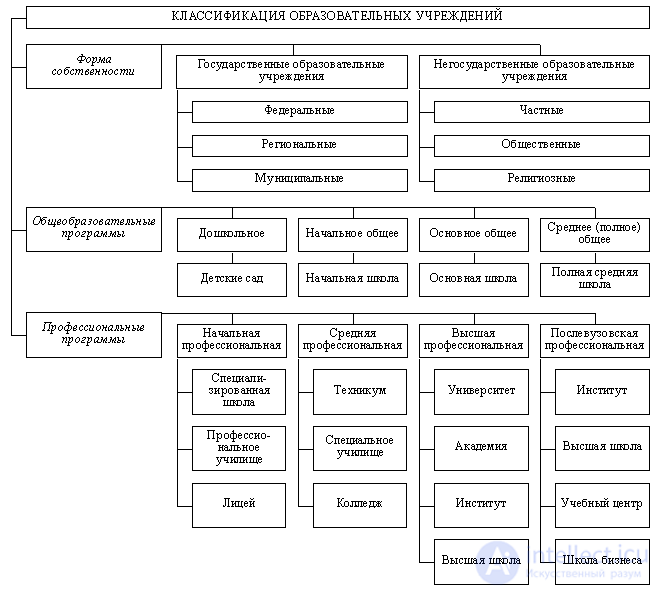
Fig. Classification of educational institutions
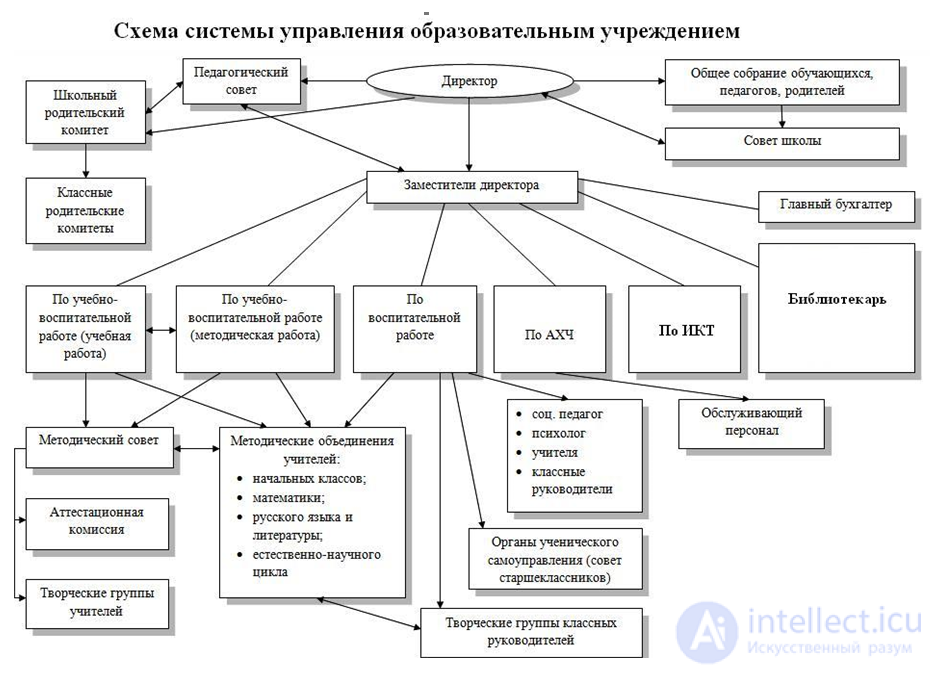
Fig. Management system of a general education institution
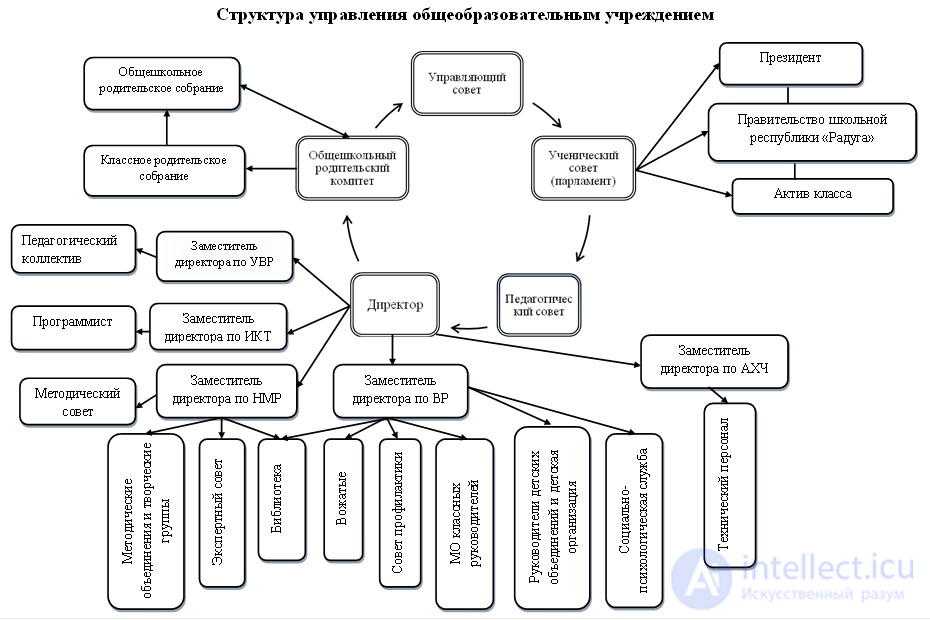
\
Fig. Management structure of a general education institution
Management methods – the ways in which a managing subject influences a managed object, in which a leader influences the collective they head. Among management methods, five groups are distinguished:
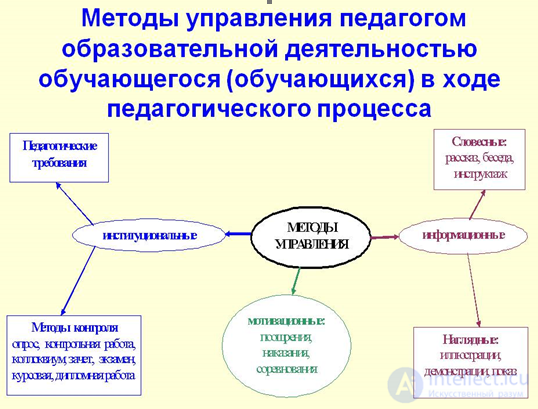
Management methods, Group I. Organizational-administrative methods of management. Tasks: long-term consolidation of organizational connections within the system, serving as the basis for its management. Methods of organizational-stabilizing influence: Regulation — the establishment of specific social rules, precise prescriptions for action, and behavioral boundaries for a unit (body) or manager. Standardization — the establishment of norms and standards. Instructing — a soft method of organizational influence: familiarization; explanation; advice; warning; clarification.
Management methods, Group II. Administrative methods. Purpose: resolving a specific situation not provided for in regulatory acts, or one envisaged as administrative activity. Composition: directives, resolutions, orders, instructions, directions, and resolutions (these are types of administrative influence, not documents). Documents bearing such titles are merely the external expression of administrative activity. Group III. Methods of disciplinary influence. Purpose: establishing responsibility (personal, collective, material, moral, official).
Management methods, Group IV: Social methods of management
Group V of methods: Psychological methods of management
The management cycle is a defined and sequential performance of the same types of activity for managing a given object. The management cycle in a school is an integral set of management functions oriented toward the achievement of a single goal, carried out simultaneously or in a certain sequence, interacting with one another, completing a full circle of development, and bounded by particular subject-spatial and temporal limits (Yu. A. Konarzhevsky — a scholar-pedagogue, Doctor of Pedagogical Sciences, professor). The management cycle consists of five management functions: 1) goal-setting, 2) gathering information and analysis, 3) preparing and adopting a management decision, or planning, 4) organizing and motivating the staff to carry out this decision, 5) intra-school monitoring, which involves correcting activity and regulating relations.
The algorithm of the «school year» management cycle in a school might look as follows: gather information on the year's results in light of the stated goal and objectives for the year and analyze it; on the basis of this analysis, outline the goal and objectives of the staff's activity for the new school year; plan the school's work for the new school year; organize the staff to carry out the annual plan; analyze the monitoring data; correct the activity of the whole-school staff; regulate the relations that have arisen on the basis of the conclusions and recommendations from the analysis of the process; and evaluate the effectiveness of the management cycle (analyze the results of the school year that has ended).
A description of the functioning of a management cycle of the «school year» type allows three conclusions to be drawn.
1. In the process of management, all functions must necessarily be carried out.
2. It is necessary to distinguish between two concepts, «work» and «functioning.» Work is the carrying out of a set of purposeful, interrelated actions by means of which a manager resolves particular management tasks. Functioning is the interaction of a function with the other types of management activity.
3. Analysis is the beginning and the end of the management cycle.
The socio-psychological functions of a manager include: reducing subordinates' dissatisfaction with their work and with various elements of the work situation (working conditions, pay, etc.). Moral and material incentives. Regulating interpersonal relations among subordinates and resolving conflicts between them. Reducing psychological tension in relations with subordinates. Defending the legitimate interests of one's subordinates. Maintaining a stable composition of subordinates and managing staff turnover. Ensuring the professional development of one's subordinates. Educational (character-building) work with subordinates.
Goal-setting is one of the most important components of management activity, as well as of the general functioning of organizations. It is both a basic function of a manager, a stage of management activity, and its structural component. Goal-setting is the formulation or selection of the goal of an organization's functioning, as well as its specification into sub-goals and their coordination. The goal is the system-forming factor of organizations. This means that it is precisely the goal that determines the overall direction of a school's activity, its composition (both of its divisions and of its personnel) and structure, regulates the nature of the relationships existing within the organization among its components, and also integrates them into a coordinated system. In addition, it serves as the basis for the criteria used in developing the most important, strategic decisions in an educational institution, and determines the content of planning.
Implementation of the goal-setting function begins with defining the organization's most general goal, which serves as the basis for all of its activity. To define this most general goal, the concepts of company philosophy, firm policy, and, most often, the organization's mission are used. The mission details the organization's status, declares its main objectives, and determines the general directions of its activity and of its management. There are no unambiguous recipes in management science for defining an organization's mission, although following one, most general rule is considered obligatory. The mission must include a formulation of general, broad, socially significant goals. Since any educational organization is a social and open system, it can survive only if it satisfies some need that lies outside itself. This concise formulation contains all the necessary features of a correctly formulated mission: a customer orientation, a definition of the sphere of activity, and a focus on broad social goals.
Requirements for the implementation of the goal-setting function.
The main characteristic of a well-set goal is its definiteness. It has two aspects — objective and subjective. Objectively, definiteness means: the clarity and unambiguity of the goal's formulation, containing a complete description of all the parameters of the future result prescribed by it; specificity in the ways the goal and its content are set, including the permissible time limits for its achievement; and the measurability of the goal. Subjectively, the definiteness of the goal means its complete and precise perception by those carrying it out, in exactly the sense and aspect in which it was originally formulated. The goal must therefore be formulated «in the language» of those who will carry it out.
Pedagogical analysis as a management function
Pedagogical analysis – a management function aimed at studying the state and development trends of the pedagogical process and objectively evaluating its results, followed by the development, on this basis, of recommendations for streamlining the managed system or transferring it to a higher qualitative state. The purpose of the analysis is to promote improvement in the school's work, to serve as a basis for long-term and operational management of the teaching staff's activities, and to stimulate the quality of teaching and upbringing.
1. Studying the state of the managed system over a certain period and as a whole.
2. Studying the results of the school's work and that of its subdivisions over a certain period.
3. Identifying factors influencing the level of students' upbringing and learning achievement.
4. Determining the causes of inconsistency in the activities of the school's structural subdivisions, between the links of the teaching-and-upbringing process.
5. Analysis of the school's relationships with its environment.
6. Identifying and substantiating internal and external pedagogical reserves for the school to improve the quality of teaching students' knowledge, skills and habits and their level of upbringing.
7. Studying and identifying best pedagogical practice.
8. Analysis of the effectiveness of school management.
Approximate structure of the annual final analysis of a school's activity:
1. The school's and teachers' compliance with orders, directive and regulatory documents of higher public-education bodies and the Ministry of Education.
2. Effectiveness of the annual management cycle. Purpose of the analysis: to determine the degree to which intra-school management influences the development of the pedagogical process, the shaping of its effectiveness, and the school's transition into a development mode.
3. Analysis of the effectiveness of methodological work. Improving the professional competence of teaching staff.
4. Analysis of the quality of teaching. The level of formation of students' key and subject-specific competencies.
5. Analysis of the quality and effectiveness of the school's work with parents.
6. Analysis of the effectiveness of pedagogical guidance of children's public organizations' activities and the effectiveness of those activities.
7. Analysis of the level of students' upbringing and the formation of their basic competencies.
8. Analysis of students' health status and the school's sanitary-hygienic condition.
9. The state, development and effective use of the material-and-instructional base and the subject-classroom system.
10. Results of the implementation of the school's educational program. Assessment of the final results of the school's work. Purpose of the analysis: to sum up the school's functioning over the past academic year and over eleven years (final examinations). To determine the level of integrity of the educational space. To outline ways of eliminating the causes of shortcomings identified during the analysis.
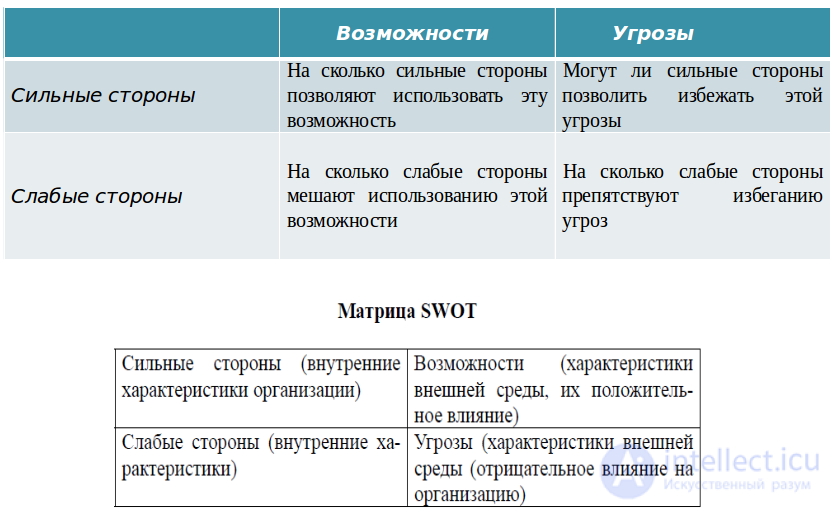
The abbreviation SWOT owes its origin to four English words: strength, weakness, opportunity and threat, and it is precisely on these that SWOT analysis is built. SWOT analysis includes an analysis of the situation inside the organization, as well as an analysis of external factors and the situation on the market, in particular, the market of educational services. All the data are subsequently brought together into a single table consisting of four main fields: strengths, weaknesses, opportunities and threats. Such a table is also called the SWOT analysis matrix. By analyzing the data arranged in the table, a list of possible actions is drawn up to neutralize the organization's weaknesses, including by drawing on its strengths. Possible options for the school's development are likewise worked out for the case of changing external factors, along with ways of using strengths to reduce risks, etc.
Thus, among the main tasks of pedagogical management, the following should primarily be listed: setting goals and
planning the pedagogical process, resource provision for the pedagogical process, ensuring high motivation of the process's participants, monitoring and coordinating the pedagogical process, and analyzing the results. Pedagogical management plays an important role in improving the quality of education, ensuring the effectiveness of educational institutions and creating a favorable environment for students' development. It is a multifaceted field that combines aspects of management, pedagogy and the social sciences with the aim of achieving high standards in education.

Comments