
Lecture
The process of cognition, like the storage of knowledge in any form, presupposes above all concreteness. The generalization of knowledge is a historically later stage; consequently, generality is a quality of knowledge that arises later.
Concreteness and generality are manifested in revealing the specific manifestations of generalized knowledge and in the ability to subsume concrete knowledge under generalized knowledge. Generalized knowledge always presupposes the presence of concrete knowledge. It is important that the learner be able to generalize concrete knowledge and facts.
Generality of knowledge implies the ability to subsume concrete knowledge under a generalization,
while the concreteness of knowledge is meant to show the concrete as a manifestation of the generalized.
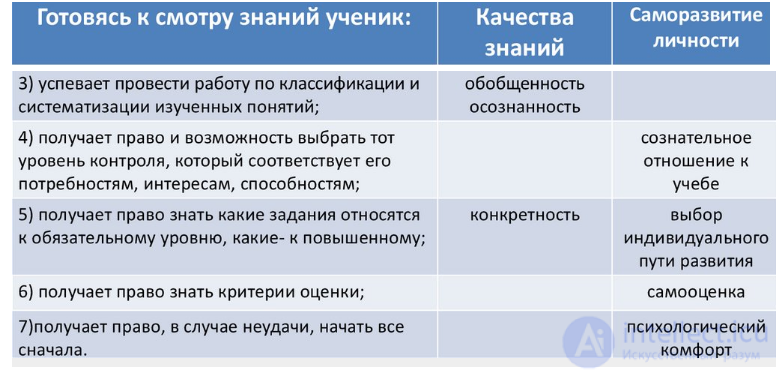
The generality of knowledge — diagnoses students' ability to reduce the entire concrete diversity of problems to a single method and to solve problems "on the spot," i.e., the ability to apply a formed mode of action to solving particular concrete-practical problems. This reveals such a qualitative feature of knowledge as whether the knowledge is tied only to those objects and problems in working with which the underlying relation was originally singled out, or whether the learner can also extend it to new objects.

Comments