
Lecture 20 min.
Students as a social group emerged in the 11th-12th centuries with the opening of the first institutions of higher education in Europe. A student (listener) is a person duly enrolled in a higher education institution and studying in a full-time (day), evening, part-time (correspondence) or distance learning form in order to obtain a certain educational and educational-qualification level.
Students are distinguished by the following features:
Among the neurophysiological features associated with the development of a student's central nervous system (CNS), the most important are:
Characteristics of the subject.
Pedagogical communication is usually understood as the professional communication of a teacher with students in the lesson and outside it (in the process of teaching and upbringing). It has certain pedagogical functions and is aimed (if it is complete and optimal) at creating a favorable psychological climate, as well as at the psychological optimization of learning activity and of the relationship between the teacher and the student.
Various new approaches in pedagogical practice (above all, the pedagogy of cooperation) are, from the psychological point of view, connected with the transition from the "subject-object" system to the "subject – subject" system. Recently the second system has become more relevant. The teacher and the student are subjects of pedagogical communication, and subject – subject relations are built between them.
The properties of a teacher are divided into special and personal.
Special properties can be:
– objective (for example, scientific and theoretical training);
– subjective (for example, personal talent, pedagogical abilities).
Personal properties – these are moral and volitional qualities.
The structure of a teacher's subjective properties:
The personality of the teacher as a subject of pedagogical work can be presented from two sides:
– the teacher as a subject of pedagogical activity;
– the teacher as a subject of pedagogical communication.
One of the main requirements placed on the teaching profession is the clarity of the social and professional position of its representatives.
In it the teacher expresses himself as a subject of PA.
The teacher's position is a system of intellectual, volitional and emotional-evaluative attitudes to the world and to professional pedagogical reality. They are the sources of his activity.
The social position of the teacher is determined by the requirements, expectations and opportunities that society places on him and provides to him. The social position of the teacher grows out of the system of views and value orientations that were formed as early as at school. In the process of professional training and work, a motivational-value attitude to PA, to the teaching profession, and to its goals and means is formed on this basis. The motivational-value attitude to PA is expressed in professional orientation, which constitutes the core of the teacher's personality.
The professional position is largely determined by the social one. The professional position is determined by internal, personal sources of activity – the motives, experiences and goals of teachers, their value orientations, worldview and ideals.
What is decisive in choosing a teacher's position is professional attitudes, the individual typological features of his personality, character, temperament, and type of civic behavior.
Often a teacher, while clearly aware of what he is doing, cannot always give a detailed answer as to why he acts in one way or another. Sometimes this happens contrary to common sense and logic, sometimes – intuitively.
In the structure of a teacher's work the following components are distinguished:
Pedagogical activity is always joint, not individual. This is because in the pedagogical process there are always two active sides:
It is joint, because it is almost always "ensemble-based": in the course of study a student interacts simultaneously not with one teacher but with a group of teachers.
The criterion of coordination of their activity is coOPERATION, aimed at achieving the final goal – the development, teaching and upbringing of the student's personality.
The student body is a special social category of youth, organizationally united by institutions of higher education.
It is characterized by a professional orientation and a formed attitude to the future profession, which is determined by the correctness of the professional choice and by the adequacy and completeness of the student's idea of the future profession.
In the socio-psychological aspect, students in comparison with other population groups are distinguished by the highest educational level, the most active consumption of culture and a high level of cognitive motivation.
The student body is a social community characterized by the highest social activity and a harmonious combination of intellectual and social maturity.
Taking these features of the student body into account underlies teachers' attitude to each student as a partner in pedagogical communication and as a personality who is interesting to the teacher.
An essential indicator of a student's work as a subject of learning activity is his ability to perform all its types and forms.
The student, as a representative of a certain age period of development, as a subject of learning activity at each educational level, is characterized by the specifics of learning motivation, a system of relations, and the particular features of learning activity.
Teachers always face an important psychological and pedagogical task of forming the student as a subject of learning activity. This presupposes, first of all, the need to teach the student to plan and organize his activity.
To do this, it is necessary to determine:
the learning actions necessary for successful study;
the program of their performance on specific learning material;
a clear organization of exercises for developing them.
Predisposition or aptitude. It is determined by a person's biological, anatomical, physiological and mental characteristics. It implies the absence of contraindications to activity of the "person – person" type (for example, hearing loss, speech impediment, mental deficiency). It presupposes a normal level of intellectual development, a positive emotional attitude, and a normal level of development of communicative and cognitive activity.
Personal readiness for pedagogical activity. It presupposes an orientation toward a profession of the "person – person" type, the worldview maturity of the person; broad, systemic professional and subject competence, communicativeness, and didactic needs.
Involvement – in interaction with other people, in pedagogical communication. It presupposes ease and adequacy in establishing contact with an interlocutor, the ability to follow the interlocutor's reaction, to respond to it adequately oneself, and to enjoy communication. The ability to perceive and interpret the reactions of students in the audience and to analyze incoming visual and auditory signals is regarded as a sign of a "good communicator".
The teacher as a subject of pedagogical activity represents an alloy of individual, personal, properly subjective qualities, whose adequacy to the requirements of the profession ensures the effectiveness of his work.
Characteristics of typical role-based pedagogical positions:
A teacher may act as:
An informant – if he confines himself to communicating specific requirements, views and norms;
A friend – if he seeks to penetrate the "soul" of the pupil or student;
A dictator – if the teacher forcibly implants norms and value orientations in the minds of the students;
An adviser – if the teacher uses gentle persuasion in his work;
A supplicant – if the teacher begs the students to be "the way they should be", stooping to self-abasement and flattery;
An inspirer – if the teacher seeks to captivate and fire students with interesting tasks and prospects.
Each of these positions can produce either a " + " or a " – " effect, depending on the specific characteristics of the teacher's personality. But the following always produce a " – " effect: injustice and arbitrariness, playing up to students, turning the student into a dictator, disrespect for the individual, and suppression of initiative.
The "self-concept" of the future specialist is a complex, dynamic system of a student's ideas about himself as a person and as a subject of educational and professional activity. It includes: - the "self-image", revealing the uniqueness of self-perception through the student's fixing of a certain social-role position and attitudes for himself; - an emotional-value attitude to oneself, which is determined by self-assessment of professional qualities and personal traits, and by the level of self-perception and self-esteem; - a behavioral component as self-presentation – certain actions (internal or practical) that are generated by the idea of oneself and by self-attitude
The consequences of students' negative "self-concept" may be the following phenomena:
Signs of an age crisis may include:
The following crisis situations are characteristic of student age
At student age, all the main mechanisms of socialization are involved:
The result of a student's socialization is:
Adaptation is a change in oneself (attitudes, character traits, behavior stereotypes, etc.) in accordance with the new requirements of activity, social conditions, and a new environment. It is entry into a new social position and a new system of relationships. Depending on the speed of adaptation and its results, the following types of student adaptation are distinguished:
Type 1 is a student who adapts easily to new conditions, quickly develops a strategy for his or her behavior, easily joins the group, and is emotionally stable and non-conflictual in behavior.
Type 2 is a student whose adaptation depends entirely on the environment and the social surroundings. Difficulties arise in the organization of work, in the daily routine, and in communication. Help, external control, and support are important.
Type 3 is a student who adapts with difficulty because of his or her individual characteristics.
A student's career guidance is a multifaceted, integral system of scientific and practical activity of public institutions aimed at preparing a person to choose a profession, based on his or her inclinations and the needs of society, by forming readiness for independent activity and adaptability to the dynamics of social and labor relations. In modern Russian society, the main goal of career guidance is to form and maintain readiness for effective behavior in a free labor market.
By level of professional orientation, the following typology of students is considered:
The first type is students with a positive professional orientation, which is maintained throughout the whole period of study. It is based on a clear idea of the future profession. These students are characterized by a high level of activity.
The second type is students who have not yet finally made up their minds about their attitude toward the profession. For most students of this group, a compromise is acceptable between a negative (or indifferent) attitude toward the profession and continuing their studies at the university. Therefore, their activity is characterized by inconsistency, with alternating declines and upswings.
The third type is students with a negative attitude toward the profession. Their motivation for choosing it is determined by the main values of higher education that are generally recognized in society. Their level of understanding of the profession is low. What attracts them in the professional sphere is material reward and the social opportunities the profession offers (the possibility of working in a city, a long vacation, etc.). Their indicators of activity are low and very unstable.
A social group is an association of people who have a common significant social characteristic on which their participation in some activity is based, connected by a system of relationships that are regulated by formal or informal social institutions.
Types of students that students themselves see in their student environment:
Students in a group are united by:
A student belongs to the following social groups
Causes of conflicts in the group
Mechanisms of group influence on its student members
Signs of a positive microclimate in a group of students:
Student self-government performs the following tasks.
The Law "On Higher Education" defines the tasks of student self-government:
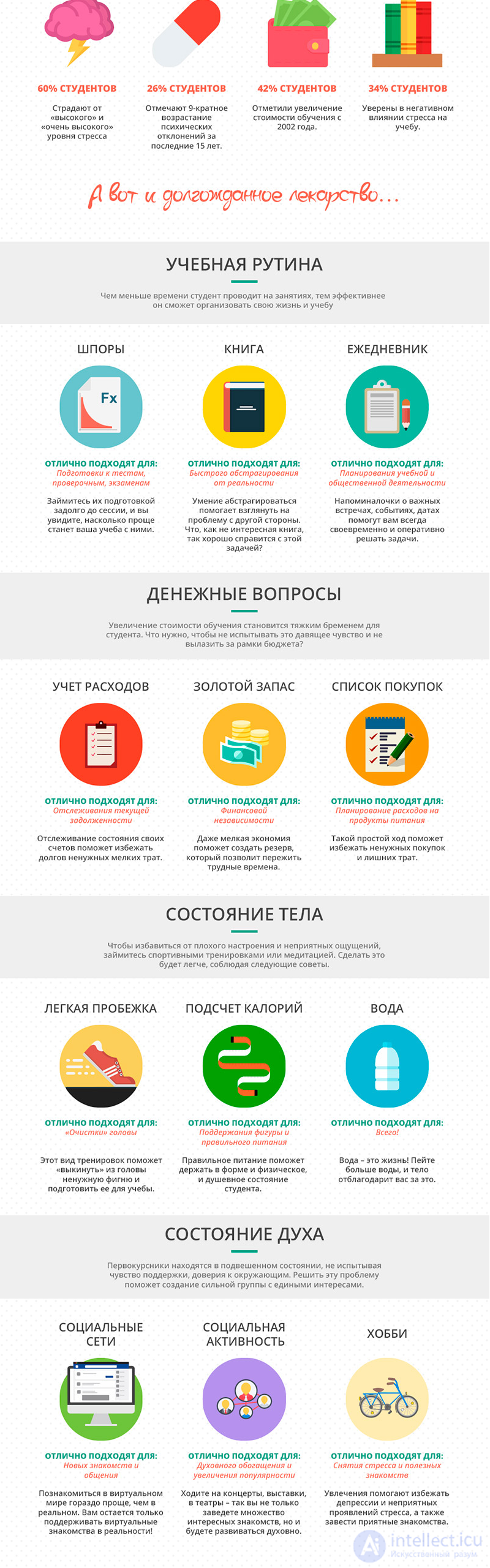
advice to the student
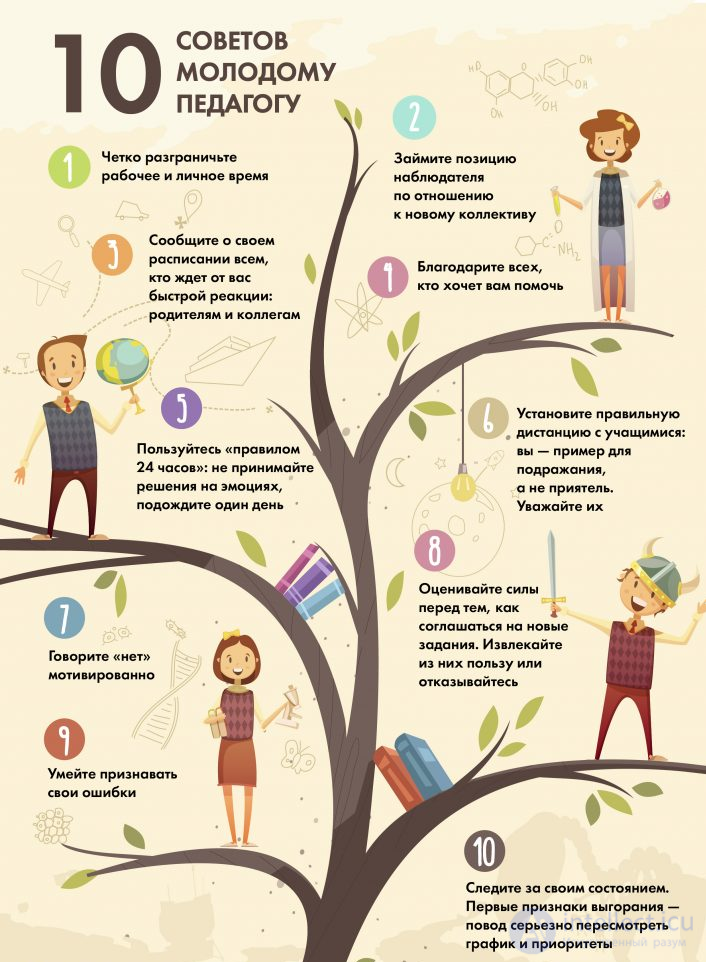
advice to the teacher

Comments