
Lecture
The content of special education is a pedagogically adapted social experience (comprising a system of knowledge, abilities, skills,
modes of activity, experience of creative activity, and emotional-value relationships), the use and processing of which is oriented toward forming the values of national and universal human culture, correcting existing physical and (or) mental
impairments, ensuring the self-determination and self-realization of students with
special psychophysical developmental needs (SPDN), improving their quality of life, and their adaptation in society.
The concept of «the content of special education» can be formulated as a specially selected and pedagogically processed
system of knowledge, abilities and skills in accordance with the cognitive
capabilities of students, its practical and correctional-developmental
significance, and the completeness of education at a given level. The instruction and upbringing of students with special features of psychophysical development are organically interconnected and mutually complementary in the educational
process, which takes place under special conditions that include
the following:
— the availability of special programs (general-education and correctional-developmental);
— taking into account the characteristics of each child, an individual pedagogical approach manifested in the special organization of the correctional-pedagogical process, the application of special methods and means (including
technical ones) of education, compensation and correction;
— an adequate living environment;
— the conducting of the correctional-pedagogical process by special-education teachers (speech therapists) and psychological support of the educational process by special psychologists;
— the provision of medical, psychological and social services.
The competency-based approach focuses attention on the development of practically expedient activity of students, bringing to the fore
general and special abilities that are directly in demand in life and in
subsequent professional education. Thus, competence is understood as something potential, cognitive, procedural, while competency is understood as something actual, personal, resultant.
In some publications and dictionaries, competency and competence are treated as synonyms, with no distinction drawn between them.
In the future, special education is seen as ensuring
above all the preparation of students for practical activity. To this end, at every lesson they must plan and carry out various
types of activity. the main task of a special school becomes
a communicative-educational one, making up for the lack of live communication among participants in the educational process, and ensuring
a correctional and practical orientation, an activity-based and
life-oriented focus of instruction. On the basis of mastering key competencies, a transition from the simple to the complex, from the concrete to the abstract, can take place, and everyday education and independent efforts in this direction can become promising. Key competencies are regarded as the most general (universal) abilities
and skills that allow a person to achieve results in practical activity and personal life under conditions of the increasing dynamism
of modern society.
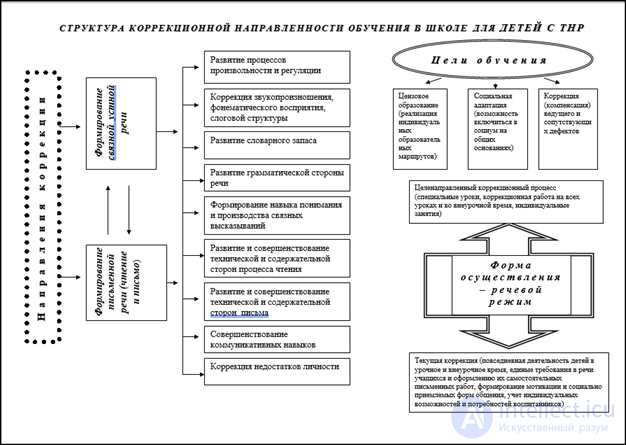
Table 1. Structure of the correctional orientation of instruction in a school for children with severe speech disorders (SSD)
The key competencies recognized are social, personal, communicative, and cognitive-informational.
Social competence is related to the cognition of the surrounding
material world and the formation of abilities to perform vitally significant actions with everyday objects. The student learns
the purpose of surrounding objects, relates the word to the object, and masters the ability to independently use objects according to their functional
purpose, to perform actions necessary to satisfy vital needs (for food, drink, clothing, etc.). The ability
to interact with people around them is formed, which is aided by an objective assessment of one's capabilities, needs and civic duty.
Personal competence ensures physical and spiritual self-development. The student masters modes of activity that make it possible
to develop the personal qualities necessary for a modern person.
He knows and follows the rules of a healthy lifestyle, follows the rules
of safe living, possesses sexual literacy, ecological culture, observes the rules of behavior in society, and has value orientations and moral attitudes that correspond to the national mentality and are connected with life in a multicultural society.
Communicative competence includes knowledge of the language (languages) and
the ability to use it (them) within a group, in connection with performing various
social roles (subordinate and leader, family member, etc.). The student has command of oral and written communication, can write a letter,
an announcement, a note, ask a question, write a power of attorney, a receipt, an application, fill out a questionnaire, a money transfer. Real-life situations are created in lessons, real objects of communication are introduced, so that the student
learns to use language.
Cognitive-informational competence reflects command
of general learning abilities and skills, attests to the schoolchild's ability to think (analyze, generalize, compare), to learn the unfamiliar and new, and the ability to use available information and communication tools and technologies. It presupposes the formation
of the ability to use a computer, television, telephone, audio-video recordings. The student is able to obtain knowledge, can distinguish facts from unreal events and story lines. Mastery of key competencies will allow graduates, to an accessible extent, to act independently in situations of uncertainty when solving problems relevant to them. This
ability can also be realized beyond the bounds of school education. In the context of the competency-based approach, special correctional
education is regarded not as a process of forming knowledge, abilities and skills, but as a process of forming key educational
competencies. This means that in each specific school subject
a search is conducted and key competencies are identified, and their
hierarchy is established.
Depending on the degree of limitation of capabilities and, above
all, on the preservation of intellectual abilities, as well as on the quality and timeliness of creating special educational conditions,
persons with special features of psychophysical development can master different
levels of education. Thus, some people with severe speech disorders (SSD) are capable not only of mastering general secondary education, but also of obtaining secondary vocational and higher education.
The conditions for exercising the right to and equal opportunities for education
are determined by the state educational standard in the form of norms defined taking into account the physical and mental characteristics
of students.
an educational standard is a technical normative legal
act that defines the content of an educational program by means
of establishing requirements for the educational process and the results of mastering its content.
educational standards of special education establish requirements for the content of the curricular documentation of special-education programs, the organization of the educational process, the maximum amount of the instructional load of pupils and students, and the obligatory number of teaching hours for conducting
correctional sessions, and for the level of graduates' preparedness.
educational standards of special education define
the mandatory minimum content of education, the optimal amount
of instructional load, the terms of study in accordance with the type of institution
of education for the different categories of persons with special features
of psychophysical development, and contain requirements for the level of preparedness
of graduates taking into account social adaptation, and for the documents on
education (the Code of the Republic of Belarus «on Education»).
educational standards of special education are oriented toward the growing person with limited capabilities throughout the entire period of his formation and socialization, that is, from the first months
of life to mature age.
The education standard was introduced with the aim of preserving a unified educational space. i t sets out the stages of instruction, their duration, the permissible instructional load at each stage, and gives an idea of the content and structure of education as a whole, in which
there are present state, regional and school components.
The standard of special education, as applied to each category of persons with special needs, reflects requirements for general-educa50
Electronic archive of the library of Mogilev State A.A. Kuleshov University
tional training, correctional-developmental work, as well as labor and initial vocational training.
In developing these criteria, both the general deficiencies
of development common to all children with limited capabilities and the features characteristic only of a particular category are taken into account.
Special education is the process of instructing and educating students
with special psychophysical developmental needs (SPDN), which includes special conditions for obtaining a corresponding education, the provision of correctional assistance, social adaptation, and the integration of these persons into society.
The curriculum of special education is a normative technical document that establishes the list of compulsory
school subjects by grade, the number of teaching hours for studying them,
the number of teaching hours for conducting correctional and elective sessions, and the total number of teaching hours financed from the republican or local budgets.
The optimal amount of instructional load is the compulsory number
of teaching hours allotted for studying school subjects, for conducting
correctional, elective, stimulating, and supportive sessions; the total number of teaching hours financed from the local
budget in each grade per instructional week.
Correctional sessions are a form of organizing the educational process outside class hours that ensures the correction or mitigation of students' existing physical and (or) mental impairments.
Educational programs of special education are subdivided into: an educational program of special education at the preschool education level; an educational program of special
education at the general secondary education level.
Educational programs of special education are developed on the basis of the educational program of preschool education and
the educational programs of general secondary education.
Educational programs of special education are implemented
in institutions of special education, and can also be implemented
in institutions of preschool education, institutions of general secondary
education, children's homes, special educational-correctional institutions, special medical-educational institutions, educational-health centers, other organizations, by individual
entrepreneurs who, in accordance with the legislation, have been granted the right to carry out educational activity.
The content of education is reflected in curricula and programs,
textbooks and manuals. There are several approaches to its construction and structuring, which determine the ways of compiling
a program and creating a textbook.
The linear method - individual parts of the instructional material are presented sequentially and continuously as links of a single integral topic,
which together reveal a section, and all the sections together make up the course.
The concentric method - the same question is examined several times; on each repetition the content is expanded, enriched with new information, and mastered at a higher level.
The spiral method - repeated return to the working through
of the same topics and the addition of new ones, that is, a problem is posed to whose solution students and the teacher constantly return, expanding and
enriching the range of knowledge and modes of activity associated with it from various
spheres of human activity.
The modular method - the entire content of each instructional topic, as an integral unit of the content of education, is redistributed among the following
blocks: orientational, methodological (or worldview-forming), content-descriptive, operational-activity-based, and control-verification.
The curriculum is a certificate of the educational institution that determines:
The number of hours for studying a subject depends on its general-educational and developmental significance, and on the time needed to form the knowledge, abilities and skills that students must master in
the process of studying the course.
The curriculum is developed taking into account the regularities of the instructional-educational process, sanitary-hygienic and organizational
requirements, and established traditions. It reflects the educational
ideal accepted by society, the goals outlined, and the current concept of forming the content. Modern curricula of special educational institutions and general-type educational institutions
that have created conditions for obtaining an education by persons with special features
of psychophysical development determine the procedure for organizing the educational process in special general-education schools (boarding schools), special classes, and classes of integrated instruction.
Taking into account the specific conditions of the educational institution's operation, the length of the school week is determined for students in grades I-IV and
grades V-X.
The structure of the curriculum consists of the state, correctional, and school components.
By decision of the school's pedagogical (methodological) council, the number of hours allotted for individual subjects of the correctional
component may be redistributed among themselves within these limits.
Sessions are conducted according to a separate schedule. Depending on the year
of study and the type of education, they include the development of cognitive activity, play, rhythmics and dance, speech-therapy sessions, and correction
of physical development, etc.
The hours of the school component are intended for conducting stimulating and supportive sessions, interest-based sessions, elective sessions, sports sections, socially useful work; for
training in a related trade. Stimulating and supportive sessions are organized by the school administration within the allotted hours
regardless of group size (no less than 1 hour per week in each
year of study), and may also be conducted with individual students. The school
component is not compulsory for everyone. When conducting sessions
it is necessary to take into account the maximum permissible instructional load per student.
An individual curriculum is drawn up on the basis of the base plan, taking into account specific conditions.
A syllabus is a state document
approved by the Ministry of Education, in which
the content and scope of knowledge, abilities and skills for individual subjects are established, and
the sequence of their study by years of instruction is determined. The curricula and syllabi of special education include:
Syllabi are drawn up on the basis of educational standards for
each subject studied, separately. They specify the con
tent of the curriculum in the form of a list of the main questions, grouped into particular systems by the topics and sections of the syllabus.
Educational literature (textbooks and instructional aids) must be created as an instrument of the instructional process and possess certain qualities and characteristics designed to help students more fully
master the content of education. the general functions of a textbook are: the educational function, realized through students' mastery of factual information and knowledge of the methodological principles that are used
in instructional-cognitive activity; the upbringing function, consisting
in the formation of a worldview; and the correctional-developmental function, expressed in the stimulation of the development of cognitive activity.
the basic requirements for the textual part of a textbook come down to the following: correspondence to the syllabus, structural simplicity of text construction,
an explanatory character, material presented in the form of reasoning rather than description,
broad use of the comparative method, the presence in the final chapters and sections of summary materials and brief conclusions, a didactically dosed volume of instructional material, its step-by-step progressive unfolding; the content of the textbook material must meet
the principles of scientific rigor, accessibility, and visual clarity. Approximately 80% of its volume is occupied by the standard model (universal human knowledge), 20% by the national aspect.
It is important to maintain the external graphic layout of the text, to use various fonts to highlight especially important instructional information (the highlighting of headings and subheadings, the number of paragraph
indentations, the size of paragraphs, the length of the phrases contained in them, and punctuation).
All this creates the rhythmic framework of the text. Internal figurative visual clarity usually serves as one of the factors that organize and, to a certain extent, order the learner's thoughts as he perceives new
scientific information

Comments