
Lecture
Career is a concept that describes consistent forward movement in the professional sphere, usually accompanied by a gradual improvement in status, salary, responsibility and skill development. A career can be an important part of many people's lives, and it can take various forms depending on individual goals, interests and circumstances.
Career (from Italian carriera — running, life path, field of activity, from Latin carrus — cart, wagon):
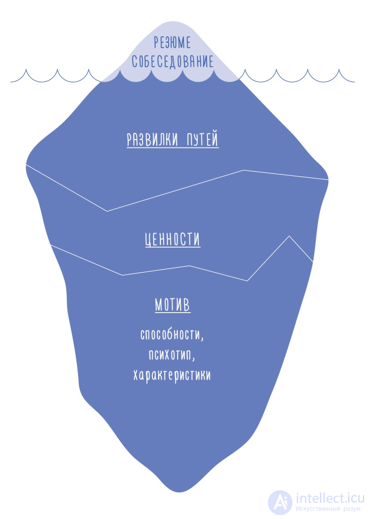
If you picture a person's career as an iceberg, then instrumental things such as writing a résumé and behaving well at a job interview, which are mistakenly given the most attention, make up only its tip, while below it lie far more important fundamental mechanisms, including:
The main problems faced by people who build their careers without regard to their psychotype and physical characteristics:
Behaviour types according to the DISC model (William Marston):
1. Domination: striving for power, money, superiority; a high orientation toward results, accompanied by universal recognition and fame (business founders, senior executives, top athletes, managers); cost: people become a resource.
2. Influence: striving for communication, creativity, something new (sales managers, business trainers, TV presenters, film stars); cost: the ability to make only a short-lived impression.
3. Stability: a tendency toward relationships and stability, performing identical, repetitive actions (logistics, accounting, production departments).
4. Compliance: analytics, rules, risk avoidance (lawyers, financiers, quality controllers, engineers).
A personal-philosophical conflict very often arises between representatives of the Domination and Stability types, as well as between Compliance and Influence. Rarely does a person belong to a single type; as a rule, it is a combination of two types — a dominant one and a supporting one, in varying degrees of expression.
Components of the human personality:
There are two main types of career: professional and intra-organisational.
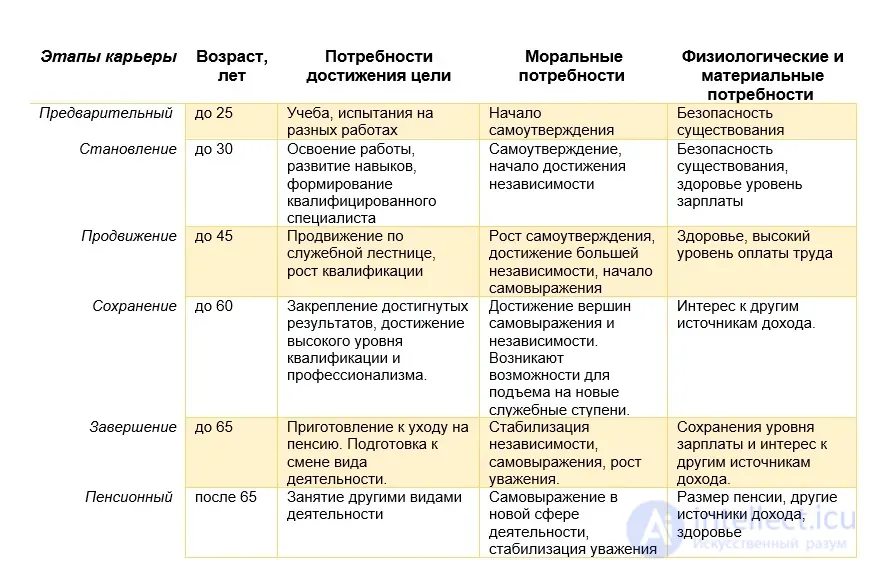
the stages of a professional career, which include the preliminary stage, establishment and advancement. This is an interesting classification that helps to understand the process of career development at different stages of life. Let's take a closer look at them:
Preliminary stage (up to age 25): During this period, a person prepares for the start of their professional activity. They may study at educational institutions, obtain an education, and identify their interests and skills, which may potentially lead to the choice of a particular profession or career path. It is important to use this time for education, self-development and defining one's professional goals.
Establishment (up to age 30): At this stage a person has already started working and mastering the chosen profession. They may hold entry-level positions and actively develop the corresponding professional skills. This period may also include undergoing internships, on-the-job training and the accumulation of experience. This stage helps establish the foundation for future career growth.
Advancement (up to age 45): At this stage the employee has already achieved a high level of development and self-realisation in their profession. They may hold more responsible and higher-paying positions, and possess extensive experience and expertise. This stage may also include leadership, participation in strategic decisions, and a level of responsibility to the company or organisation.
Completion (over age 60): At this stage the employee begins preparing for retirement. This may include not only planning the financial aspects of retirement, but also passing on experience and knowledge to younger employees. Senior employees often play an important role in training and mentoring the new generation of employees, in order to pass on their experience and knowledge.
Retirement (after age 65): After retiring, the employee ends their working life and begins to enjoy a well-earned rest. At this stage many people turn their attention to hobbies, travel, volunteer work and other interests to which they can devote more time in their retirement.
It is important to note that these career stages may be unique to each individual, and may vary depending on factors such as health, financial stability and personal preferences. Some employees may continue working after age 65 or move into new types of activity, including consulting, teaching or involvement in non-profit organisations. These career stages highlight the importance of long-term planning and adapting to changes over the course of a lifetime.
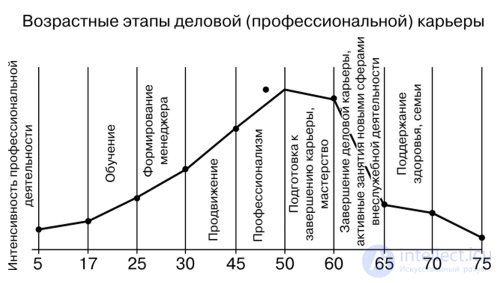
Fig. GRAPH OF LIFE PATH AND PROFESSIONAL CAREER
It is important to note that a professional career can have many variations and differ for different people depending on their interests, goals and opportunities. Some may move faster through these stages, while others may linger at particular stages in order to focus on specific aspects of their career.
Types of careers can include:
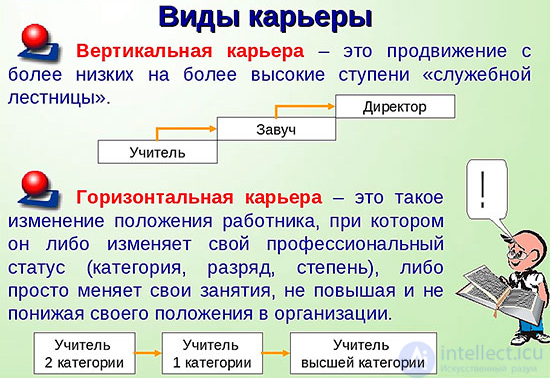
Vertical career: This is the most common type of career, in which an employee moves upward along the hierarchical ladder within an organisation. Starting from lower positions, an employee can advance to higher and more responsible posts, such as manager, director, vice-president and so on.
Horizontal career: In this case, an employee may change their position or specialisation within a single organisation, or even move from one company to another, while retaining their level of responsibility and status. The main goal is to develop a diverse range of skills and experience.
Mixed career: This type of career combines vertical and horizontal movement. An employee may change positions while also striving for upward advancement within the organisation.
Specialised career: Some people choose a narrow area of specialisation and strive to become experts in that field. In this case, advancement up the career ladder may be less important than deep knowledge and experience in a specific area.
Entrepreneurial career: Some people choose the entrepreneurial path and create and manage their own businesses. This requires entrepreneurial skills, risk-taking and the management of one's own business.
Non-profit career: People may also build a career in non-profit organisations or work in the field of social work and charity, where the main goal is to improve society and help those in need.
Freelance profession: This type of career involves the work of an independent specialist, such as a freelancer, consultant or artist, who manages their own career independently and seeks out projects or clients.
Educational career: People working in education can build a career as teachers, professors, or school and university administrators, developing and disseminating knowledge.
It is important to note that a career is an individual concept, and everyone can choose the path that best suits their life goals and interests. Career paths can also change over time depending on changing circumstances and priorities.
The types of professional careers described here represent different paths and strategies of professional development within an organisation or in a professional field.
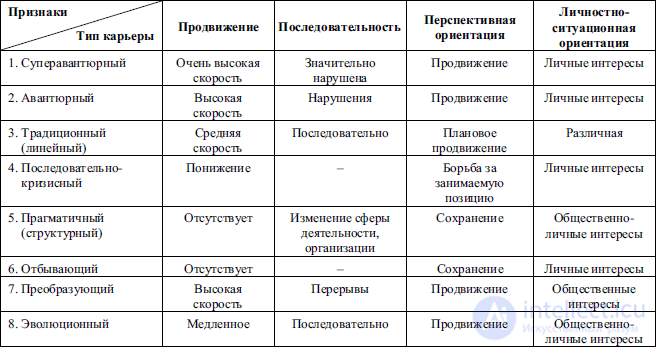
Here is a brief description of each of them:
Super-adventurous career: Characterised by rapid advancement and the possibility of skipping stages of professional development. May even involve a radical change of activity.
Random career: A career forms under the influence of external factors rather than through planning or purposeful effort.
Joint career: The employee moves along together with their manager, which can increase their chances of advancement and success.
Traditional career: Involves smooth vertical advancement based on the employee's skills and merits, without a significant role for patronage or connections.
Sequential career: Arises during periods of organisational change, where the employee must adapt and adjust to new conditions and requirements.
Pragmatic career: Involves a change of field of activity due to changes in the external environment, such as economic or market factors.
Time-serving career: Characterised by managers' desire to keep their current position and avoid risks.
Transformative career: Involves a rapid change of professional field with a high speed of advancement. Requires determination and adaptability.
Evolutionary career: Assumes that the employee moves up in position together with the development of the company, their career evolving in line with changes in the organisation.
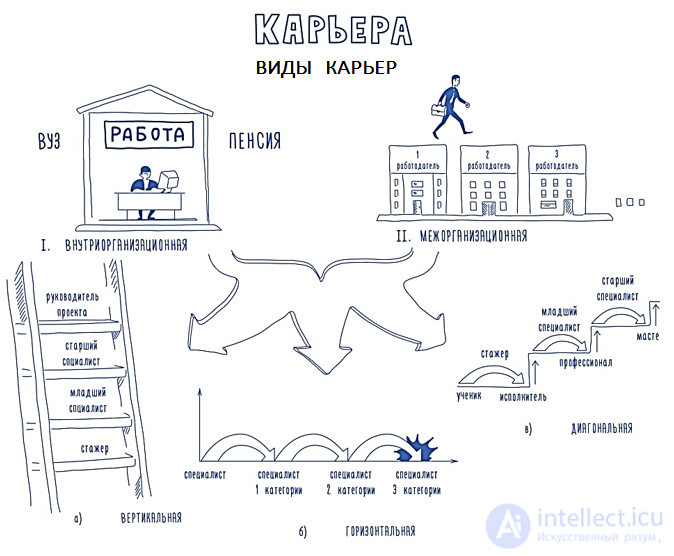
Each of these types of career has its own features and suits different personality types and situations. The choice of a particular type depends on the individual goals, wishes and opportunities of the employee, as well as on the context of the organisation and external factors.
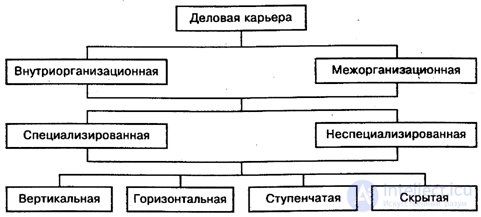
An intra-organizational career describes an employee's movement within a single organization and can be vertical, horizontal or centripetal in direction.
Vertical intra-organizational career: This type of career means an employee's advancement up the hierarchical ladder within the organization. It starts from lower positions and can include successive promotion to higher positions with increasing responsibility, status and salary. Examples might include an employee moving from an executor position to a manager position, then to a director position, and so on. This development path may require developing managerial skills, leadership qualities and a demonstrated ability to achieve the organization's goals.
Horizontal intra-organizational career: In this case, an employee may change their position or specialization within the organization without having to move up the hierarchical ladder. This type of career is usually associated with developing a variety of skills and experience in different areas. For example, an employee might start in the marketing department and then move to the sales or product development department while remaining at the same level. Horizontal movement can help broaden an employee's knowledge and increase their adaptability. Or an employee may take on additional duties within an existing area.
The concept of "centripetal direction" in the context of an intra-organizational career implies an employee's movement closer to management and the top level of the company. This type of career can include various strategies and actions aimed at establishing close ties with management and participating in the organization's key events. This may include the following elements:
Participation in key events: The employee actively participates in important events, meetings, boards of directors and other events that were previously closed to them.
Carrying out important assignments: The employee receives important tasks and assignments from management that can help them move up the organization's hierarchy.
Developing relationships with key figures: They establish close ties and relationships with the company's management, top executives and other influential figures.
Active pursuit of leadership: The employee demonstrates their readiness and ability for leadership and management.
Developing strategic vision: They understand the company's strategic goals and directions and actively work to support and achieve them.
A centripetal career requires a high degree of motivation, ambition and proactivity on the part of the employee. They must be prepared for a greater degree of responsibility and risk associated with close relationships with management and involvement in the organization's key decisions.
These types of intra-organizational careers each have their own advantages and disadvantages, and the choice depends on the employee's goals and interests. Some prefer vertical advancement in order to reach higher positions and salaries, while others prefer horizontal movement for variety and skill development in different areas. It is also worth noting that some employees may combine both types of career during their professional life within a single organization.
Here are two more interesting types of business careers: specialized and non-specialized. Let's look at them in more detail:
Specialized career: This type of career means that the employee develops and advances within a single field or industry throughout their career. They may change organizations, but remain in the same field of activity and possibly even in the same position. Advancement within this career model may be tied to salary increases, expanded responsibilities, and prospects for advancement within the industry.
Non-specialized career: This type of career, as you noted, is more popular in Japan and implies that the employee develops broadly, working in various departments and areas of activity within a single organization. The employee does not stay in one position for longer than 3 years and gains varied experience in different areas. This approach can help the employee develop a broader set of skills and an understanding of how the whole company works, which can be useful for management.
Both of these types of careers have their advantages and disadvantages. The choice between them depends on the employee's personal goals, interests, and cultural characteristics, as well as on the organization's strategy and values.
Career planning is the process of creating and managing your professional trajectory. The main principles of career planning include the following aspects:
Self-analysis: The career planning process begins with self-analysis. This includes assessing your interests, values, passions, strengths, and weaknesses. The better you understand yourself, the easier it will be to choose a suitable career path.
Goals and ambitions: Define your long-term and short-term career goals. Where do you see yourself in 5, 10, 20 years? Clearly formulated goals will help you focus and make decisions that contribute to achieving them.
Education and training: Develop an education and training plan that will help you build the skills and competencies necessary for your career. This may include obtaining additional degrees, professional certifications, or taking advanced training courses.
Labour market research: Study the labour market to understand the current and future requirements for workers in your field. This will help you make informed decisions about choosing a career path and developing your skills.
Networking: Build professional relationships and networks of contacts in your industry. Networking can be the key to learning about job openings and receiving advice and support in your career.
Continuous development: Career planning is a dynamic process. You must remain open to new opportunities and ready for change. Include continuous learning and skill development in your career plan.
Assessment and correction: Regularly assess your progress and adjust your plan if necessary. Career goals and conditions can change, so it is important to be flexible and adapt to new circumstances.
Work-life balance: Remember that a successful career should not come at the expense of your health and family life. A balanced approach to work and personal life contributes to long-term success and satisfaction.
Career planning is an individual process, and it can vary from person to person. The main thing is to be purposeful, adaptable, and to continually work on your professional development.

Professional fulfilment is the process of achieving personal and professional goals in your career. There are several paths and strategies that can help you in this process. Here are some of them:
Education and professional training: Obtaining an appropriate education and training in your field of specialisation are key factors for professional fulfilment. You can pursue studies at a university or college, or take professional courses and training programmes. Continue learning and developing your skills to stay relevant in your field.
Internships and practice: Internships and practical experience allow you to gain hands-on experience in your field and build your career from scratch. This can also lead to a subsequent job offer at the same company.
Networking and building connections: Build professional connections in your industry. Take part in events, seminars, conferences, and meetings to expand your circle of contacts and learn about opportunities in your field.
Personal brand: Create a strong personal brand that highlights your professional skills and achievements. This may include creating a profile on professional social networks, publishing articles, participating in volunteer activities, and demonstrating your expert knowledge.
Continuous learning and development: Professional fulfilment requires continuous learning and development. Keep track of new trends and changes in your industry to stay competitive.
Determination and persistence: Be persistent in achieving your goals. You may face obstacles and setbacks, but it is important to maintain self-belief and keep moving forward.
Career planning: Create a career plan with clear goals and a strategy for achieving them. The plan will help you navigate and focus on the important steps in your professional fulfilment.
Finding a mentor: Consider finding a mentor or advisor who can share their experience and give you advice about your career.
Every person has a unique path to professional fulfilment, and your path may combine several of the strategies listed above. It is important to remain open to new opportunities and ready to adapt to a changing work environment.
For a graduate who is just beginning their professional career, there are several professional development strategies that can help them successfully enter the labour market and achieve their career goals:
Continuous learning: It is important to continue learning and developing after finishing your studies. This can include taking part in professional courses, master classes, seminars, and online learning. Always strive to acquire new skills and knowledge related to your field.
Building a personal brand: Work on building a strong personal brand that highlights your professional qualities and unique skills. This includes developing a professional résumé, actively participating in professional social networks, and publishing articles and taking part in projects that can help you stand out among other graduates.
Internships and practical training: If possible, obtain an internship or practical placement at a company related to your field of interest. This will help you gain practical experience and establish professional contacts.
Networking: Start building your professional network. Take part in events, conferences, and seminars where you can meet colleagues from your industry. Networking connections can help you learn about job openings and get advice from experienced professionals.
Mentorship: Look for a mentor or advisor who can share their experience and advice about your career. An experienced mentor can become a valuable source of support and guidance.
Professional organizations: Consider joining professional organizations or associations related to your field. This will help you stay up to date on new trends and have access to resources and events that may be useful for your career.
Career planning: Create a career plan with clear goals and steps for achieving them. Gradual progress toward your goals will help you assess your progress and stay motivated.
Adaptation and flexibility: Be ready for change and for adapting to new conditions. The labour market can change, and it is important to be able to adapt and look for new opportunities.
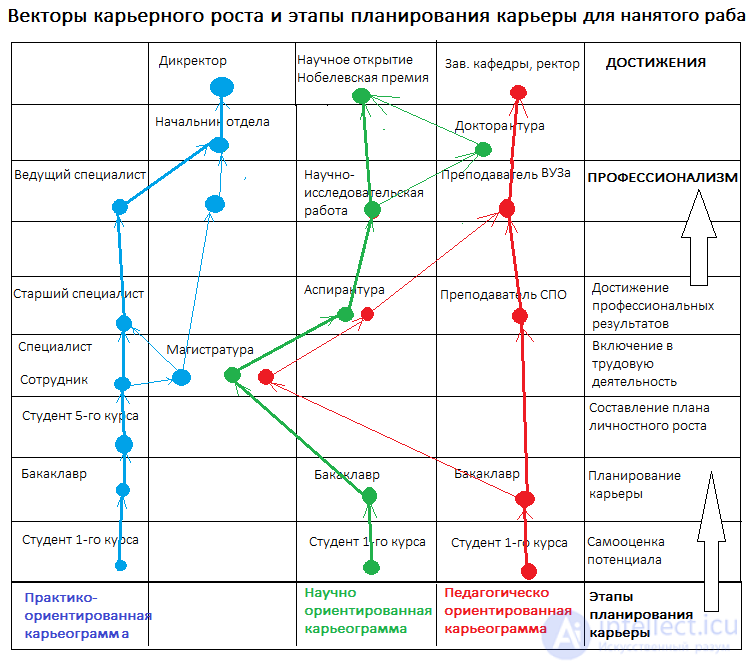
Fig. 1. Career growth vectors and career planning stages for an employed worker (not self-employed).
A graduate's successful professional development depends on their motivation, persistence, and readiness to learn and grow. It is important to remember that a career path can be long-term, and results may not come immediately, but with persistence and strategic effort you will be able to achieve success.
A career map — is a career management tool: a description of the optimal development of an employee for occupying a desired position in the organization. A formalized representation of the path a specialist must follow in order to gain the necessary knowledge and master the required skills for effective work in a specific position. It is drawn up on the basis of the employee's personal requests, their general educational level and professional training, a medical opinion on their state of health, and recommendations on professional suitability for standard schemes of professional and qualification advancement. Adapting the plan for an employee's individual advancement to the organization's capabilities in the area of job movements is achieved by combining personal career expectations with the organization's needs for qualified personnel. Forms of such ongoing alignment may include formal and informal consultation by HR specialists, consultation by the immediate supervisor, and informing employees about vacancies within the organization.
The structure of a career map usually includes:
Assessing an employee's progress is an important tool for making decisions on promoting an employee in line with their human capital. To rank the degree of progress and promotion opportunities, a special scale is used:
The result of assessing the progress of promotion candidates may be an adjustment of the individual promotion plan or of long-term position-replacement schemes. If a real organizational opportunity for promotion exists, the candidate's readiness for the position is discussed and a decision is made on their appointment. The appointment of an employee to a position is associated with the “induction into the position” stage. The purpose of this stage is to create conditions of informational, organizational, and moral support for the newly appointed employee from managers, colleagues, and subordinates. The forms of support can vary widely, from the simplest to the most complex: from conversations with the professional environment to organizing joint activities to improve the efficiency of production and commercial operations. The criterion for the effectiveness of the professional-qualification advancement of personnel is the organization's competitiveness in the long term. In this regard, monitoring of the process under consideration is carried out using a special system of indicators. These indicators should include:
Monitoring professional-qualification advancement by means of a system of indicators makes it possible to identify the strengths and weaknesses of the process under consideration, so that they can be taken into account when forming standard promotion decisions and developing organizational and individual promotion plans, and, consequently, to improve the effectiveness of the entire career management system in the organization.
Advantages:
Disadvantages:
Analysing your own reserves and limitations after the first months of work can be useful for determining what efforts need to be made to improve your professional growth and achieve your career goals. Here are some steps for conducting such an analysis:
Assess your achievements: Think about the tasks and projects you worked on during the first months of work. Assess what specific results you achieved. This may include completing projects, achieving goals, and receiving positive feedback from colleagues and management.
Identify your strengths: Determine the areas in which you performed best. These could be your professional skills, personal qualities, or specific achievements.
Identify your weak points: Think about the areas where you encountered difficulties or obstacles. These could be skills that need improvement, or aspects of your work that require greater attention.
Develop an action plan: Based on your analysis, determine what steps can be taken to strengthen your strengths and address your limitations. This may include additional training, coaching, working with a mentor, and active participation in professional development.
Plan your career: Create a career development plan for the coming months or years. Specify which goals you want to achieve and how you will work toward them.
Get feedback: Reach out to your management or mentor to get feedback on your work. This will help you better understand which aspects need improvement and which achievements should continue to be developed.
Be flexible: Career plans can change depending on the situation and new opportunities. Be ready to adapt your plan to match changing conditions.
Analysing your own reserves and limitations — is an important stage of professional growth and development. It allows you to manage your career more consciously and effectively and to strive to achieve your goals.
Correcting professional behaviour and activity is an important aspect of professional development. This process allows an employee to adapt to changing conditions, take feedback into account, and improve their professional skills. Here are some steps and strategies for correcting professional behaviour and activity:
Feedback analysis: An important part of correction is analysing feedback from management, colleagues, or clients. This feedback can point to specific aspects that need improvement.
Identifying specific aspects: After analysing the feedback, identify the specific aspects of your work or behaviour that require correction. These may be skills, processes, or personal traits.
Setting goals: Formulate specific goals for the correction. For example, if you need to improve your communication skills, you might set a goal of "taking part in a communication training course" or "practicing presentations in front of a mirror".
Developing an action plan: Create a plan that will help you achieve your goals. Include specific steps, resources, and deadlines in the plan.
Training and development: Invest in your own training and development. This can include courses, training sessions, reading specialized literature, or working with a mentor.
Practice and feedback: Practice new skills and behaviours in real work situations. Get feedback from colleagues or management and adapt based on that information.
Ongoing self-analysis: Continuously analyse your own professional behaviour and performance. Assess which changes are having a positive effect, and keep improving yourself.
Collaboration: Support from colleagues and management can be an important part of correction. Collaborate with others, and exchange experience and ideas.
Measurement and evaluation: Measure the results of the correction using specific metrics, if possible. Assess how successfully you have achieved your goals.
Flexibility and adaptation: Be prepared for the fact that correction may take time and effort. It is important to be flexible and adapt to new circumstances.
Correcting professional behaviour and performance — is a process of continuous improvement that helps you advance your professional growth and achieve your career goals.
Self-education and professional development are key elements of professional growth. They allow employees to improve their knowledge and skills, broaden their experience, and maintain their competitiveness in the labour market. Here are some strategies and methods for self-education and professional development:
Courses and training sessions: Professional courses and training sessions provide an opportunity to study new topics, improve skills, and gain up-to-date knowledge. These can be online courses, webinars, seminars, or educational programmes at educational institutions.
Reading and research: Reading professional literature, scientific articles, and books helps expand knowledge in your field. Subscribing to journals and participating in scientific conferences also contribute to professional growth.
Online resources: The internet provides broad access to educational resources. There are many online platforms where you can find free or paid courses on various subjects.
Certification: Obtaining professional certificates can confirm your competencies and increase your attractiveness in the labour market.
Mentoring and coaching: Working with a mentor or coach can help you get valuable advice and recommendations from more experienced colleagues.
Independent projects: Taking part in professional projects and assignments, even if not directly related to your current job, can help you develop new skills and gain experience.
Sharing experience: Communicating with colleagues and sharing experience with other specialists in your field can lead to new ideas and approaches.
Continuous learning: Professional growth — is a process that should be ongoing. Regularly update and expand your knowledge and skills.
Planning and goals: Set specific goals for your professional development and create an action plan for achieving them.
Self-assessment: Continuously evaluate your professional growth and reflect on your achievements and areas for improvement.
Self-education and skills upgrading allow employees to grow in their careers while remaining adapted to the rapidly changing requirements of the labor market and modern technologies.
Professional retraining and the accumulation of professional knowledge play an important role in maintaining relevance and competitiveness in the labor market. Here are several forms and methods of professional retraining and knowledge updating that take into account the requirements of a specific workplace:
Training courses and programs:
Self-directed learning:
Attending conferences and seminars:
Mentoring:
Projects and practical experience:
Sharing experience:
Practice and testing:
Certification and accreditation:
Mental models and frameworks:
Using specialized tools and software:
Remember that successful professional retraining and the accumulation of knowledge require constant effort and self-discipline. It is important to adapt learning methods to your needs and goals, and also to keep track of changes in your field in order to remain a sought-after specialist.
Most often, we associate a successful career with a person achieving a certain professional status, accompanied by a high material standard of living and recognition from those around them.
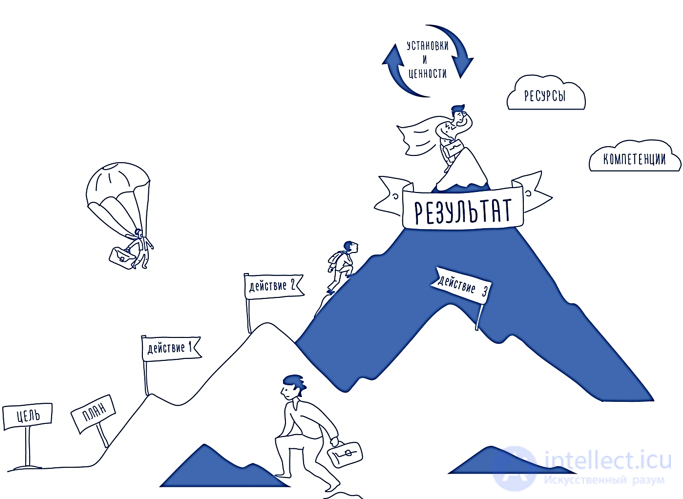
"Success is the achievement of set goals in an intended undertaking, the successful attainment of a set goal".
D. N. Ushakov,
For one person, a successful career – is rapid advancement up the career ladder, a "high" salary, dozens, hundreds, or thousands of subordinates.
For another, a successful career – is achieving mastery in one's profession, working with like-minded people who understand each other perfectly.
Thus, we can say that a successful career – is the achievement of set career goals. It is obvious that these goals are individual.
It can then be said that a successful career – is a trajectory of professional movement that a person builds themselves, based on their own goals and desires in their profession, values, and attitudes.
One of the job search portals conducted a survey on the topic: «What mistakes cost you your job». The results were as follows:

Here is a continuation of the list of behavioural or professional situations for which an employee may be dismissed:
Improper conduct and violation of work rules:
Professional misconduct:
Non-compliance with corporate policies and rules:
Lack of professional development and training:
Non-compliance with labour discipline standards:
Problems with professional ethics and team integration:
Unworthy personal conduct:
Remember that the specific grounds for dismissal may vary depending on company policy and the legislation of your country. It is recommended to always maintain high professional and ethical standards in order to avoid negative consequences for your career.

Comments